
Risk the Strait or Wait: The Costly Dilemma Trapping 500 Ships in the Persian Gulf
With the Strait of Hormuz effectively closed, over 500 commercial vessels and 20,000 mariners remain trapped in a geopolitical standoff that is choking off 20% of the world's oil supply.
By Factlen Editorial Team
- Global Energy Importers
- Nations heavily reliant on Gulf energy are scrambling to secure alternative supplies and mitigate inflation.
- Maritime & Insurance Industries
- Shipowners and insurers are focused on catastrophic financial risk and the safety of trapped crews.
- Geopolitical & Energy Analysts
- Strategists view the blockade as a catalyst for a permanent restructuring of global supply chains.
What's not represented
- · Stranded Mariners' Families
- · Agricultural Producers in Developing Nations
Why this matters
The effective closure of the Strait of Hormuz is choking off 20% of the world's oil and triggering a global supply chain crisis. For consumers, this translates directly into surging prices at the gas pump, higher grocery bills due to fertilizer shortages, and prolonged inflation that affects interest rates and mortgages.
Key points
- More than 500 commercial ships and 20,000 mariners remain trapped in the Persian Gulf following the closure of the Strait of Hormuz.
- War-risk insurance premiums spiked by nearly 4,000% before stabilizing, making transit financially ruinous for most shipping companies.
- The blockade has choked off 20% of the world's daily oil supply and 20% of its liquefied natural gas, sending Brent crude prices soaring.
- Beyond energy, the halt of Gulf sulfur and urea exports is triggering a global fertilizer shortage and stalling critical mineral processing.
- Analysts warn that an extended disruption through late 2026 could push oil toward $200 per barrel and trigger a severe global recession.
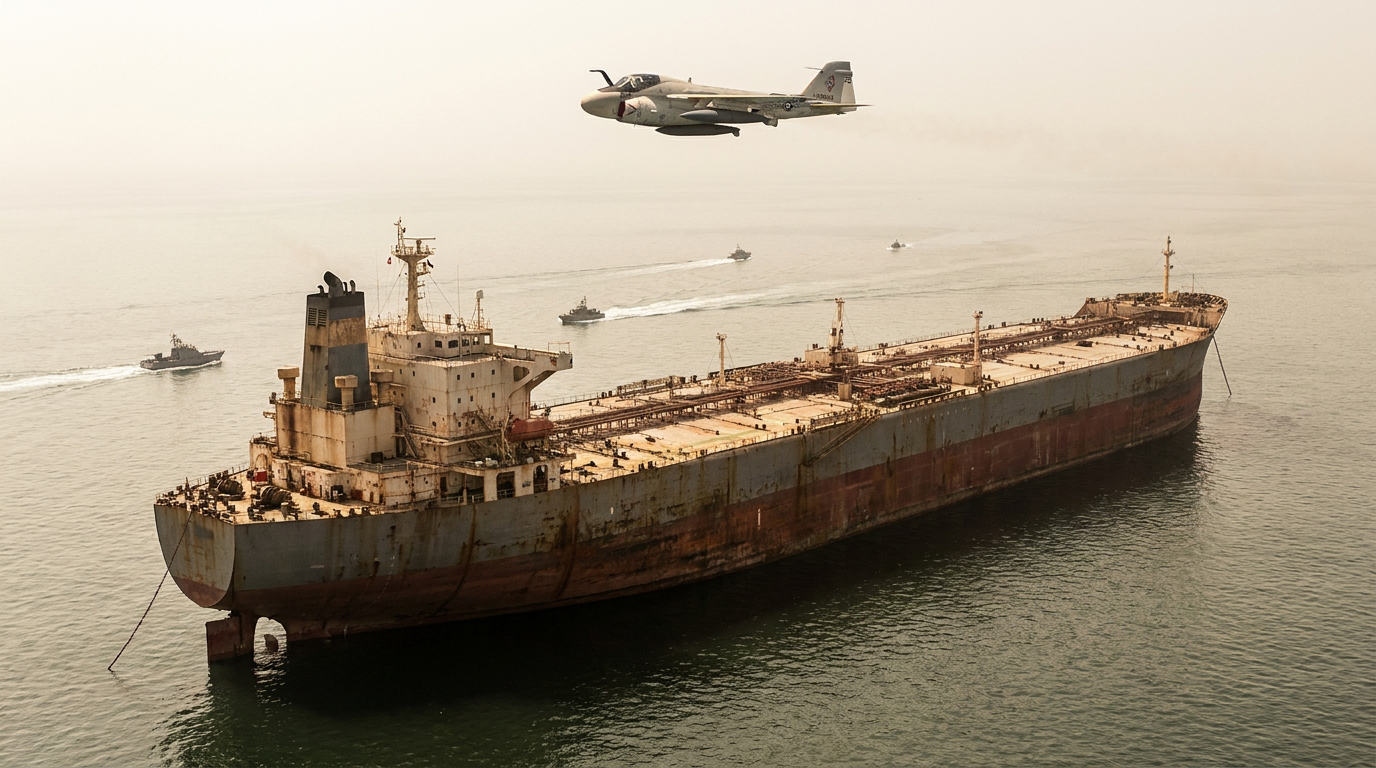
More than 500 commercial ships sit idle in the sun-baked waters of the Persian Gulf, their massive hulls anchored and waiting. Aboard these vessels, an estimated 20,000 mariners are trapped in a geopolitical standoff, rationing dwindling supplies of fresh water and food while navigating the psychological toll of floating in an active war zone. The Strait of Hormuz, the 21-mile-wide maritime chokepoint that serves as the jugular vein of the global economy, is effectively closed. What began as a military escalation has metastasized into the most severe supply chain and energy disruption in modern history, leaving shipping companies facing an impossible, costly dilemma.[1][2]
The crisis ignited on February 28, 2026, following coordinated U.S. and Israeli airstrikes on Iranian targets. In immediate retaliation, Iran leveraged its geographic advantage to shut down the Strait, utilizing drones, ballistic missiles, and fast-attack boats to threaten any vessel attempting to transit the narrow corridor. The resulting bottleneck has paralyzed a waterway that, in peacetime, facilitates the movement of roughly 20% of the world's daily oil supply and a fifth of its liquefied natural gas (LNG). Today, maritime traffic through the Strait has plummeted by approximately 95%, transforming one of the planet's busiest trade routes into a militarized dead zone.[2][4]
For the shipping companies that own the stranded vessels, the barrier to exit is not solely the threat of physical destruction—it is the labyrinthine mechanics of maritime insurance. Standard hull and machinery insurance policies explicitly exclude acts of war. The moment the conflict erupted, peacetime coverage for the region was effectively voided, forcing shipowners to seek specialized war-risk insurance. In the immediate aftermath of the strikes, those premiums skyrocketed from a nominal 0.25% of a ship's total value to an astronomical 10%. For a fully loaded supertanker, that translates to millions of dollars in unrecoverable costs just to move.[6][7]

While premiums have since stabilized to between 2% and 6%, the financial mathematics remain brutal. A ship cannot simply choose to sail uninsured; without valid liability coverage, no port in the world will allow the vessel to dock, and the cargo becomes effectively radioactive. The Lloyd's Market Association has publicly clarified that marine war insurance remains available in the London market, pushing back against claims that coverage has vanished entirely. However, insurers note that the ultimate decision rests with shipmasters and owners, who must weigh the exorbitant financial cost against the severe physical risk to their crews.[6][7]
For the 20,000 sailors caught in the middle, the geopolitical chess match translates into a grueling daily reality. Interviews with mariners trapped on these vessels paint a bleak picture of isolated lives spent moving between cramped quarters and blistering, sun-baked decks. Many are suffering from pay delays, a lack of fresh provisions, and the constant, gnawing anxiety of drone strikes. The International Transport Workers' Federation has been flooded with desperate calls for repatriation, but with peace negotiations stalled and the waters heavily mined, relief remains agonizingly out of reach for the crews anchored off the coast.[1][7]
Complicating the extraction of these vessels is a murky system of tolls and permissions that has emerged in the vacuum of international law. Reports indicate that Iran has established a 'Persian Gulf Strait Authority,' demanding payments that frequently exceed $1 million per vessel in exchange for guaranteed safe passage. Shipowners attempting to extricate their stranded assets must navigate this legally perilous extortion, balancing the desperate need to free their crews and cargo against the risk of violating international sanctions by funneling millions to the Islamic Revolutionary Guard Corps.[1][2]
Complicating the extraction of these vessels is a murky system of tolls and permissions that has emerged in the vacuum of international law.
The situation in the Strait is further compounded by a broader 'dual blockade' dynamic. While Iran restricts movement through the chokepoint, the United States initiated its own naval blockade of Iranian ports in mid-April, attempting to choke off Tehran's remaining economic lifelines. This overlapping militarization has left commercial shipping caught in the crossfire of two competing sieges. Simultaneously, the resumption of Houthi attacks in the Red Sea has effectively closed the Suez Canal route, meaning that for the first time in modern history, both of the Middle East's major maritime corridors are blocked at once.[2][7]

The energy market's reaction to the closure has been violent and sustained. The International Energy Agency has characterized the event as the largest supply disruption in the history of the global oil market. Brent crude prices surged rapidly, breaking the $100 per barrel threshold for the first time in four years and peaking near $126. While pipeline routes through Saudi Arabia and the United Arab Emirates are running at maximum capacity to bypass the Strait, they can only offset a fraction of the 14 million barrels per day that are currently shut in.[2][4]
Asian economies are bearing the brunt of this energy shock. China, Japan, India, and South Korea historically absorb roughly 75% of the oil and 59% of the LNG exported through the Strait of Hormuz. With those shipments stranded, LNG spot prices in Asia have surged by over 140%. The International Monetary Fund warns that these energy-importing nations face a toxic macroeconomic cocktail: acute supply shortages, currency volatility, and a massive wave of imported inflation that threatens to derail post-pandemic economic recoveries and force central banks to abandon planned interest rate cuts.[2][3]
Yet, the fallout extends far beyond the energy sector, bleeding into critical global supply chains that rarely make headlines. The Persian Gulf region accounts for approximately 45% of the world's sulfur production and is a massive exporter of urea and ammonia. These unglamorous commodities are the bedrock of global agriculture. With shipments halted, the world is facing a severe fertilizer shortage right at the onset of crucial planting seasons. The IMF has raised alarms that this disruption will inevitably translate into lower crop yields and a sharp spike in global food prices, disproportionately threatening food security in low-income nations.[3][7]

The industrial sector is also feeling the squeeze of the sulfur blockade. Sulfuric acid is an indispensable chemical used in the processing of critical minerals. Indonesia, which supplies roughly half of the world's nickel—a vital component for electric vehicle batteries—is facing severe processing bottlenecks due to the lack of imported sulfur. Similarly, global copper production is stalling. The inability to move these foundational chemicals out of the Gulf highlights the deep, often invisible interconnectedness of modern industry, where a geopolitical standoff in the Middle East halts battery manufacturing in Southeast Asia.[3][7]
Looking ahead, the duration of the blockade will dictate the severity of the global economic damage. Analysts at Wood Mackenzie have modeled multiple scenarios, ranging from a 'Quick Peace' that reopens the Strait by summer to an 'Extended Disruption' lasting through the end of 2026. In the latter scenario, the compounding effects of dwindling global oil inventories and sustained supply shut-ins could drive Brent crude prices toward $200 per barrel. Such an outcome would trigger a severe global recession, with the Middle East's GDP contracting by over 10% and growth in the U.S. and China grinding to a near halt.[5]
Regardless of when the 500 stranded ships finally sail free, the 2026 crisis has permanently altered the geopolitical landscape. The illusion that the Strait of Hormuz could be reliably insulated from regional conflict has been shattered. Energy analysts and policymakers now recognize that the risk profile of Persian Gulf producers has fundamentally changed. In the long term, this traumatic disruption is expected to aggressively accelerate the global transition away from fossil fuels, as importing nations realize that true energy security cannot rely on a 21-mile chokepoint halfway across the world.[4][5]
How we got here
Feb 28, 2026
U.S. and Israeli forces strike Iran; Iran retaliates by effectively closing the Strait of Hormuz.
Early March 2026
War-risk insurance premiums for the region spike by nearly 4,000%, trapping hundreds of commercial vessels.
March 8, 2026
Brent crude oil prices surpass $100 per barrel for the first time in four years.
April 13, 2026
The United States initiates a naval blockade of Iranian ports, creating a dual-blockade scenario.
May 2026
Iran publishes new territorial maps and reportedly begins charging tolls exceeding $1 million for safe passage.
Viewpoints in depth
Global Energy Importers
Nations heavily reliant on Gulf energy are scrambling to secure alternative supplies and mitigate inflation.
Asian economies—particularly China, Japan, India, and South Korea—absorb the vast majority of oil and LNG flowing through the Strait. For these nations, the blockade is an existential economic threat. They argue for immediate diplomatic off-ramps and coordinated releases from strategic petroleum reserves, prioritizing the resumption of trade over prolonged military posturing. The International Monetary Fund warns that these importers bear the brunt of the crisis, facing a toxic mix of energy shortages, currency volatility, and imported inflation.
Maritime & Insurance Industries
Shipowners and insurers are focused on catastrophic financial risk and the safety of trapped crews.
The maritime sector views the crisis through the lens of liability and human life. While the Lloyd's Market Association maintains that war-risk insurance remains technically available, shipowners argue that premiums reaching up to 10% of a vessel's value make transit commercially impossible. Furthermore, industry advocates emphasize that no amount of insurance mitigates the physical danger to the 20,000 mariners currently trapped on scorching decks in a war zone. Their primary demand is the establishment of a secure, demilitarized humanitarian corridor to extract stranded crews and cargo.
Geopolitical & Energy Analysts
Strategists view the blockade as a catalyst for a permanent restructuring of global supply chains.
Analysts from institutions like Wood Mackenzie and Brookings argue that the 2026 crisis has permanently shattered the illusion of a secure Persian Gulf. Even if a near-term peace settlement materializes, the demonstrated vulnerability of the 21-mile chokepoint will accelerate the global transition away from Middle Eastern oil. They project that importing nations will aggressively diversify their energy mix and onshore critical mineral processing, fundamentally reducing the geopolitical leverage of the OPEC states over the next decade.
What we don't know
- Whether the U.S. naval blockade of Iranian ports will force a diplomatic breakthrough or trigger further military escalation.
- How long the 20,000 stranded mariners can survive on dwindling supplies before a humanitarian corridor is established.
- The exact threshold at which sustained $100+ oil prices will force central banks to reverse course and hike interest rates.
Key terms
- Strait of Hormuz
- A 21-mile-wide waterway connecting the Persian Gulf to the open ocean, serving as the world's most critical energy chokepoint.
- War-Risk Insurance
- A specialized maritime insurance policy required for vessels entering conflict zones, priced as a percentage of the ship's total value.
- Liquefied Natural Gas (LNG)
- Natural gas that has been cooled to a liquid state for easier and safer non-pipeline transport, heavily exported by Gulf states.
- Urea
- A highly concentrated nitrogen fertilizer produced in large quantities in the Middle East, essential for global agriculture.
- Dual Blockade
- The current geopolitical standoff where Iran restricts movement through the Strait while the U.S. blockades Iranian ports.
Frequently asked
Why can't the stranded ships just sail out?
Standard maritime insurance is voided in war zones. Without specialized, prohibitively expensive war-risk insurance, ships cannot legally dock at any destination port.
How does this affect global gas prices?
The blockade has choked off roughly 20% of the world's daily oil supply, causing Brent crude prices to spike and directly increasing costs at the pump.
Why is this impacting food and agriculture?
The Persian Gulf exports massive amounts of urea and sulfur, which are critical components for global fertilizer production. The shortage threatens crop yields.
Are the trapped sailors safe?
The 20,000 mariners are physically trapped in an active war zone, facing dwindling supplies of food and water, scorching heat, and the constant threat of drone strikes.
Sources
Source coverage
7 outlets
3 viewpoints surfaced







[1]The New York TimesMaritime & Insurance Industries
Risk Strait of Hormuz or Wait? Shipping Companies Face a Costly Dilemma.
Read on The New York Times →[2]WikipediaGeopolitical & Energy Analysts
2026 Strait of Hormuz crisis
Read on Wikipedia →[3]International Monetary FundGlobal Energy Importers
The Global Economic Impact of the Middle East Conflict
Read on International Monetary Fund →[4]Brookings InstitutionGeopolitical & Energy Analysts
Blowback: How the Iran war may change the world
Read on Brookings Institution →[5]Wood MackenzieGeopolitical & Energy Analysts
Strait Talking: Iran War Scenarios and the Future of Energy
Read on Wood Mackenzie →[6]Lloyd's Market AssociationMaritime & Insurance Industries
LMA statement on marine war insurance in the Strait of Hormuz
Read on Lloyd's Market Association →[7]Factlen Editorial TeamGeopolitical & Energy Analysts
Synthesis by Factlen editorial team
Read on Factlen Editorial Team →
More in business
See all 47 stories →Skills-First Hiring
The Collapse of the 'Paper Ceiling': How Skills-First Hiring is Rewiring the Corporate Ladder
6 sources

SpaceX Listing
SpaceX Prices Record $1.77 Trillion IPO, Becoming Largest Public Offering in History
7 sources
UK AI Ecosystem
How London Built a $230 Billion AI Ecosystem
6 sources

Space Economy
SpaceX Debuts on Nasdaq in Record $75 Billion IPO, Valued at $1.77 Trillion
6 sources
Every angle. Every day.
Get business stories with full source coverage and perspective breakdowns delivered to your inbox.