
SpaceX Debuts on Nasdaq in Historic $75 Billion IPO, Reaching $1.77 Trillion Valuation
Elon Musk's aerospace giant has officially gone public in the largest market debut in history, raising $75 billion despite ongoing debates over the company's lack of profitability.
By Factlen Editorial Team
- Retail & Institutional Bulls
- Investors viewing the IPO as a generational opportunity to back Elon Musk's track record.
- Market Skeptics
- Critics warning of severe overvaluation, lack of profitability, and governance risks.
- Index & Passive Managers
- Financial architects grappling with the mechanical challenges of absorbing a $1.77 trillion company.
What's not represented
- · Competitors in the commercial spaceflight industry
- · Taxpayers funding NASA contracts awarded to SpaceX
Why this matters
SpaceX's $1.77 trillion public debut fundamentally reshapes the U.S. stock market, injecting massive new weight into tech indices and offering everyday investors their first chance to own a piece of the commercial space race. However, its sheer size and lack of profitability also introduce unprecedented volatility risks for retirement accounts tracking major benchmarks.
Key points
- SpaceX debuted on the Nasdaq under the ticker SPCX, raising $75 billion in the largest IPO in history.
- The company achieved a $1.77 trillion valuation, pricing its shares at a fixed $135 each.
- Retail investors placed over $100 billion in orders, driving total demand to $250 billion.
- The listing pushes Elon Musk's estimated net worth to nearly $1 trillion.
- Despite the massive valuation, SpaceX posted a $4.28 billion net loss in the first quarter of 2026.
- Nasdaq fast-tracked the stock into its indices, while the S&P 500 excluded it due to unprofitability.
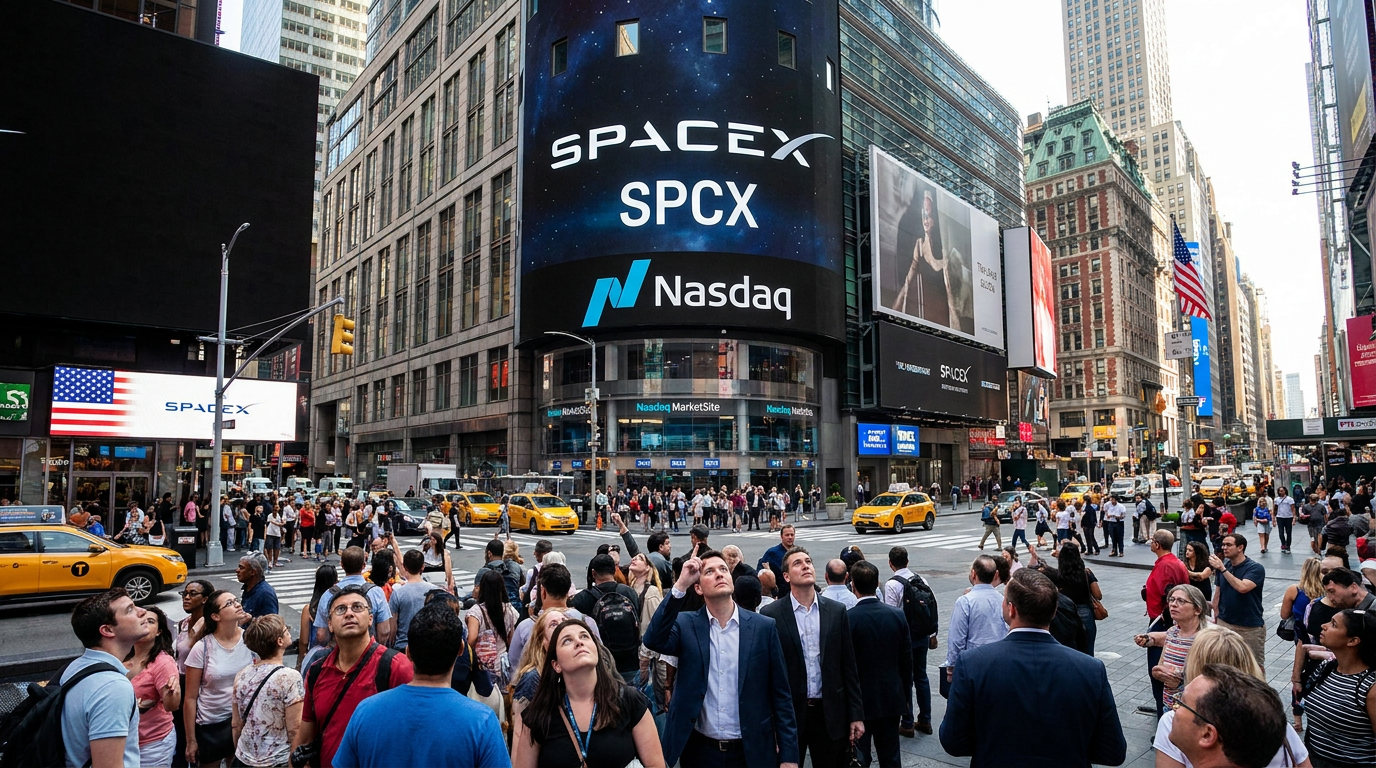
SpaceX is officially a public company. On Friday, June 12, 2026, Elon Musk’s aerospace and telecommunications giant made its highly anticipated debut on the Nasdaq stock exchange under the ticker symbol SPCX. The listing marks the culmination of nearly two and a half decades of private operation, transforming the rocket manufacturer into one of the most valuable publicly traded entities on Earth. The sheer scale of the debut immediately commanded the attention of the global financial system, drawing unprecedented demand from both institutional heavyweights and everyday retail traders eager to secure a stake in the commercial space race.[1][4]
The financial metrics of the offering shattered every existing record on Wall Street. SpaceX raised a staggering $75 billion in capital, achieving an initial public valuation of $1.77 trillion. To put the magnitude of the event into perspective, the capital raised is more than double the size of the previous record holder—Saudi Aramco’s $29.4 billion listing in 2019. The valuation instantly propels SpaceX into the elite "trillion-dollar club," placing its market capitalization just behind tech behemoths like Apple, Microsoft, and Nvidia on its very first day of trading.[1]
In a stark departure from traditional Wall Street mechanics, SpaceX bypassed the standard bookbuilding process—where investment banks float a price range over several weeks and narrow it based on institutional feedback. Instead, the company went straight to the market with a fixed, non-negotiable price of $135 per share. The aggressive strategy signaled immense confidence from Musk and the underwriting banks, effectively dictating terms to the market rather than asking for price discovery. Investors absorbed the fixed price without hesitation, validating the company's unorthodox approach to its public transition and setting a potential new precedent for future mega-cap technology listings.[2][8]

Demand for the stock reached historic extremes, driven heavily by Elon Musk’s massive cultural footprint. Retail investors alone placed orders exceeding $100 billion, an unprecedented wave of individual capital that far outstripped the 20 percent of shares the company had reportedly reserved for the public. Institutional giants were equally aggressive; BlackRock reportedly placed a single order for at least $5 billion in shares. In total, the offering drew an estimated $250 billion in demand, meaning the largest IPO in human history was still oversubscribed by a factor of more than three to one.[1][2]
The immediate consequence of the listing was a historic wealth transfer for the company's workforce. The IPO minted thousands of new millionaires overnight among current and former SpaceX employees who held stock options and restricted share units. Tom Mueller, the company’s very first employee, described the milestone as a "life-changing" event for the staff who spent decades building the Falcon and Starship programs. Across the company's facilities in California and Texas, employees celebrated the financial realization of equity that Musk had long promised would eventually pay off.[3]
For Elon Musk, the IPO cements a level of personal wealth never before seen in modern financial history. The $1.77 trillion valuation catapults his estimated net worth to roughly $982 billion, placing him on the absolute precipice of becoming the world’s first trillionaire. His massive stake in SpaceX, combined with his holdings in Tesla and the recently integrated xAI platform, gives him a financial footprint that rivals the gross domestic product of several developed nations. If the stock experiences even a modest post-listing "pop" in its opening days, Musk will easily cross the trillion-dollar threshold, fundamentally redefining the upper limits of individual wealth accumulation.[4]
For Elon Musk, the IPO cements a level of personal wealth never before seen in modern financial history.
Despite the euphoric market reception, the underlying financials of SpaceX paint a complex picture. Unlike the highly profitable tech giants it now sits alongside, SpaceX is currently operating at a significant loss. According to the company's S-1 registration statement filed with the Securities and Exchange Commission, SpaceX posted a $4.28 billion net loss in the first quarter of 2026 alone. The company also carries an accumulated deficit of over $40 billion, a testament to the astronomical capital expenditures required to develop reusable rockets, build the Starlink satellite constellation, and fund the experimental Starship program.[7][8]

This stark disconnect between profitability and valuation has fueled intense skepticism from traditional market analysts. Veteran short-seller James Chanos publicly dismissed the debut as a "hopes-and-dreams IPO," arguing that the $1.77 trillion price tag is driven entirely by retail enthusiasm for artificial intelligence and the cult of personality surrounding Musk, rather than any grounded financial fundamentals. Critics warn that pricing a company at nearly 100 times its projected future revenue leaves absolutely no margin for error in its execution over the next decade.[1]
Corporate governance advocates and regulators have also raised red flags regarding the structure of the newly public entity. Senator Elizabeth Warren formally urged the SEC to scrutinize the deal, highlighting the dual-class share structure that allows Musk to retain approximately 85 percent of the shareholder voting power. This arrangement effectively renders public investors powerless to influence corporate strategy, replace board members, or hold executive leadership accountable, concentrating unprecedented control of a trillion-dollar public asset into the hands of a single individual.[2]
The sheer gravity of the SpaceX listing has also created a mechanical crisis for the architects of the global financial system. Passive index funds, which automatically track major market benchmarks, are being forced to adapt to the sudden arrival of a $1.77 trillion behemoth. Nasdaq opted to aggressively accommodate the listing, waiving standard seasoning periods to fast-track SPCX into the Nasdaq 100 index. This decision guarantees a massive wave of forced buying from passive funds, which some analysts warn could distort the stock's price discovery and create artificial liquidity bottlenecks.[5]
Conversely, the gatekeepers of the S&P 500 have taken a much more conservative stance. S&P Dow Jones Indices confirmed that SpaceX will not immediately qualify for inclusion in its flagship benchmark. The index requires constituent companies to demonstrate a history of positive earnings and maintain a minimum public float—two hurdles that SpaceX currently fails to clear. This divergence between Nasdaq and S&P creates a rare fracture in how the world's largest indices treat a mega-cap technology company, leaving trillions of dollars in passive retirement capital sitting on the sidelines for now.[7]

Given the intense media coverage and the stock's inevitable volatility, financial advisors are urging caution, particularly for older investors. Market analysts have warned that the intense "fear of missing out" surrounding the IPO poses a severe risk to retirement portfolios. While a speculative bet on a highly volatile space exploration stock might be appropriate for a younger investor with decades to recover, allocating critical retirement funds into a newly listed, unprofitable company at a peak valuation carries the risk of catastrophic portfolio damage if the market sentiment shifts.[6]
Looking ahead, the SpaceX debut is widely viewed as the opening salvo in what is expected to be a historic year for mega-cap technology listings. With artificial intelligence dominating market narratives, heavily capitalized private firms like OpenAI and Anthropic are reportedly monitoring the SpaceX IPO closely as they prepare for their own potential public offerings later in 2026. If the market successfully digests SpaceX's $75 billion capital raise without triggering a broader liquidity crunch, it could clear the runway for a trillion-dollar wave of AI-driven market debuts.[4][5]

Ultimately, for Musk and the leadership at SpaceX, the historic IPO is not the final destination, but rather a massive fundraising mechanism for an even grander ambition. The $75 billion in newly raised capital is explicitly earmarked to accelerate the Starship program and fund the staggering logistical costs of deep space exploration. As the company stated in its prospectus, the ultimate mission remains unchanged: utilizing the public markets to finance the technologies necessary to establish a permanent human colony on Mars and make humanity a multiplanetary species.[4][8]
How we got here
March 2025
Elon Musk merges his AI startup xAI with social media platform X, setting the stage for a broader corporate consolidation.
April 2026
SpaceX files confidential IPO paperwork with the U.S. Securities and Exchange Commission.
May 2026
The company publicly releases its S-1 prospectus, revealing its internal finances and a $4.28 billion Q1 loss.
June 11, 2026
SpaceX finalizes its IPO price at a fixed $135 per share, bypassing the traditional pricing range.
June 12, 2026
Shares begin trading on the Nasdaq under the ticker SPCX in the largest market debut in history.
Viewpoints in depth
Retail & Institutional Bulls
Investors viewing the IPO as a generational opportunity to back Elon Musk's track record.
For bullish investors, traditional valuation metrics are secondary to the sheer scale of SpaceX's ambitions and its near-monopoly on commercial spaceflight. They point to the success of Starlink's rapidly growing broadband network and the transformative potential of the Starship program. To this camp, the $1.77 trillion valuation is justified by the company's total addressable market, which they believe spans global telecommunications, AI infrastructure, and eventually, interplanetary logistics.
Market Skeptics & Regulators
Critics warning of severe overvaluation, lack of profitability, and governance risks.
Skeptics argue that the IPO is driven by "hopes and dreams" rather than financial fundamentals. They highlight the company's $4.28 billion first-quarter loss and its massive accumulated deficit. Furthermore, regulators and corporate governance advocates are deeply concerned by the dual-class share structure that grants Elon Musk 85% of the voting power, effectively leaving public shareholders with no ability to influence the company's direction or hold leadership accountable.
Index & Passive Managers
Financial architects grappling with the mechanical challenges of absorbing a $1.77 trillion company.
For the managers of passive index funds, the SpaceX IPO presents a structural headache. The company's massive market capitalization combined with a relatively low public float creates immense liquidity pressure. While Nasdaq opted to fast-track SPCX into its indices to capture the momentum, S&P Dow Jones has held firm on its profitability and float requirements, creating a rare divergence in how the world's largest benchmarks treat a mega-cap tech giant.
What we don't know
- Whether the stock will experience a massive post-listing surge or face a correction once initial retail demand is satisfied.
- How quickly SpaceX can transition from heavy research and development losses to consistent profitability.
- When, or if, S&P Dow Jones Indices will alter its rules to allow SpaceX into the S&P 500.
Key terms
- Initial Public Offering (IPO)
- The process by which a private company offers its shares to the public for the first time, allowing anyone to buy ownership stakes on a stock exchange.
- Public Float
- The portion of a company's shares that are freely available for trading by the general public, excluding locked-in shares held by insiders or founders.
- Bookbuilding
- The traditional process where investment banks gather bids from institutional investors to determine the final price of an IPO.
- Dual-Class Share Structure
- A corporate structure that issues two different classes of shares, typically giving founders or executives significantly more voting power than regular public investors.
Frequently asked
What is the SpaceX stock ticker symbol?
SpaceX trades on the Nasdaq exchange under the ticker symbol SPCX.
Did SpaceX join the S&P 500?
No. While Nasdaq fast-tracked SpaceX into the Nasdaq 100, the S&P 500 excluded the company because it does not currently meet the index's profitability and public float requirements.
How much of the company does Elon Musk control?
Despite taking the company public, Elon Musk retains approximately 85% of the shareholder voting power through a dual-class share structure.
Is SpaceX a profitable company?
Not currently. According to its SEC filings, SpaceX posted a $4.28 billion net loss in the first quarter of 2026 and carries a significant accumulated deficit.
Sources
Source coverage
8 outlets
3 viewpoints surfaced








[1]BloombergRetail & Institutional Bulls
SpaceX IPO Raises $75 Billion in Biggest Debut of All Time
Read on Bloomberg →[2]ForbesRetail & Institutional Bulls
SpaceX Cements Final IPO Price At $135 As Retail Investor Orders Top $100 Billion
Read on Forbes →[3]Fox BusinessRetail & Institutional Bulls
Musk's first SpaceX employee calls historic $1.77 trillion IPO 'life-changing'
Read on Fox Business →[4]The GuardianMarket Skeptics
SpaceX to list on US stock market at $1.77tn valuation in largest ever debut
Read on The Guardian →[5]CME GroupIndex & Passive Managers
The SpaceX Mega-IPO: Why Index Choice Matters
Read on CME Group →[6]MarketWatchMarket Skeptics
SpaceX IPO hype is massive — and the FOMO can ruin your retirement
Read on MarketWatch →[7]Fidelity InternationalIndex & Passive Managers
SpaceX IPO: what you need to know
Read on Fidelity International →[8]U.S. Securities and Exchange CommissionMarket Skeptics
Space Exploration Technologies Corp. Form S-1 Registration Statement
Read on U.S. Securities and Exchange Commission →

More in finance
See all 69 stories →Housing Market
How Assumable Mortgages Work: The Strategy Saving Homebuyers Thousands
8 sources

Retirement Income
Fixed Annuities vs. Index Funds: The Retirement Income Trade-Off
8 sources

Space Economy
The SpaceX IPO and the Space Economy: How Mega-Listings and Leveraged ETFs Actually Work
8 sources
Foster Care
How the New 'Fostering the Future' Savings Accounts Work for Foster Youth
8 sources

Every angle. Every day.
Get finance stories with full source coverage and perspective breakdowns delivered to your inbox.