
The Solid-State Era Arrives: How 2026 Became the Breakthrough Year for Next-Gen EV Batteries
After decades of lab research, solid-state batteries are officially entering pilot production in 2026, promising to double EV range, slash charging times, and eliminate fire risks.
By Factlen Editorial Team
- Solid-State Pioneers
- Focused on pushing the technological boundary to achieve 600+ mile ranges and 10-minute charging.
- Scale Pragmatists
- Focused on cost-effective, mass-market chemistries like LFP while treating solid-state as a long-term premium option.
- Market Skeptics
- Focused on the immense manufacturing and cost hurdles of scaling solid-state technology.
What's not represented
- · Lithium mining communities
- · Independent EV repair shops
Why this matters
Range anxiety and battery degradation are the two biggest hurdles to mass EV adoption. Solid-state technology solves both while making vehicles fundamentally safer, paving the way for 600-mile ranges and 10-minute charge times that rival the convenience of gasoline.
Key points
- Solid-state EV batteries have officially moved from laboratory research to pilot production in 2026.
- The technology replaces flammable liquid electrolytes with solid materials like ceramics or sulfides.
- Solid-state cells can safely double the energy density of current batteries, enabling 600+ mile ranges.
- Charging times are expected to plummet, allowing vehicles to reach 80% capacity in 10 to 15 minutes.
- Early production will be limited and expensive, initially targeting luxury and flagship vehicles.
- Mass-market adoption is projected to scale up significantly by 2030.
For the better part of a decade, the automotive industry has chased a "holy grail" that always seemed perpetually five years away. Solid-state batteries promised to cure every ailment of the electric vehicle experience—range anxiety, charging bottlenecks, and fire risks—but remained stubbornly confined to laboratory environments. In 2026, that narrative has definitively fractured. Across North America, Europe, and Asia, the first pilot production lines are spinning up, moving next-generation cells out of the beaker and into the chassis.[4]
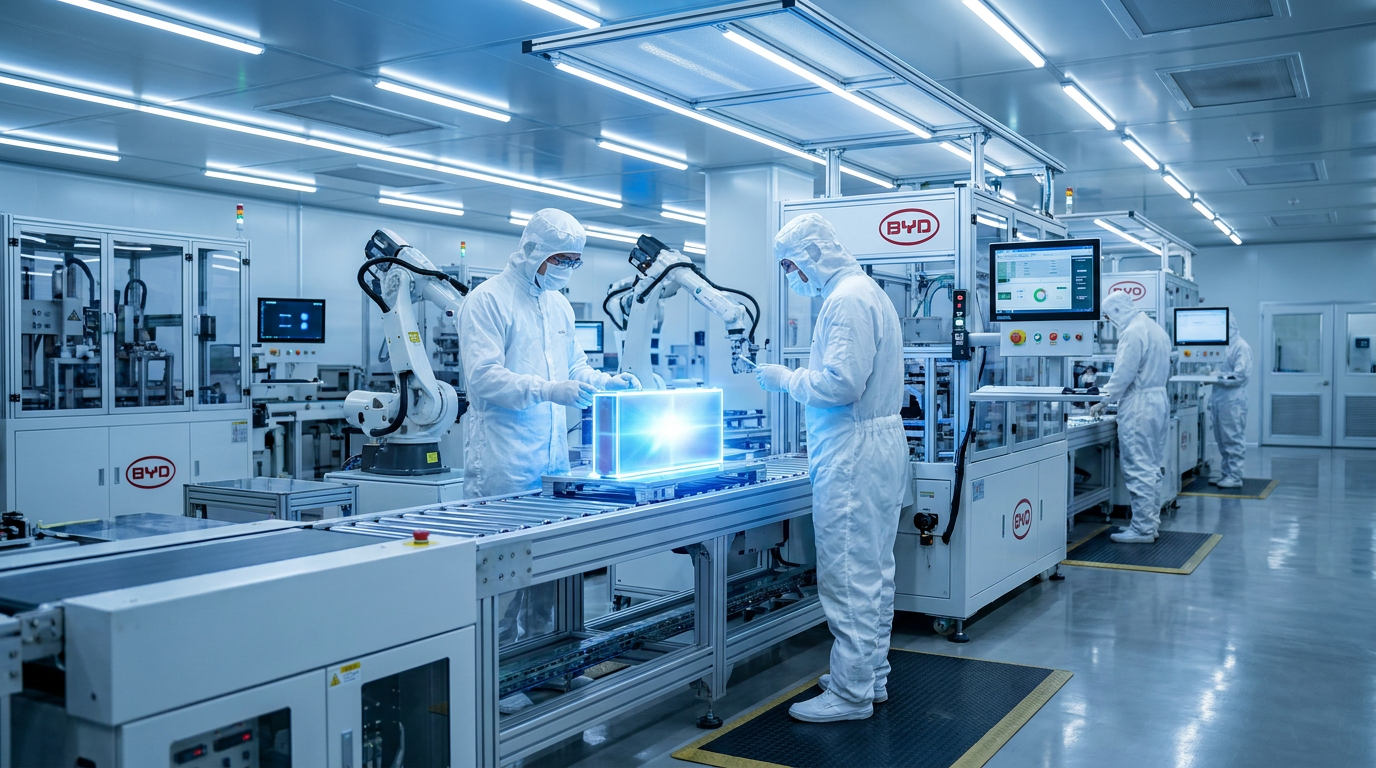
The shift from theoretical breakthrough to industrial reality is happening on multiple fronts simultaneously. In California, QuantumScape inaugurated its "Eagle Line" in early 2026, a highly automated pilot facility designed to produce solid-state cells for automotive sampling. Meanwhile, the Japanese government officially validated Toyota's production roadmap, greenlighting a massive domestic manufacturing push. In China, state-backed Greater Bay Technology (GBT) rolled its first "A-sample" cells off the line, targeting gigawatt-hour scale by the end of the year.[1][2][3][4][5]
To understand why this transition is so monumental, one must look inside the architecture of the batteries powering today's electric vehicles. Conventional lithium-ion batteries rely on a liquid electrolyte—a chemical soup of lithium salts dissolved in an organic solvent—to ferry ions back and forth between the anode and the cathode during charging and discharging.[4]
While liquid electrolytes are well-understood and cheap to manufacture, they harbor fundamental flaws. The liquid is inherently volatile and flammable. If the battery is punctured in a crash, overcharged, or subjected to extreme heat, the solvent can ignite, triggering a cascading failure known as thermal runaway. Furthermore, liquid systems are vulnerable to dendrites—microscopic, needle-like metallic whiskers that grow from the anode over time, eventually piercing the separator and short-circuiting the cell.[4][6]

Solid-state technology solves these issues by replacing the liquid soup with a solid, non-flammable material. Depending on the manufacturer, this solid electrolyte might be made of ceramics, specialized polymers, or sulfide-based glass. Because the solid barrier is physically rigid, it suppresses dendrite growth, allowing engineers to use pure lithium metal for the anode instead of the heavier, bulkier graphite used in traditional cells.[4][5][6]
The immediate payoff of this architectural swap is a massive leap in energy density—the amount of power a battery can hold relative to its weight. Today's best lithium-ion cells hover between 200 and 300 watt-hours per kilogram (Wh/kg). The first wave of commercial solid-state cells is targeting 400 to 500 Wh/kg, effectively doubling the energy capacity without increasing the physical footprint of the battery pack.[4]

For the consumer, this translates directly into unprecedented range. Toyota's initial solid-state roadmap projects flagship vehicles capable of traveling over 600 miles (roughly 1,000 kilometers) on a single charge. A recent real-world test of a Mercedes-Benz EQS equipped with prototype solid-state cells from Factorial managed a staggering 748-mile journey across Europe without stopping to plug in.[3][4][7]
For the consumer, this translates directly into unprecedented range.
Range, however, is only half the equation; charging speed is the other. Because solid electrolytes are vastly more stable at high voltages and temperatures, they can absorb electricity at a blistering pace without degrading. QuantumScape and Toyota both project that their solid-state architectures will allow a vehicle to charge from 10 percent to 80 percent in roughly 10 to 15 minutes. This brings the EV refueling experience remarkably close to the time it takes to pump a tank of gasoline.[3][7][8]
Safety margins also see a dramatic improvement. Comparative testing has shown that thermal events in solid-state systems do not begin until internal temperatures reach nearly 250 degrees Celsius, compared to just 90 degrees for conventional lithium-ion batteries. Even when breached, the lack of a flammable liquid solvent means the cells are highly resistant to catastrophic fires, a crucial selling point for cautious consumers and safety regulators alike.[4][7]
Despite the clear advantages, manufacturing these cells at scale has proven to be one of the most complex industrial challenges of the 21st century. The solid electrolyte must maintain perfect, microscopic contact with the electrodes as they expand and contract during use. Achieving this requires immense precision, specialized equipment, and entirely new manufacturing techniques that cannot simply be bolted onto existing lithium-ion assembly lines.[6]
QuantumScape's approach involves a proprietary ceramic separator and a "Cobra process" designed to manufacture it rapidly and uniformly. Rather than building massive gigafactories itself, the company is positioning itself as a technology licensor, partnering with Volkswagen's PowerCo division to integrate the technology into VW's future fleet.[1][5][6]

Toyota, conversely, is betting heavily on sulfide-based solid electrolytes. The automaker has partnered with Japanese petrochemical giant Idemitsu Kosan to build a large-scale pilot plant dedicated to synthesizing the highly specialized powder required for the cells. Toyota's strategy is characteristically deliberate: start with limited-batch production in 2026 and 2027, refine the quality control, and push toward mass market volumes by 2030.[2][3][7]
The competitive landscape is further intensified by China's aggressive battery sector. While Western and Japanese firms have focused heavily on solid-state research, Chinese giants like CATL and BYD have dominated the current market with cheap, durable Lithium Iron Phosphate (LFP) batteries. However, neither company is ignoring the solid-state threat; both have quietly filed patents for sulfide-based systems and are targeting pilot production by 2027 to ensure they are not outflanked.[4]
The arrival of solid-state batteries will not immediately render current EVs obsolete. Because the manufacturing processes are still in their infancy, early solid-state cells will be exceptionally expensive to produce. Industry analysts expect them to debut exclusively in high-margin luxury vehicles, flagship sports cars, and heavy-duty commercial trucks where the premium price can be absorbed.[2][4]

For the broader market, the immediate future will likely be a tiered ecosystem. Budget and mid-range vehicles will increasingly rely on highly refined LFP and emerging sodium-ion batteries, which offer lower energy density but unbeatable cost-effectiveness. Solid-state technology will sit at the top of the pyramid, serving as the premium option for buyers who demand maximum range and rapid charging.[4]
Ultimately, the 2026 pilot launches represent the crossing of a critical threshold. The fundamental chemistry has been proven, the pilot lines are built, and the capital has been deployed. As manufacturing yields improve and economies of scale take hold over the next five years, solid-state batteries are poised to eliminate the final compromises of electric mobility, reshaping the automotive landscape for decades to come.[1][3][4]
How we got here
2020–2023
Major automakers and startups announce lab-scale breakthroughs in solid electrolyte materials, though mass production remains elusive.
Late 2025
A Mercedes-Benz EQS equipped with prototype solid-state cells completes a 748-mile journey across Europe on a single charge.
Early 2026
QuantumScape inaugurates its "Eagle Line" pilot facility in California to begin producing solid-state cells for automotive sampling.
Mid 2026
Toyota receives official approval from the Japanese government to begin its domestic solid-state manufacturing push.
Viewpoints in depth
Solid-State Pioneers
Companies like QuantumScape and Toyota view solid-state as an immediate, necessary leap to unlock mass EV adoption.
This camp argues that current lithium-ion technology has reached the top of its "S-curve," with only marginal gains left to extract. They believe that to win over the remaining internal-combustion holdouts, EVs must offer 600-mile ranges and 10-minute charge times—metrics only achievable by entirely replacing liquid electrolytes. They are willing to endure immense upfront R&D and manufacturing complexities to secure a generational technological moat.
Scale Pragmatists
Dominant battery manufacturers emphasize parallel development, prioritizing cheap, proven chemistries for the masses.
Giants like CATL and BYD acknowledge the superiority of solid-state chemistry but argue that the immediate future of the EV transition relies on affordability, not just peak performance. They are heavily invested in refining Lithium Iron Phosphate (LFP) and emerging sodium-ion batteries, which are vastly cheaper to produce at a gigawatt-hour scale. For this camp, solid-state is a premium niche product for the next decade, while liquid-based cells will continue to power the vast majority of the world's fleet.
Market Skeptics
Industry analysts warn that moving from lab prototypes to profitable mass production is a monumental hurdle.
Financial and engineering skeptics point out that building a perfect solid-state cell in a controlled laboratory is vastly different from manufacturing millions of them flawlessly on an assembly line. They highlight the extreme sensitivity of solid electrolytes to moisture and pressure, warning that early production yields may be low and costs astronomically high. This camp cautions investors against assuming a rapid, frictionless transition, noting that traditional lithium-ion gigafactories took over a decade to optimize.
What we don't know
- The exact price premium solid-state vehicles will carry when they first hit dealership lots in 2027.
- How well the solid electrolytes will hold up to a decade of real-world physical vibrations and extreme weather conditions.
- Whether the complex manufacturing techniques required for solid-state cells can be scaled quickly enough to meet global EV demand by 2030.
Key terms
- Electrolyte
- The medium inside a battery that allows electrical charge (ions) to flow between the cathode and the anode.
- Dendrites
- Microscopic, needle-like metallic growths that can form inside liquid batteries over time, potentially causing short circuits and fires.
- Energy Density
- A measure of how much energy a battery can store relative to its weight or size, typically expressed in watt-hours per kilogram (Wh/kg).
- Thermal Runaway
- A dangerous chain reaction inside a battery where excessive heat causes a rapid, uncontrollable increase in temperature, often leading to a fire.
Frequently asked
What makes a solid-state battery different?
It replaces the flammable liquid electrolyte found in traditional lithium-ion batteries with a solid material, like ceramic or glass, making it safer and more energy-dense.
When can I buy a car with a solid-state battery?
Pilot production is beginning in 2026, but early cells will likely be reserved for high-end luxury vehicles and sports cars in 2027 and 2028. Mass-market availability is expected closer to 2030.
Will solid-state batteries charge faster?
Yes. Because solid electrolytes are more stable at high temperatures, they can accept electricity much faster, with targets of charging from 10% to 80% in just 10 to 15 minutes.
Are solid-state batteries safer?
Significantly. By eliminating the volatile liquid solvent, solid-state batteries are highly resistant to thermal runaway and fires, even if punctured or overcharged.
Sources
Source coverage
8 outlets
3 viewpoints surfaced








[1]ElectrekMarket Skeptics
QuantumScape inaugurates Eagle Line pilot for solid-state battery production
Read on Electrek →[2]Green Car ReportsMarket Skeptics
Toyota to manufacture solid-state batteries in Japan starting in 2026
Read on Green Car Reports →[3]CBT NewsSolid-State Pioneers
Toyota to launch solid-state battery production by 2026
Read on CBT News →[4]EleportScale Pragmatists
New battery technologies 2026: Solid-State out of the labs
Read on Eleport →[5]QuantumScapeSolid-State Pioneers
QuantumScape celebrates inauguration of Eagle Line
Read on QuantumScape →[6]Battery Tech OnlineMarket Skeptics
QuantumScape CEO releases commercialization update
Read on Battery Tech Online →[7]Toyota GlobalSolid-State Pioneers
Toyota sets out advanced battery technology roadmap
Read on Toyota Global →[8]Intellectia AISolid-State Pioneers
QuantumScape Solid-State Battery Testing to Begin in Vehicles by 2026
Read on Intellectia AI →

More in automotive
See all 33 stories →EV Showdown
Rivian R2 vs. Tesla Model Y (2026): Choosing Your Next Electric SUV
6 sources
EV Buying Guide
PHEV vs. BEV in 2026: The Ultimate Trade-Off Analysis for Car Buyers
8 sources
Electric SUVs
The 2026 Mid-Size Electric SUV Showdown: Rivian R2 vs. Tesla Model Y
8 sources
Electric Hydrofoils
How Hydrofoil Technology is Finally Making Electric Boats Viable
7 sources
Every angle. Every day.
Get automotive stories with full source coverage and perspective breakdowns delivered to your inbox.