
Rivian R2 vs. Tesla Model Y (2026): Choosing Your Next Electric SUV
As Rivian launches its highly anticipated R2, buyers face a choice between a rugged, off-road-capable adventurer and Tesla's highly efficient, tech-forward daily driver.
By Factlen Editorial Team
- Utility & Off-Road Advocates
- Focus on cargo space, ground clearance, and rugged camping features.
- Efficiency & Highway Commuters
- Focus on aerodynamic teardrop design, sporty handling, and daily driving comfort.
- Tech & Autonomy Analysts
- Focus on sensor suites, comparing vision-only systems against multi-modal redundancy.
What's not represented
- · Traditional Legacy Automakers
- · Budget-Conscious EV Buyers
Why this matters
The midsize electric SUV segment is the most competitive in the auto industry, and this matchup defines the next generation of family EVs. Choosing between the R2 and the Model Y determines whether your daily driver is optimized for aerodynamic highway efficiency or rugged weekend adventures.
Key points
- The Rivian R2 and Tesla Model Y occupy a similar footprint but feature radically different designs: a boxy traditional SUV versus an aerodynamic teardrop.
- Rivian's R2 offers significantly more ground clearance (9.6 inches) and total cargo space (90.1 cubic feet), making it highly capable off-road.
- Despite its boxy shape, the R2 Performance slightly edges out the Model Y Performance in EPA efficiency ratings and maximum range.
- Tesla's Model Y provides a firmer, sportier ride on paved roads, while the R2's suspension is tuned to absorb large bumps and rough terrain.
- Both vehicles will utilize the North American Charging Standard (NACS), granting them equal access to the expansive Supercharger network.
The midsize electric SUV segment is the most fiercely contested battleground in the automotive industry, and the summer of 2026 has delivered its most anticipated matchup. Rivian’s long-awaited R2 is finally hitting the streets, aiming directly at the reigning champion of the segment: the Tesla Model Y.[1][6]
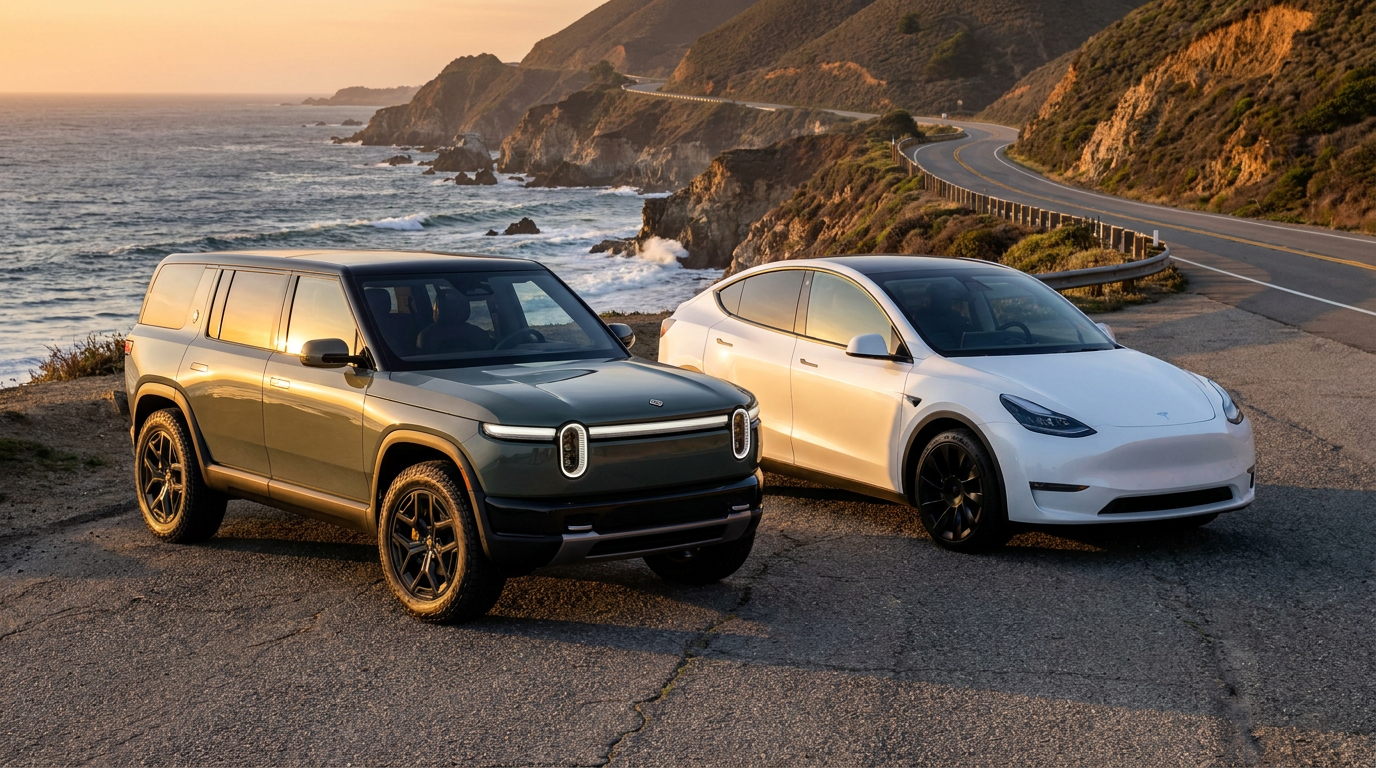
While both vehicles occupy roughly the same footprint and target a similar price bracket, they represent radically different philosophies of what an electric crossover should be. The Model Y is designed as a highly efficient, tech-forward daily driver, whereas the R2 is built from the ground up as a rugged, adventure-focused utility vehicle.[3][6]
The physical dimensions tell the story of these divergent priorities. The Rivian R2 is 185.9 inches long, making it nearly three inches shorter than the Model Y. However, the R2 is almost an inch wider and a full 3.1 inches taller, giving it a much boxier, traditional SUV silhouette compared to the Model Y’s aerodynamic teardrop shape.[3][6]
Nowhere is this design divergence more apparent than underneath the vehicles. The R2 boasts up to 9.6 inches of ground clearance, which is roughly 60 percent more than the Model Y’s 6.0 inches. Combined with steep approach and departure angles, this clearance makes the R2 genuinely capable on off-road trails, a domain where the Model Y simply cannot compete.[2][4]

Inside the cabin, the packaging differences become even more pronounced. The R2’s upright greenhouse and taller profile translate into a massive 90.1 cubic feet of total cargo space when the seats are folded down, which includes a class-leading 5.2 cubic-foot front trunk (frunk). This represents a nearly 19 percent advantage over the Model Y’s 75.5 cubic feet of total storage.[2][3]
Rivian has also leaned heavily into lifestyle features for the R2. The interior features a nature-inspired minimalism with sustainable fabrics, dual gloveboxes, and front seats that fold completely flat to accommodate in-car camping. Additionally, the R2 features a powered rear glass window that rolls down, enhancing the open-air feel for rear passengers or allowing long items like surfboards to hang out the back.[3][4]
By contrast, the Tesla Model Y maintains its ultra-minimalist aesthetic, centered almost entirely around its single massive touchscreen. The 2026 "Juniper" refresh of the Model Y has improved cabin refinement significantly, adding double-layer acoustic glass for a quieter ride and ventilated seats, making it an exceptionally comfortable and streamlined space for daily commuting.[5]
When it comes to performance, both vehicles deliver the blistering acceleration that EV buyers have come to expect. In their top-tier Performance trims, both the R2 and the Model Y can sprint from zero to 60 mph in roughly 3.3 seconds. However, the R2 Performance delivers more raw horsepower, pushing 656 hp compared to the Model Y Performance's 510 hp.[1][4]
When it comes to performance, both vehicles deliver the blistering acceleration that EV buyers have come to expect.
The most surprising metric in this matchup is efficiency. Tesla has historically held an undisputed lead in powertrain efficiency, largely due to the Model Y's slippery aerodynamics. Yet, the EPA rates the boxy, heavier Rivian R2 Performance at 109 MPGe combined, slightly edging out the Model Y Performance’s 104 MPGe.[2]

This engineering feat translates directly to driving range. Equipped with 21-inch wheels, the R2 Performance achieves an estimated 330 miles on a full charge, which is a 24-mile advantage over the equivalent Model Y Performance. While the real-world financial difference in charging costs is negligible, the extra buffer provides peace of mind on long road trips.[4]
On the road, the driving dynamics cater to different tastes. The R2’s suspension is tuned to absorb large bumps and dips effortlessly, providing an eerily quiet and refined ride even on rough dirt surfaces. The Model Y, sitting lower to the ground, offers a firmer, sportier ride with more direct steering, making it more engaging on twisty canyon roads but slightly less forgiving over potholes.[5]
The approach to autonomous driving technology is another major dividing line. Tesla continues to rely on its vision-only Full Self-Driving (FSD) system, which uses only cameras to navigate. Rivian, prioritizing hardware redundancy, equips the R2 with a diverse sensor suite that includes 11 cameras, five radars, and the computing architecture to support future LiDAR integration for point-to-point driving.[1]
Pricing for both vehicles is highly competitive, though availability differs. The top-tier Performance models for both the R2 and the Model Y sit at roughly $57,990. While Tesla offers its full range of trims immediately, Rivian is launching the expensive Performance models first in mid-2026, with the more affordable $45,000 base models slated for late 2027.[1][4]
Charging infrastructure remains a crucial consideration for any EV buyer. Tesla’s Supercharger network has long been the gold standard for reliability and coverage. However, because the Rivian R2 is built natively with the North American Charging Standard (NACS) port, it has seamless access to the exact same Supercharger network, effectively neutralizing Tesla’s historical moat.[4]

In a direct trade-off analysis, the arguments for the Tesla Model Y center on its proven manufacturing scale, immediate availability across all price points, and its sporty, highly efficient on-road dynamics. The primary arguments against it are its ubiquitous, somewhat aging teardrop design and its inability to handle rough terrain.[3][5]
Conversely, the arguments for the Rivian R2 highlight its superior cargo capacity, genuine off-road capability, and thoughtful adventure-ready features like fold-flat seats. The main arguments against the R2 are the delayed availability of its cheaper trims and the fact that Rivian is still scaling its service center network compared to Tesla’s established footprint.[1][2]
Ultimately, the Rivian R2 fits well when your lifestyle involves weekend camping, hauling large amounts of gear, navigating rough dirt roads, or simply preferring the commanding view and rugged aesthetic of a traditional SUV. It is the definitive choice for the outdoor enthusiast.[2][4]
The Tesla Model Y fits well when you prioritize a sporty, car-like driving experience, want the absolute most mature software interface on the market, or need to purchase a sub-$50,000 electric crossover today rather than waiting for late 2027. It remains the undisputed king of the suburban daily commute.[3][5]
How we got here
2019
Tesla introduces the Model Y, which quickly becomes the best-selling electric vehicle in the world.
March 2024
Rivian officially unveils the R2 midsize SUV, targeting the highly competitive $45,000 price segment.
Early 2026
Tesla releases the highly anticipated 'Juniper' refresh for the Model Y, updating its interior and suspension.
June 2026
Rivian begins initial customer deliveries of the high-end R2 Performance models.
Viewpoints in depth
Adventure Enthusiasts
Drivers who prioritize outdoor utility, camping, and off-road capability.
For this camp, the Rivian R2 is the clear winner. The 9.6 inches of ground clearance, combined with a boxy shape that maximizes cargo volume, makes it a true utility vehicle. The ability to fold all seats flat for in-car camping and roll down the rear glass for long items like surfboards are features that traditional teardrop crossovers simply cannot offer.
Efficiency & Highway Commuters
Drivers focused on aerodynamic efficiency, sporty handling, and proven daily reliability.
This group favors the Tesla Model Y. Its lower center of gravity and firmer suspension provide a more engaging, car-like driving experience on paved roads. Furthermore, the teardrop shape minimizes wind resistance at highway speeds, making it an incredibly efficient highway cruiser with a track record of reliability over millions of miles driven.
Tech & Autonomy Analysts
Industry watchers evaluating the divergent approaches to self-driving hardware.
Analysts are closely watching the sensor war between the two brands. Tesla remains steadfast in its vision-only approach, relying entirely on cameras and massive data sets to train its Full Self-Driving software. Rivian, however, is betting on hardware redundancy, equipping the R2 with cameras, radar, and the architecture for future LiDAR, arguing that multiple sensor types are necessary for safe, unsupervised autonomous driving.
What we don't know
- How Rivian's multi-modal autonomous driving suite will perform in real-world edge cases compared to Tesla's mature, data-rich FSD system.
- Whether Rivian can scale R2 production fast enough to meet initial consumer demand without significant delivery delays.
Key terms
- MPGe
- Miles Per Gallon Equivalent, a metric used by the EPA to compare the energy efficiency of electric vehicles to traditional gas-powered cars.
- NACS
- The North American Charging Standard, originally developed by Tesla, which has now been adopted by nearly all major automakers for universal charging access.
- Frunk
- A front trunk, which provides enclosed storage space under the hood where a traditional gas engine would normally sit.
- Approach and Departure Angles
- The maximum angles a vehicle can climb up or descend from an obstacle without the bumpers scraping the ground, crucial for off-roading.
Frequently asked
Does the Rivian R2 use the Tesla Supercharger network?
Yes. The Rivian R2 is built natively with the North American Charging Standard (NACS) port, giving it seamless access to Tesla's Supercharger network.
Which vehicle has more cargo space?
The Rivian R2 offers 90.1 cubic feet of total storage (including the frunk) with the seats folded, compared to the Model Y's 75.5 cubic feet.
Can you sleep inside the Rivian R2?
Yes. The R2 is designed with front and rear seats that fold completely flat, specifically to accommodate an air mattress for in-car camping.
Are both vehicles available to buy right now?
The Tesla Model Y is available now across all trims. The Rivian R2 begins deliveries for its high-end Performance models in mid-2026, with base models arriving in late 2027.
Sources
Source coverage
6 outlets
3 viewpoints surfaced






[1]ForbesTech & Autonomy Analysts
Rivian R2 Is Imminent: How It Stacks Up Against The Tesla Model Y
Read on Forbes →[2]ElectrekUtility & Off-Road Advocates
Rivian R2 vs Tesla Model Y spotted side-by-side: Detailed size comparison
Read on Electrek →[3]AutoblogUtility & Off-Road Advocates
2026 Rivian R2 Performance vs. 2026 Tesla Model Y: Which Crossover EV Should You Choose?
Read on Autoblog →[4]CarBuzzUtility & Off-Road Advocates
Here's every way the new SUV is ready to beat the Model Y at its own game
Read on CarBuzz →[5]CarwowEfficiency & Highway Commuters
Rivian R2 vs Tesla Model Y
Read on Carwow →[6]InsideEVsEfficiency & Highway Commuters
Rivian R2 vs Tesla Model Y: Size, Specs, And Features Compared
Read on InsideEVs →

More in automotive
See all 33 stories →Synthetic Fuels
How Synthetic Fuels Are Saving the Supercar V12 from Extinction
7 sources
EV Buying Guide
PHEV vs. BEV in 2026: The Ultimate Trade-Off Analysis for Car Buyers
8 sources
Electric SUVs
The 2026 Mid-Size Electric SUV Showdown: Rivian R2 vs. Tesla Model Y
8 sources
Electric Hydrofoils
How Hydrofoil Technology is Finally Making Electric Boats Viable
7 sources
Every angle. Every day.
Get automotive stories with full source coverage and perspective breakdowns delivered to your inbox.