
SpaceX Debuts on Nasdaq in Record $75 Billion IPO, Valued at $1.77 Trillion
SpaceX begins trading today in the largest initial public offering in stock market history, raising $75 billion and pushing CEO Elon Musk's net worth past the $1 trillion mark.
By Factlen Editorial Team
- Institutional Bulls
- Investors who view SpaceX's valuation as justified by its total dominance of the space economy and its pivot to AI.
- Value Skeptics
- Analysts who warn that the IPO price is detached from financial reality and corporate governance norms.
- Retail Investors
- Individual traders eager to buy into Elon Musk's most ambitious venture.
What's not represented
- · Space Industry Competitors
- · Environmental Regulators
Why this matters
The sheer scale of SpaceX's public debut reshapes the global equities market, creating a new mega-cap tech giant overnight. For investors, it represents a rare opportunity to buy into the commercial space economy and orbital artificial intelligence, while testing Wall Street's tolerance for massive valuations unmoored from current profitability.
Key points
- SpaceX has priced its IPO at $135 per share, raising a record-breaking $75 billion.
- The $1.77 trillion valuation makes it the largest public debut in stock market history.
- The listing pushes CEO Elon Musk's net worth past $1.1 trillion, making him the world's first trillionaire.
- SpaceX bypassed traditional Wall Street price discovery, dictating a fixed price and reserving 30% for retail investors.
- Despite $18.7 billion in 2025 revenue, the company remains unprofitable, posting a $4.9 billion net loss last year.
- The company is pitching a massive new business line: orbital AI data centers powered by its xAI subsidiary.
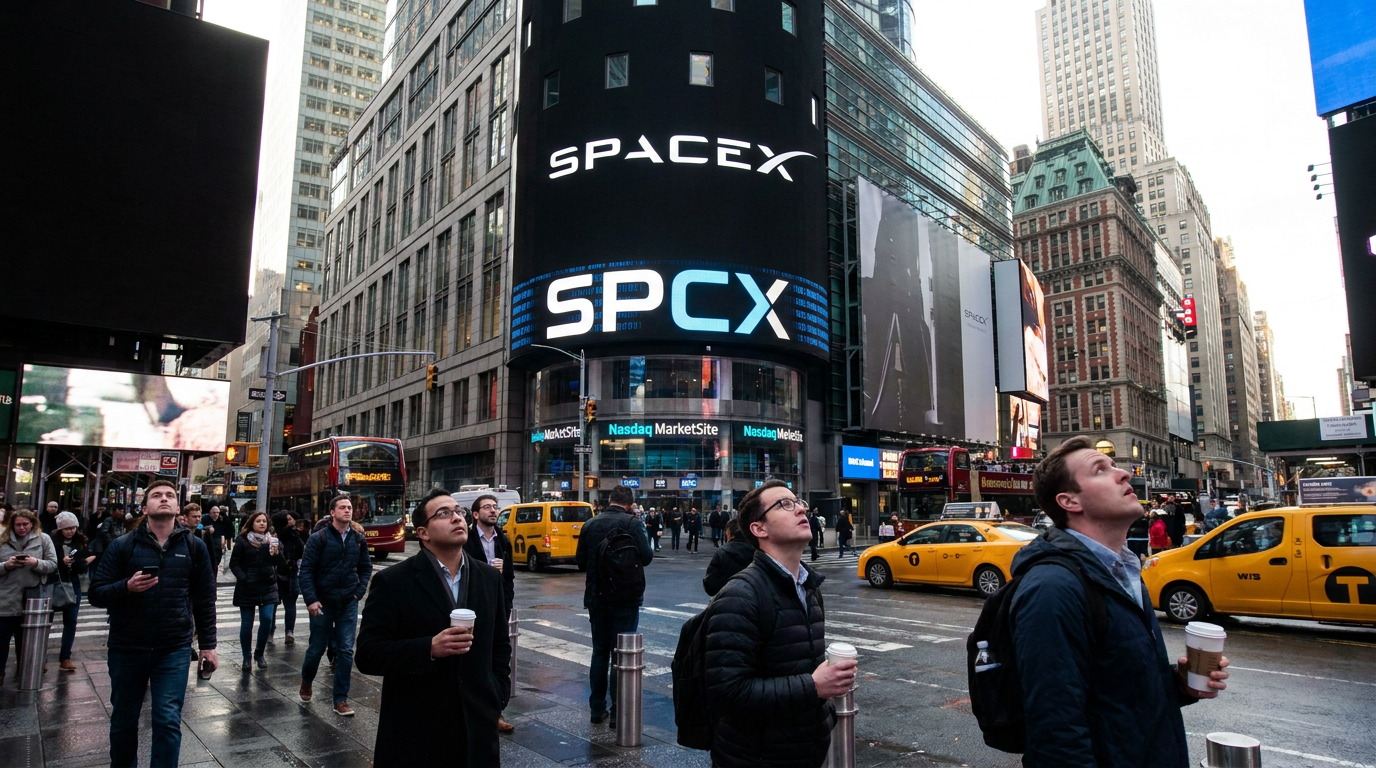
SpaceX officially begins trading on the Nasdaq today under the ticker symbol SPCX, marking the culmination of the most highly anticipated stock market debut in a generation. The aerospace and artificial intelligence conglomerate priced its shares at $135 late Thursday, locking in a staggering $1.77 trillion valuation.[1][5]
The offering shatters all previous records, raising $75 billion and dwarfing the $29.4 billion raised by Saudi Aramco in 2019. The sheer gravity of the listing instantly places SpaceX among the ten most valuable publicly traded companies in the United States, alongside tech titans like Apple, Microsoft, and Nvidia.[4][5]
For CEO Elon Musk, the IPO represents a historic personal milestone. With his roughly 42 percent economic stake in the newly public entity, Musk's net worth has surged past $1.1 trillion, making him the world's first documented trillionaire.[2][5]

The path to today's listing bypassed almost every traditional Wall Street convention. Rather than announcing a price range and adjusting it through weeks of institutional bookbuilding, SpaceX simply dictated a fixed price of $135 per share. The company handed the market a number and refused to negotiate, a testament to the overwhelming leverage Musk held over eager underwriters.[1][6]
That take-it-or-leave-it approach did nothing to dampen enthusiasm. The offering generated more than $250 billion in total demand, leaving the deal nearly four times oversubscribed. Major asset managers scrambled for allocations, with BlackRock alone reportedly requesting at least $5 billion in stock.[5][6]
That take-it-or-leave-it approach did nothing to dampen enthusiasm.
In a highly unusual move for a mega-cap offering, SpaceX reserved up to 30 percent of the shares for retail investors. This populist allocation strategy guarantees that the retail trading frenzy that has long defined Musk's other major public company, Tesla, will immediately transfer to SPCX.[6]

While SpaceX built its reputation on reusable rockets and the Starlink satellite internet constellation, the company's IPO prospectus revealed a dramatic pivot toward artificial intelligence. Following its $125 billion internal acquisition of Musk's AI startup xAI in February 2026, SpaceX is now pitching itself as the ultimate infrastructure play for the AI boom.[3][5]
The company's most ambitious new initiative involves building orbital data centers. By moving AI compute infrastructure into space, SpaceX argues it can bypass the severe terrestrial power grid constraints currently bottlenecking the tech industry. This futuristic vision was validated earlier this month when Google signed a $920 million monthly cloud computing agreement to utilize SpaceX's orbital infrastructure.[3][5]
However, the astronomical valuation comes with equally astronomical financial realities. Despite generating $18.7 billion in revenue in 2025, SpaceX posted a net loss of $4.9 billion. The cash burn has only accelerated, with the company reporting a $4.3 billion loss in just the first quarter of 2026 as it aggressively builds out its AI and Starship capabilities.[1][6]

Because of these heavy losses, SpaceX does not currently meet the GAAP profitability requirements for inclusion in the S&P 500 index. This means standard S&P tracker funds—which typically provide a massive baseline of passive buying for mega-cap stocks—will be forced to sit on the sidelines for now, though the Nasdaq 100 has cleared the company for immediate entry.[2][6]
Corporate governance remains another significant friction point for institutional skeptics. Through a structure of super-voting shares, Musk will retain 82.4 percent of the company's voting power. Investors are effectively buying into a public company where they will have zero ability to override the founder's decisions, concentrating unprecedented key-man risk in a single executive.[5][6]
As the opening bell rings in New York, the market's reaction will serve as the ultimate referendum on the so-called Elon Musk premium. Traders and long-term investors alike are betting that SpaceX's monopoly on commercial spaceflight and its audacious orbital AI plans will eventually justify a valuation that currently defies all traditional financial metrics.[1][3]

How we got here
March 2002
Elon Musk founds SpaceX with the goal of reducing space transportation costs.
May 2019
SpaceX begins launching the first batch of Starlink satellites to provide global internet coverage.
February 2026
SpaceX acquires Musk's AI startup xAI for $125 billion, signaling a major pivot toward artificial intelligence.
May 20, 2026
SpaceX publicly files its S-1 prospectus, revealing its financials and plans for a massive public offering.
June 11, 2026
The company prices its shares at a fixed $135, locking in a $1.77 trillion valuation.
June 12, 2026
SpaceX officially begins trading on the Nasdaq under the ticker SPCX.
Viewpoints in depth
Institutional Bulls
Investors who view SpaceX's valuation as justified by its total dominance of the space economy and its pivot to AI.
For major asset managers and growth funds, SpaceX is not just a rocket company; it is an infrastructure monopoly. Bulls argue that by combining the world's only reliable heavy-lift launch cadence with the Starlink communications network and xAI's computing power, SpaceX is building an unassailable moat. They view the $1.77 trillion valuation not as a multiple of current earnings, but as a discount on a future where SpaceX controls the physical backbone of the orbital economy and off-world data processing.
Value Skeptics
Analysts who warn that the IPO price is detached from financial reality and corporate governance norms.
Skeptics point to the company's staggering $4.9 billion net loss in 2025 and an even steeper $4.3 billion loss in Q1 2026. They argue that the $135 fixed share price was dictated by Musk rather than discovered through market consensus, creating a dangerous 'Elon Musk premium.' Furthermore, with Musk retaining over 82 percent of voting power, traditional institutional investors are effectively locked out of any governance oversight, making the stock a high-risk proposition if the company's capital-intensive AI bets fail to materialize.
Retail Investors
Individual traders eager to buy into Elon Musk's most ambitious venture.
Retail demand for SpaceX shares has been unprecedented, accounting for over $70 billion in requested allocations. For this camp, the appeal is largely ideological and personality-driven. Much like the retail base that propelled Tesla's valuation over the past decade, these investors are buying into Musk's vision of a multi-planetary species and artificial general intelligence. The unusual decision to reserve 30 percent of the IPO for retail buyers has only cemented their loyalty.
What we don't know
- How the stock will perform in secondary market trading after bypassing the traditional institutional price-discovery process.
- Whether the ambitious plan to build 'orbital data centers' for AI compute is technically and economically viable at scale.
- When, or if, SpaceX will achieve the GAAP profitability required for inclusion in the S&P 500 index.
Key terms
- Initial Public Offering (IPO)
- The process by which a private company offers shares to the public in a new stock issuance, allowing it to raise capital from public investors.
- Bookbuilding
- The traditional process where underwriters attempt to determine the price at which an IPO will be offered by generating and recording investor demand.
- GAAP Profitability
- Earnings calculated according to Generally Accepted Accounting Principles, a strict standard required for inclusion in major indices like the S&P 500.
- Super-voting shares
- A class of stock that provides its holders with significantly more voting power than regular shares, often used by founders to retain control of a company.
- Orbital Data Centers
- A proposed infrastructure model where computer servers, particularly those used for AI processing, are housed in satellites to bypass Earth's power grid limitations.
Frequently asked
Why isn't SpaceX joining the S&P 500 immediately?
The S&P 500 requires companies to be profitable under strict GAAP accounting standards for their most recent quarter and trailing twelve months. Because SpaceX posted a $4.9 billion loss in 2025, it does not yet qualify.
How much of the company does Elon Musk still own?
Musk retains roughly a 42 percent economic stake in the company, but through super-voting shares, he controls 82.4 percent of the voting power.
Can regular people buy SpaceX stock?
Yes. Starting today, anyone with a brokerage account can buy shares of SpaceX on the Nasdaq under the ticker symbol SPCX. The company also reserved an unusually high 30 percent of its initial offering specifically for retail investors.
Sources
Source coverage
6 outlets
3 viewpoints surfaced






[1]BloombergValue Skeptics
SpaceX Poised to Pop After Record IPO
Read on Bloomberg →[2]The GuardianRetail Investors
Elon Musk on track to become world’s first trillionaire today as SpaceX lists on US stock market
Read on The Guardian →[3]CNBCRetail Investors
SpaceX's Gwynne Shotwell says IPO is one small step in 'very futuristic' journey
Read on CNBC →[4]NYTValue Skeptics
How SpaceX’s IPO Compares With Saudi Aramco, Uber and Others
Read on NYT →[5]ReutersInstitutional Bulls
SpaceX raised $75 billion in its U.S. initial public offering
Read on Reuters →[6]WSJInstitutional Bulls
SpaceX heading toward what could become the largest initial public offering in history
Read on WSJ →
More in business
See all 47 stories →Skills-First Hiring
The Collapse of the 'Paper Ceiling': How Skills-First Hiring is Rewiring the Corporate Ladder
6 sources

SpaceX Listing
SpaceX Prices Record $1.77 Trillion IPO, Becoming Largest Public Offering in History
7 sources
Strait of Hormuz
Risk the Strait or Wait: The Costly Dilemma Trapping 500 Ships in the Persian Gulf
7 sources

UK AI Ecosystem
How London Built a $230 Billion AI Ecosystem
6 sources
Every angle. Every day.
Get business stories with full source coverage and perspective breakdowns delivered to your inbox.