
Renewable Energy Groups Sue Pentagon Over 'Total Halt' of Wind Farm Reviews
A coalition of clean energy developers has filed a federal lawsuit against the Department of Defense, alleging the military has frozen national security reviews for onshore wind farms. The industry claims the backlog jeopardizes $47 billion in investments and 106 projects across 21 states.
By Factlen Editorial Team
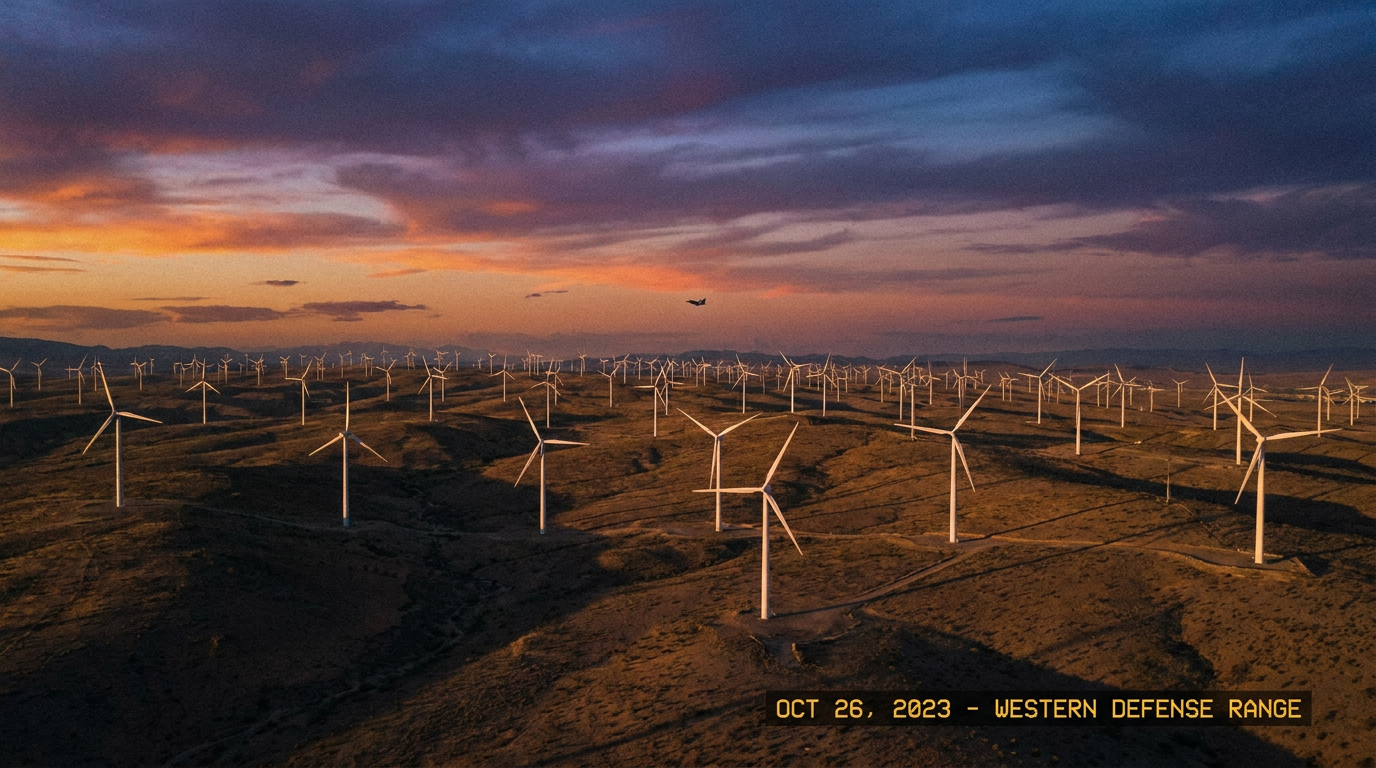
- Renewable Energy Coalition
- Argues the Pentagon's inaction is an unlawful de facto moratorium that threatens $47 billion in investments and national climate goals.
- Department of Defense
- Maintains that rigorous, time-consuming interagency reviews are necessary to ensure tall infrastructure does not compromise military radar and aviation readiness.
- Legal & Policy Analysts
- Focuses on the unprecedented scale of the backlog, the political context of the administration, and the legal threshold for forcing agency action.
What's not represented
- · Local Landowners
- · Regional Grid Operators
Why this matters
The Pentagon's review freeze threatens to derail 30 gigawatts of clean energy capacity, directly impacting the U.S. power grid's reliability and the nation's ability to meet its climate goals. If the delays persist, billions of dollars in private investment could be abandoned, leading to significant job losses in the energy sector.
Key points
- Renewable energy groups are suing the Pentagon over a halt in national security reviews for new wind farms.
- The delays affect at least 106 onshore wind projects across 21 states.
- An economic analysis estimates the frozen pipeline jeopardizes $47 billion in capital investments.
- The Pentagon maintains it is actively evaluating projects to ensure they do not impair military operations.
- Plaintiffs are seeking a federal injunction to force the resumption of the ordinary review process.
The U.S. military is facing a major legal challenge over its handling of renewable energy infrastructure. In June 2026, a coalition of clean energy groups filed a lawsuit in the U.S. District Court in Oregon against the Department of Defense and Defense Secretary Pete Hegseth. The plaintiffs allege that the Pentagon has enacted a "de facto moratorium" on national security reviews for new onshore wind farms. This sudden halt has effectively frozen the development pipeline for land-based wind energy across the country, prompting an aggressive legal response from an industry that provides roughly ten percent of the nation's electricity.[1][3]
At the center of the dispute is the DoD Siting Clearinghouse, the military office tasked with evaluating whether proposed energy projects interfere with national security. Under normal procedures, the Federal Aviation Administration (FAA) routes wind farm proposals to the Pentagon to ensure that turbines—which can reach hundreds of feet in height—do not obstruct military training routes or create clutter on defense radar systems. If a conflict arises, developers and the military typically negotiate a mitigation agreement. However, industry representatives claim this established interagency process has completely broken down.[2][5]
The timeline of the breakdown, according to the plaintiffs, reveals a progressive slowdown rather than an overnight policy shift. The American Clean Power Association (ACP) asserts that developers first noticed anomalies in August 2025, when the Pentagon stopped countersigning finalized mitigation agreements. By February 2026, the issuance of new draft agreements had ceased entirely. The situation escalated in April when the DoD allegedly canceled meetings and halted routine processing even for projects that required no mitigation measures.[1][2]

The economic stakes of this administrative bottleneck are massive. An independent economic analysis submitted alongside the lawsuit by Charles River Associates estimates that the frozen pipeline jeopardizes more than $47 billion in capital investments. This figure encompasses the cascading costs of stalled infrastructure: purchasing turbines, securing financing commitments, hiring specialized contractors, and paying non-refundable fees to maintain positions in regional grid interconnection queues.[1][4]
The scale of the disruption extends across 21 states, affecting at least 106 independently verified wind projects. These developments represent a combined capacity of 30 gigawatts—enough electricity to power millions of homes and a critical component of the nation's strategy to offset greenhouse gas emissions. The geographic impact is heavily concentrated in the wind-rich corridors of the American Midwest and South, with Texas, Kansas, and Illinois facing the largest backlog of stalled developments.[2][4]

The Department of Defense has pushed back against the characterization of a deliberate moratorium. In public statements, the Pentagon maintains that the Siting Clearinghouse is actively evaluating projects in accordance with statutory requirements. Defense officials emphasize that balancing the rapid expansion of renewable energy with the imperative of military readiness requires complex, time-consuming interagency coordination. The department has officially declined to comment on the specific economic damages cited in the open litigation.[1][5]
The Department of Defense has pushed back against the characterization of a deliberate moratorium.
Evidence supporting the military's need for rigorous review is well-documented. Wind turbines can create significant radar interference, generating false targets or masking the presence of actual aircraft. The DoD has historically worked closely with developers to upgrade radar software or adjust turbine layouts to mitigate these risks. However, the plaintiffs argue that the current system-wide halt is unprecedented and cannot be explained by routine technical evaluations, noting that there has never been a backlog of this magnitude in the Clearinghouse's history.[2][5][6]
The legal strategy of the renewable energy coalition hinges on forcing administrative action. Late Thursday, the plaintiffs filed a motion asking the federal court to issue an injunction that would compel the Pentagon to resume its ordinary review process. The lawsuit argues that the policy of inaction poses an "existential threat" to the onshore wind industry, making it impossible for developers to finalize financing or begin construction on private lands.[1][3]
Political context heavily colors the dispute. The lawsuit arrives during the administration of President Donald Trump, who has a long and highly publicized history of opposing wind power. The administration previously attempted to halt leasing and permitting for wind energy projects—an order that was subsequently struck down by a federal judge. While the current lawsuit focuses strictly on administrative procedure and statutory obligations, industry advocates privately view the Pentagon's slowdown as an extension of the executive branch's broader hostility toward renewable energy.[1][6]

The uncertainty surrounding the Siting Clearinghouse has already triggered a chilling effect on the broader renewable energy market. The first quarter of 2026 recorded the slowest start for new installations of land-based wind power since 2018. If the court does not grant the requested injunction, developers face a difficult choice: continue paying holding costs for stalled projects or abandon the investments entirely, which would result in significant job losses across the estimated 380,000 positions supported by the domestic wind industry.[1][2]
The evidence pack presented to the court relies heavily on the discrepancy between the DoD's stated policy and its actual administrative output. While the Pentagon claims reviews are ongoing, the plaintiffs have documented a near-zero transmittal rate of approved projects back to the FAA over the past several months. This quantitative drop-off forms the core of the legal argument that the agency is failing to execute its statutory duties.[2][3]
Moving forward, the U.S. District Court in Oregon will serve as the critical venue for resolving the standoff. Legal experts anticipate that the DoD will argue for broad deference in matters of national security, a domain where federal courts are traditionally hesitant to intervene. Conversely, the plaintiffs will demand transparent timelines and specific justifications for why previously routine approvals have ground to a halt. Until a ruling is issued, the $47 billion pipeline of American wind energy remains in administrative limbo.[3][6]
The broader implications for the U.S. power grid are also coming into focus. As electricity demand skyrockets due to the electrification of transport and the proliferation of data centers, grid operators are relying on the timely completion of these 30 gigawatts of wind capacity to maintain system reliability. A prolonged delay not only threatens the financial viability of the developers but also raises the risk of future energy shortfalls in regions heavily dependent on the interconnection queue.[2][4]
Ultimately, the resolution of this conflict will establish a vital precedent for how federal agencies balance competing national priorities. The tension between securing domestic energy independence through renewables and maintaining unencumbered military operational readiness is not new, but the scale of the current freeze elevates the stakes. The court's decision will likely dictate the regulatory environment for onshore wind development for the remainder of the decade.[6]
How we got here
August 2025
The Pentagon reportedly stops countersigning finalized mitigation agreements for new wind projects.
February 2026
The issuance of new draft mitigation agreements by the DoD ceases entirely, according to industry groups.
April 2026
Routine processing for all wind projects, including those not requiring mitigation, allegedly grinds to a halt.
May 2026
The American Clean Power Association publicly calls out the backlog, labeling it a 'de facto moratorium'.
June 12, 2026
A coalition of renewable energy groups files a lawsuit in U.S. District Court in Oregon against the Pentagon.
Viewpoints in depth
Renewable Energy Coalition's View
The industry argues the Siting Clearinghouse has enacted an unlawful, system-wide freeze.
Industry groups, led by the American Clean Power Association, contend that the Pentagon's actions constitute a 'de facto moratorium' rather than a routine backlog. They point to a timeline showing a progressive shutdown of the review process, culminating in a complete halt of FAA transmittals by April 2026. The coalition argues that this administrative freeze violates statutory requirements and jeopardizes $47 billion in capital, threatening the viability of 106 projects that are crucial for meeting both economic and climate targets.
Department of Defense's View
The military emphasizes the necessity of protecting national security operations from infrastructure interference.
The Pentagon maintains that it is actively evaluating projects and denies the existence of a deliberate moratorium. Defense officials argue that modern wind turbines, which can exceed 600 feet in height, pose severe risks to military aviation training routes and can significantly degrade the performance of early-warning radar systems. The DoD asserts that resolving these conflicts requires complex interagency coordination that cannot be rushed without compromising military readiness and national security.
What we don't know
- Whether the federal court will grant the injunction to force the Pentagon to resume reviews.
- How long developers can afford to hold their positions in the interconnection queue before abandoning projects.
- If the administration will formally intervene in the Siting Clearinghouse process.
Key terms
- DoD Siting Clearinghouse
- A military office responsible for evaluating proposed energy projects to ensure they do not negatively impact military operations or readiness.
- Mitigation Agreement
- A negotiated contract in which a developer agrees to specific terms, such as altering turbine heights or funding radar upgrades, to resolve military concerns.
- Interconnection Queue
- The waiting list and evaluation process that new power generation projects must complete before they can connect to the regional electric grid.
- Gigawatt
- A unit of power equal to one billion watts, often used to measure the capacity of large-scale power plants or energy grids.
Frequently asked
Why does the Pentagon review wind farm projects?
The Department of Defense evaluates wind farms to ensure that tall turbines do not interfere with military aviation training routes or create clutter on national security radar systems.
How much money and energy is at stake?
An economic analysis estimates that the stalled reviews jeopardize $47 billion in capital investments and 30 gigawatts of energy capacity across more than 100 projects.
What is the lawsuit asking the court to do?
The plaintiffs are seeking an injunction from the U.S. District Court in Oregon to compel the Pentagon to resume its ordinary, timely review process for new wind energy projects.
Has the military stopped reviewing all energy projects?
The lawsuit specifically targets a halt in reviews for land-based wind energy projects; the DoD maintains that its Siting Clearinghouse is still actively evaluating proposals, despite the industry's claims of a complete freeze.
Sources
Source coverage
6 outlets
3 viewpoints surfaced






[1]Associated PressLegal & Policy Analysts
Pentagon reviews are blocking wind farms, putting jobs at risk, lawsuit says
Read on Associated Press →[2]American Clean Power AssociationRenewable Energy Coalition
ACP Statement on DoD Siting Clearinghouse Delays
Read on American Clean Power Association →[3]U.S. District Court for the District of OregonLegal & Policy Analysts
Renewable Northwest et al. v. Department of Defense
Read on U.S. District Court for the District of Oregon →[4]Charles River AssociatesRenewable Energy Coalition
Economic Impact of Delayed Wind Energy Projects
Read on Charles River Associates →[5]DoD Siting ClearinghouseDepartment of Defense
DoD Siting Clearinghouse: Mission and Process
Read on DoD Siting Clearinghouse →[6]Factlen Editorial TeamLegal & Policy Analysts
Synthesis by Factlen editorial team
Read on Factlen Editorial Team →

Every angle. Every day.
Get science stories with full source coverage and perspective breakdowns delivered to your inbox.