
Penn Physicists Create Light-Matter Particle to Power AI Computing
Researchers have developed a hybrid quasiparticle that allows artificial intelligence chips to process data using light instead of electricity, drastically reducing energy consumption.
By Factlen Editorial Team
- Quantum & Photonic Physicists
- Focuses on the fundamental science of light-matter interactions and overcoming the physical limits of electron-based computing.
- AI Hardware Industry
- Views the breakthrough as a necessary evolution to sustain the exponential scaling of artificial intelligence models.
- Optical Engineering Sector
- Emphasizes the practical challenges and immense potential of scaling lab-grade optical switches into commercial manufacturing.
What's not represented
- · Semiconductor Manufacturers
- · Data Center Operators
Why this matters
Artificial intelligence is currently constrained by the massive energy demands and heat generation of traditional electronic chips. By shifting computation to light, this breakthrough could slash the carbon footprint of data centers and enable ultrafast, low-power AI in everyday devices.
Key points
- Penn physicists created a hybrid light-matter particle called an exciton-polariton.
- The particle allows AI computing logic to be performed entirely with light.
- The breakthrough eliminates the need to convert optical signals back into electricity.
- All-light switching was achieved using just 4 quadrillionths of a joule of energy.
- If scaled, the technology could drastically reduce the massive power demands of AI data centers.
Eighty years after researchers at the University of Pennsylvania launched the modern digital age with ENIAC—the world's first general-purpose electronic computer—a new team of Penn physicists is preparing to rewrite the hardware rules all over again. Since the 1940s, the entire computing industry has relied on the electron to process information. But as artificial intelligence models scale to unprecedented sizes, the physical limitations of electron-based hardware are becoming an existential threat to the industry's growth.[1][2][3]
Electrons carry an electrical charge. As they move through the microscopic pathways of modern silicon chips, they encounter resistance and generate heat. For decades, engineers managed this by shrinking transistors and improving cooling systems, but the sheer volume of data required to train and run modern AI systems is pushing traditional electronics to their breaking point. Data centers are consuming massive amounts of electricity, and the energy penalty of moving electrons is becoming harder to ignore.[2][4][5]
To solve this looming energy crisis, physicists have increasingly looked toward the electron's massless counterpart: the photon. Because photons are charge-neutral and have zero rest mass, they can carry information at the speed of light over long distances with virtually no energy loss. This is why fiber-optic cables already dominate global communications. However, that same charge neutrality makes photons notoriously difficult to use for actual computation.[1][5][6]
"Because they are charge-neutral... they barely interact with their environment, making them bad at the sort of signal-switching logic that computers depend on," explained Li He, a former postdoctoral researcher at Penn and co-first author of the new study. In a traditional computer, transistors act as switches, using one electrical signal to control another. Photons, by contrast, tend to pass right through each other like passing ghosts, making it incredibly difficult to build an optical switch.[2][5][6]

The AI industry has experimented with photonic chips before, but they have always come with a stubborn trade-off. While existing optical chips can perform straightforward linear calculations rapidly, they stumble when asked to perform "nonlinear activation steps"—the crucial decision-making operations that allow neural networks to learn complex patterns. To execute these steps, older photonic systems had to convert the optical signal back into an electronic one, perform the logic, and then convert it back to light.[1][3][5][6]
Those repeated conversions act as a massive bottleneck. They erode the blistering speed of optical computing and consume significant amounts of power, largely defeating the purpose of using light in the first place. The holy grail for hardware engineers has been "all-optical switching"—a system that can perform complex AI logic entirely within the realm of light, without ever handing the data back to power-hungry electrons.[2][3][5]
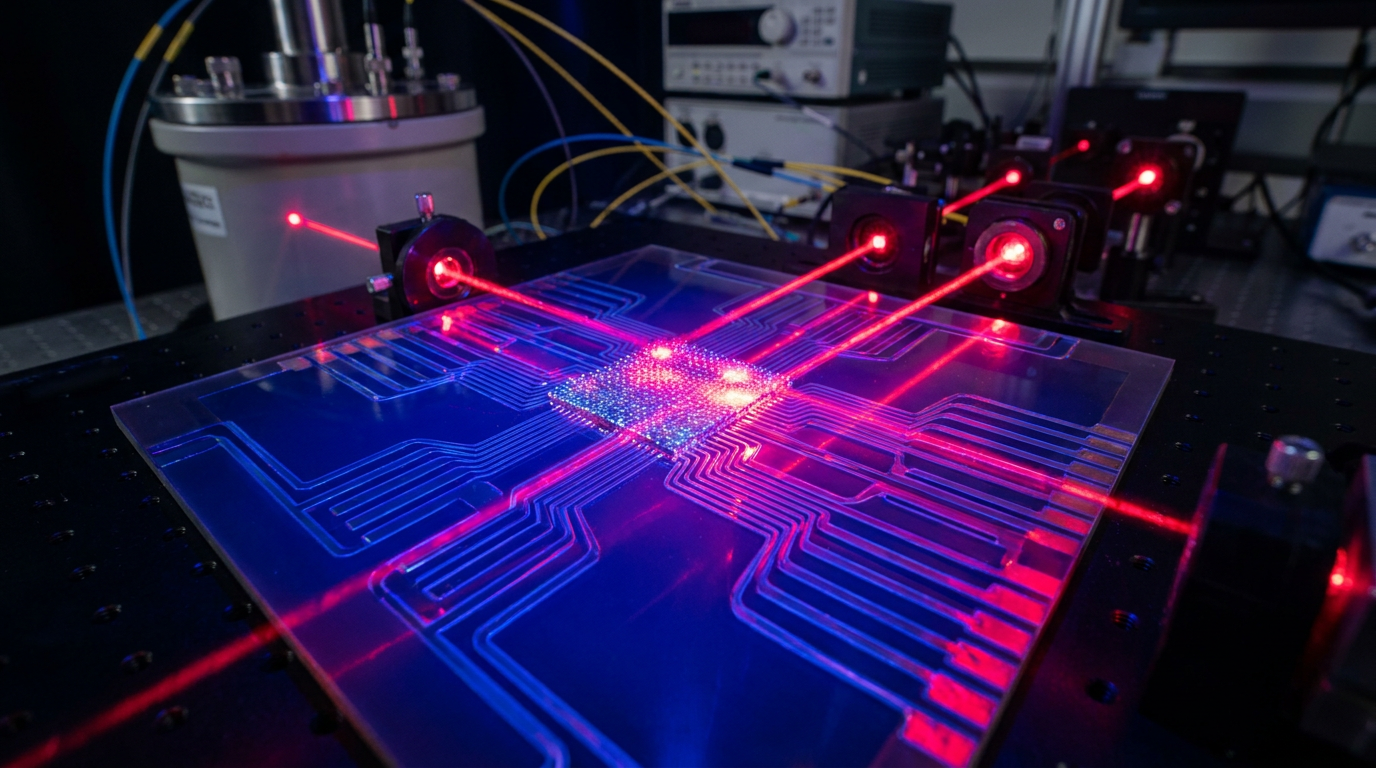
Now, a team led by Penn physicist Bo Zhen has achieved exactly that. In a breakthrough published in the journal Physical Review Letters, the researchers demonstrated a way to force light to interact strongly enough to compute. They did this by creating a highly exotic hybrid quasiparticle known as an "exciton-polariton."[2][4]
Now, a team led by Penn physicist Bo Zhen has achieved exactly that.
To create these quasiparticles, the team coupled photons with electrons inside an atomically thin semiconductor material. The resulting exciton-polariton is essentially a chimera: it retains the blistering speed and frictionless travel of a photon, but it inherits the strong interactive properties of matter. This allows the hybrid particles to bounce off one another and perform the signal-switching logic that pure light cannot achieve on its own.[1][2][3][5][6]
The efficiency of this new architecture is staggering. In their laboratory tests, the Penn team demonstrated all-light switching using roughly 4 femtojoules of energy—about 4 quadrillionths of a joule. To put that into perspective, it is an extraordinarily tiny fraction of the energy required to briefly illuminate a microscopic LED light. The researchers noted that this figure sets a new benchmark for switching energy in two-dimensional exciton-polariton systems.[2][3][5]

The team achieved this by shifting the semiconductor material into specific doped states using a gate voltage, which allowed them to observe a strong-coupling regime. In this state, the device produced distinct polariton peaks, with the researchers extracting an exciton-photon coupling strength of 16.8 millielectron volts. This deep physical interaction is what allows the optical logic to function without the traditional electronic crutch.[5]
If this technology can be successfully scaled from a laboratory proof-of-concept to commercial manufacturing, the implications for the artificial intelligence sector would be profound. The most immediate benefit would be a drastic reduction in the power demands of large-scale AI data centers, which are currently straining electrical grids worldwide. By keeping data entirely in the optical domain, the massive energy penalty of heat generation and signal conversion is practically eliminated.[1][3][4][5]
Beyond data centers, the breakthrough could revolutionize edge computing and machine vision. Future photonic chips could process visual information directly from camera sensors as raw light, instantly applying AI models to the optical data without ever converting it into a digital electronic format. This would enable ultrafast, low-power autonomous systems, from self-driving cars to advanced robotics, that can "see" and react in true real-time.[1][3][5]

The researchers also suggest that these light-matter interactions could eventually pave the way for basic quantum computing capabilities on standard semiconductor chips. Because exciton-polaritons can produce unusual quantum effects like Bose-Einstein condensation and superfluidity, they are highly valued for photonic quantum information processing.[1][4][5]
The road to commercialization remains steep. Moving from a precisely controlled two-dimensional nanocavity in a physics lab to mass-produced, reliable silicon-compatible chips will require years of engineering. However, the demonstration that all-optical nonlinear logic is possible at such low energy levels removes one of the most significant theoretical roadblocks in hardware design.[5][6]
As the AI industry races toward ever-larger models, the realization that electrons may not be able to carry the load indefinitely is prompting a surge of investment into alternative architectures. By harnessing the very particles that illuminate the universe, physicists are ensuring that the next great leap in computing power won't be constrained by the heat of a wire.[1][2][4]
How we got here
1946
Penn researchers launch the electronic computing age with ENIAC, relying entirely on electrons.
Early 2020s
AI models grow exponentially, pushing traditional electronic chips to their physical and thermal limits.
April 2026
Penn physicists publish their breakthrough on exciton-polaritons in Physical Review Letters.
May 2026
The research gains widespread attention as a potential solution to the AI industry's looming energy crisis.
Viewpoints in depth
Quantum & Photonic Physicists
Focuses on the fundamental science of light-matter interactions and overcoming the physical limits of electron-based computing.
For physicists, the breakthrough represents a triumph over the inherent limitations of the photon. Because light particles are charge-neutral, they naturally pass through one another without interacting, making it theoretically difficult to use them for the 'switching' logic required in computing. By successfully coupling photons with electrons to create exciton-polaritons, researchers have proven that light can be forced to interact strongly enough to compute, opening entirely new frontiers in quantum and optical physics.
AI Hardware Industry
Views the breakthrough as a necessary evolution to sustain the exponential scaling of artificial intelligence models.
The AI hardware sector is currently facing a looming 'thermal wall.' As models require exponentially more compute power, the heat and resistance generated by moving electrons through silicon are becoming unmanageable, leading to massive energy bills and cooling requirements for data centers. Industry analysts view all-optical switching not just as a neat scientific trick, but as a critical survival mechanism that will allow AI to continue scaling without breaking the global electrical grid.
Optical Engineering Sector
Emphasizes the practical challenges and immense potential of scaling lab-grade optical switches into commercial manufacturing.
While celebrating the milestone, optical engineers are quick to point out the immense chasm between a two-dimensional nanocavity in a controlled laboratory and a mass-produced commercial chip. The engineering sector's focus is now shifting toward finding ways to integrate these atomically thin semiconductor materials into existing silicon fabrication lines, a process that will require years of material science innovation before photonic AI chips reach the consumer market.
What we don't know
- How long it will take to scale this technology from a laboratory proof-of-concept to commercial mass production.
- Whether existing semiconductor fabrication facilities can be easily adapted to manufacture these atomically thin hybrid materials.
Key terms
- Exciton-polariton
- A hybrid quasiparticle created by coupling photons (light) with electrons in a semiconductor, combining the speed of light with the strong interactions of matter.
- Photonic computing
- A type of computing that uses photons (light particles) instead of electrons to process and transmit information.
- Nonlinear activation
- The mathematical 'decision-making' step in an artificial neural network that allows AI to learn complex patterns.
- Femtojoule
- A unit of energy equal to one quadrillionth of a joule, representing an extraordinarily tiny amount of power.
Frequently asked
Why are traditional computer chips struggling with AI?
Traditional chips use electrons, which carry a charge and generate heat and resistance as they move. As AI models grow, this creates massive energy waste and cooling challenges.
What makes this new particle different?
The exciton-polariton combines the speed of light with the ability of matter to interact with its environment, allowing it to perform computing logic without converting back to electricity.
Will this be in my computer soon?
Not immediately. The technology is currently a proof-of-concept in the lab, and scaling it up to commercial manufacturing is the next major hurdle.
Sources
Source coverage
6 outlets
3 viewpoints surfaced






[1]ScienceDailyQuantum & Photonic Physicists
Forget electrons, this breakthrough uses light-matter particles to power AI
Read on ScienceDaily →[2]Penn TodayQuantum & Photonic Physicists
Making 'light' work of computing
Read on Penn Today →[3]SciTechDailyAI Hardware Industry
Light-Matter Particles Could Revolutionize AI Computing
Read on SciTechDaily →[4]DataconomyAI Hardware Industry
Penn physicists use light-matter particles to boost AI chip speeds
Read on Dataconomy →[5]The Brighter Side of NewsQuantum & Photonic Physicists
UPenn physicists make 'light' work of computing
Read on The Brighter Side of News →[6]Photonics SpectraOptical Engineering Sector
Hybrid Particle Points Toward Ultrafast Optical AI Hardware
Read on Photonics Spectra →


Every angle. Every day.
Get ai stories with full source coverage and perspective breakdowns delivered to your inbox.