
The Clinical Evidence Behind 'Nature Prescriptions' for Mental Health
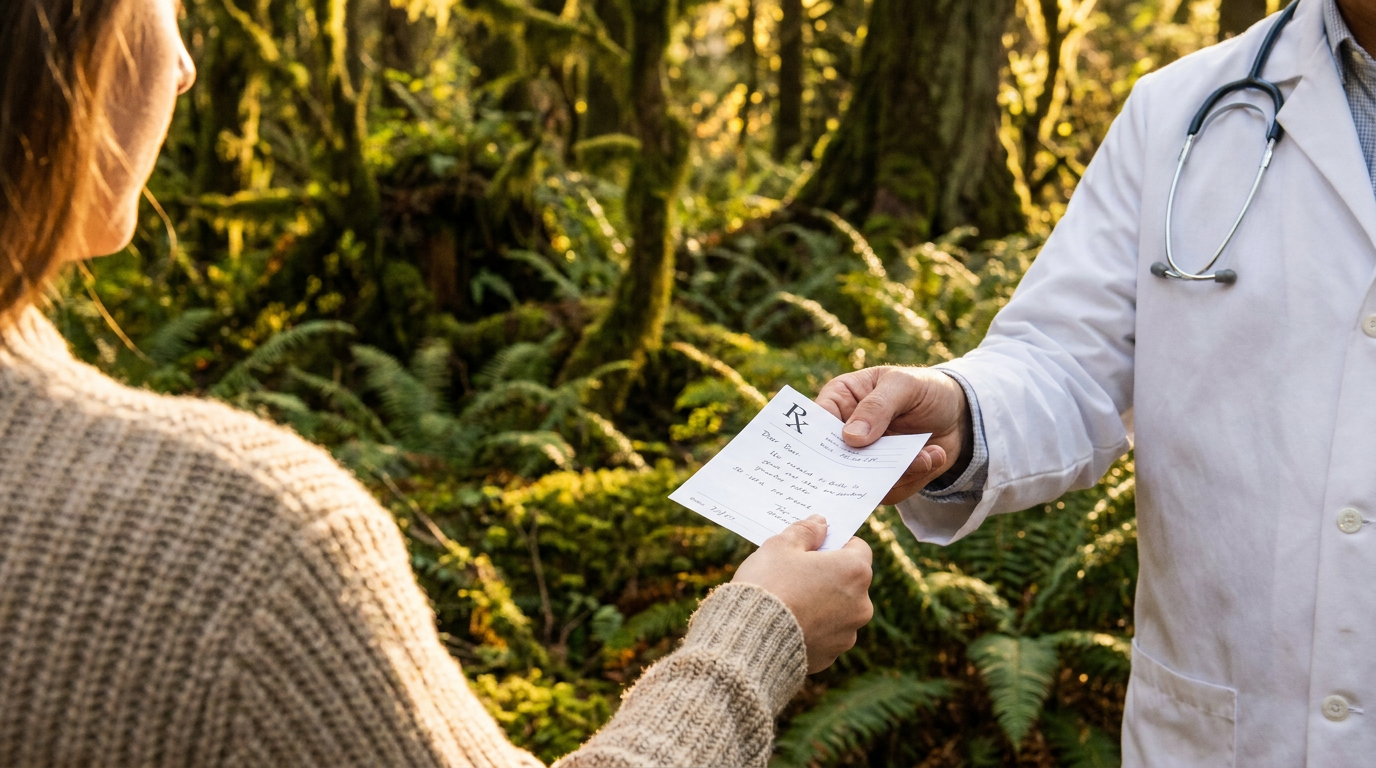
Healthcare providers globally are increasingly writing formal prescriptions for time in nature, backed by a growing body of evidence showing measurable reductions in anxiety, depression, and stress.
By Factlen Editorial Team
- Clinical Researchers
- Focus on the empirical data, biomarkers like cortisol, and fMRI results proving nature's impact on the brain.
- Public Health Officials
- View nature prescriptions as a scalable, low-cost population health intervention to reduce the burden on medical systems.
- Urban Planners
- Emphasize the need for equitable access to green spaces so that all demographics can benefit from these interventions.
- Mental Health Advocates
- Champion nature therapy as an empowering, non-pharmacological tool that patients can control themselves.
What's not represented
- · Patients with severe mobility issues who cannot access traditional green spaces
- · Insurance providers evaluating the reimbursement models for social prescribing
Why this matters
If you struggle with mild to moderate anxiety or burnout, structured time in green spaces offers a free, accessible, and scientifically validated intervention that can complement traditional treatments.
Key points
- Healthcare providers are formalizing 'nature prescriptions' to treat mild-to-moderate anxiety and depression.
- Time in green spaces measurably lowers cortisol, blood pressure, and sympathetic nervous system arousal.
- Neurological studies show nature exposure reduces brain activity associated with negative thought loops.
- The clinical threshold for optimal mental health benefits is approximately 120 minutes per week.
- Nature therapy is an adjunctive treatment, not a replacement for acute psychiatric care.
The idea that spending time outdoors is good for the mind is ancient, but over the past decade, it has evolved from folk wisdom into a formal clinical intervention. Across the globe, healthcare providers are increasingly issuing "nature prescriptions"—formal directives to spend specific amounts of time in green or blue spaces to combat anxiety, depression, and burnout.[1][6]
This shift is driven by a critical mass of empirical data. Rather than simply suggesting patients "get some fresh air," physicians are utilizing structured programs like Canada's PaRx or the UK's Green Social Prescribing initiatives, treating nature exposure as an adjunctive therapy with measurable physiological and psychological outcomes.[2][6]
To understand the efficacy of nature prescriptions, it is necessary to examine the evidence base across three domains: physiological down-regulation, neurological changes, and clinical psychological outcomes. The data reveals a complex interaction between environmental stimuli and the human nervous system.[3][4]
The most immediate measurable effect of nature exposure is physiological. Studies consistently demonstrate that spending time in natural environments rapidly reduces sympathetic nervous system arousal—the body's "fight or flight" response, which is chronically activated in individuals suffering from anxiety disorders.[5]

A primary biomarker for this effect is salivary cortisol. Research indicates that a 20-to-30-minute walk in a natural setting can reduce cortisol levels by up to 30% compared to walking in an urban environment. This neuroendocrine response is crucial for mitigating chronic stress, which is a known catalyst for depressive episodes.[3][5]
Beyond cortisol, nature exposure improves heart rate variability (HRV) and lowers blood pressure. High HRV is a strong indicator of autonomic nervous system resilience and emotional regulation. The World Health Organization has highlighted these cardiovascular and endocrine shifts as foundational to the mental health benefits of green spaces.[4]
Neurologically, nature exposure appears to alter brain activity in regions associated with mental illness. A landmark mechanism in this field is the reduction of "rumination"—the repetitive, negative thought loops characteristic of depression and anxiety.[5][6]
Functional magnetic resonance imaging (fMRI) studies have shown that a 90-minute walk in a natural setting significantly decreases activity in the subgenual prefrontal cortex, an area of the brain highly active during rumination. Conversely, walking for the same duration in a high-traffic urban setting produces no such neurological deactivation.[5]
Psychologists also point to "Attention Restoration Theory" (ART) to explain cognitive benefits. Urban environments demand "directed attention," requiring the brain to constantly filter out stimuli like traffic, crowds, and screens, leading to cognitive fatigue and increased irritability.[3][5]
Psychologists also point to "Attention Restoration Theory" (ART) to explain cognitive benefits.
Natural environments, by contrast, engage "soft fascination." The stimuli in a forest or by a lake capture attention effortlessly, allowing the brain's directed attention mechanisms to rest and replenish. This cognitive restoration translates directly to improved mood, better executive function, and a heightened sense of well-being.[5]
Clinically, systematic reviews of nature prescriptions show statistically significant improvements in patient outcomes. A comprehensive review published in The Lancet Planetary Health analyzed dozens of studies, concluding that nature-based interventions effectively reduce symptoms of mild-to-moderate depression and anxiety.[3]
The evidence is particularly strong for generalized anxiety disorder (GAD) and occupational burnout. Patients prescribed structured outdoor activities report higher adherence rates than those given generic exercise recommendations, likely due to the lower perceived exertion and higher intrinsic enjoyment of natural settings.[1][3]
A critical question for clinicians has been the "dosage"—exactly how much nature is required to achieve these clinical benefits? The emerging consensus points to a specific, measurable threshold that physicians can use to guide their patients.[6]
Large-scale epidemiological research suggests that the mental health benefits of nature exposure peak at approximately 120 minutes per week. This can be achieved in a single two-hour block or broken down into smaller increments, such as 20 minutes a day over six days.[5][6]

Interestingly, the data shows no significant additional mental health benefits beyond the 120-minute mark, and falling short of this threshold yields outcomes statistically similar to zero exposure. This "dose-response" curve provides a concrete metric for physicians writing prescriptions.[3]
The implementation of these findings is accelerating globally. In the United Kingdom, the National Health Service (NHS) has invested millions into "green social prescribing" pilot programs, linking patients with local nature-based activities to reduce the burden on traditional psychiatric services.[2]

Similarly, in North America, programs allow doctors to prescribe free access to national and provincial parks. These initiatives are not just symbolic; they are integrated into electronic health record systems, allowing physicians to track adherence just as they would with a pharmaceutical intervention.[1][6]
Despite the robust evidence, researchers emphasize transparent uncertainty regarding severe psychiatric conditions. Nature prescriptions are highly effective for mild-to-moderate mood disorders, stress, and burnout, but they are not a replacement for pharmacological or intensive psychotherapeutic interventions in cases of severe major depressive disorder, bipolar disorder, or schizophrenia.[3][4]

Furthermore, the efficacy of nature prescriptions is heavily dependent on environmental equity. Public health officials note that marginalized communities often live in "nature-deprived" urban areas, making it difficult to fulfill a nature prescription without significant travel time and expense.[4]
Ultimately, the evidence pack supporting nature prescriptions represents a paradigm shift in preventative mental healthcare. By formalizing the therapeutic value of the natural world, medicine is reclaiming an accessible, low-cost intervention that empowers patients to actively participate in their own psychological resilience.[1][5][6]
How we got here
1989
Attention Restoration Theory (ART) is first proposed by environmental psychologists Rachel and Stephen Kaplan.
2015
Stanford researchers publish landmark fMRI study showing nature walks reduce brain activity linked to depression.
2020
The UK government launches a £5.77 million project to test 'green social prescribing' across the National Health Service.
2021
Canada launches PaRx, the country's first national evidence-based nature prescription program.
2023
The Lancet Planetary Health publishes a major systematic review confirming the clinical efficacy of nature prescriptions.
Viewpoints in depth
Clinical Researchers
Focusing on the biological mechanisms and empirical data.
For clinical researchers, the value of nature prescriptions lies in the measurable biomarkers. They point to consistent data showing that exposure to green spaces lowers salivary cortisol, improves heart rate variability, and down-regulates the sympathetic nervous system. By utilizing fMRI scans, researchers have moved the conversation from subjective feelings of well-being to objective neurological changes, specifically the deactivation of the subgenual prefrontal cortex, which interrupts the cycle of depressive rumination.
Public Health Officials
Viewing nature as a scalable population health tool.
Public health experts view green prescribing as a critical tool for managing the escalating global mental health crisis. With psychiatric services often overwhelmed, nature prescriptions offer a low-cost, highly accessible, and preventative intervention. However, these officials also highlight the challenge of environmental equity, noting that the populations most at risk for chronic stress often live in urban areas with the least access to safe, high-quality green spaces.
Mental Health Advocates
Emphasizing patient empowerment and holistic care.
Advocacy groups champion nature prescriptions because they demedicalize aspects of mental health treatment. Unlike pharmaceuticals, which can have side effects and require passive compliance, spending time in nature is an active, empowering process. Advocates argue that formalizing these prescriptions validates the patient's experience and provides a structured, stigma-free way to build psychological resilience outside of a clinical setting.
What we don't know
- Whether virtual reality (VR) nature experiences can provide similar neurological benefits for bedridden patients.
- The exact long-term adherence rates for nature prescriptions compared to traditional pharmaceutical interventions.
- How different types of natural environments (e.g., dense forests vs. open beaches) compare in their specific psychological impacts.
Key terms
- Green Social Prescribing
- A practice where healthcare professionals refer patients to local, non-clinical nature-based activities to improve their health and well-being.
- Attention Restoration Theory (ART)
- A psychological theory suggesting that exposure to natural environments encourages effortless attention, allowing the brain to recover from cognitive fatigue.
- Subgenual Prefrontal Cortex
- A region of the brain associated with mood regulation and rumination, which shows decreased activity after exposure to natural environments.
- Heart Rate Variability (HRV)
- The variation in time between consecutive heartbeats; higher HRV is linked to better stress resilience and emotional regulation.
Frequently asked
What exactly is a nature prescription?
A nature prescription is a formal recommendation from a healthcare provider directing a patient to spend a specific amount of time in natural environments to improve their physical or mental health.
How much time in nature is needed to see benefits?
Epidemiological studies suggest that spending at least 120 minutes per week in green spaces is the threshold for significant improvements in mental health and well-being.
Can nature replace my depression medication?
No. While highly effective for mild-to-moderate anxiety and burnout, nature prescriptions are considered an adjunctive (complementary) therapy and should not replace prescribed medications for severe psychiatric conditions.
Does walking in a city count?
Generally, no. Studies show that urban environments require 'directed attention' which causes cognitive fatigue, whereas natural environments engage 'soft fascination' that allows the brain to rest.
Sources
Source coverage
6 outlets
4 viewpoints surfaced






[1]The Washington PostMental Health Advocates
Doctors are increasingly prescribing nature to improve mental health
Read on The Washington Post →[2]BBC NewsPublic Health Officials
Why doctors are prescribing a walk in the woods for anxiety
Read on BBC News →[3]The Lancet Planetary HealthClinical Researchers
The impact of nature prescriptions on mental health: a systematic review
Read on The Lancet Planetary Health →[4]World Health OrganizationPublic Health Officials
Green and blue spaces and mental health: new evidence and perspectives
Read on World Health Organization →[5]American Psychological AssociationClinical Researchers
Nurtured by nature: Psychological research is advancing our understanding of how time in nature can improve our mental health
Read on American Psychological Association →[6]Factlen Editorial Team
Synthesis by Factlen editorial team
Read on Factlen Editorial Team →



Every angle. Every day.
Get health stories with full source coverage and perspective breakdowns delivered to your inbox.