
The Quiet AI Revolution: Why Millions Are Moving Their Models Offline
Advances in consumer hardware and optimized models are allowing users to run powerful AI directly on their laptops and phones, eliminating subscription fees and guaranteeing absolute data privacy.
By Factlen Editorial Team

- Privacy & Security Advocates
- Prioritizing data sovereignty, zero-trust architecture, and local execution.
- Open-Source Developers
- Championing accessible, decentralized AI tooling and free model weights.
- Hybrid & Ecosystem Analysts
- Viewing local AI as a crucial layer that complements, rather than replaces, cloud AI.
What's not represented
- · Cloud Infrastructure Providers
- · Hardware Manufacturers
Why this matters
Running AI locally shifts the balance of power from massive cloud providers back to the user. It allows you to use advanced artificial intelligence for sensitive personal or business tasks without paying subscription fees or surrendering your private data to third-party servers.
Key points
- Local LLMs allow users to run artificial intelligence directly on their laptops or phones without an internet connection.
- Processing data locally ensures complete privacy, making it ideal for medical, legal, and proprietary enterprise workflows.
- Modern consumer hardware, particularly chips with Neural Processing Units (NPUs) and unified memory, makes local inference fast and battery-efficient.
- Tools like Ollama and LM Studio have eliminated the technical barriers, allowing anyone to install an AI model like a standard app.
- While local models cannot match the reasoning power of massive cloud AI, they are highly capable for daily drafting and summarization tasks.
For the past several years, interacting with artificial intelligence has meant renting a supercomputer. Every time a user types a prompt into a major commercial chatbot, that text is packaged, sent across the internet, and processed on massive server farms owned by tech giants.[7]
This cloud-centric model enabled the AI boom, offering access to frontier models with trillions of parameters. But it also introduced significant compromises: recurring subscription fees, latency delays, and, most critically, the requirement to hand over personal or corporate data to third parties.[1][7]
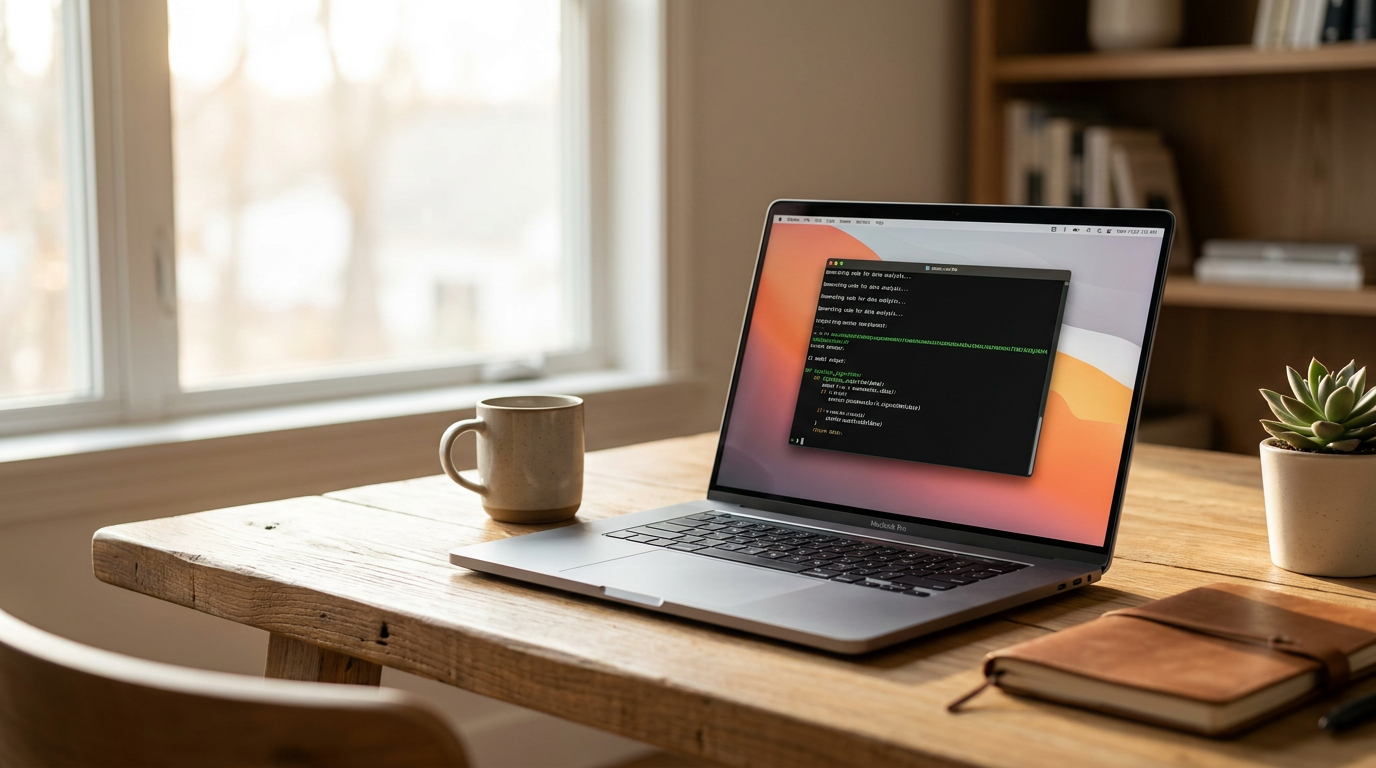
In 2026, a quiet but profound shift is accelerating. Driven by highly optimized "small" language models and powerful consumer hardware, millions of users and enterprises are moving their AI workloads offline. They are running large language models (LLMs) locally—directly on their laptops, desktops, and smartphones, without an internet connection.[1][6]
To understand how local AI works, it helps to separate the training of a model from its execution. Training an AI requires warehouses of graphics processing units and months of computation. But once trained, the model is essentially a compressed file of mathematical weights.[1]

"Inference"—the act of feeding a prompt into that model to generate a response—requires significantly less power. Running a local LLM simply means downloading that file of weights to a personal device and using the machine's own processors to perform the inference calculations.[1][8]
The primary catalyst for this shift is data sovereignty. When an AI model runs locally, zero data leaves the machine. There are no API calls to external servers, and no third-party privacy policies to trust.[2][8]
For enterprises, this solves a massive compliance headache. Medical professionals handling protected patient records, lawyers reviewing confidential case files, and developers writing proprietary code can now use AI assistance without violating data protection laws.[2][8]
A recent industry analysis noted that the average enterprise data breach costs upwards of $4.4 million, making the "privacy-by-design" architecture of local LLMs a corporate necessity rather than a hobbyist pursuit.[2]

Everyday consumers are also recognizing the benefits. Local models allow users to summarize personal financial documents, draft sensitive emails, or maintain private journals with an AI assistant, knowing the data remains entirely on their hard drive.[7][8]
This software revolution is entirely dependent on a parallel hardware revolution. Historically, running AI locally required expensive, dedicated graphics cards that consumed massive amounts of electricity and generated significant heat.[1][4]
This software revolution is entirely dependent on a parallel hardware revolution.
The landscape changed with the widespread adoption of Neural Processing Units (NPUs) and unified memory architectures, pioneered by Apple Silicon and now standard in modern Intel and Qualcomm processors.[4][5]
Apple's M-series and A-series chips, for instance, feature unified memory that allows the central processor, graphics processor, and NPU to share the exact same pool of RAM. This eliminates the bottleneck of moving massive AI model files between different components, allowing consumer laptops to run complex models at interactive speeds while sipping battery power.[4]

Apple has leaned heavily into this architecture with its intelligence features, processing the vast majority of user requests—like proofreading, photo editing, and notification summaries—entirely on-device to guarantee privacy.[5]
The software ecosystem has also matured dramatically. Just a couple of years ago, running a local model required navigating complex command-line interfaces and managing fragile programming environments. Today, specialized deployment tools have made the process as simple as installing a standard desktop application.[3][8]
Ollama operates much like a container system for AI, allowing developers to pull open-source models with a single command and run them efficiently in the background of their operating system.[3]
For non-programmers, applications like LM Studio provide a clean graphical interface. Users can browse a catalog of models, click download, and immediately start chatting in a familiar window—all powered exclusively by their local hardware.[8]

There are, of course, limitations to the local approach. A model running on a standard laptop with 16 gigabytes of RAM cannot match the sheer reasoning power or vast knowledge base of a trillion-parameter cloud model running in a data center.[1][7]
The size of the model a user can run is strictly limited by their device's memory. However, developers have found that for the vast majority of daily tasks—summarizing text, formatting data, or answering straightforward coding questions—smaller, specialized local models are more than capable.[1][8]
The future of AI deployment appears to be hybrid. Users will rely on fast, private, and free local models for their daily workflows, only reaching out to expensive cloud APIs when they encounter a problem requiring massive computational reasoning.[5][6]

How we got here
Late 2022
Cloud-based LLMs like ChatGPT launch, requiring massive data centers for inference.
Early 2023
Open-source models like Llama are released, sparking interest in running AI outside of proprietary clouds.
Mid 2024
Tools like Ollama and LM Studio launch, replacing complex command-line setups with simple, app-like interfaces.
Late 2024
Apple and Intel heavily market 'AI PCs' featuring dedicated Neural Processing Units (NPUs).
2026
Local inference becomes a standard enterprise practice for handling sensitive data and offline workflows.
Viewpoints in depth
Privacy & Compliance Officers
Prioritizing data sovereignty and regulatory adherence.
For enterprise compliance teams, local LLMs are a silver bullet. Sending proprietary code or patient health information (PHI) to a cloud provider introduces massive third-party risk and often violates GDPR or HIPAA regulations. By running models on air-gapped or locally secured hardware, organizations eliminate the risk of data transit interception and ensure that sensitive information never trains a public model.
Open-Source Developers
Championing accessible, decentralized AI tooling.
The open-source community views local AI as a democratization of technology. Rather than paying metered API costs to a handful of tech giants, developers can use tools like Ollama to pull models directly to their machines. This camp emphasizes the freedom to tinker, fine-tune models for specific niche tasks, and build resilient applications that function perfectly without an internet connection.
Cloud-First Proponents
Maintaining that frontier capabilities require data centers.
Despite the rise of local models, cloud AI advocates point out the hard limits of consumer hardware. A laptop with 16GB of RAM simply cannot load a trillion-parameter model capable of complex, multi-step reasoning or advanced mathematical problem-solving. This camp argues that while local AI is great for drafting emails, the true frontier of artificial general intelligence (AGI) will always reside in the cloud.
What we don't know
- How quickly consumer hardware memory will scale to support larger, more capable models.
- Whether cloud providers will lower API costs aggressively to compete with free local alternatives.
- The long-term impact of constant local AI inference on laptop battery degradation.
Key terms
- Inference
- The process where a trained AI model takes a user's prompt and calculates the generated response.
- Model Weights
- The core mathematical file of an AI model that contains everything it learned during its training phase.
- NPU (Neural Processing Unit)
- A specialized hardware chip designed specifically to handle the complex math required by AI models efficiently.
- Unified Memory
- A hardware architecture where the CPU, GPU, and NPU share the same pool of RAM, drastically speeding up AI performance.
- Quantization
- A compression technique that shrinks the file size of an AI model so it can fit into the limited memory of a consumer laptop.
Frequently asked
Do I need an internet connection to use a local LLM?
No. Once the model weights and the inference software (like Ollama or LM Studio) are downloaded to your device, the AI runs entirely offline.
Is running AI locally free?
Yes. After the initial purchase of your hardware, there are no subscription fees or per-prompt API costs. You only pay for the electricity your computer uses.
Can my current laptop run a local AI model?
It depends on your RAM. Most modern small models require at least 8GB to 16GB of unified memory or GPU VRAM to run smoothly.
Are local models as smart as ChatGPT?
Not quite. Local models are smaller and optimized for speed and efficiency. They are excellent for writing, summarizing, and basic coding, but may struggle with highly complex reasoning tasks compared to massive cloud models.
Sources
Source coverage
8 outlets
3 viewpoints surfaced







[1]Sapient ProOpen-Source Developers
Running an LLM Locally: Benefits, Use Cases, and Step-by-Step Setup
Read on Sapient Pro →[2]Digital AppliedPrivacy & Security Advocates
Local LLM Deployment: Privacy-First AI Complete Guide
Read on Digital Applied →[3]CohorteOpen-Source Developers
Run LLMs Locally with Ollama: 2026 Production Guide
Read on Cohorte →[4]CompugenPrivacy & Security Advocates
How Apple's Neural Engine Offers a Competitive Edge for AI Workloads
Read on Compugen →[5]SMBtechHybrid & Ecosystem Analysts
Apple Intelligence Brings AI Capabilities To Everyday Apps
Read on SMBtech →[6]Factlen Editorial TeamHybrid & Ecosystem Analysts
Synthesis by Factlen editorial team
Read on Factlen Editorial Team →[7]ApX Machine LearningOpen-Source Developers
Benefits of Running LLMs Locally
Read on ApX Machine Learning →[8]Find SkillPrivacy & Security Advocates
Local AI & Privacy: Ollama, LM Studio + Private RAG
Read on Find Skill →

Every angle. Every day.
Get ai stories with full source coverage and perspective breakdowns delivered to your inbox.