
OLED vs. Mini-LED: The 2026 Display Technology Comparison
As display technologies reach new heights in 2026, choosing between OLED's perfect contrast and Mini-LED's massive brightness requires matching the panel to your room and habits.
By Factlen Editorial Team
- Cinematic Purists
- Viewers who prioritize perfect black levels and infinite contrast for dark-room movie watching.
- Bright-Room Viewers
- Consumers who need a display capable of overpowering ambient daylight and glare.
- Productivity Power Users
- Professionals and PC users who require static image durability and crisp text clarity.
What's not represented
- · Budget Consumers
- · Environmental Regulators
Why this matters
Premium televisions and monitors are significant investments that dictate your daily entertainment and productivity experience. Understanding the fundamental trade-offs between these two leading technologies ensures you don't spend thousands of dollars on a display that fights against your room's lighting or your viewing habits.
Key points
- OLED panels are self-emissive, offering perfect blacks and infinite contrast ideal for dark rooms.
- Mini-LED displays use thousands of backlight zones, delivering massive brightness that easily overpowers sunlit rooms.
- OLED carries a slight risk of burn-in from static images, while Mini-LED is completely immune to permanent image retention.
- Mini-LEDs can suffer from blooming, where light bleeds around bright objects on dark backgrounds.
- 2026 advancements like Tandem OLED and denser dimming zones are narrowing the performance gap between the two technologies.
- Mini-LED remains the most cost-effective option for ultra-large screens exceeding 85 inches.
The 2026 display market presents consumers with a high-stakes dilemma. As television and monitor technologies reach unprecedented levels of fidelity, the choice is no longer simply about spending more money for a better picture. Instead, buyers must choose between two fundamentally different architectures: OLED and Mini-LED. Each technology represents a distinct set of engineering trade-offs, and selecting the right panel requires carefully matching its specific strengths to the ambient lighting conditions of the room and the daily viewing habits of the user.[1]
The core difference between the two lies in how they generate light. OLED, or Organic Light-Emitting Diode, is a self-emissive technology. This means that every single pixel on the screen produces its own light and color independently. In a standard 4K display, that equates to over eight million individual light sources. Mini-LED, by contrast, is an evolution of traditional LCD technology. It relies on a liquid crystal layer to create the image, which is then illuminated from behind by an array of thousands of microscopic LED lights grouped into localized dimming zones.[2][4]
The primary argument for OLED centers on its absolute mastery of contrast and black levels. Because an OLED panel can completely turn off individual pixels, it achieves what engineers call an infinite contrast ratio. When a scene calls for pitch black, the screen emits zero light in that exact area, creating a level of depth and three-dimensionality that transmissive displays struggle to match. This physical capability ensures that shadows remain perfectly dark without washing out the surrounding colors, providing a remarkably lifelike image.[3][5]
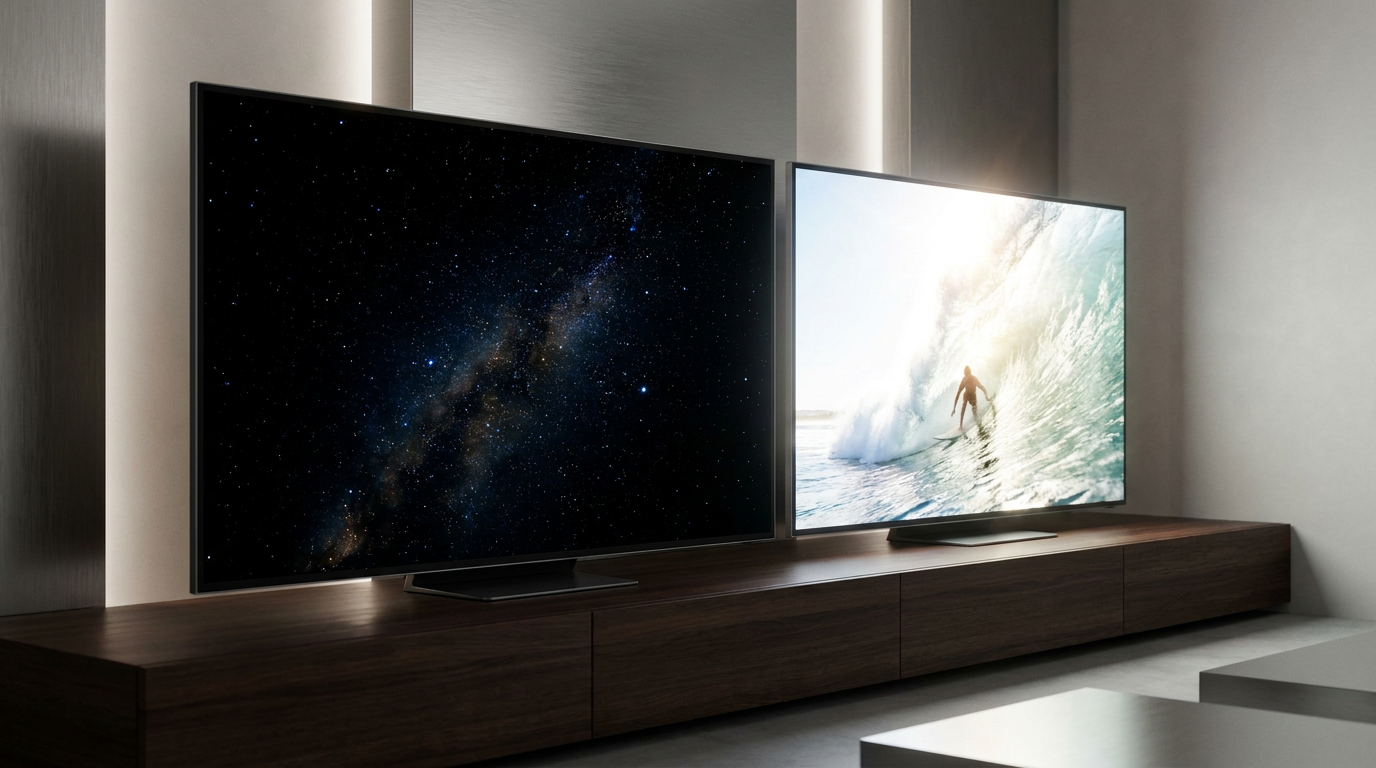
The evidence for OLED's contrast dominance is most visible in dark-room viewing. Independent testing consistently shows that OLEDs display perfect black uniformity without any light bleeding into adjacent dark areas. If you are watching a science fiction movie with bright stars against the vacuum of space, each star is pinpoint sharp, with the surrounding space remaining perfectly inky. This pixel-level precision makes OLED the undisputed champion for dedicated home theaters and cinematic purists who demand the highest level of visual fidelity.[2][8]

However, the case against OLED revolves around brightness limitations and power management. Because the organic compounds in OLED panels generate heat and consume significant power when driven hard, manufacturers implement an Auto Brightness Limiter (ABL). When a large portion of the screen becomes bright white—such as a snowy landscape in a nature documentary or a maximized web browser on a PC—the display automatically dims the entire image to protect the panel and manage power consumption, which can be distracting.[3][7]
Furthermore, the evidence against OLED includes the lingering risk of permanent image retention, commonly known as burn-in. While 2026 models feature advanced pixel-shifting and thermal management algorithms that drastically reduce this risk, the organic materials still degrade over time. Leaving static elements on the screen for thousands of hours—such as a rolling news channel ticker, a video game heads-up display, or a computer taskbar—can eventually leave a permanent ghost image etched into the panel, causing anxiety for heavy users.[4][7]
Conversely, the argument for Mini-LED is built entirely on raw, unadulterated brightness and long-term durability. By utilizing an inorganic LED backlight, these displays can be driven incredibly hard without any risk of organic degradation or burn-in. This makes them practically invincible to static content, offering total peace of mind for users who leave their screens on all day, watch static broadcasts, or use them as primary computer monitors for demanding professional workflows where static interfaces are unavoidable.[4][8]
Conversely, the argument for Mini-LED is built entirely on raw, unadulterated brightness and long-term durability.
The evidence for Mini-LED's brightness advantage is easily quantified and immediately noticeable. Premium 2026 Mini-LED televisions routinely hit peak HDR brightness levels between 2,000 and 2,500 nits, while easily sustaining over 1,000 nits across the entire screen. In a sun-drenched living room with open blinds, a Mini-LED panel easily cuts through the harsh daylight glare, delivering vibrant, punchy colors and striking highlights that would cause an OLED screen to look washed out and dim by comparison.[3][6]

The case against Mini-LED focuses on its inability to control light at the pixel level, resulting in visual artifacts known as blooming or haloing. Even the most advanced 2026 Mini-LED displays only have a few thousand dimming zones to illuminate over eight million pixels. When a bright object moves across a dark background, the backlight zone illuminating that object is much larger than the object itself, causing a visible glow to spill over into the surrounding dark areas of the screen.[3][6]
The evidence of this limitation is most apparent when viewing off-angle or watching content with bright white subtitles in a pitch-dark room. While manufacturers have vastly improved their local dimming algorithms to suppress this bloom, it remains an inherent physical limitation of the transmissive technology. For viewers who are highly sensitive to backlight bleed, this halo effect can break the immersion of a dark, moody scene, reminding them that they are looking at an illuminated panel rather than a window into reality.[2][6]
The 2026 market has seen both technologies attempt to bridge their respective gaps. The introduction of Tandem OLED—which stacks multiple light-emitting layers—has significantly boosted OLED brightness and longevity, narrowing the gap with Mini-LED in moderately lit rooms. Meanwhile, Mini-LED manufacturers are packing ever-denser arrays of microscopic lights into their panels, refining the complex algorithms that control them to minimize blooming to near-imperceptible levels for the average viewer sitting directly in front of the screen, making the choice harder than ever.[6]
For gamers, the trade-offs require careful consideration of their specific play styles. OLED panels offer near-instantaneous pixel response times, resulting in zero motion blur during fast-paced action, which competitive players highly prize. However, gamers who play the exact same title for thousands of hours must weigh that pristine motion clarity against the burn-in risk of static health bars and minimaps. Mini-LED offers a worry-free alternative with massive HDR punch, though with slightly slower pixel transitions that eagle-eyed players might notice.[3][7]
In the realm of productivity and PC monitors, the calculus shifts heavily toward durability. The workflow friction of OLED—specifically the aggressive dimming of white backgrounds and the subtle color fringing on text caused by non-standard subpixel layouts—can be grating during an eight-hour workday. Mini-LED monitors provide superior workspace density, crisp text rendering, and sustained full-screen brightness, making them the preferred endgame for many professionals who need a reliable, bright canvas for their daily tasks without constantly worrying about hiding their taskbar.[4][7]
Finally, sizing and economics play a crucial role in the final purchasing decision. Manufacturing flawless OLED panels at massive scales remains prohibitively expensive for most consumers. If a buyer is looking to fill a massive wall with an 85-inch, 98-inch, or even 115-inch display, Mini-LED offers tremendous value and scale that OLED simply cannot match without venturing into astronomical, luxury-tier price brackets that are entirely out of reach for the general public.[5][6]

Ultimately, an OLED display fits well when placed in a light-controlled room, utilized primarily for cinematic movie watching, prestige television, and varied gaming. It delivers an unmatched sense of depth and pixel-perfect precision that videophiles crave. It does not fit well when placed in a bright, sunlit room, or when used as a permanent display for static news channels and heavy desktop productivity, where its automatic brightness limiters and inherent burn-in risks become genuine, daily liabilities that detract from the experience.[1][5]
Conversely, a Mini-LED display fits well when serving as the centerpiece of a bright, active living room, handling daytime sports, mixed family viewing, and worry-free PC usage. Its sheer luminance and inorganic durability make it a versatile, stress-free powerhouse. It does not fit well when scrutinized in a pitch-black home theater by videophiles who demand absolute black levels, as the inevitable blooming around bright highlights will always reveal the presence of the backlight behind the liquid crystal layer, breaking the cinematic illusion.[1][8]
How we got here
2007
Sony introduces the XEL-1, the world's first consumer OLED television, featuring an 11-inch screen.
2013
LG launches the first large-format 55-inch OLED TVs, establishing dominance in the premium dark-room market.
2019
Apple introduces the Pro Display XDR, popularizing advanced full-array local dimming that would evolve into Mini-LED.
2021
Mini-LED technology hits the mainstream consumer TV market, offering a high-brightness alternative to OLED.
2024
QD-OLED and Micro Lens Array (MLA) technologies push OLED brightness past the 1,000-nit barrier.
2026
Tandem OLED architectures and advanced Mini-LED algorithms bring both technologies closer together in performance than ever before.
Viewpoints in depth
Cinematic Purists
Viewers who prioritize perfect black levels and infinite contrast for dark-room movie watching.
This camp argues that absolute black is the foundation of picture quality. Because OLED pixels emit their own light and can turn off completely, they create a sense of depth and three-dimensionality that transmissive displays cannot replicate. For these viewers, the occasional lack of peak brightness is a worthwhile trade-off to avoid the haloing and blooming artifacts that plague backlit televisions during dark, moody scenes.
Bright-Room Viewers
Consumers who need a display capable of overpowering ambient daylight and glare.
This perspective values raw luminance and sustained full-screen brightness above all else. In a living room with large windows or open blinds, the perfect blacks of an OLED are rendered moot by reflections and washed-out colors. Bright-room viewers argue that Mini-LED's ability to push 2,000+ nits of peak brightness delivers a far more impactful and usable HDR experience for daytime sports and casual family viewing.
Productivity Power Users
Professionals and PC users who require static image durability and crisp text clarity.
For those using large displays as computer monitors, burn-in anxiety and Auto Brightness Limiters (ABL) are dealbreakers. This camp points out that OLED's tendency to aggressively dim large white windows—like word processors or web browsers—causes severe workflow friction. Furthermore, they favor Mini-LED for its standard subpixel layouts, which render text more sharply than many OLED panels, and its total immunity to permanent image retention from static taskbars.
What we don't know
- How long the new Tandem OLED structures will actually last in real-world, heavy-use scenarios compared to traditional single-layer OLEDs.
- Whether Micro-LED—a technology combining OLED's perfect blacks with Mini-LED's brightness—will ever become affordable enough to replace both.
- Exactly how much manufacturers will continue to invest in traditional OLED R&D as they shift focus toward cheaper, brighter Mini-LED production lines.
Key terms
- Self-emissive
- A display technology where each individual pixel generates its own light, eliminating the need for a separate backlight.
- Local Dimming
- A feature in LED/LCD TVs that dims the backlight behind dark areas of the screen to improve contrast and black levels.
- Nits
- A unit of measurement for luminance, used to describe how bright a display can get.
- Auto Brightness Limiter (ABL)
- A protective mechanism in OLED displays that automatically dims the screen when a large portion of the image is bright white, preventing overheating and excessive power draw.
- Burn-in
- Permanent image retention caused by uneven degradation of organic pixels, usually resulting from leaving static elements on the screen for extended periods.
- Tandem OLED
- A newer manufacturing technique that stacks multiple light-emitting layers to increase the overall brightness and lifespan of an OLED panel.
Frequently asked
Does Mini-LED suffer from burn-in?
No. Because Mini-LED relies on an inorganic backlight rather than organic compounds, it is immune to the permanent image retention that can affect OLED screens.
Is OLED bright enough for a living room?
Yes, modern OLEDs are bright enough for moderately lit rooms, especially 2026 models featuring Tandem OLED technology. However, they will still struggle with glare in heavily sun-drenched spaces compared to Mini-LEDs.
What is blooming or haloing?
Blooming is a visual artifact on Mini-LED displays where the backlight bleeds into dark areas surrounding a bright object, creating a faint glow. It is most noticeable around subtitles or stars in dark movie scenes.
Which is better for PC gaming?
It depends on your habits. OLED offers superior motion clarity and near-instant response times, but Mini-LED is safer if you play games with static HUDs for thousands of hours or use the screen for daily desktop work.
Sources
Source coverage
8 outlets
3 viewpoints surfaced








[1]Factlen Editorial TeamCinematic Purists
Synthesis by Factlen editorial team
Read on Factlen Editorial Team →[2]RTINGSCinematic Purists
OLED vs Mini LED TV Comparison
Read on RTINGS →[3]EcoPicksGoCinematic Purists
LG G5 OLED vs LG QNED9M Mini LED Comparison (2026 Buyer's Guide)
Read on EcoPicksGo →[4]Panox DisplayProductivity Power Users
Micro OLED vs Mini LED: Which Display Technology Actually Wins?
Read on Panox Display →[5]Jeff RauseoBright-Room Viewers
OLED vs. Mini-LED vs. QLED: What's the Best TV for You?
Read on Jeff Rauseo →[6]Data Wire SolutionsBright-Room Viewers
Best TVs for 2026: 10 OLED and Mini-LED Picks
Read on Data Wire Solutions →[7]KTC PlayProductivity Power Users
5K Mini-LED: Choosing Your 2026 Endgame
Read on KTC Play →[8]100% AppliancesBright-Room Viewers
OLED vs Mini LED: Key Differences
Read on 100% Appliances →

More in shopping
See all 7 stories →Right To Repair
The DIY Smartphone Revolution: How Right-to-Repair is Changing the Phones We Buy
0 sources
E-Bike Tech
The 2026 E-Bike Buying Guide: Decoding Classes, Batteries, and Motor Torque
0 sources

Powertrain Choice
Comparing the True Costs and Lifestyle Fit of EVs and Plug-in Hybrids in 2026
0 sources

Used EV Market
The 2026 Guide to Buying a Used EV: Battery Health, Adapters, and Finding the Best Value
0 sources

Every angle. Every day.
Get shopping stories with full source coverage and perspective breakdowns delivered to your inbox.