
Laser Phase Plate Breakthrough Illuminates the Invisible 90% of the Human Proteome
A revolutionary optical device using a 75-kilowatt laser has shattered the resolution limits of electron microscopy. The breakthrough allows scientists to clearly image the small proteins that make up the vast majority of human biology, accelerating the future of drug discovery.
By Factlen Editorial Team
- Structural Biologists
- For biologists, the breakthrough unlocks the vast majority of the human proteome.
- Microscopy Engineers
- Engineers view the device as a triumph over decades of physical limitations.
- Pharmaceutical Innovators
- The medical industry sees a powerful new engine for drug discovery.
What's not represented
- · Computational biologists relying on AI predictions like AlphaFold
- · Venture capitalists funding biotech infrastructure
Why this matters
Proteins are the microscopic machines that drive every process in the human body, but 90% of them have been too small to clearly photograph. By using a powerful laser to bring these invisible molecules into focus, scientists have unlocked a new era of biology that will dramatically accelerate the discovery of new life-saving drugs.
Key points
- A new laser phase plate allows cryo-electron microscopes to clearly image proteins smaller than 70 kilodaltons.
- Previously, 90% of the human proteome was too small to be effectively studied using standard cryo-EM techniques.
- The device uses a 75-kilowatt continuous-wave laser to shift the phase of the electron beam without physical degradation.
- The breakthrough is expected to accelerate pharmaceutical drug discovery by revealing the exact structures of small protein targets.
The microscopic machinery of life operates on a scale so vanishingly small that it has historically remained entirely invisible to human eyes. Proteins are the fundamental gears and motors of biology, driving everything from the digestion of food to the firing of neurons and the replication of DNA. In 2017, the scientific community celebrated a monumental breakthrough when the Nobel Prize in Chemistry was awarded for the development of cryo-electron microscopy (cryo-EM). This revolutionary technique allowed researchers to flash-freeze biological samples and bombard them with electrons, capturing the atomic structure of these molecular machines mid-motion. It was heralded as the dawn of a new era in structural biology, promising to reveal the inner workings of the cell with unprecedented clarity. However, despite its transformative impact, cryo-EM has harbored a glaring and frustrating blind spot that has kept the vast majority of human biology hidden in the dark.[1][5]
That blind spot is fundamentally a problem of size and contrast. Cryo-EM works by firing a beam of high-energy electrons at a biological sample that has been vitrified—frozen so rapidly that the water molecules do not have time to form ice crystals. As the electrons pass through the sample, they are scattered by the atoms in the proteins, creating a faint shadow or projection that is captured by a detector. The challenge is that biological molecules are composed primarily of light elements like carbon, nitrogen, and oxygen, which do not scatter electrons very strongly. For massive protein complexes, the cumulative scattering is sufficient to generate a clear image. But for smaller proteins, the signal is incredibly weak. The faint shadows cast by these tiny molecules are easily overwhelmed by the background noise of the surrounding vitrified ice, rendering them effectively invisible to even the most advanced detectors.[2][6]
This limitation is not merely a niche technical issue; it represents a massive barrier to our understanding of human health. Proteins that fall below 70 kilodaltons in mass are generally considered the practical lower limit for standard cryo-electron microscopy. The staggering reality is that roughly 90 percent of the entire human proteome—the complete set of proteins expressed by our bodies—falls below this 70-kilodalton threshold. For decades, structural biologists have been effectively locked out of seeing the vast majority of the molecules that drive human physiology and disease. Researchers have been forced to rely on arduous biochemical workarounds, such as artificially binding small target proteins to larger scaffold molecules just to add enough bulk to make them visible under the electron beam. These workarounds are time-consuming, frequently alter the natural behavior of the protein, and often fail entirely.[2][3]

Now, a multi-institutional team of physicists, engineers, and structural biologists has successfully shattered that long-standing barrier. Researchers from the University of California, Berkeley, the Lawrence Berkeley National Laboratory, and the Chan Zuckerberg Biohub have collaborated to develop and demonstrate a revolutionary new device known as a laser phase plate. By integrating this highly complex optical instrument into a state-of-the-art electron microscope, the team has achieved what was once thought physically impossible: they have dramatically boosted the contrast of the electron beam without introducing any physical material that could degrade the image. This breakthrough effectively removes the size limit that has hobbled structural biology, illuminating the previously invisible 90 percent of the proteome and opening an entirely new frontier in biological imaging.[2][3]
Writing in the journal Science, with their findings subsequently highlighted by Nature, the research team detailed the successful operation of the laser phase plate on a range of challenging biological samples. The device relies on an incredibly intense, tightly focused continuous-wave laser beam to bend the electron beam as it passes through the microscope. Because light has no mass, it can interact with the electrons via a phenomenon known as the ponderomotive force, shifting their phase without physically touching them or absorbing any of the beam's energy. This frictionless interaction solves the fundamental degradation problems that have plagued previous attempts to build phase plates for electron microscopes, providing a stable, tunable, and highly reliable method for enhancing image contrast to unprecedented levels.[1][6]
To fully appreciate the magnitude of this engineering achievement, one must look back nearly a century to the history of optical microscopy. In the early 1930s, the Dutch physicist Frits Zernike realized that biological cells are mostly transparent to visible light, making them incredibly difficult to study under a standard microscope without using toxic chemical stains that kill the cell. Zernike's stroke of genius was the invention of the phase contrast microscope. He inserted a specially shaped glass plate into the optical path, which shifted the phase of the light waves passing through it. When these shifted waves recombined with the unshifted light, they created interference patterns that turned invisible, transparent cellular structures into high-contrast, easily observable images.[3][7]
Zernike's invention revolutionized biology, earning him the Nobel Prize in Physics in 1953 and becoming a standard feature in high school and university biology laboratories worldwide. Ever since the invention of the electron microscope, engineers have desperately tried to build an equivalent phase plate for electron beams. The theoretical benefits were obvious: a working phase plate would instantly solve the contrast problems inherent in imaging biological samples. However, electrons are fundamentally different from photons of light. They carry an electrical charge and possess significant mass and energy. When engineers tried to insert physical phase plates—typically made of ultra-thin carbon films—into the path of an electron beam, the results were consistently disastrous.[2]
Physical phase plates, such as the widely tested Volta phase plate, suffer from rapid and unavoidable degradation. As the high-energy electron beam strikes the carbon film, it causes the material to accumulate a localized electrical charge. This charging effect unpredictably distorts the electron beam, introducing severe optical aberrations and ruining the resulting images. Furthermore, the intense bombardment physically burns and destroys the carbon film over time, requiring constant replacement and realignment. This instability made physical phase plates entirely unsuitable for the highly automated, multi-day data collection runs required in modern cryo-electron microscopy, where microscopes must autonomously capture tens of thousands of perfect images to reconstruct a single protein structure.[2][7]
Physical phase plates, such as the widely tested Volta phase plate, suffer from rapid and unavoidable degradation.
The solution to this intractable physical problem was first proposed over a decade ago, but it was widely dismissed as science fiction due to the extreme engineering challenges involved. The theoretical concept was elegant: instead of using a physical piece of matter to shift the phase of the electrons, use a concentrated beam of light. A sufficiently intense laser field could theoretically create a localized electromagnetic potential that would retard the phase of the passing electrons by exactly 90 degrees. Because the laser is composed entirely of photons, there would be no physical material to accumulate an electrical charge, and nothing for the electron beam to burn or destroy. The phase plate would be completely invisible and indestructible.[4][7]
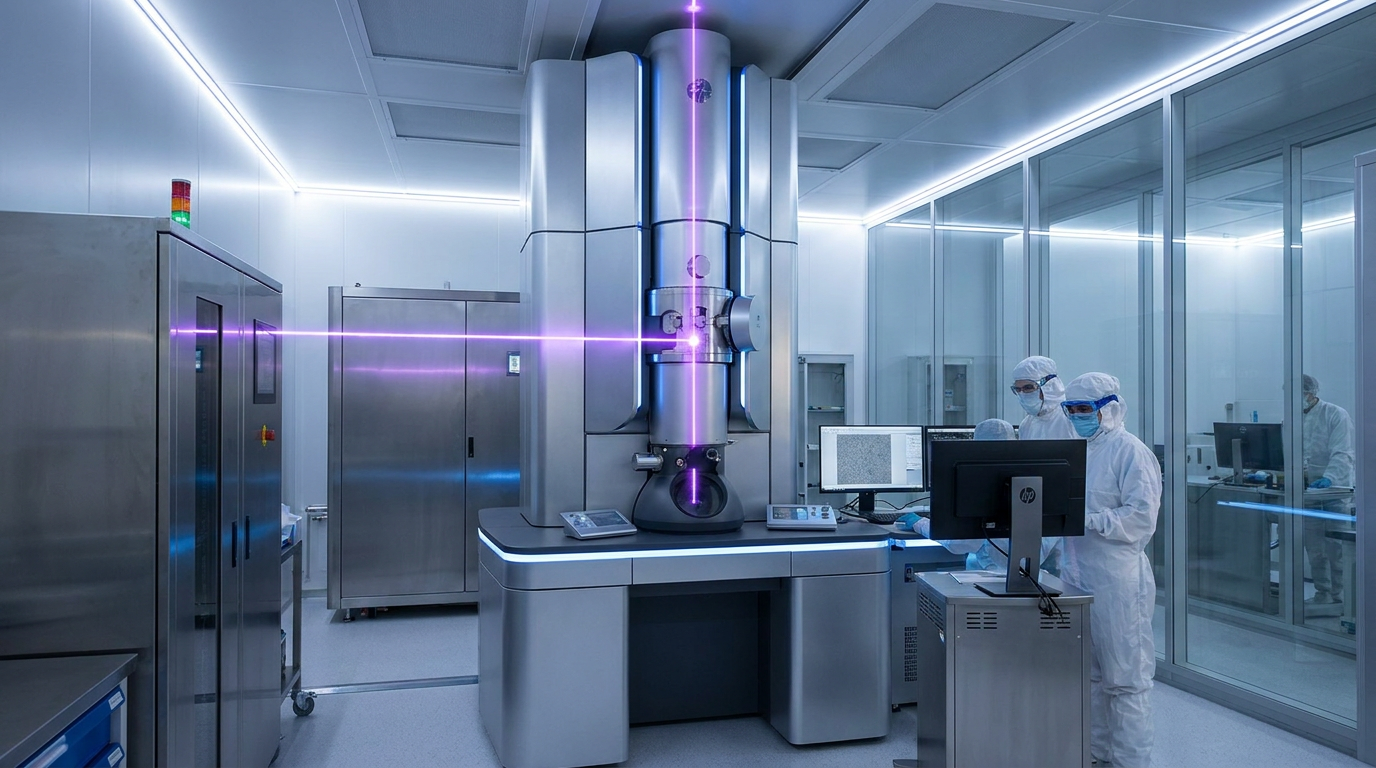
Turning that elegant theory into a working instrument required an optical engineering marvel of the highest order. The research team had to construct a highly customized Fabry-Pérot mirrored cavity and install it directly inside the ultra-high vacuum chamber of a commercial Thermo Fisher Krios cryo-electron microscope. A continuous-wave laser is injected into this microscopic cavity, where it bounces back and forth between two precisely aligned concave mirrors nearly 10,000 times. This continuous reflection allows the light to build up to a staggering localized intensity of 75 kilowatts, concentrated into a focal spot just a few microns wide.[3][4]

The energy density achieved inside this microscopic optical cavity is difficult to overstate. The concentrated laser light reaches an intensity millions of times brighter than the surface of the sun. To prevent the laser from instantly melting the surrounding equipment, the mirrors themselves had to be manufactured to an astonishing degree of precision. Each mirror is polished to atomic-level smoothness, boasting a surface roughness of less than one angstrom—roughly the diameter of a single hydrogen atom. Any microscopic imperfection on the mirror's surface would cause the laser light to scatter and rapidly heat the cavity, destroying the delicate alignment required to maintain the standing wave of light.[2]
When the electron beam passes through this microscopic inferno of concentrated light, its phase is shifted by exactly 90 degrees, perfectly replicating the effect of Zernike's glass plate but without any of the physical drawbacks. The result is a massive and immediate boost in image contrast. This enhancement is particularly pronounced for the low-frequency spatial signals that define the overall shape and outline of small proteins. In conventional cryo-EM, these low-frequency signals are often intentionally suppressed to achieve higher resolution on smaller details, a compromise that makes small proteins incredibly difficult to detect against the background noise. The laser phase plate eliminates the need for this compromise, delivering both high contrast and high resolution simultaneously.[2][3]
To prove the efficacy of their new instrument, the research team targeted hemoglobin, the vital protein responsible for carrying oxygen in human red blood cells. At a mass of just 64 kilodaltons, hemoglobin sits at the very edge of what conventional cryo-electron microscopy can resolve. Imaging it typically requires massive datasets, perfectly optimized ice thickness, and pristine sample preparation. With the laser phase plate engaged, the contrast of the hemoglobin molecules leaped dramatically. The researchers were able to easily identify the individual proteins in the raw images and reconstruct high-resolution 3D models with far fewer images than traditionally required, definitively proving the technology's power and robustness.[4][7]
The implications of this enhanced imaging capability extend far beyond the realm of basic biological research; they represent a seismic shift for the pharmaceutical industry and the future of medicine. The vast majority of therapeutic drugs on the market today work by binding to specific small proteins in the body, either inhibiting or enhancing their function. When a target protein is too small to be imaged by conventional cryo-EM, designing a drug to interact with it is largely a process of trial and error—akin to trying to cut a key for a lock you cannot see. By bringing these elusive small proteins into sharp focus, the laser phase plate provides pharmaceutical researchers with the exact structural blueprints they need.[2][3]

With clear, high-resolution images of small protein targets, scientists can use computer-aided design to engineer chemical compounds that perfectly fit into the protein's active binding pockets. This structure-based drug design approach dramatically reduces the time and cost associated with developing new therapeutics, while simultaneously increasing the likelihood of clinical success. The ability to routinely image proteins below the 70-kilodalton threshold is expected to unlock entirely new classes of drug targets that were previously considered undruggable simply because their structures could not be accurately mapped. This could lead to rapid breakthroughs in treatments for a wide variety of challenging conditions, from neurodegenerative diseases to rare genetic disorders.[2][3]
Beyond the analysis of isolated, purified proteins, the laser phase plate is poised to revolutionize an emerging and highly complex field known as cryo-electron tomography (cryo-ET). While standard cryo-EM looks at purified proteins frozen in a thin layer of ice, cryo-ET aims to take 3D snapshots of intact, fully functioning cells. By tilting the cellular sample and taking pictures from multiple angles, computers can reconstruct a three-dimensional tomogram of the cell's interior. This allows scientists to observe proteins operating in their natural, crowded cellular environment, interacting with other molecules exactly as they do in a living organism.[1][5]
However, cryo-ET suffers from even worse contrast problems than standard cryo-EM. Because the electron beam must pass through the entire thickness of a cell, the resulting images are incredibly noisy and cluttered. Finding a specific small protein inside a cellular tomogram without phase contrast has been compared to finding a specific leaf in a dense, fog-filled forest. The laser phase plate acts as a powerful spotlight cutting through that fog. By dramatically boosting the low-frequency contrast, the phase plate brings the entire cellular landscape into sharp relief, allowing researchers to clearly distinguish individual proteins, membranes, and organelles within the chaotic interior of the cell.[1][2]

While the current laser phase plate is a custom-built, highly specialized prototype operating in a handful of advanced laboratories, the race is already underway to commercialize the technology and make it widely available to research institutions around the world. As the engineering becomes more streamlined and the optical cavities become easier to manufacture and align, the laser phase plate is expected to become a standard, indispensable component of all future cryo-electron microscopes. The transition from a bespoke physics experiment to a ubiquitous biological tool will mark a turning point in our ability to explore the microscopic world.[2][5]
Ultimately, the successful deployment of the laser phase plate represents the closing of a technological loop that began with Frits Zernike nearly a century ago. By finally bringing the power of phase contrast to the electron microscope without the destructive side effects of physical materials, physicists have handed biologists the ultimate key to the cell. As researchers begin to turn this new technology toward the 90 percent of the human proteome that has long remained hidden in the dark, we are standing on the precipice of a new golden age of biological discovery, one where the invisible machinery of life is finally brought fully into the light.[1][5]
How we got here
1930s
Frits Zernike invents the phase-contrast light microscope, winning the 1953 Nobel Prize.
2017
The Nobel Prize in Chemistry is awarded for the development of cryo-electron microscopy (cryo-EM).
Early 2010s
Physicists first propose using an intense laser to shift the phase of an electron beam.
June 2026
Researchers successfully demonstrate the laser phase plate in a working cryo-EM, imaging small proteins like hemoglobin.
Viewpoints in depth
Structural Biologists
For biologists, the breakthrough unlocks the vast majority of the human proteome.
Structural biologists have spent the last decade celebrating the 'resolution revolution' brought by cryo-EM, but they have also been quietly frustrated by its limits. Because 90% of human proteins fall below the 70-kilodalton threshold, researchers have had to rely on complex workarounds—like artificially binding small proteins to larger scaffold molecules—just to make them visible. The laser phase plate eliminates the need for these biochemical tricks, allowing scientists to study small proteins in their natural state and opening the door to mapping the entire human proteome at atomic resolution.
Microscopy Engineers
Engineers view the device as a triumph over decades of physical limitations.
For physicists and engineers, the laser phase plate is the culmination of a decades-long quest to replicate Frits Zernike's optical phase plate for electron beams. Previous attempts using physical materials, like carbon films, inevitably failed because the high-energy electron beam would quickly charge or burn the material, ruining the image. By replacing matter with a 75-kilowatt standing wave of light, engineers have created a frictionless phase plate. Achieving this required polishing mirrors to atomic-level smoothness and maintaining perfect optical alignment inside the vacuum of an active electron microscope.
Pharmaceutical Innovators
The medical industry sees a powerful new engine for drug discovery.
Modern drug discovery relies heavily on structure-based design—the process of creating a chemical compound that perfectly fits into a specific pocket on a target protein. When a protein is too small to image, designing a drug for it is like trying to pick a lock in the dark. By bringing these small, elusive proteins into sharp focus, the laser phase plate provides pharmaceutical researchers with the blueprints they need. This is expected to significantly accelerate the development pipeline for new therapeutics, particularly for challenging diseases where the target proteins have historically evaded structural analysis.
What we don't know
- How quickly the custom-built laser phase plate can be miniaturized and commercialized for widespread laboratory use.
- Whether the intense laser field might induce subtle, currently undetected thermal effects on highly sensitive biological samples.
Key terms
- Cryo-electron microscopy (cryo-EM)
- A technique that fires electrons at flash-frozen biological samples to reveal the atomic structure of molecules.
- Phase contrast
- A method of manipulating waves (light or electrons) to make transparent or invisible structures stand out darkly against their background.
- Kilodalton (kDa)
- A unit of mass used by biologists to measure the size of proteins and other large molecules.
- Proteome
- The entire set of proteins expressed by a genome, cell, tissue, or organism at a certain time.
- Cryo-electron tomography (cryo-ET)
- An advanced imaging technique that takes multiple pictures from different angles to build a 3D model of an intact cell.
Frequently asked
Why couldn't scientists see small proteins before?
Small proteins do not scatter enough electrons to create a clear image, causing their faint outlines to get lost in the background noise of the surrounding vitrified ice.
How does the laser phase plate work?
It uses a highly concentrated, 75-kilowatt laser beam to create an invisible lens of light that shifts the phase of the electron beam by 90 degrees, drastically boosting image contrast without physically touching the electrons.
Will this technology help cure diseases?
Yes. By allowing scientists to see the exact shape of small proteins, pharmaceutical companies can more easily design chemical compounds that bind to those specific targets, accelerating drug discovery.
Sources
Source coverage
7 outlets
3 viewpoints surfaced







[1]NatureStructural Biologists
An innovative technology boosts image quality for protein structures
Read on Nature →[2]UC BerkeleyStructural Biologists
Laser phase plate promises clear images of most proteins in the cell
Read on UC Berkeley →[3]Lawrence Berkeley National LaboratoryPharmaceutical Innovators
Laser-based phase plate produces sharp images of molecules
Read on Lawrence Berkeley National Laboratory →[4]arXivMicroscopy Engineers
Design improvements for biological imaging with the laser phase plate
Read on arXiv →[5]Factlen Editorial TeamStructural Biologists
Synthesis by Factlen editorial team
Read on Factlen Editorial Team →[6]ScienceMicroscopy Engineers
A continuous-wave laser phase plate for cryo-electron microscopy
Read on Science →[7]National Institutes of HealthMicroscopy Engineers
Laser phase plate for transmission electron microscopy
Read on National Institutes of Health →

Every angle. Every day.
Get science stories with full source coverage and perspective breakdowns delivered to your inbox.