
Iron vs. Algorithms: How Digital Weight is Rewriting the Science of Strength Training
Smart home gyms are replacing traditional free weights with electromagnetic resistance, unlocking advanced techniques like eccentric overload. Here is how digital weight works and why it is changing exercise science.
By Factlen Editorial Team

- Digital Resistance Advocates
- Argue that algorithmic tension and eccentric overload provide a superior, more efficient stimulus for muscle growth.
- Traditional Free Weight Purists
- Maintain that gravity-based iron builds essential stabilizing muscles and functional real-world strength.
- Variable Resistance Innovators
- Focus on matching the resistance to the human body's natural strength curve.
- Exercise Science Analysts
- Evaluate the biomechanical trade-offs between inertia-free digital tension and traditional mass.
What's not represented
- · Physical Therapists
- · Commercial Gym Owners
Why this matters
The shift from gravity-based iron to algorithmic digital weight is democratizing elite sports science. By automating complex training protocols like eccentric overload and digital spotting, these systems allow anyone to safely maximize muscle growth in a fraction of the time and space required by a traditional gym.
Key points
- Digital weight systems use electromagnetic motors instead of gravity to generate constant, relentless resistance.
- Smart machines eliminate momentum, maximizing the time muscles spend under tension during a workout.
- Automated eccentric overload safely adds weight during the lowering phase of a lift, accelerating muscle growth.
- Built-in sensors act as automatic spotters, instantly removing resistance if a user struggles or fails a repetition.
- While digital gyms offer clinical efficiency, traditional free weights remain superior for developing stabilizing muscles and managing inertia.
For decades, the pursuit of physical strength has been governed by a single, unchanging force: gravity. From the rusted plates of a garage gym to the polished dumbbells of a commercial fitness center, lifting weights has always meant moving physical mass against the earth's pull. But a quiet revolution is rewriting the physics of resistance training.[1]
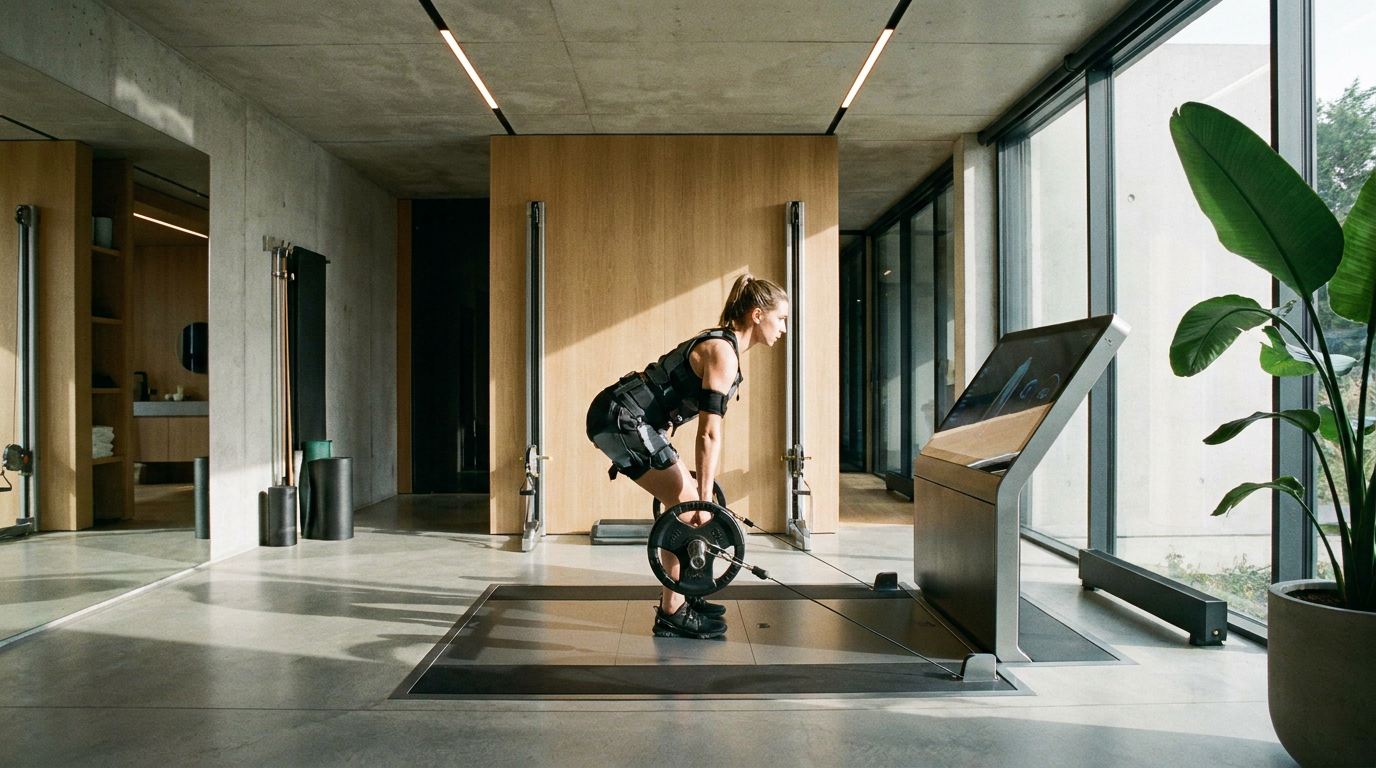
Welcome to the era of "digital weight." Driven by advancements in electromagnetic motors and algorithmic control, a new generation of smart exercise equipment is replacing cold iron with code. Devices like Tonal, Vitruvian, and Speediance are no longer just counting repetitions; they are actively manipulating the resistance you feel in real-time.[1][6]
To understand why this matters, one must look at the mechanical limitations of traditional free weights. A 50-pound dumbbell weighs exactly 50 pounds at the bottom of a bicep curl, in the middle, and at the top. However, human biomechanics do not work that way. Because of leverage and joint angles, your muscles are significantly stronger in certain phases of a movement than in others.[4][5]
Furthermore, physical weights possess inertia. When you explosively push a barbell off your chest during a bench press, the momentum carries the weight upward, momentarily decreasing the actual tension on your pectoral muscles. You get a micro-rest at the top of the movement.[4][7]

Digital resistance eliminates this inertia completely. Instead of relying on gravity, smart cable machines use high-torque electric motors and electromagnets to generate tension. If a digital machine is set to 50 pounds, it delivers exactly 50 pounds of relentless, constant force throughout the entire range of motion.[4][7]
"Training on a virtual weight machine is a trip," notes fitness hardware reviewer Goimu. "Unlike iron, which gets easier as you gain momentum, electromagnetic resistance is relentless. There is no 'cheating' the movement with physics." This constant tension maximizes the time muscles spend under load, a critical driver for hypertrophy, or muscle growth.[4][7]
But the true superpower of digital weight lies in its ability to adapt mid-repetition, unlocking a highly effective training protocol known as eccentric overload. In exercise science, the concentric phase is when the muscle shortens (lifting the weight), and the eccentric phase is when it lengthens (lowering the weight).[1][2][3]
But the true superpower of digital weight lies in its ability to adapt mid-repetition, unlocking a highly effective training protocol known as eccentric overload.
Humans are naturally up to 40 percent stronger during the eccentric phase. Yet, with traditional weights, you are limited by what you can lift concentrically. If you can only press 100 pounds, you can only lower 100 pounds, leaving your muscles under-stimulated on the way down.[1][2]

In a traditional gym, safely achieving eccentric overload requires specialized equipment or two attentive spotters to press down on the bar as you lower it. Digital weight machines automate this process entirely. The machine's sensors detect when you reach the top of a lift and instantly add digital weight for the lowering phase, stripping it back off the millisecond you begin to push again.[2][7]
This surgical application of resistance taxes muscle fibers more thoroughly than a static weight ever could. According to Tonal's sports science team, loading the eccentric phase can significantly boost power, strength, and muscle size. Early research suggests that by utilizing automated drop sets and eccentric loading, users can achieve similar hypertrophy outcomes in nearly 40 percent less time.[2][8]
Beyond muscle growth, digital weight systems fundamentally change the safety profile of solo strength training. Pushing to muscular failure—the point where you physically cannot complete another repetition—is highly effective for growth but dangerous when trapped under a heavy barbell.[4][7]
Smart machines feature automatic spotter functions. If the system's computer vision or cable velocity sensors detect that the bar is moving too slowly or has stopped entirely, the motors instantly disengage the resistance, allowing the user to safely exit the movement. This empowers users to train at maximum intensity without the fear of injury or the need for a training partner.[1][7][8]

The space efficiency of these systems is equally transformative. A traditional power rack, barbell, and plate tree require upwards of 40 square feet of dedicated floor space. In contrast, wall-mounted digital trainers or compact floor units like the Vitruvian Trainer+ require less than 10 square feet, condensing an entire commercial gym's worth of variable resistance into the footprint of a bookshelf.[4][6][7]
Despite the clinical efficiency of digital weight, traditional iron is not obsolete. Purists argue that free weights demand more from the body's stabilizing muscles. Balancing a heavy barbell on your back requires micro-adjustments from the core, hips, and ankles—neurological adaptations that a guided cable simply cannot replicate.[1][7]

Furthermore, the tactile feedback of a knurled steel bar and the psychological satisfaction of moving physical mass hold a permanent place in strength culture. For competitive powerlifters and Olympic weightlifters, the specific skill of managing inertia is the sport itself.[7]
Ultimately, the choice between iron and algorithms is not a zero-sum game. Digital weight represents a massive leap in exercise science accessibility, offering a highly efficient, data-driven, and safe method for building muscle. It may lack the soul of clanking plates, but for the modern lifter, it provides a level of precision that gravity simply cannot match.[1][7][8]
How we got here
1990s
Isokinetic machines are introduced in sports science laboratories, offering constant speed and variable resistance for elite athlete rehabilitation.
2015
Tonal is founded, beginning the development of electromagnetic resistance engines small enough to mount on a residential wall.
2018
The first consumer smart home gyms hit the market, introducing digital weight and computer-vision form tracking to the general public.
2022
Advanced software updates introduce automated eccentric overload, allowing machines to dynamically add weight during the lowering phase of a lift.
2026
Next-generation systems launch with increased weight capacities up to 440 lbs and AI-driven automated drop sets, bridging the gap with commercial powerlifting equipment.
Viewpoints in depth
Digital Resistance Advocates
Argue that algorithmic tension and eccentric overload provide a superior, more efficient stimulus for muscle growth.
Proponents of smart gyms emphasize that gravity is a flawed tool for hypertrophy. By utilizing electromagnetic motors, digital weight eliminates the momentum that allows muscles to rest during a repetition. Furthermore, the ability to automatically add weight during the eccentric (lowering) phase of a lift safely pushes muscles past their normal limits, triggering faster growth and strength adaptations without the need for a human spotter.
Traditional Free Weight Purists
Maintain that gravity-based iron builds essential stabilizing muscles and functional real-world strength.
Strength purists and competitive lifters argue that the lack of inertia in digital weight is actually a detriment to functional fitness. Balancing a physical barbell requires the engagement of countless micro-stabilizer muscles in the core, hips, and ankles. They contend that while digital cables are excellent for isolated muscle growth, they fail to replicate the neurological demands and tactile feedback of moving real mass through physical space.
Variable Resistance Innovators
Focus on matching the resistance to the human body's natural strength curve.
This camp, which includes advocates of heavy resistance bands and specialized digital platforms, points out that human biomechanics make us stronger at the top of a movement than at the bottom. They argue that a static 50-pound weight under-stimulates the muscle when the joint is in its strongest position. By using variable resistance that gets heavier as the user pushes, they believe lifters can achieve deeper muscle fatigue and greater hormonal responses.
What we don't know
- Whether the long-term neurological adaptations of balancing free weights provide functional benefits that digital resistance cannot replicate.
- How the lifespan and maintenance costs of high-torque electromagnetic motors will compare to traditional iron over decades of heavy use.
Key terms
- Concentric Phase
- The portion of an exercise where the muscle shortens while contracting, such as lifting the dumbbell during a bicep curl.
- Eccentric Phase
- The portion of an exercise where the muscle lengthens under tension, such as slowly lowering the dumbbell during a bicep curl.
- Hypertrophy
- The scientific term for an increase in muscle mass and cross-sectional area, typically achieved through resistance training.
- Variable Resistance
- A training method where the weight or tension changes throughout the range of motion to match the muscle's natural strength curve.
- Inertia
- The property of a physical object to resist changes in its state of motion, which allows traditional weights to feel lighter when lifted explosively.
Frequently asked
Can digital weight machines build as much muscle as free weights?
Yes. By providing constant tension and enabling eccentric overload, digital resistance effectively stimulates muscle hypertrophy, often in less time than traditional weights.
What does digital weight feel like compared to iron?
Digital weight feels heavier and more relentless because it lacks momentum and inertia. A 50-pound digital resistance will feel significantly harder to move than a 50-pound dumbbell.
Do I need a subscription to use a smart home gym?
It depends on the brand. Systems like Tonal and Vitruvian require monthly subscriptions for full functionality and guided classes, while others like Speediance offer built-in programs without mandatory fees.
Is digital resistance safe for beginners?
Yes, it is often safer. Smart machines feature automatic spotter functions that instantly remove the weight if you struggle or fail a repetition, eliminating the risk of being crushed.
Sources
Source coverage
8 outlets
4 viewpoints surfaced








[1]Factlen Editorial TeamExercise Science Analysts
Synthesis by Factlen editorial team
Read on Factlen Editorial Team →[2]TonalDigital Resistance Advocates
Eccentric Mode Will Take Your Performance to the Next Level
Read on Tonal →[3]SpeedianceDigital Resistance Advocates
How to Improve Explosive Power with AI-Integrated Strength Equipment
Read on Speediance →[4]PortlDigital Resistance Advocates
Digital Resistance vs. Traditional Weights: Which Is Better For Strength Training?
Read on Portl →[5]Jaquish BiomedicalVariable Resistance Innovators
X3 Elite Home Gym
Read on Jaquish Biomedical →[6]The Body BlueprintVariable Resistance Innovators
Tonal Alternatives (2026 Edition): The Best Smart Gym Replacements
Read on The Body Blueprint →[7]GoimuTraditional Free Weight Purists
Can the Best Smart Exercise Equipment Actually Replace Free Weights?
Read on Goimu →[8]Future of FitnessDigital Resistance Advocates
Tonal 2.0: Redefining Connected Strength Training with AI and Innovation
Read on Future of Fitness →

More in fitness
See all 6 stories →Rucking Science
The Science of Rucking: Why Weighted Walking is Replacing Running for Joint-Conscious Athletes
0 sources

Nervous System
The Science of Yoga Nidra: How 'Non-Sleep Deep Rest' Rewires the Nervous System
0 sources

Digital Weight
The End of Iron: How AI-Driven Digital Weight is Rewiring Strength Training
0 sources
Brain Health
The Neurobiology of Martial Arts: How Combat Sports Rewire the Brain for Resilience
0 sources

Every angle. Every day.
Get fitness stories with full source coverage and perspective breakdowns delivered to your inbox.