
Inside the 'Self-Driving' Labs Where AI and Robotics Are Automating Scientific Discovery
Autonomous laboratories are combining artificial intelligence with robotic hardware to compress the timeline for discovering new materials and drugs from decades to months.
By Factlen Editorial Team
- AI Automation Advocates
- Argue that combining generative AI with robotic execution is the only way to search the vast chemical space fast enough to solve urgent global challenges.
- Laboratory Infrastructure Developers
- Emphasize that the true bottleneck is no longer hardware or AI, but the software middleware and data standards required to make diverse instruments interoperate.
- Scientific Skeptics
- Caution that while autonomous systems excel at optimizing known parameters, they have yet to prove they can conceptualize fundamentally novel scientific breakthroughs without human intuition.
What's not represented
- · Bench scientists facing shifting job roles
- · Regulators evaluating AI-generated safety data
Why this matters
Developing next-generation batteries, carbon-capture materials, and life-saving drugs traditionally takes up to 20 years of manual trial and error. By handing the physical execution and iterative optimization over to AI, scientists can accelerate the arrival of critical technologies that address climate change and human health.
Key points
- Self-driving labs combine AI and robotics to automate the entire scientific method.
- These platforms aim to reduce materials discovery timelines from 20 years to just 1-2 years.
- AI models use inverse design to propose novel molecular structures optimized for specific properties.
- Robotic fluid handlers and reactors physically synthesize the AI's proposed materials.
- A major remaining bottleneck is software middleware to connect proprietary lab instruments.
- Most advanced autonomous labs currently operate at Level 2 or 3 on a five-level autonomy scale.
For over a century, the core mechanics of chemical synthesis and materials discovery have remained remarkably human-dependent. Brilliant scientists spending hours at the lab bench manually pipetting fluids, monitoring temperature profiles, and adjusting physical valves has long been the gold standard of research and development. But as we advance through 2026, a quiet revolution has reached maturity on the laboratory floor. Driven by the convergence of cloud computing, advanced robotics, and specialized artificial intelligence, "Self-Driving Labs" (SDLs) are transitioning from experimental academic concepts into industrial infrastructure.[1][9]
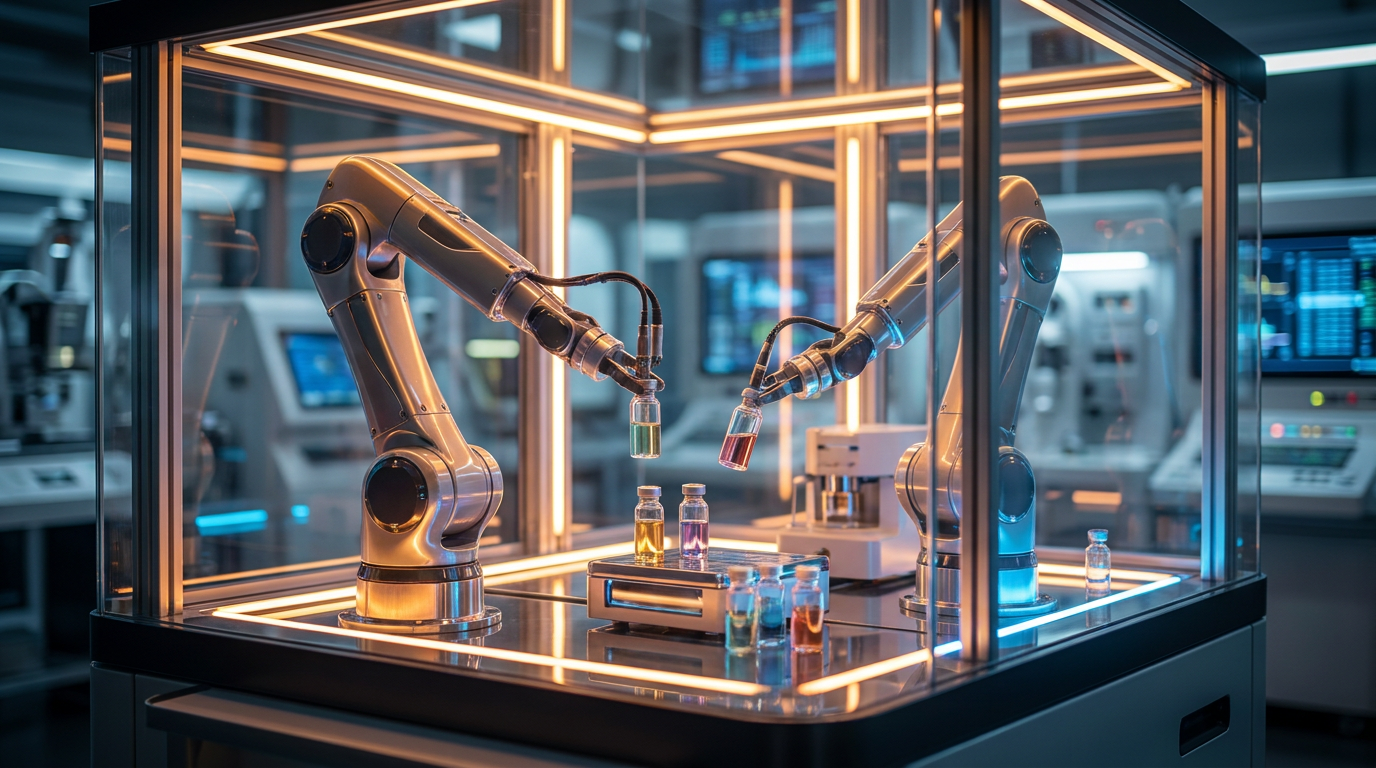
A self-driving laboratory is not merely a room filled with robotic arms; it is an entirely closed-loop, decision-making ecosystem. These platforms combine robotic synthesis, in situ characterization, and AI-driven decision-making to execute the scientific method autonomously. They are capable of designing experiments, executing the physical synthesis, characterizing the results, and iteratively optimizing toward target materials—all with minimal human intervention.[2][5]
The urgency behind this automation stems from the agonizingly slow pace of traditional materials science. Historically, bringing a new material from concept to commercialization—whether it is a more efficient solar cell, a safer solid-state battery, or a novel drug compound—requires 10 to 20 years of manual trial and error. The sheer volume of the chemical space is simply too vast for human researchers to explore sequentially.[2][8]

AI-driven methods are compressing this timeline dramatically. By integrating computational prediction, inverse design, and automated experimentation, self-driving labs aim to reduce the discovery cycle from decades to just one or two years. This accelerated pace is achieved by removing human latency from the iterative loop, allowing the laboratory to run continuous design-build-test-learn cycles 24 hours a day.[2][3]
The architecture of a true self-driving lab relies on a seamlessly integrated technology stack, beginning with the "AI Brain." Rather than evaluating millions of existing candidates, generative models and graph neural networks propose entirely new molecular structures optimized for specific target properties. This process, known as inverse design, allows the system to start with the desired outcome—such as maximum tensile strength or specific optical performance—and work backward to formulate the mathematically optimal recipe.[1][2]
Once the AI generates a hypothesis, the physical execution begins. Automated fluid-handlers, multi-axis mechanical hardware, and miniaturized batch reactors execute raw machine code to physically blend precursors. These robotic systems are capable of handling complex nanofabrication processes, precisely controlling variables like temperature, pressure, and mixing speeds with a level of consistency that surpasses human operators.[1][3]

Synthesis is immediately followed by automated, real-time analysis. Integrated analytical suites—incorporating high-performance liquid chromatography (HPLC), Raman spectroscopy, and rheometers—run immediate material characterization checks. This in situ characterization provides the critical ground-truth data needed to evaluate whether the synthesized material actually possesses the properties the AI predicted.[1][4]
Synthesis is immediately followed by automated, real-time analysis.
The defining feature of the self-driving lab is the closed-loop optimization. The platform ingests the analytical outputs, updates its primary machine learning models, and triggers the next optimized run. Using active learning algorithms, the AI dynamically decides which experiment to perform next to gain the most information, efficiently navigating high-dimensional parameter spaces to balance complex, multi-objective constraints simultaneously.[1][5]

Leading research institutions have already demonstrated the viability of these systems. At the Lawrence Berkeley National Laboratory, the "A-Lab" operates as a fully automated platform guided by AI and robotics. The A-Lab connects AI-driven simulations directly to autonomous experimentation, synthesizing materials identified through computational screening and feeding the experimental results back into the massive Materials Project database, which now houses data on over 577,000 molecules.[8][9]
Similarly, Oak Ridge National Laboratory (ORNL) is developing an interconnected ecosystem of self-driving labs through its INTERSECT initiative. By combining leadership-class supercomputing with cutting-edge instrumentation, ORNL is creating "Labs of the Future" where machine learning algorithms analyze resulting data and determine the most promising next experiments, allowing human scientists to focus entirely on interpreting high-level results and guiding research priorities.[6]
Despite these high-profile successes, scaling self-driving labs across the broader scientific industry faces significant hurdles. Industry analysts note that the hardware is no longer the primary bottleneck; robotic arms and analytical instruments are highly capable. The missing piece is the software middleware required to connect disparate, proprietary instruments into a single, intelligent system. Getting a spectrometer from one manufacturer to seamlessly share real-time data with a fluid handler from another remains a complex engineering challenge.[7]
To address this interoperability crisis, the scientific community is rallying around standardized data formats and communication protocols. Standards like SiLA2 (Standard in Lab Automation) and MCP (Model Context Protocol) are emerging as the critical infrastructure that will define how instruments communicate in autonomous architectures. Vendor-agnostic software platforms are now shipping to bridge these gaps, attempting to provide a universal operating system for AI-ready labs.[7][9]
It is also crucial to separate the marketing hype from operational reality. While many vendors claim to offer "self-driving" capabilities, most current laboratories operate at Level 2 or Level 3 on a five-level autonomy scale. They excel at closed-loop optimization on specific, narrow tasks, but true Level 5 autonomy—where a facility operates indefinitely without any human intervention or goal-setting—does not yet exist.[5][7]

Furthermore, a philosophical and scientific debate continues regarding the nature of AI-driven research. Some critics argue that while self-driving labs are unparalleled at optimizing known parameters, they have yet to prove they can conceptualize fundamentally novel scientific breakthroughs. Critiques of early autonomous lab publications have suggested that the systems are highly efficient at interpolating between known data points, but still lack the intuitive leaps that characterize human-led paradigm shifts.[9]
Looking ahead, the integration of Large Language Models is beginning to serve as a "cognitive partner" for these systems, improving experimental planning and multi-agent coordination. As these platforms mature, they will also need to navigate strict regulatory frameworks, particularly in pharmaceutical development where autonomous decisions must meet rigorous compliance standards. Ultimately, self-driving labs represent a fundamental reimagining of scientific methodology, promising to liberate researchers from routine labor and usher in an era of AI-orchestrated discovery.[3][4][7]
How we got here
2011
The Materials Project launches, beginning the massive compilation of computed materials data required to train future AI models.
2023
Berkeley Lab's A-Lab publishes initial results demonstrating a closed-loop autonomous platform integrating computation with robotics.
2025
The field sees a surge in "Self-Driving Lab 2.0" architectures, integrating Large Language Models as cognitive partners for experimental planning.
Early 2026
Vendor-agnostic software platforms emerge, attempting to solve the middleware bottleneck that prevents different laboratory instruments from communicating.
Viewpoints in depth
AI Automation Advocates
The imperative for speed and scale in scientific discovery.
Proponents of autonomous laboratories argue that the traditional 10-to-20-year timeline for materials discovery is fundamentally incompatible with the urgent need for climate technologies and novel therapeutics. They view the integration of generative AI and robotic execution as the only viable method to search the nearly infinite chemical space. By removing human latency from the iterative loop, they believe science can finally scale at the pace of computation.
Laboratory Infrastructure Developers
The challenge of the middleware bottleneck.
Engineers and software developers building these systems emphasize that the true barrier to widespread adoption is no longer the intelligence of the AI or the dexterity of the robots. Instead, the challenge lies in the software middleware and data standards required to make diverse, proprietary instruments interoperate. They advocate for universal protocols like SiLA2 and MCP to ensure that a spectrometer from one manufacturer can seamlessly share real-time data with a fluid handler from another.
Scientific Skeptics
The debate over optimization versus true discovery.
Some researchers caution against conflating rapid optimization with fundamental scientific discovery. While they acknowledge that self-driving labs are unparalleled at navigating high-dimensional parameter spaces to optimize known materials, they question whether AI can conceptualize entirely novel physics or chemistry without human intuition. They point to critiques of early autonomous lab publications, suggesting that the systems are currently highly efficient interpolators rather than true scientific pioneers.
What we don't know
- Whether self-driving labs can successfully navigate the strict regulatory compliance (GxP) required for autonomous pharmaceutical manufacturing.
- How the scientific community will standardize data formats so that autonomous labs globally can share their failed experiments and learn from each other.
Key terms
- Self-Driving Lab (SDL)
- A research facility where AI systems autonomously design experiments, robotic platforms execute them, and the AI analyzes results to decide the next step.
- Closed-Loop Experimentation
- A continuous cycle where an AI system designs, builds, tests, and learns from an experiment without requiring human intervention between steps.
- Inverse Design
- An AI technique that starts with a desired material property and works backward to generate a novel molecular structure that will achieve it.
- Active Learning
- A machine learning approach where the algorithm dynamically chooses which data points or experiments to sample next to improve its predictions fastest.
Frequently asked
Will AI replace human scientists?
No. Self-driving labs automate the manual pipetting, data transcription, and routine optimization, freeing human scientists to focus on high-level strategy, hypothesis generation, and interpreting complex results.
What kind of materials are these labs discovering?
Current autonomous labs are focused on developing novel nanomaterials, solid-state battery electrolytes, electrocatalysts, and targeted drug delivery vehicles.
Are these labs fully autonomous yet?
Not entirely. Most operate at "Level 2 or 3" autonomy, meaning they can run closed-loop optimization for specific, narrow tasks, but humans still set the overarching goals and handle hardware exceptions.
Sources
Source coverage
9 outlets
3 viewpoints surfaced









[1]ChemCopilotAI Automation Advocates
Self-Driving Labs: The Rise of Autonomous Chemical Discovery in 2026
Read on ChemCopilot →[2]CyprisAI Automation Advocates
AI-Accelerated Materials Discovery
Read on Cypris →[3]ChemRxivLaboratory Infrastructure Developers
Autonomous Materials Synthesis Laboratories: Integrating Artificial Intelligence with Advanced Robotics
Read on ChemRxiv →[4]Royal Society of ChemistryLaboratory Infrastructure Developers
Self-driving laboratories 2.0: toward flexible, scalable, and collaborative discovery engines
Read on Royal Society of Chemistry →[5]Royal Society PublishingScientific Skeptics
The emerging technology of autonomous, 'self-driving' laboratories
Read on Royal Society Publishing →[6]Oak Ridge National LaboratoryAI Automation Advocates
Autonomous Laboratories at Oak Ridge National Laboratory
Read on Oak Ridge National Laboratory →[7]QPillarsLaboratory Infrastructure Developers
What is a self-driving laboratory? Separating signal from noise
Read on QPillars →[8]UC BerkeleyAI Automation Advocates
Autonomous experimentation for accelerated materials discovery
Read on UC Berkeley →[9]Factlen Editorial TeamScientific Skeptics
Synthesis by Factlen editorial team
Read on Factlen Editorial Team →

Every angle. Every day.
Get ai stories with full source coverage and perspective breakdowns delivered to your inbox.