
Induction vs. Gas Cooktops: The 2026 Performance, Health, and Efficiency Comparison
As induction technology matures and health concerns surrounding combustion grow, the debate between electromagnetic and gas cooking has shifted. This side-by-side analysis weighs the evidence on speed, efficiency, indoor air quality, and cost.
By Factlen Editorial Team
- Public Health Advocates
- Focus on eliminating indoor air pollution and reducing respiratory risks.
- Energy Efficiency Proponents
- Prioritize thermodynamic efficiency and the reduction of household energy waste.
- Traditional Culinary Enthusiasts
- Value the visual feedback, versatility, and tactile control of open flames.
What's not represented
- · Renters unable to upgrade appliances
- · Electrical contractors handling panel upgrades
Why this matters
Choosing a cooktop is no longer just about culinary preference; it directly impacts your home's indoor air quality, your monthly energy bills, and your carbon footprint. Understanding the quantified trade-offs ensures you invest in an appliance that fits your cooking style and health priorities.
Key points
- Induction cooktops transfer 85 to 90 percent of their energy directly to cookware, compared to 40 to 55 percent for gas.
- Gas stoves emit nitrogen dioxide and benzene, contributing to indoor air pollution and respiratory risks.
- Induction boils water nearly twice as fast as gas but requires magnetic cookware like cast iron or stainless steel.
- While gas cooktops are often cheaper upfront, induction offers long-term energy savings and qualifies for federal rebates.
The kitchen appliance landscape in 2026 is defined by a fundamental shift in how we heat our food, moving away from century-old methods toward modern electrification. The debate between induction and gas cooktops has evolved from a simple matter of culinary preference into a complex, high-stakes evaluation of thermodynamics, public health, and household economics. As induction technology matures into a highly accessible standard and awareness of indoor air quality grows, consumers are faced with a definitive choice between electromagnetic innovation and traditional combustion. This comprehensive analysis weighs the quantifiable trade-offs of both systems, providing the evidence needed to navigate one of the most significant infrastructure upgrades in the modern home.[7]
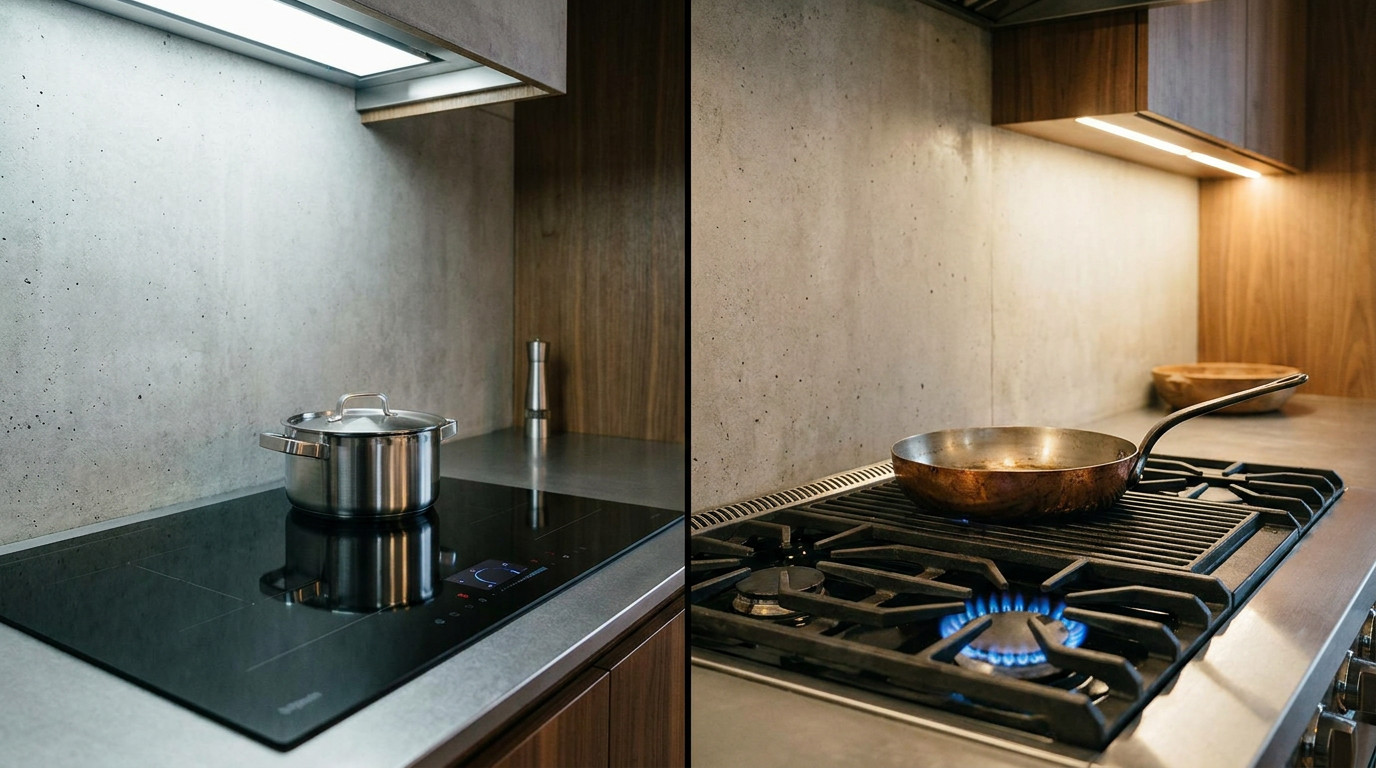
At the core of this comparison is a stark difference in physical mechanism and energy transfer. Gas cooktops rely on the combustion of natural gas or propane to create an open, visible flame, transferring heat to the bottom of the cookware and, inevitably, the surrounding air. Induction cooktops, conversely, use tightly wound copper coils situated beneath a smooth glass-ceramic surface to generate an alternating high-frequency magnetic field. This invisible field induces an electrical current directly within the atomic structure of magnetic cookware, effectively turning the pot or pan itself into the primary heat source while the glass surface remains passive.[5][6]
When evaluating raw heating speed and performance, the trade-off analysis presents a clear divergence in capability. For induction, the primary argument is unmatched velocity and immediate thermal response. The evidence from independent appliance benchmarks demonstrates that induction can bring one liter of water to a rolling boil in just two to three minutes, bypassing the need to heat the ambient air. Against gas, the argument centers on inherent thermal lag and energy dispersion. The evidence shows that gas typically requires four to six minutes to boil the exact same volume of water, as the open flame must first heat the vessel from the outside in before the energy reaches the liquid.[6]
In the critical category of energy efficiency, the thermodynamic gap between the two technologies widens significantly. For induction, the argument is direct energy transfer with minimal systemic waste. The evidence, supported by the U.S. Department of Energy, indicates that induction cooktops operate at an impressive 85 to 90 percent efficiency, meaning nearly all electrical input becomes cooking heat. Against gas, the argument is severe ambient heat loss and systemic inefficiency. The evidence reveals that gas cooktops achieve only 40 to 55 percent efficiency, meaning nearly half the energy consumed escapes into the kitchen air, which subsequently forces household HVAC systems to work harder to maintain comfortable room temperatures.[3][4][5]

The most profound shift in the 2026 debate centers on indoor air quality and long-term respiratory health. For induction, the argument is the complete elimination of point-source emissions within the living space. The evidence from a Columbia University pilot program showed a remarkable 56 percent reduction in average daily nitrogen dioxide concentrations when households switched from gas to induction. Against gas, the argument focuses heavily on hazardous, invisible combustion byproducts. The evidence from Stanford University research links gas stove emissions to elevated levels of fine particulate matter and benzene—a known carcinogen found in gas-equipped kitchens at levels comparable to secondhand tobacco smoke.[1][2][4]
Temperature control and culinary feel present a more subjective, user-dependent trade-off. For gas, the argument is intuitive, tactile responsiveness that generations of cooks have mastered. The evidence lies in the enduring preference of many professional chefs who rely on the immediate visual feedback of a flickering flame to gauge heat levels instantly. Against induction, the argument is a steeper initial learning curve and a reliance on digital touch interfaces. However, the evidence from recent consumer surveys suggests this gap is rapidly closing, with 54 percent of new induction users adapting to the digital controls and preset temperature holds within just two weeks of installation.[5][6]
Temperature control and culinary feel present a more subjective, user-dependent trade-off.
Maintenance and daily appliance upkeep offer another stark contrast in the user experience. For induction, the argument is effortless, rapid cleaning. The evidence is the perfectly smooth, continuous glass surface that remains relatively cool during operation, preventing accidental spills and splatters from baking onto the cooktop and allowing for a simple wipe-down with a damp cloth. Against gas, the argument is labor-intensive, multi-step maintenance. The evidence points to the ongoing necessity of removing heavy cast-iron grates, scrubbing around delicate burner caps, and periodically unclogging individual burner ports to maintain an even, safe flame distribution.[5]
Cookware compatibility remains one of the most significant logistical hurdles in the transition away from fossil fuels. For gas, the argument is universal utility and ultimate flexibility. The evidence is that gas flames effectively heat absolutely any material, including pure copper, lightweight aluminum, ceramic pots, and traditional round-bottom woks that require a ring. Against induction, the argument is strict, uncompromising material requirements. The evidence dictates that induction only functions with magnetic bases, such as cast iron or magnetic stainless steel, often requiring consumers to replace hundreds of dollars worth of legacy cookware before they can cook their first meal.[5][6]

The financial trade-off involves carefully balancing initial capital investment against long-term operational savings. For gas, the argument is a significantly lower barrier to entry for appliance replacement. The evidence shows that gas cooktops generally cost less upfront, provided the home already has an active, safe gas line installed. Against induction, the argument is high initial capital expenditure. The evidence indicates that while induction ranges often exceed $1,000, the true cost can be much higher if an older home requires extensive electrical panel upgrades to support a dedicated 240-volt circuit, though federal and state rebates are increasingly offsetting these transition expenses.[3][6]
Environmental impact extends far beyond the immediate kitchen walls, touching on broader infrastructure issues. For induction, the argument is seamless alignment with national grid decarbonization efforts. The evidence shows that as the electrical grid incorporates more wind and solar energy, the carbon footprint of an induction stove continuously shrinks without any action from the homeowner. Against gas, the argument is systemic, unavoidable methane leakage. The evidence from climate researchers reveals that gas stoves leak methane even when completely turned off, with the total climate impact of U.S. gas stoves rivaling the annual tailpipe emissions of half a million gasoline-powered cars.[1]
Synthesizing these quantified trade-offs provides clear, actionable guidance for consumers navigating this choice. Induction technology fits well when a household explicitly prioritizes maximum energy efficiency, rapid heating times, and the absolute easiest possible cleanup routine. It is the definitive, uncompromising choice for families deeply concerned about indoor air quality, childhood asthma rates, or accidental burns, as the lack of an open flame and the cool-to-the-touch surface offer unparalleled safety. It also fits well when homeowners are actively electrifying their properties to align with modern renewable energy trends and building codes.[4][5][7]
Conversely, induction does not fit well when a home experiences frequent, prolonged power outages and lacks whole-house backup generation, as the appliance is entirely dependent on a stable electrical supply. It is also less suitable for specialty cooks who rely heavily on non-magnetic cookware or traditional techniques that require charring ingredients directly over an open flame. Furthermore, it may not fit well for budget-conscious buyers residing in older homes where upgrading the electrical panel presents a prohibitive upfront cost that cannot be mitigated by local rebates.[5][6][7]

Traditional gas cooking fits well when a kitchen is already fully equipped with safe, modern gas infrastructure and the user places a premium on the tactile, visual experience of analog cooking. It remains a highly practical, reliable choice in specific geographic regions where natural gas is significantly cheaper than electricity, or for culinary traditionalists who demand universal cookware compatibility and the peace of mind that comes with the ability to cook a hot meal during severe electrical grid failures and winter storms.[5][6]
However, gas does not fit well when a kitchen lacks high-quality, exterior-venting exhaust hoods, as the daily accumulation of nitrogen dioxide and benzene poses heavily documented, severe health risks to occupants. It is increasingly difficult to justify in modern, airtight, energy-efficient homes where combustion byproducts cannot easily escape through drafty windows. Ultimately, as the 2026 appliance market clearly demonstrates, the transition toward induction is accelerating rapidly, driven by a growing consensus that the health, safety, and efficiency benefits increasingly outweigh the familiar comfort of the traditional blue flame.[1][2][7]
How we got here
1990s–2010s
Gas stoves dominate the premium home appliance market as the culinary gold standard.
2022
Stanford researchers publish data linking gas stoves to significant methane leaks and indoor benzene emissions.
2023
The U.S. Department of Energy highlights induction's superior efficiency and announces upcoming rebate programs.
2024
Columbia University demonstrates a 56 percent reduction in indoor NO2 when households switch to induction.
2026
Induction cooktops reach price parity in many markets, accelerating the transition away from residential gas.
Viewpoints in depth
Public Health Advocates
Prioritizing indoor air quality and the elimination of combustion byproducts.
Public health researchers and environmental groups argue that gas stoves represent a significant, often unmitigated source of indoor pollution. Citing studies that link gas combustion to elevated nitrogen dioxide and benzene levels, this camp advocates for rapid electrification to reduce childhood asthma rates and overall respiratory risks. They emphasize that even with ventilation, gas stoves compromise the safety of the home environment.
Traditional Culinary Enthusiasts
Valuing the tactile control, visual feedback, and versatility of open-flame cooking.
Many professional chefs and experienced home cooks maintain a strong preference for gas. They argue that the visual feedback of a flame allows for intuitive temperature adjustments that digital interfaces cannot replicate. Furthermore, gas accommodates specialty techniques like wok cooking and charring, and works with all cookware materials, including copper and aluminum, making it the most versatile option for traditional culinary arts.
Energy Efficiency Proponents
Focusing on thermodynamic efficiency and grid decarbonization.
Energy analysts emphasize the sheer thermodynamic superiority of induction. By transferring electromagnetic energy directly into the cookware, induction minimizes ambient heat loss, keeping kitchens cooler and utilizing up to 90 percent of the inputted energy. This camp views the transition as essential for reducing household energy waste and aligning residential infrastructure with a rapidly decarbonizing electrical grid.
What we don't know
- How quickly the electrical grid in various regions will decarbonize to maximize the source-energy benefits of induction.
- Whether the upfront costs of electrical panel upgrades required for some induction installations will decrease as adoption scales.
- The long-term durability of digital induction interfaces compared to the mechanical simplicity of traditional gas knobs.
Key terms
- Induction Cooking
- A method that uses copper coils to generate a magnetic field, heating the cookware directly rather than the stove surface.
- Nitrogen Dioxide (NO2)
- A gaseous air pollutant produced by combustion, linked to respiratory issues and asthma.
- Benzene
- A known carcinogen released during the combustion of natural gas, even at low levels.
- Thermal Efficiency
- The percentage of energy consumed by the appliance that is actually transferred into the food being cooked.
Frequently asked
Do I need special pots and pans for an induction cooktop?
Yes. Induction requires cookware with a magnetic base, such as cast iron or magnetic stainless steel. Aluminum, copper, and glass will not work unless they have a magnetic plate built into the bottom.
Is induction cooking safe for households with children?
Induction is widely considered the safest cooktop option. Because it heats the pan directly, the glass surface itself remains relatively cool, and there is no open flame or risk of gas leaks.
Will an induction cooktop work during a power outage?
No. Unlike gas stoves, which can often be ignited manually during an outage, induction cooktops require electricity to function.
Are gas stoves going to be banned?
While some municipalities have restricted gas hookups in new construction, there are currently no federal bans on existing gas stoves or purchasing new ones for existing homes.
Sources
Source coverage
7 outlets
3 viewpoints surfaced







[1]ForbesPublic Health Advocates
Gas Stoves vs. Induction: Health and Climate Impacts
Read on Forbes →[2]Columbia UniversityPublic Health Advocates
Switching to Indoor Induction Stoves Reduces NO2
Read on Columbia University →[3]U.S. Department of EnergyEnergy Efficiency Proponents
Cooking Appliances: Efficiency and Rebates
Read on U.S. Department of Energy →[4]Energy SolutionsEnergy Efficiency Proponents
The Case for Cooking Electrification
Read on Energy Solutions →[5]Alabama ApplianceTraditional Culinary Enthusiasts
Induction vs. Gas Cooktops: Which Should You Choose?
Read on Alabama Appliance →[6]Stahl KitchensTraditional Culinary Enthusiasts
Induction vs Gas Cooktops: Which One Is the Better Choice in 2026?
Read on Stahl Kitchens →[7]Factlen Editorial TeamPublic Health Advocates
Synthesis by Factlen editorial team
Read on Factlen Editorial Team →
More in shopping
See all 5 stories →


Every angle. Every day.
Get shopping stories with full source coverage and perspective breakdowns delivered to your inbox.