
How Virtual Power Plants Are Turning Homes Into the Grid's Best Defense
By networking millions of residential batteries, EVs, and smart thermostats, Virtual Power Plants are stabilizing the electrical grid without the need for new fossil-fuel facilities.
By Factlen Editorial Team
- Grid Operators & Utilities
- Focused on maintaining grid reliability, deferring multi-billion-dollar infrastructure upgrades, and managing peak load efficiently.
- Prosumers & Homeowners
- Focused on energy independence, financial compensation for device participation, and maintaining backup resilience during outages.
- VPP Aggregators
- Focused on scaling software platforms, optimizing device networks, and navigating fragmented state-level energy regulations.
- Environmental Advocates
- Focused on accelerating the retirement of heavily polluting fossil-fuel peaker plants and maximizing the utilization of renewable energy.
What's not represented
- · Renters and low-income households who cannot afford the upfront cost of home batteries or EVs
- · Traditional fossil-fuel power plant operators facing reduced demand for peak generation
Why this matters
Virtual Power Plants allow everyday consumers to earn passive income by sharing their smart devices' flexibility, while simultaneously preventing rolling blackouts and accelerating the retirement of heavily polluting fossil-fuel peaker plants.
Key points
- Virtual Power Plants (VPPs) network home batteries, EVs, and smart thermostats to act as a single power plant.
- VPPs provide emergency grid relief faster and cheaper than building new physical infrastructure.
- Participating homeowners become 'prosumers,' earning hundreds of dollars annually for sharing their stored energy.
- The Department of Energy projects VPPs could save the U.S. grid $10 billion annually by 2030.
- By shifting demand, VPPs reduce reliance on expensive, heavily polluting fossil-fuel peaker plants.
- Regulatory fragmentation across states remains the primary hurdle to nationwide VPP deployment.
The modern electrical grid is facing an unprecedented and compounding squeeze. Between the massive, continuous power demands of new artificial intelligence data centers, the rapid nationwide electrification of passenger vehicles, and the increasing frequency of extreme weather events driving up heating and cooling loads, utilities are struggling to keep the lights on. For over a century, the grid operated on a simple, predictable model: centralized power plants pushed electricity in one direction to passive consumers. Today, that linear model is buckling under the weight of dynamic, unpredictable demand, forcing grid operators to routinely issue emergency conservation alerts during peak summer and winter months.[7]
Traditionally, the solution to a strained electrical grid was brute force: build more multi-billion-dollar power plants and string thousands of miles of new high-voltage transmission lines across the country. However, physical infrastructure projects are notoriously slow and expensive. Permitting, financing, and constructing a new natural gas facility or a major transmission corridor routinely takes five to ten years, often facing fierce local opposition along the way. The widening gap between skyrocketing electricity demand and sluggish infrastructure development has created a critical vulnerability, forcing energy planners and policymakers to look for a faster, more agile alternative to keep the network stable.[4][8]
The answer, it turns out, is already sitting quietly in millions of garages, basements, and living rooms across the country. By networking together residential battery storage systems, electric vehicles, and smart home appliances, energy providers are creating what the industry calls "Virtual Power Plants" (VPPs). This software-driven, decentralized approach is rapidly transforming how the world manages electricity, shifting the paradigm from building new physical generation to intelligently optimizing the resources that already exist behind the utility meter. This digital solution effectively unlocks a hidden reservoir of energy, proving that the future of grid resilience relies just as much on smart code as it does on concrete and copper.[1][7]
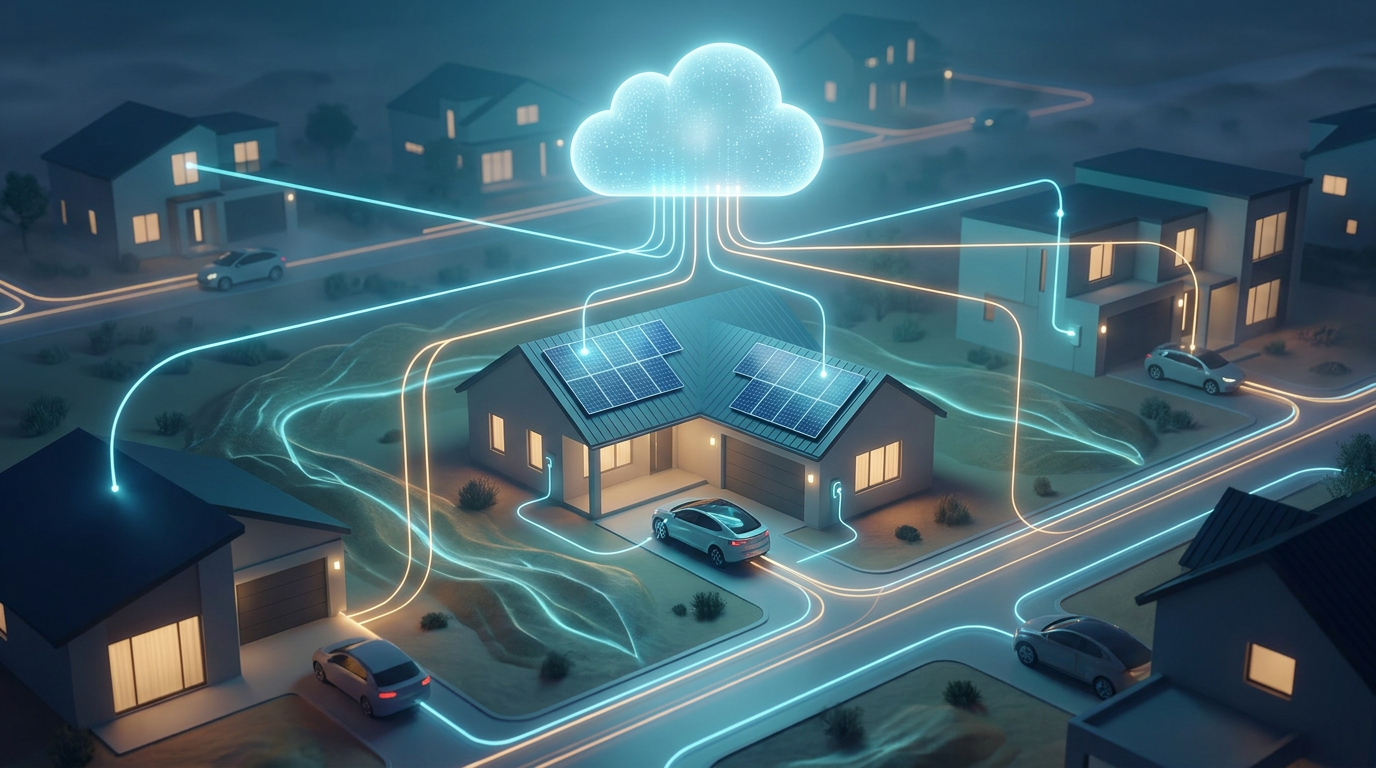
A Virtual Power Plant is not a sprawling brick-and-mortar facility with towering smokestacks and spinning turbines. Instead, it is a cloud-based, centralized digital network that aggregates thousands of decentralized Distributed Energy Resources (DERs). These resources encompass a wide variety of consumer-owned hardware, including rooftop solar arrays, home battery storage systems, electric vehicle chargers, smart HVAC systems, and even connected water heaters. Individually, a single home battery or smart thermostat has a negligible impact on the broader electrical grid. But when thousands or millions of these devices are linked together and managed collectively, their combined capacity rivals that of a massive, traditional power station.[3][4][5][7]

Through advanced software and artificial intelligence, a VPP coordinates these scattered assets so they act as a single, highly responsive, dispatchable power plant. When the grid experiences a dangerous spike in demand—such as a sweltering summer afternoon when millions of air conditioners kick on simultaneously and threaten to overwhelm local substations—the VPP springs into action. Instead of the utility operator scrambling to buy expensive emergency power on the spot market, the VPP aggregator receives a digital signal indicating that the grid needs immediate relief to maintain its delicate frequency balance. Within milliseconds, the software evaluates the available capacity across its entire network of connected homes and businesses, determining exactly which devices can be tapped without disrupting the participants' daily lives or safety.[4][6][7]
The execution is entirely automated and virtually invisible to the consumer. The software can subtly adjust smart thermostats up by a single degree across tens of thousands of homes, or temporarily pause electric vehicle charging for an hour while the grid stabilizes. Simultaneously, it can command thousands of home and commercial batteries to discharge their stored solar energy back into the grid, injecting a massive surge of clean power exactly where it is needed most. To the grid operator monitoring the system, this synchronized, distributed response looks and acts exactly like a traditional gas-fired "peaker" plant ramping up to supply emergency power—but it happens faster, cleaner, and with far greater precision.[2][3][4][8]
The economics of this system represent a fundamental shift in the relationship between utility companies and everyday consumers. Historically, energy flowed in one direction, and customers simply paid a monthly bill based on their consumption. Virtual Power Plants turn everyday consumers into "prosumers" who actively participate in energy markets and are financially compensated for their contribution to grid stability. By allowing their privately owned hardware to be utilized for the public good, homeowners unlock a new, passive revenue stream that helps offset the initial purchase price of their solar panels or battery systems. This democratization of energy generation means that the financial rewards of grid management are no longer exclusively captured by massive utility monopolies, but are instead distributed directly to the households providing the flexibility.[5][7][8]
The economics of this system represent a fundamental shift in the relationship between utility companies and everyday consumers.
Homeowners typically join a Virtual Power Plant through a "Bring Your Own Device" (BYOD) model, enrolling their existing hardware via a smartphone application provided by the equipment manufacturer or a third-party energy aggregator. In exchange for allowing the VPP software to manage their devices during critical grid events, participants receive various forms of compensation, including upfront hardware rebates, monthly capacity payments, or event-based performance payouts. The enrollment process is designed to be frictionless, allowing users to set strict parameters—such as ensuring their home battery never drops below a 20 percent charge—so they are never left vulnerable during an actual localized blackout.[2][5][7]

The financial incentives for participation can be substantial, particularly in regions struggling with severe grid congestion. In high-demand markets like California and Texas, some participating households earn between $500 and $1,000 per year simply for sharing their stored battery power during peak evening hours when solar generation drops off. Because the system only draws power when the homeowner's primary backup needs are fully met, participants maintain their personal energy resilience while generating a steady stream of passive income. This compelling financial proposition is driving a surge in battery attachment rates, as consumers realize their backup power systems can effectively pay for themselves over time.[4][5][7]
For grid operators and utility planners, the value proposition of Virtual Power Plants is equally, if not more, compelling. VPPs offer a distinct "speed-to-market" advantage that traditional infrastructure simply cannot match; while a physical power plant takes a decade to permit and build, a VPP can be deployed and scaled across a community in under twelve months. This agility acts as a critical pressure valve, unlocking immediate grid capacity while physical transmission lines wait in the bureaucratic construction queue. Furthermore, because VPPs utilize infrastructure that consumers have already purchased, utilities can expand their operational capacity without taking on massive capital expenditures.[6][7][8]
The U.S. Department of Energy views Virtual Power Plants as a cornerstone of near-term grid stability and national energy security. According to the agency's comprehensive modeling, tripling the nation's current VPP capacity to between 80 and 160 gigawatts by 2030 could address up to 20 percent of the country's peak electricity load. Achieving this ambitious scale would save approximately $10 billion annually in grid costs by avoiding the construction of new centralized generation facilities and delaying expensive, disruptive upgrades to neighborhood distribution networks. These savings ultimately flow back to all ratepayers, keeping electricity prices lower even for those who do not own smart devices.[1][3][8]

The environmental benefits of scaling Virtual Power Plants are equally profound. Traditional peaker plants—which sit idle for most of the year and only fire up during severe grid emergencies—are typically the most expensive, inefficient, and heavily polluting facilities on the electrical network. They are also disproportionately located in lower-income communities, exacerbating local air quality issues. By shifting demand and deploying stored renewable energy instead, VPPs drastically reduce the grid's reliance on these fossil-fuel facilities, maximizing the utility of clean energy already generated by residential solar panels and pushing the entire system closer to true decarbonization.[1][3][8]
This technology is no longer a theoretical concept; it is already proving its immense worth in the real world under extreme conditions. During a severe heatwave in late June, one major VPP aggregator successfully connected over a million smart devices to shift an amount of energy equivalent to powering more than 115,000 homes for a full day. This massive, coordinated effort helped keep air conditioners running across multiple states, preventing rolling blackouts and protecting vulnerable populations during the worst of the extreme heat. Similar success stories are emerging globally, proving that decentralized networks can handle the immense stress of climate-driven weather events.[6][7]
Recognizing this success, state-level mandates and regulatory frameworks are beginning to accelerate VPP adoption. Texas has significantly expanded its Aggregate Distributed Energy Resource pilot program, while states like Virginia, Maryland, and Colorado are actively mandating that their utility providers incorporate distributed resources into their long-term capacity planning. Commercial buildings are also joining the fray, networking their massive industrial HVAC systems and commercial-grade battery banks to provide utility-scale relief during peak hours. As these programs mature, the definition of a power plant is fundamentally shifting from a single geographic location to a fluid, digital network spanning entire states.[4][7][8]

Despite the clear economic and environmental benefits, scaling Virtual Power Plants to their full potential is not without friction. The primary hurdles facing the industry today are regulatory rather than technological. Grid operators have spent over a century managing highly centralized, predictable power systems, and the digital tools required to evaluate, integrate, and fairly compensate highly decentralized VPPs remain frustratingly inconsistent across different utility jurisdictions. Many legacy utility companies still view distributed resources as a threat to their traditional business models, leading to slow integration and complex, restrictive enrollment rules for consumers.[1][7][8]
Federal policy changes, such as the Federal Energy Regulatory Commission's landmark Order 2222, have begun to open wholesale electricity markets to aggregated distributed resources, but state-by-state regulatory fragmentation continues to slow nationwide deployment. Furthermore, unlocking the full potential of VPPs requires widespread consumer education to overcome natural hesitation about relinquishing control of personal home appliances to third-party software algorithms. Building deep consumer trust—ensuring that data is protected and that homes will never be left without power when they need it most—is just as critical as perfecting the underlying aggregation software.[4][5][7][8]
Ultimately, the rapid rise of Virtual Power Plants proves that the path to meeting the 21st century's surging energy demands does not have to rely solely on pouring millions of tons of concrete and burning more fossil fuels. By intelligently coordinating the smart devices we already own, VPPs are transforming the electrical grid into a smarter, more resilient, and more democratic network. It is a profound shift in how society interacts with energy—one where every participating home is no longer just a drain on the system, but an active, empowered partner in keeping the lights on for everyone.[6][7][8]
How we got here
2020
FERC Order 2222 opens wholesale electricity markets to distributed energy resources, laying the regulatory groundwork for VPPs.
2023
The Department of Energy publishes its VPP Liftoff Report, highlighting the potential for $10 billion in annual grid savings.
June 2025
A major VPP aggregator successfully shifts energy equivalent to 115,000 homes during a severe U.S. heatwave, preventing blackouts.
2026
States including Virginia, Maryland, and Colorado begin implementing mandates requiring utilities to integrate VPPs into capacity planning.
2030 (Projected)
U.S. VPP capacity is targeted to reach 80 to 160 gigawatts, capable of handling up to 20 percent of peak grid load.
Viewpoints in depth
Grid Operators' View
Focused on the urgent need for flexible capacity to defer multi-billion-dollar infrastructure upgrades.
For utility planners, the math behind Virtual Power Plants is undeniable. Facing a historic surge in electricity demand from AI data centers and vehicle electrification, grid operators simply do not have the time or capital to build enough physical power plants to keep pace. VPPs offer a critical 'speed-to-market' advantage, allowing utilities to deploy gigawatts of flexible capacity in months rather than decades. However, integrating millions of decentralized assets into legacy grid management software remains a daunting operational challenge, leading some cautious operators to prefer the predictability of traditional, centralized generation.
The Prosumer Perspective
Focused on the financial empowerment of households and the shift from passive ratepayer to active energy trader.
Homeowners and commercial building managers view VPPs as a way to fundamentally rewrite their relationship with utility monopolies. By enrolling their privately purchased batteries and smart thermostats into a VPP, they transform sunk hardware costs into revenue-generating assets. This 'prosumer' model democratizes energy generation, ensuring that the financial rewards of grid stabilization flow directly to the community rather than corporate shareholders. The primary concerns for this group revolve around data privacy, fair compensation rates, and ensuring that third-party software never drains their batteries right before a localized blackout.
Environmental & Policy Advocates
Focused on the rapid retirement of dirty peaker plants and maximizing the efficiency of existing renewables.
Climate advocates champion VPPs as the fastest route to decarbonizing the grid's most polluting hours. Traditional 'peaker' plants—which only fire up during extreme demand—are disproportionately reliant on fossil fuels and are often located in marginalized communities. By shifting demand and dispatching stored solar energy instead, VPPs can render these dirty facilities obsolete. Policy advocates are currently focused on breaking down state-level regulatory barriers and pushing for standardized compensation models that properly value the carbon-reduction benefits that distributed energy resources provide.
What we don't know
- How quickly legacy utility companies will adapt their business models to fully embrace decentralized energy resources.
- Whether financial incentives will remain high enough to drive mass consumer adoption once early-adopter subsidies expire.
- How effectively VPP software will handle the unprecedented strain of simultaneous, multi-state extreme weather events.
Key terms
- Virtual Power Plant (VPP)
- A cloud-based network that aggregates decentralized energy resources—like home batteries and smart thermostats—to function as a single, coordinated power source for the grid.
- Distributed Energy Resources (DERs)
- Small-scale energy generation, storage, or demand-management devices located on the consumer's side of the utility meter.
- Peaker Plant
- A traditional, often fossil-fuel-powered generation facility that only operates during times of exceptionally high electricity demand.
- Prosumer
- An individual who both consumes energy from the grid and produces or stores energy to sell back to it.
- Bring Your Own Device (BYOD)
- A VPP enrollment model where consumers use hardware they have already purchased, rather than equipment installed and owned by the utility.
Frequently asked
Can a VPP drain my home battery during a blackout?
No. VPP software respects user-defined backup reserves (e.g., keeping the battery at least 20% charged), ensuring your home stays powered during an actual localized outage.
How much money can I make joining a VPP?
Compensation varies widely by region and program structure, but participants in high-demand markets like California and Texas can earn between $500 and $1,000 annually in bill credits or direct payments.
Do I need solar panels to participate?
No. While solar and batteries are powerful resources, you can also participate in many VPP programs using just a smart thermostat, a connected water heater, or a compatible electric vehicle charger.
Does the utility control my thermostat all the time?
No. Adjustments are typically limited to a few degrees during specific, rare 'peak events' (like a severe heatwave), and users can almost always override the system manually if they choose.
Sources
Source coverage
8 outlets
4 viewpoints surfaced








[1]U.S. Department of EnergyGrid Operators & Utilities
Virtual Power Plants: Empowering Americans to Support Grid Reliability
Read on U.S. Department of Energy →[2]TeslaVPP Aggregators
Virtual Power Plant Overview
Read on Tesla →[3]Alliance to Save EnergyEnvironmental Advocates
Why VPPs Matter for Energy Efficiency
Read on Alliance to Save Energy →[4]Sol-ArkVPP Aggregators
A Guide to Virtual Power Plants for Commercial Buildings in 2026
Read on Sol-Ark →[5]EcoFlowProsumers & Homeowners
What Is The Purpose Of A Virtual Power Plant?
Read on EcoFlow →[6]EnergyHubVPP Aggregators
VPPs and your role in a smarter energy future
Read on EnergyHub →[7]Factlen Editorial TeamProsumers & Homeowners
Synthesis by Factlen editorial team
Read on Factlen Editorial Team →[8]University of ChicagoGrid Operators & Utilities
Making Space for Virtual Power Plants
Read on University of Chicago →
Every angle. Every day.
Get energy stories with full source coverage and perspective breakdowns delivered to your inbox.