
How Vacuum Snowmaking and 'Snow Farming' Are Saving the Ski Season
As winters become increasingly unpredictable, ski resorts are turning to temperature-independent snowmaking and summer snow-preservation techniques to guarantee their seasons. These breakthroughs in thermodynamics and materials science are reshaping the future of alpine sports.
By Factlen Editorial Team
- Alpine Industry Operators
- Focused on the economic necessity of guaranteed opening dates and protecting the multi-billion dollar winter sports economy.
- Ecological Conservationists
- Concerned with the energy intensity of artificial snowmaking and its broader impact on fragile alpine ecosystems.
- Climate Adaptation Advocates
- View technological interventions as a necessary, pragmatic bridge to sustain mountain communities while broader climate goals are pursued.
What's not represented
- · Local municipal water authorities
- · Recreational skiers concerned about ticket prices
Why this matters
The $70 billion global winter sports industry supports millions of jobs and entire mountain economies. By decoupling snow from freezing temperatures, these technologies ensure the survival of skiing while pushing the boundaries of sustainable resource management.
Key points
- Ski resorts are using 'snow farming' to preserve up to 80% of winter snow through the summer using reflective blankets.
- Vacuum Ice Maker technology allows resorts to produce snow in temperatures as high as 30°C without chemical refrigerants.
- Modern snowmaking systems are increasingly powered by renewable energy to offset their high electrical demands.
- LiDAR-equipped snowcats map snow depth to optimize snowmaking, preventing water and energy waste.
For decades, the global ski industry has operated at the mercy of the atmosphere. A late freeze or a dry winter meant delayed openings, lost revenue, and disappointed athletes. But as climatic volatility increases, alpine operators are no longer waiting for the sky to deliver.[3][5]
A quiet revolution in thermodynamics and materials science is transforming how ski resorts manage their most critical asset. Through a combination of "snow farming" and temperature-independent snowmaking (TIS), mountains are decoupling their operations from the traditional winter weather window.[6]
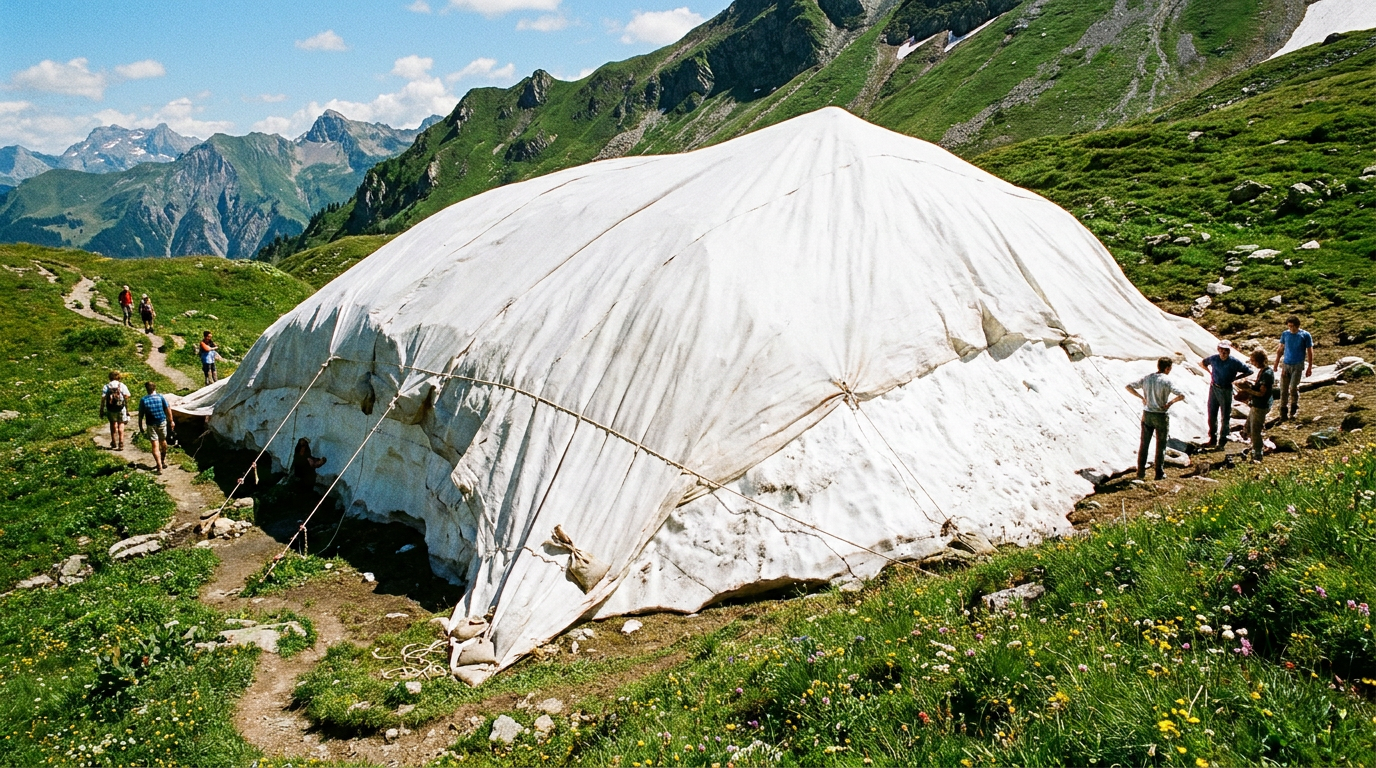
The most visually striking of these interventions is snow farming, a practice that sounds agricultural but relies heavily on advanced geosynthetics. At the end of the spring season, resorts bulldoze massive volumes of remaining snow into concentrated mounds, preparing them for a summer hibernation.[1]
To survive the July heat, these mounds are wrapped in specialized geotextile blankets. These multi-layered covers are engineered with a highly reflective white surface to maximize albedo—bouncing solar radiation back into the atmosphere—while a porous inner layer allows trapped meltwater to evaporate, creating a localized cooling effect.[2]

The results of this thermal management are staggering. According to the WSL Institute for Snow and Avalanche Research, modern snow farming techniques can preserve up to 80% of a snow pile's volume through a 30°C (86°F) summer.[1]
When autumn arrives, this preserved snow is unrolled and spread across the slopes, providing a guaranteed base layer weeks before natural snowfall or traditional snowmaking temperatures arrive. Resorts in Levi, Finland, and Kitzbühel, Austria, now routinely open in October using snow harvested the previous April.[3]
But preservation is only half the equation; the other is generation. Traditional snowmaking requires a "wet-bulb temperature" (a metric combining ambient temperature and humidity) of at least -2°C (28°F). If the air is too warm or too humid, the water droplets simply hit the ground as rain.[4]
But preservation is only half the equation; the other is generation.
Enter Temperature-Independent Snowmaking, or Vacuum Ice Maker (VIM) technology. Originally developed for the mining and concrete cooling industries, VIM systems can produce high-quality snow in ambient temperatures as high as 30°C, completely bypassing the wet-bulb constraint.[4][6]

The mechanism relies on the triple point of water—the specific pressure and temperature at which water can exist simultaneously as a gas, liquid, and solid. Inside a massive vacuum chamber, water is exposed to extreme low pressure. A portion of the water rapidly evaporates, absorbing massive amounts of latent heat from the remaining liquid.[4]
This sudden energy transfer causes the remaining water to flash-freeze into dry, crystalline ice flakes, entirely without the use of chemical refrigerants like Freon or ammonia. The resulting snow is then pneumatically pumped onto the slopes, providing a critical lifeline for lower-elevation base areas.[4][6]

Naturally, the deployment of such heavy infrastructure raises questions about energy consumption. Generating a vacuum and pumping water requires significant electrical power, prompting scrutiny from ecological watchdogs who warn against creating a feedback loop of emissions to save a winter sport.[5]
In response, the industry has aggressively optimized its energy footprint. Modern snowmaking arrays use 25% less energy than their 2010 counterparts, and leading resorts are increasingly powering these systems with on-site renewable energy, such as micro-hydro plants integrated into the snowmaking water pipes themselves.[3][4]
Furthermore, the water used in both traditional and vacuum snowmaking operates on a closed-loop delay. The water is borrowed from local reservoirs in the autumn and winter, stored on the mountain as snow, and returned to the watershed during the spring melt, often helping to regulate downstream flow during drier months.[1][2]
To maximize efficiency, resorts are now pairing these physical technologies with artificial intelligence. Snowcats equipped with LiDAR and GPS map the mountain's snow depth down to the centimeter, feeding data back to a central server that tells the snow guns exactly where to fire, eliminating over-production.[3][6]

Ultimately, the transition from passive reliance on weather to active snow management represents a fundamental shift in alpine sports. By treating snow as a year-round, manageable resource rather than a seasonal gift, the industry is engineering its own survival, ensuring that future generations can still experience the thrill of the carve.[5][6]
How we got here
Early 2000s
Scandinavian resorts begin experimenting with sawdust and wood chips to preserve snow over summer.
2014
Vacuum Ice Maker technology, originally used in mining, is adapted for alpine ski resort use.
2019
Advanced multi-layer geotextile blankets become the industry standard for snow farming.
2026
AI and LiDAR integration becomes widespread, optimizing snowmaking efficiency down to the centimeter.
Viewpoints in depth
Alpine Industry Operators
Focused on the economic necessity of guaranteed opening dates and protecting the multi-billion dollar winter sports economy.
For resort operators, the shift to advanced snow management is an existential requirement, not a luxury. The ability to guarantee a specific opening date allows resorts to sell early-season packages, secure seasonal labor, and maintain investor confidence. By deploying snow farming and vacuum snowmaking, operators argue they are stabilizing local economies that would otherwise collapse under the weight of unpredictable weather patterns.
Ecological Conservationists
Concerned with the energy intensity of artificial snowmaking and its broader impact on fragile alpine ecosystems.
Environmental groups acknowledge the economic pressures but warn against the 'techno-fix' mentality. They point out that generating vacuums and pumping millions of gallons of water requires massive electrical loads. Even if powered by renewables, conservationists argue that this infrastructure alters the natural hydrology of alpine environments and creates a false sense of security that distracts from the root cause of warming winters.
Climate Adaptation Advocates
View technological interventions as a necessary, pragmatic bridge to sustain mountain communities while broader climate goals are pursued.
This camp, which includes many glaciologists and sustainability researchers, views snow farming and efficient snowmaking as vital adaptation strategies. They emphasize that while these technologies are energy-intensive, the closed-loop water systems and transition to micro-hydro power represent a responsible use of resources. For them, saving the sport through engineering is a valid way to maintain public connection to alpine environments, which in turn drives broader climate advocacy.
What we don't know
- How the long-term use of geotextile blankets might affect the underlying soil microbiology of alpine pastures.
- Whether the high capital costs of vacuum snowmaking will eventually price out smaller, independent ski hills.
Key terms
- Snow Farming
- The practice of collecting end-of-season snow into large mounds and covering it with insulating materials to preserve it through the summer.
- Wet-bulb temperature
- A measurement that combines ambient air temperature and relative humidity, dictating whether water droplets will freeze before hitting the ground.
- Albedo
- The proportion of incident light or radiation that is reflected by a surface, crucial for keeping snow mounds cool under the summer sun.
- Triple point of water
- The unique temperature and pressure at which water can exist as a solid, liquid, and gas simultaneously, utilized in vacuum snowmaking.
Frequently asked
Does snow farming use chemicals to keep the snow cold?
No. Snow farming relies entirely on passive thermodynamics. The geotextile blankets reflect sunlight and allow trapped moisture to evaporate, which naturally cools the snow mound.
How can a machine make snow in 30°C heat?
Vacuum Ice Makers use extreme low pressure inside a sealed chamber. This pressure drop forces some water to evaporate instantly, which absorbs heat and flash-freezes the remaining water into ice crystals.
Does artificial snowmaking waste drinking water?
Snowmaking is largely a non-consumptive use of water. The water is temporarily stored on the mountain as snow and returns to the local watershed when it melts in the spring.
Sources
Source coverage
6 outlets
3 viewpoints surfaced






[1]WSL Institute for Snow and Avalanche ResearchClimate Adaptation Advocates
Snow farming: preserving snow over the summer
Read on WSL Institute for Snow and Avalanche Research →[2]Journal of GlaciologyClimate Adaptation Advocates
Albedo and thermal resistance of geosynthetics for snow preservation
Read on Journal of Glaciology →[3]International Ski and Snowboard FederationAlpine Industry Operators
FIS Sustainability Report: Climate Adaptation in Alpine Sports
Read on International Ski and Snowboard Federation →[4]TechnoAlpinAlpine Industry Operators
SnowFactory: Temperature-Independent Snowmaking Systems
Read on TechnoAlpin →[5]Protect Our WintersEcological Conservationists
Adapting to the New Normal: How Resorts are Surviving Warmer Winters
Read on Protect Our Winters →[6]Factlen Editorial TeamClimate Adaptation Advocates
Synthesis by Factlen editorial team
Read on Factlen Editorial Team →

More in sports
See all 5 stories →NBA Salary Cap
The Knicks Won Their First Title in 53 Years. Now the NBA's 'Second Apron' Threatens to Break Them Up.
8 sources

Women's Soccer
Women's Soccer Reaches New Heights as NWSL Shatters Attendance Records and USL Super League Crowns Champion
7 sources

Women's Soccer
Angel City FC Acquires USWNT Star Ally Sentnor in Record $850,000 Transfer
7 sources

Every angle. Every day.
Get sports stories with full source coverage and perspective breakdowns delivered to your inbox.