
How the PWHL's Innovative Rules Are Changing the Future of Hockey
From the 'Jailbreak' rule to the Gold Plan draft system, the Professional Women's Hockey League has become a testing ground for structural fixes that even NHL players want to adopt.
By Factlen Editorial Team
- Progressive Analysts
- Champion the PWHL's mathematical fixes—like the 3-2-1 system and the Gold Plan—as necessary evolutions that eliminate tanking and incentivize aggressive play.
- League Innovators
- Focus on using the PWHL as a laboratory to test rules that prioritize entertainment, player safety, and continuous action.
- Hockey Traditionalists
- Prefer the established NHL rulebook, arguing that radical changes disrupt historical statistical comparisons and risk introducing gimmicks.
What's not represented
- · NHL front-office executives
- · Sports betting analysts
Why this matters
The PWHL's rulebook solves decades-old problems in hockey—like late-season tanking and passive penalty kills—proving that structural changes can make the sport faster, fairer, and more entertaining.
Key points
- The PWHL's 'Jailbreak' rule ends a penalty immediately if the shorthanded team scores a goal.
- The league uses a 3-2-1 point system to incentivize teams to win in regulation.
- The 'Gold Plan' draft system eliminates tanking by rewarding wins after playoff elimination.
- Nearly 30% of polled NHL players want the men's league to adopt the Jailbreak rule.
- The PWHL enforces strict player safety with automatic ejections for illegal hits to the head.
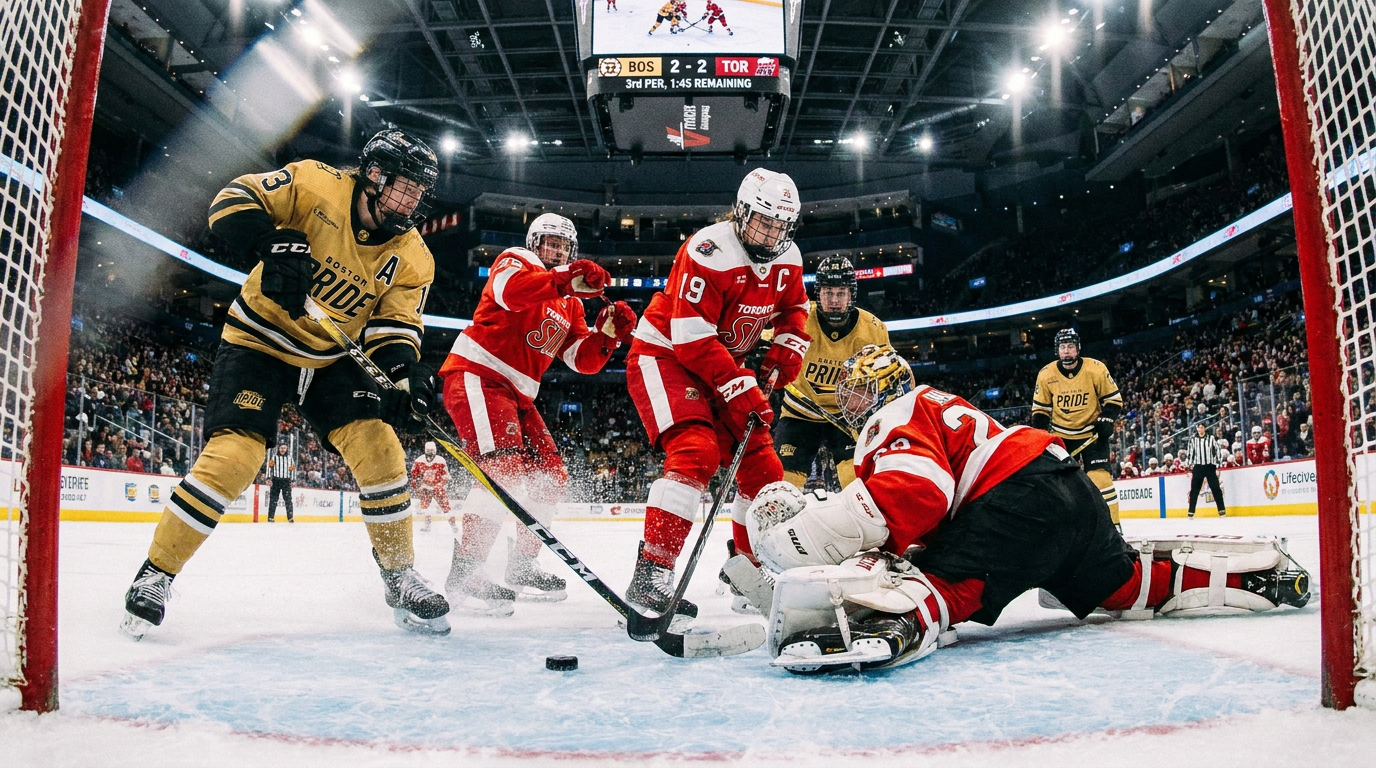
The Professional Women's Hockey League (PWHL) recently concluded its third season in the spring of 2026, cementing its status as a massive commercial and athletic success. But beyond sold-out arenas and record-breaking television ratings, the league has quietly become something else: a real-time research and development laboratory for the future of hockey. Unburdened by a century of entrenched tradition, the PWHL's founders had the rare opportunity to build a rulebook from scratch. They looked at the structural flaws that have frustrated hockey fans for decades—passive penalty kills, late-season tanking, and teams playing for ties—and engineered elegant solutions to fix them.[1][6]
The National Hockey League (NHL) has notoriously been resistant to sweeping rule changes, often prioritizing historical statistical continuity over modern game theory. The NHL's rulebook, while deeply familiar to millions of fans, contains several quirks that inadvertently incentivize cautious, defensive play. The PWHL took a decidedly different approach, prioritizing continuous action, competitive integrity, and player safety. By implementing radical concepts like the "Jailbreak" rule and the Gold Plan draft system, the women's league has proven that structural changes can make the sport faster and fairer without losing its physical edge.[6][7]
Perhaps the most universally praised innovation in the PWHL is the "Jailbreak" rule. Under traditional hockey rules, if a player commits a minor penalty, they must sit in the penalty box for two full minutes, or until the opposing team scores a power-play goal. If the shorthanded team manages to score a goal themselves, the penalty continues. The PWHL flipped this logic entirely: if a shorthanded team scores a goal, their penalty immediately ends, and the player is released from the box. It is the ultimate double-whammy, rewarding the defending team while severely punishing a sloppy power play.[1][2]
This single rule change fundamentally alters the geometry and psychology of special teams. In traditional hockey, a penalty kill is an exercise in survival. Defending players form a tight box near their goaltender, block shots, and simply ice the puck down the rink whenever they gain possession. The Jailbreak rule incentivizes the exact opposite behavior. Because a shorthanded goal acts as a get-out-of-jail-free card, defending teams are highly motivated to attack the puck carrier, force turnovers, and rush the opposing net. It turns the most passive two minutes in sports into a high-stakes, aggressive counter-attack.[5][6]
The Jailbreak rule has been so successful that it has caught the attention of the men's league. In an annual poll conducted by the NHL Players' Association, athletes were asked which PWHL rule they would most like to see adopted by the NHL. Nearly 30 percent of the respondents voted for the Jailbreak rule, making it the most popular choice by a wide margin. Players recognize that the rule rewards skill and hustle, adding an entirely new layer of excitement to special teams play that fans universally love.[3][4]

Another major structural fix the PWHL implemented is the 3-2-1 point system, which addresses the mathematical flaw of the NHL's "loser point." In the NHL, a regulation win is worth two points in the standings. However, if a game goes to overtime, the winning team still gets two points, but the losing team is awarded one point. This means a regulation game awards two total points, while an overtime game awards three total points. Consequently, when an NHL game is tied late in the third period, both teams often stop trying to score, preferring to play defensively to guarantee they reach overtime and secure at least one point.[6][7]
The PWHL's 3-2-1 system eliminates this perverse incentive entirely. A regulation win is worth three points. An overtime or shootout win is worth two points, and an overtime or shootout loss is worth one point. A regulation loss is worth zero. Under this math, every single game awards exactly three total points to the standings, regardless of when it ends. If a game is tied late in the third period, teams are heavily incentivized to pull their goaltender or take offensive risks to secure the three-point regulation win, rather than settling for the two points available in overtime.[1][4]

The PWHL's 3-2-1 system eliminates this perverse incentive entirely.
Beyond the ice, the PWHL has also solved one of the most toxic problems in modern North American sports: the draft lottery and the epidemic of "tanking." In leagues like the NHL and NBA, the teams that finish at the bottom of the standings are rewarded with the highest odds of securing the first overall draft pick. This creates a perverse incentive where teams that are eliminated from playoff contention actively try to lose games—trading away good players and fielding subpar rosters—to secure a franchise-altering rookie.[6]
To combat this, the PWHL utilizes the "Gold Plan," a concept originally proposed by a PhD student at the 2012 MIT Sloan Sports Analytics Conference. Under the Gold Plan, a team's regular-season points do not determine their draft order. Instead, once a team is mathematically eliminated from playoff contention, their point total effectively resets to zero for draft purposes. From that moment on, the team begins accumulating "draft order points" using the standard 3-2-1 system.[1][7]
The team that earns the most draft order points after being eliminated is awarded the first overall pick. This elegant solution completely destroys the incentive to tank. Because the worst teams are eliminated earliest in the season, they have the most remaining games to accumulate draft points, giving them a natural advantage. However, they still have to actually win those games to earn the pick. This ensures that every team is trying to win every night, maintaining the integrity of the league and giving fans of eliminated teams a reason to cheer for victories in April and May.[6][7]

The PWHL has not stopped innovating since its inaugural season. In its second year, the league introduced the "No Escape" rule, another tweak designed to increase scoring and punish undisciplined play. Under this rule, when a team takes a penalty, the players who were on the ice at the time of the infraction are not allowed to change lines. They must remain on the ice for the ensuing faceoff, forcing tired players to immediately defend against the opposing team's fresh, top-tier power-play unit.[2]
The No Escape rule forces coaches to rethink their roster construction. Because any player on the ice could suddenly be trapped in a penalty-kill situation, teams can no longer hide defensively deficient forwards. Every player must be capable of defending in high-leverage situations. It also leads to moments of sheer exhaustion and chaos, creating prime scoring opportunities for the team on the power play and driving up the entertainment value of the broadcast.[2][6]
The league has also reimagined the postseason format to properly reward regular-season dominance. In traditional playoff brackets, matchups are strictly determined by seeding, which can sometimes result in a top seed facing a uniquely difficult opponent due to late-season trades or injuries. The PWHL gives the first-place team the ultimate advantage: the right to choose their semi-final opponent. The top seed gets to select between the third- and fourth-place finishers, adding a layer of strategic gamesmanship and bulletin-board material right before the playoffs begin.[3][4]
Crucially, the PWHL's innovations extend to player safety. While the league allows bodychecking—a departure from traditional international women's hockey rules—it maintains a zero-tolerance policy for head contact. Any illegal hit to the head results in an automatic major penalty and a game misconduct, ejecting the offending player from the match. This strict enforcement proves that a hockey league can embrace high-speed physicality while still drawing a hard, uncompromising line to protect its athletes from brain injuries.[2][7]

Despite the overwhelming popularity of these rules among fans and players, the NHL has remained hesitant to adopt them. Hockey traditionalists and league executives argue that the NHL's current parity is excellent, and that changing the point system would make it impossible to compare modern team records to historical dynasties. Furthermore, some coaches prefer the predictability of the current rulebook, worrying that rules like the Jailbreak might introduce too much variance and chaos into tightly contested playoff series.[6][7]
Nevertheless, the momentum is clearly shifting. The PWHL has successfully acted as a beta-testing environment for the sport, proving that fans do not need a century of tradition to enjoy a deeply compelling hockey product. By aligning the mathematical incentives of the rulebook with the aggressive, fast-paced style of play that fans actually want to watch, the PWHL has created a blueprint for the future. As the women's league continues to thrive, the pressure on the rest of the hockey world to modernize will only become harder to ignore.[4][6]
How we got here
2012
The 'Gold Plan' draft system is first proposed at the MIT Sloan Sports Analytics Conference.
January 2024
The PWHL launches its inaugural season, debuting the Jailbreak rule and 3-2-1 point system.
November 2024
The PWHL introduces the 'No Escape' rule for its second season, preventing line changes for penalized teams before the faceoff.
April 2025
An NHLPA poll reveals that the Jailbreak rule is the number one PWHL rule NHL players want to adopt.
May 2026
The PWHL completes its third season, cementing its innovative rulebook as a structural success.
Viewpoints in depth
Progressive Analysts
Champion the PWHL's mathematical fixes as necessary evolutions.
Data-driven hockey analysts have long complained about the NHL's 'loser point' and the structural incentives that encourage late-season tanking. They view the PWHL's 3-2-1 point system and the Gold Plan as elegant mathematical solutions. By ensuring every game awards exactly three points, teams are forced to play aggressively in the third period. Similarly, the Gold Plan completely removes the incentive to lose, ensuring that the integrity of the competition remains intact through the final game of the regular season.
League Innovators
Focus on using the PWHL as a laboratory to test rules that prioritize entertainment.
For PWHL executives and rule-makers, the goal was never just to replicate the NHL. Unburdened by a century of tradition, they designed a rulebook optimized for modern entertainment and player safety. Rules like the 'Jailbreak' and 'No Escape' were specifically engineered to increase scoring chances and force players to be versatile. They argue that hockey must evolve to capture new audiences, and that strict automatic ejections for head hits prove a league can be both highly physical and fiercely protective of its athletes.
Hockey Traditionalists
Prefer the established NHL rulebook and worry about statistical continuity.
While generally supportive of the PWHL's success, traditionalists and some NHL executives remain cautious about importing these rules to the men's game. They argue that the NHL's parity is currently at an all-time high, and that radical changes to the point system could disrupt historical statistical comparisons that fans cherish. Furthermore, some coaches worry that rules like the 'Jailbreak' might introduce too much chaos into special teams, preferring the structured, predictable nature of traditional penalty kills.
What we don't know
- Whether the NHL's competition committee will formally propose adopting the Jailbreak rule in the near future.
- If the PWHL will continue to tweak its playoff format as the league expands beyond its original six teams.
Key terms
- Jailbreak Rule
- A PWHL rule where a shorthanded goal immediately ends the team's penalty, releasing the player from the box.
- Gold Plan
- A draft system where teams earn the top pick by accumulating the most points after being eliminated from playoff contention, eliminating the incentive to tank.
- 3-2-1 Point System
- A standings format awarding 3 points for a regulation win, 2 for an OT win, 1 for an OT loss, and 0 for a regulation loss.
- No Escape Rule
- A PWHL rule preventing a penalized team from changing players on the ice until after the next faceoff.
- Tanking
- The practice of a sports team intentionally losing games to secure a higher draft pick.
Frequently asked
Does the NHL use the Jailbreak rule?
No, in the NHL, a shorthanded goal does not end the penalty. However, nearly 30% of NHL players recently polled said they want the rule adopted.
How does the PWHL draft work?
The PWHL uses the 'Gold Plan.' Instead of rewarding the team with the worst overall record, the first overall pick goes to the team that earns the most standings points after being mathematically eliminated from the playoffs.
Why is the 3-2-1 point system better?
It ensures every game is worth exactly three total points. This incentivizes teams to try to win in regulation, rather than playing defensively to force overtime and secure a guaranteed 'loser point.'
Sources
Source coverage
7 outlets
3 viewpoints surfaced







[1]The PWHLLeague Innovators
PWHL Rulebook and Standings
Read on The PWHL →[2]CBC SportsLeague Innovators
From 'jailbreak' to 'no escape': PWHL continues to tweak rules in season 2
Read on CBC Sports →[3]The Hockey NewsProgressive Analysts
If NHL Players Could Choose A PWHL Rule, They'd Implement The Jailbreak
Read on The Hockey News →[4]Daily FaceoffProgressive Analysts
NHLPA Player Poll reveals interest in adopting PWHL rules
Read on Daily Faceoff →[5]The IX SportsProgressive Analysts
Which PWHL rules should the NCAA adopt?
Read on The IX Sports →[6]Factlen Editorial TeamProgressive Analysts
Synthesis by Factlen editorial team
Read on Factlen Editorial Team →[7]WikipediaHockey Traditionalists
Professional Women's Hockey League
Read on Wikipedia →

More in sports
See all 6 stories →Track Tech
How 'Super Spikes' Rewrote the Track and Field Record Books
0 sources

Sports Diplomacy
FIFA to Open New U-15 Global Tournament with Symbolic Israel-Palestine Match
0 sources

Shooting Biomechanics
The Science of the Deep Three: How Biomechanics and Analytics Reshaped Basketball's Geometry
0 sources

Sports Logistics
How the UFC Built an Octagon on the South Lawn: Inside the Logistics of Freedom 250
0 sources

Every angle. Every day.
Get sports stories with full source coverage and perspective breakdowns delivered to your inbox.