
The Science of Yoga Nidra: How 'Non-Sleep Deep Rest' Rewires the Nervous System
Modern neuroscience is validating the ancient practice of Yoga Nidra, showing that guided deep rest can lower cortisol, improve nighttime sleep, and accelerate neuroplasticity.
By Factlen Editorial Team
- Neuroscientists & Sleep Researchers
- Focus on the objective metrics of the practice, such as EEG brain wave changes, delta-wave sleep enhancement, and accelerated neuroplasticity.
- Wearable Tech & Biohackers
- View NSDR primarily as a measurable, highly efficient tool to optimize heart rate variability, lower cortisol, and quickly recover from mental fatigue.
- Traditional Yoga Practitioners
- Emphasize the ancient roots of Yoga Nidra as a holistic spiritual and physical practice designed for deep self-awareness and emotional release.
What's not represented
- · Clinical Psychologists using it for trauma therapy
Why this matters
Chronic stress and sleep deprivation are primary drivers of cognitive decline and metabolic disease. Understanding how to manually shift the nervous system into a state of deep recovery offers a zero-cost, scientifically validated tool to protect long-term brain and body health.
Key points
- Yoga Nidra, or NSDR, is a guided relaxation practice that shifts the body into a state of deep rest without sleep.
- The practice manually activates the parasympathetic nervous system, lowering heart rate and cortisol levels.
- A 2023 PLOS ONE study found that daytime practice increases restorative delta-wave sleep at night.
- Neuroscientists note that NSDR can accelerate neuroplasticity when practiced immediately after intense learning.
- Unlike seated mindfulness meditation, NSDR is entirely passive and requires no active focus.
In an era defined by chronic stress, digital burnout, and widespread sleep deprivation, the search for effective recovery tools has led both ancient yogic practitioners and modern neuroscientists to the exact same conclusion: true, restorative rest does not always require actual sleep. For decades, the wellness industry has pushed complex morning routines and expensive supplements, but a growing body of clinical evidence points toward a much simpler, zero-cost intervention. Enter Yoga Nidra, an ancient Indian practice of conscious relaxation that has recently surged in mainstream popularity under a new, clinical moniker: Non-Sleep Deep Rest, or NSDR. By bridging the gap between spiritual tradition and measurable neuroscience, this practice is offering a scientifically validated lifeline to exhausted nervous systems.[2][3]
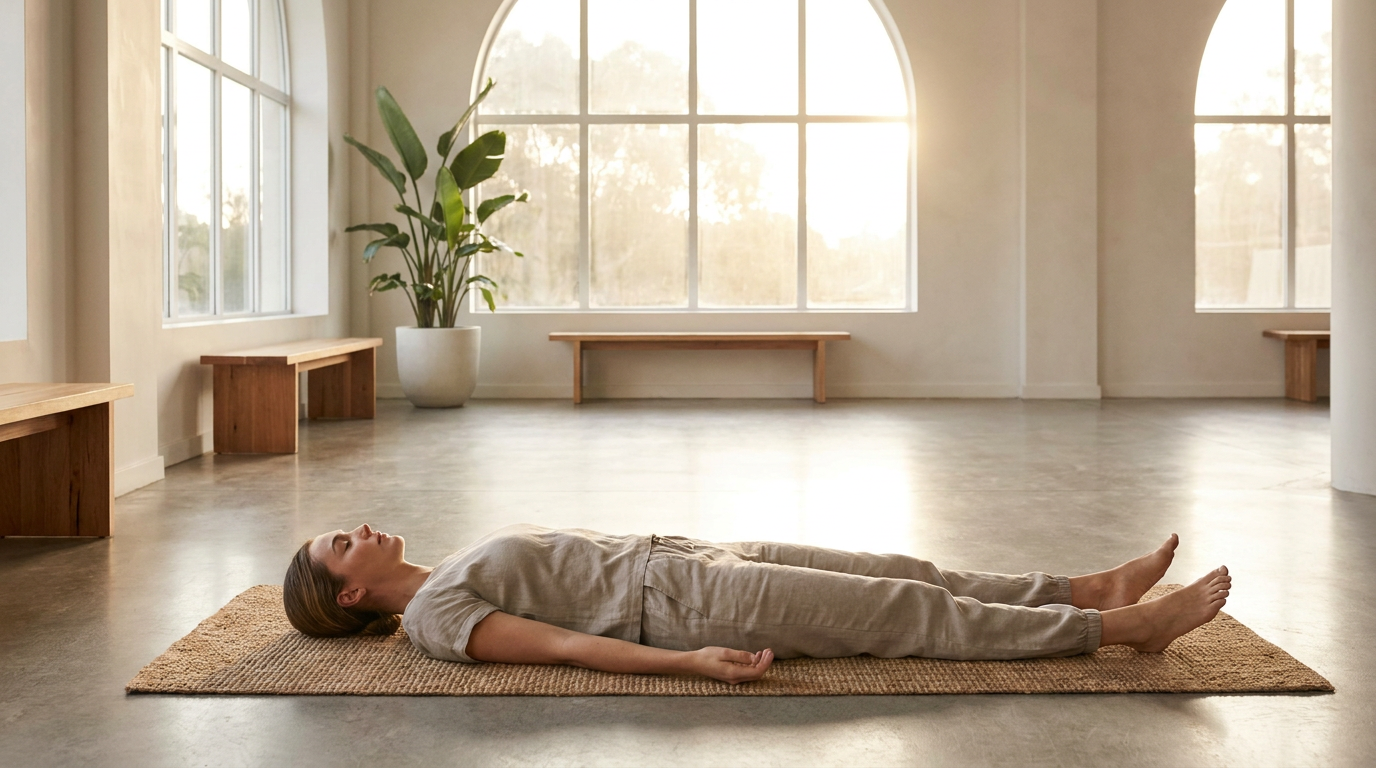
While the concept of simply resting might sound incredibly easy in theory, achieving a state of profound physiological downregulation is notoriously difficult for a modern nervous system that has become accustomed to constant, high-level stimulation. Yoga Nidra, which directly translates from Sanskrit as "yogic sleep," is a guided relaxation technique that is traditionally practiced while lying completely flat on the back in a posture known as savasana. Unlike active, movement-based yoga flows that focus on physical postures, stretching, and muscular control, this specific practice requires absolutely zero physical movement. Instead, a practitioner simply listens to an audio guide that directs their conscious awareness through a highly systematic body scan, combined with specific, elongated breathing patterns designed to signal safety to the brain.[1][3][6]
The practice has gained massive mainstream traction in recent years, largely due to the advocacy of Stanford University neurobiologist Dr. Andrew Huberman, who coined the secular umbrella term NSDR. Huberman introduced this new acronym specifically to strip away the mystical or esoteric connotations often associated with words like "yoga" and "hypnosis." His goal was to make these highly effective, scientifically validated protocols more accessible to corporate workers, professional athletes, and individuals who might otherwise be intimidated by traditional spiritual practices. Whether it is referred to by its ancient name of Yoga Nidra or its modern clinical title of NSDR, the underlying biological objective remains identical: to deliberately shift the human brain and body into a state of profound, restorative relaxation without ever crossing the threshold into actual unconscious sleep.[2][3][6]
The primary mechanism behind this dramatic biological shift lies deep within the autonomic nervous system. The vast majority of modern adults spend their waking days locked in a state of sympathetic dominance—the biological "fight-or-flight" mode that is constantly driven by work stress, caffeine consumption, digital notifications, and endless multitasking. Yoga Nidra acts as a deliberate, manual brake pedal for this overactive system. Through the use of extended exhales and highly focused internal attention, the practice forces the body to deactivate the sympathetic response and engage the parasympathetic nervous system, which is commonly known in medical literature as the "rest-and-digest" network. This shift is the foundational requirement for any true physical or mental recovery to occur.[3][4][5]

As the parasympathetic nervous system takes over control of the body, a cascade of highly measurable, objective physiological changes begins to occur almost immediately. Heart rate variability (HRV)—a key clinical marker of nervous system resilience and overall health—increases significantly, while overall resting blood pressure drops. Simultaneously, the adrenal glands receive signals to drastically reduce their output of cortisol, the body's primary stress hormone that is linked to systemic inflammation when chronically elevated. Wearable technology companies and biohackers have even begun integrating specific NSDR tracking features into their digital platforms, allowing users to watch their own biometrics objectively improve in real-time during a standard twenty-minute guided session.[4][5][6]
While the physical relaxation is profound, the most significant and transformative changes actually happen inside the brain's electrical architecture. During a normal, active waking state, the human brain operates primarily in Beta waves—fast, high-frequency electrical patterns that are heavily associated with active problem-solving, intense focus, and general alertness. As a Yoga Nidra session begins and the body settles into stillness, the brain's electrical activity visibly slows down, transitioning first into Alpha waves, which represent the frequency of calm, relaxed wakefulness. This initial downshift is what most people experience when they close their eyes and take a few deep breaths, but Yoga Nidra pushes the brain much further down the frequency spectrum.[1][5][6]
As the guided practice deepens and the body becomes increasingly heavy, practitioners enter what neurologists call the "hypnagogic state," which is the liminal, transitional space hovering just between wakefulness and true sleep. In this specific state, the brain begins to produce Theta waves, which operate at a slow frequency of four to seven Hertz. In this unique neurological state, the conscious mind remains awake and fully aware of the audio guide's instructions, but the physical body feels entirely asleep and paralyzed, much like it does during REM sleep. It is a highly unique hybrid state of human consciousness that allows for deep, systemic physical restoration while simultaneously maintaining a tether to mental presence.[3][5][6]
In this specific state, the brain begins to produce Theta waves, which operate at a slow frequency of four to seven Hertz.
The long-term benefits of accessing this Theta-dominant state on a regular basis are increasingly supported by rigorous clinical data and peer-reviewed research. A landmark 2023 study published in the prestigious open-access journal PLOS ONE by researchers at the Armed Forces Medical College in India provided some of the most compelling objective polysomnographic evidence of Yoga Nidra's impact to date. The research team took a cohort of healthy novice practitioners and instructed them to listen to a standard twenty-minute Yoga Nidra audio recording during the daytime, every single day for a period of two weeks, while carefully monitoring their baseline cognitive and sleep metrics.[1][5]

The results of the two-week intervention were striking, particularly regarding the participants' nighttime sleep architecture. When the subjects went to sleep at night, clinical EEG monitors revealed a highly significant increase in the overall percentage of delta-waves—the incredibly slow, high-amplitude brain waves that characterize the deepest, most physically restorative phase of human sleep. By practicing conscious, deliberate relaxation during their waking daytime hours, the participants had effectively trained their nervous systems to downregulate more efficiently, allowing them to achieve much higher quality, deeper sleep at night without the use of any pharmaceutical sleep aids.[1][3][6]
Beyond simply improving nighttime sleep architecture, the PLOS ONE study also measured the practice's direct impact on waking cognitive performance. Following the two-week daytime intervention, the participants demonstrated significantly faster reaction times and measurably improved accuracy across a comprehensive battery of cognitive tests. These assessments measured complex mental functions including working memory, abstract thinking, emotional recognition, and spatial learning. The researchers ultimately concluded that the daily periods of daytime deep rest were actively making the participants' brain processing faster, more accurate, and vastly more efficient, proving that rest is not a waste of time, but a prerequisite for high performance.[1][5][6]
This measurable cognitive enhancement ties directly into the neurobiological concept of neuroplasticity—the brain's remarkable ability to physically rewire itself, form new neural connections, and adapt to new information. While the actual learning of a new physical skill or complex piece of academic information requires intense focus, agitation, and effort, the physical rewiring of the neurons does not happen during the learning event itself; it happens during periods of deep rest. Leading neuroscientists have noted that engaging in a twenty-minute NSDR session immediately following a bout of intense learning can accelerate the rate of neuroplasticity by up to fifty percent, helping the brain consolidate the new information much faster than it would through normal waking recovery.[2][5][6]
When discussing these benefits, it is vitally important to distinguish Yoga Nidra from traditional seated mindfulness meditation, as the two practices serve entirely different neurological functions. Standard mindfulness meditation typically requires active, conscious effort: the practitioner must focus on their breath, actively notice when their thoughts wander, and repeatedly exert the mental effort to bring their attention back to the present moment. That constant cognitive effort can sometimes feel frustrating, fatiguing, or overly stimulating for a stressed individual. NSDR, by stark contrast, is an entirely passive experience. The goal is never to work hard at focusing, but rather to completely surrender to the guided audio instructions and let the nervous system naturally match the profound physical stillness of the body.[2][3][4]

Despite its profound and scientifically validated restorative properties, sleep researchers are always careful to note exactly what Yoga Nidra is not: it is absolutely not a complete biological substitute for actual nighttime sleep. While the daytime practice successfully mimics some of the restorative qualities of deep sleep, true biological sleep triggers full-brain, synchronized slow-wave activity that is strictly required for critical survival functions. This includes the activation of the glymphatic system, which physically washes toxic cellular waste products and amyloid plaques out of the brain tissue. Yoga Nidra is an incredibly powerful supplement to a healthy lifestyle, but it cannot permanently replace the fundamental biological necessity of a full eight-hour night of unconscious sleep.[1][3][5]
Still, as a zero-cost, highly accessible health intervention, its clinical utility is virtually unmatched in the modern wellness landscape. Unlike expensive cold plunges, specialized supplements, or complex fitness equipment, Yoga Nidra requires absolutely no financial investment, no baseline physical flexibility, and no prior meditation experience whatsoever. Anyone with a smartphone and a pair of headphones can instantly access thousands of free, high-quality guided protocols online. These sessions range from brief ten-minute midday resets designed to clear brain fog, to expansive forty-five-minute deep dives intended to help practitioners recover from severe sleep debt or emotional exhaustion.[2][3][4]

For a modern, hyper-connected society that is currently grappling with epidemic levels of burnout and anxiety, the emerging science of Yoga Nidra offers a highly compelling and practical antidote. The data definitively proves that we do not need to retreat to a silent mountaintop monastery to find meaningful calm, nor do we need to rely solely on our unpredictable nighttime sleep to recover from the demands of our days. By simply taking twenty minutes to lie completely still and listen to a guiding voice, we can consciously command our own nervous systems to heal, adapt, and deeply rest.[3][5][6]
How we got here
Ancient India
The foundational concepts of conscious deep sleep are documented in ancient yogic texts.
1960s
Swami Satyananda Saraswati systematizes the modern practice of Yoga Nidra, creating structured guided audio protocols.
2022
Stanford neurobiologist Dr. Andrew Huberman popularizes the term 'Non-Sleep Deep Rest' (NSDR) to introduce the practice to clinical and secular audiences.
December 2023
A landmark PLOS ONE study provides objective polysomnographic evidence that daytime Yoga Nidra improves nighttime delta-wave sleep and cognitive accuracy.
Viewpoints in depth
Neuroscientists & Sleep Researchers
Focus on the objective metrics of the practice, such as EEG brain wave changes, delta-wave sleep enhancement, and accelerated neuroplasticity.
For the clinical and scientific community, the value of Yoga Nidra lies entirely in its measurable biological outcomes. Researchers are primarily interested in how the practice alters brain wave frequencies, specifically the transition from active Beta waves down to Theta waves. By utilizing tools like polysomnography and fMRI scans, this camp has proven that daytime deep rest directly improves nighttime sleep architecture by increasing delta-wave activity. Furthermore, neurobiologists emphasize the practice's role in accelerating neuroplasticity, noting that the physical rewiring of the brain after intense learning occurs most efficiently during these states of profound, conscious rest.
Wearable Tech & Biohackers
View NSDR primarily as a measurable, highly efficient tool to optimize heart rate variability, lower cortisol, and quickly recover from mental fatigue.
The biohacking and self-optimization community views NSDR as a targeted intervention to maximize human performance and manage stress. Rather than focusing on the spiritual origins of the practice, this camp relies heavily on wearable technology—such as Oura rings and Whoop straps—to track real-time changes in their autonomic nervous systems. For them, a 20-minute NSDR session is a strategic tool used to manually increase Heart Rate Variability (HRV), blunt cortisol spikes, and rapidly clear brain fog in the middle of a demanding workday.
Traditional Yoga Practitioners
Emphasize the ancient roots of Yoga Nidra as a holistic spiritual and physical practice designed for deep self-awareness and emotional release.
Traditional yogic practitioners and instructors view Yoga Nidra not just as a biological hack, but as a profound spiritual discipline with centuries of history. While they welcome the modern scientific validation of the practice, they argue that reducing it merely to "Non-Sleep Deep Rest" strips away its deeper purpose. For this camp, the ultimate goal of Yoga Nidra is not just to lower blood pressure or improve focus, but to guide the practitioner through the "koshas" (layers of the self) to achieve a state of profound self-awareness, emotional processing, and spiritual liberation.
What we don't know
- The exact optimal dosage (e.g., 10 minutes vs. 45 minutes) required to treat specific clinical conditions like chronic insomnia.
- Whether the cognitive benefits of accelerated neuroplasticity are retained long-term or if they require continuous daily practice.
- The full neurological mapping of the 'local sleep' phenomenon, where parts of the brain sleep while others remain awake during the practice.
Key terms
- Yoga Nidra
- An ancient guided relaxation practice, translating to 'yogic sleep,' performed while lying completely still.
- NSDR
- Non-Sleep Deep Rest, a modern clinical umbrella term for practices that induce deep relaxation without actual sleep.
- Parasympathetic Nervous System
- The network in the body responsible for the 'rest-and-digest' response, which lowers heart rate and reduces stress.
- Theta Waves
- Slow brain waves (4-7 Hz) typically generated during the transitional state between wakefulness and light sleep.
- Neuroplasticity
- The brain's ability to reorganize itself and form new neural connections, which is accelerated during states of deep rest.
Frequently asked
Is NSDR the same thing as taking a nap?
No. While a nap involves actually falling asleep and losing consciousness, NSDR keeps your mind awake and aware while your body enters a sleep-like state of deep relaxation.
Do I need meditation experience to do this?
Not at all. Unlike seated mindfulness which requires active focus, NSDR is entirely passive. You simply lie down and listen to a guided audio track.
What happens if I accidentally fall asleep during the practice?
Falling asleep is common, especially for beginners or those with sleep debt. While you miss the specific benefits of the conscious hypnagogic state, your body still gets much-needed rest.
Sources
Source coverage
6 outlets
3 viewpoints surfaced






[1]PLOS ONENeuroscientists & Sleep Researchers
Improved sleep, cognitive processing and enhanced learning and memory task accuracy with Yoga nidra practice
Read on PLOS ONE →[2]Huberman LabNeuroscientists & Sleep Researchers
Tool: Enhancing Learning & Memory – Sleep, Non-Sleep Deep Rest (NSDR)
Read on Huberman Lab →[3]Sleep FoundationNeuroscientists & Sleep Researchers
What Is Non-Sleep Deep Rest (NSDR)?
Read on Sleep Foundation →[4]OuraWearable Tech & Biohackers
What Is Non-Sleep Deep Rest (NSDR)?
Read on Oura →[5]National Institutes of HealthNeuroscientists & Sleep Researchers
Scientific Studies on Yoga Nidra
Read on National Institutes of Health →[6]Factlen Editorial TeamTraditional Yoga Practitioners
Synthesis by Factlen editorial team
Read on Factlen Editorial Team →


Every angle. Every day.
Get fitness stories with full source coverage and perspective breakdowns delivered to your inbox.