
Trump Signs $70 Billion 'Secure America Act' to Fund ICE and CBP Through 2029
President Trump has signed a $70 billion budget reconciliation package that fully funds federal immigration enforcement agencies through the end of his term. The legislation ends a months-long funding standoff and bankrolls a significant expansion of border security and deportation operations.
By Factlen Editorial Team
- Administration Officials
- Argues the funding is a necessary victory for national security and law enforcement.
- Congressional Opposition
- Condemns the legislation as a blank check that ignores demands for accountability.
- Immigrant Advocacy Groups
- Warns that the massive influx of cash will fuel a deadly expansion of the detention system.
What's not represented
- · Local Law Enforcement in Sanctuary Cities
- · Private Prison and Detention Contractors
- · Undocumented Immigrants Targeted by Enforcement
Why this matters
This $70 billion package bypasses the normal appropriations process to guarantee funding for the administration's mass deportation and border security operations through 2029. By stripping out demands for oversight and guardrails, the law gives ICE and CBP unprecedented financial resources and operational freedom.
Key points
- President Trump signed the $70 billion Secure America Act, funding ICE and CBP through September 2029.
- The bill ends a four-month DHS funding standoff sparked by demands for accountability following the deaths of two protesters.
- The legislation was passed via budget reconciliation, bypassing the Senate filibuster and requiring only a simple majority.
- Advocacy groups warn the funds will rapidly expand private detention centers and mass deportation operations.
- The package includes no new congressional oversight requirements or spending guardrails.
On June 10, 2026, President Donald Trump signed the Secure America Act into law, securing nearly $70 billion in funding for federal immigration enforcement through the end of his term in 2029. The legislation effectively ends a bitter, four-month standoff on Capitol Hill that had partially shut down the Department of Homeland Security.[1][2][4]
The package allocates $38.5 billion to Immigration and Customs Enforcement (ICE) and $26 billion to Customs and Border Protection (CBP), with an additional $5 billion directed to DHS contingency operations. To bypass a filibuster in the Senate, lawmakers utilized the budget reconciliation process—a fast-track legislative maneuver requiring only a simple majority.[3][6][7][8]
The Senate passed the measure 52-47 after a marathon "vote-a-rama" session, with Senator Lisa Murkowski standing as the sole defector from the majority party. Days later, the House narrowly approved the bill in a 214-212 vote along party lines, sending the massive funding package to the president's desk.[1][2][3][5]

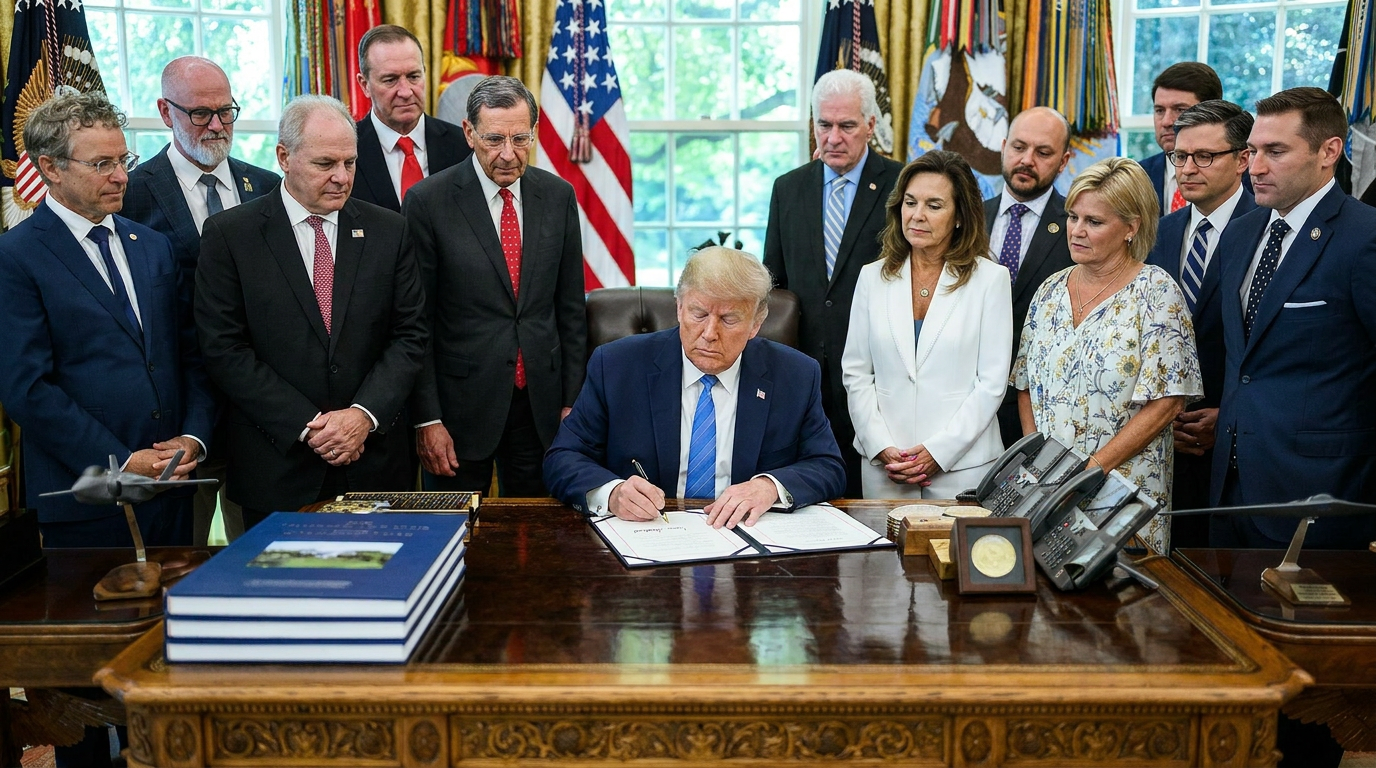
During the Oval Office signing ceremony, President Trump praised the legislation, stating it would "immediately and fully fund" DHS and put an end to the partisan bickering over border security. He credited congressional leadership for pushing the bill across the finish line despite fierce opposition, framing the package as a crucial step in restoring law and order.[2][8]
Administration officials celebrated the financial windfall as a green light for expanded operations. Border Czar Tom Homan promised the public would see an immediate increase in targeting and arrests, noting that the funding allows the government to pay medical contractors and scale up detention capacity. DHS Secretary Markwayne Mullin echoed those sentiments, calling the resources imperative for executing the agency's mission.[5][8]
Administration officials celebrated the financial windfall as a green light for expanded operations.
However, the legislation has drawn fierce condemnation from civil rights advocates and congressional opposition, who argue it provides a "blank check" to agencies with a history of alleged abuses. House Minority Leader Hakeem Jeffries accused lawmakers of funding a "violent mass deportation machine" without any oversight or guardrails.[1][4][7]
The initial funding freeze began in January after two U.S. citizens were fatally shot by federal agents during protests in Minneapolis. In the wake of the killings, opposition lawmakers demanded that any new funding be tied to strict accountability measures, including mandatory body cameras, judicial warrants for private property arrests, and bans on enforcement actions in sensitive locations like hospitals and schools.[1][4]
By using the reconciliation process, the majority stripped out those guardrails entirely, leaving ICE and CBP with unprecedented financial resources and no new congressional oversight requirements. Immigrant advocacy groups warn the funds will be used to rapidly expand the network of private detention centers and accelerate mass deportation operations across the interior of the country.[6][7]

The American Immigration Council noted that the $70 billion comes on top of $170 billion already allocated to DHS last summer through a previous reconciliation bill. According to the organization, this gives the agencies nearly a quarter of a trillion dollars in less than a year, fundamentally transforming the scale of federal immigration enforcement.[6]
Advocates also raised alarms about provisions in the Secure America Act that allow ICE funding to reimburse state and local governments participating in 287(g) agreements. These partnerships, which deputize local police to perform federal immigration duties, have grown exponentially under the current administration, expanding from 135 jurisdictions to over 1,900.[6]
The National Immigrant Justice Center warned that the lack of spending constraints enables the administration to maximize deportations and launch retaliatory campaigns against sanctuary cities that refuse to collaborate with ICE. The group argued that Congress is rewarding agencies that have "wreaked chaos" in immigrant communities.[7]

With the funding secured through September 2029, the administration now has the financial runway to execute its sweeping immigration agenda without needing to return to Congress for annual appropriations. The legislative victory cements a signature policy goal, ensuring that the border security apparatus remains fully funded well into the next presidential term.[1][3][6]
How we got here
January 2026
Two U.S. citizens are fatally shot by federal agents during protests in Minneapolis, prompting opposition lawmakers to block DHS funding and demand accountability reforms.
April 2026
Congress adopts a budget resolution, paving the way to use the reconciliation process to fund immigration agencies without bipartisan support.
June 5, 2026
The Senate passes the Secure America Act in a 52-47 vote after a marathon amendment session.
June 9, 2026
The House of Representatives narrowly approves the bill in a 214-212 vote along party lines.
June 10, 2026
President Trump signs the Secure America Act into law in the Oval Office.
Viewpoints in depth
Administration Officials
Argues the funding is a necessary victory for national security and law enforcement.
Proponents view the Secure America Act as a fulfillment of core national security promises. Border Czar Tom Homan and DHS Secretary Markwayne Mullin argue that the extended funding runway allows agencies to plan long-term operations, pay medical contractors, and dramatically scale up arrests and targeting. Officials frame the opposition as an attempt to "defund the police" and protect criminal networks, asserting that the new resources will dismantle cartels and secure the border.
Congressional Opposition
Condemns the legislation as a blank check that ignores demands for accountability.
Opposition lawmakers, including House Minority Leader Hakeem Jeffries, argue that bypassing the standard appropriations process strips away crucial oversight. The bloc had sought to tie funding to reforms—such as mandatory body cameras and restrictions on raids in sensitive areas—following the fatal shootings of two protesters by federal agents in January. They argue that handing $70 billion to ICE and CBP without these guardrails rewards rogue behavior and endangers communities.
Immigrant Advocacy Groups
Warns that the massive influx of cash will fuel a deadly expansion of the detention system.
Organizations like the National Immigrant Justice Center and the American Immigration Council point out that ICE and CBP are already sitting on billions in unobligated funds from previous bills. They warn that the new $70 billion will be funneled into private prison contracts and retaliatory operations against sanctuary cities. Advocates stress that the lack of spending constraints allows the administration to maximize deportations and expand detention capacity with zero congressional interference through 2029.
What we don't know
- How quickly ICE and CBP will deploy the $70 billion, given the lack of mandated spending timelines.
- Whether the administration will use the funds to financially penalize or target sanctuary cities.
- How the expansion of 287(g) agreements will impact local policing dynamics in cooperating jurisdictions.
Key terms
- Budget Reconciliation
- A legislative process that allows certain spending and tax bills to bypass the Senate filibuster and pass with a simple 51-vote majority.
- Immigration and Customs Enforcement (ICE)
- The federal agency responsible for enforcing immigration laws within the interior of the United States, including deportations and detention.
- Customs and Border Protection (CBP)
- The federal agency responsible for securing U.S. borders and ports of entry.
- 287(g) Agreements
- Partnerships that allow state and local law enforcement agencies to perform certain federal immigration enforcement functions.
Frequently asked
What is the Secure America Act?
A budget reconciliation bill signed in June 2026 that provides nearly $70 billion in funding for ICE, CBP, and DHS through September 2029.
Why was the funding delayed for months?
Opposition lawmakers blocked the funding starting in January, demanding accountability reforms and oversight guardrails after federal agents fatally shot two protesters in Minneapolis.
How did the bill pass without bipartisan support?
Lawmakers used the budget reconciliation process, a legislative maneuver that allows spending bills to bypass the Senate filibuster and pass with a simple majority.
How is the $70 billion divided?
The package allocates $38.5 billion to Immigration and Customs Enforcement (ICE), $26 billion to Customs and Border Protection (CBP), and $5 billion to the Department of Homeland Security (DHS).
What does the bill mean for immigration enforcement?
It bankrolls the administration's mass deportation and border security operations through the end of the presidential term, allowing agencies to scale up arrests and detention capacity without needing annual congressional approval.
Sources
Source coverage
8 outlets
3 viewpoints surfaced








[1]The GuardianCongressional Opposition
Trump signs $70bn immigration act ensuring ICE funding through 2029
Read on The Guardian →[2]CBS NewsAdministration Officials
Trump signs $70 billion immigration bill, capping lengthy fight over ICE funding
Read on CBS News →[3]Courthouse News ServiceCongressional Opposition
House passes $70 billion reconciliation package, funding ICE through end of Trump term
Read on Courthouse News Service →[4]BETCongressional Opposition
Trump Signs $70 Billion Funding Package for ICE, Border Patrol
Read on BET →[5]IANSAdministration Officials
US House passes $70 billion Trump's border protection bill
Read on IANS →[6]American Immigration CouncilImmigrant Advocacy Groups
The Secure America Act: What It Means for Immigration Enforcement
Read on American Immigration Council →[7]National Immigrant Justice CenterImmigrant Advocacy Groups
Congress Passes $70 Billion Blank Check for ICE and CBP
Read on National Immigrant Justice Center →[8]The White HouseAdministration Officials
What They Are Saying: The Secure America Act
Read on The White House →

More in news politics
See all 6 stories →US-Iran Deal
US and Iran Reach Framework Peace Deal, Reopening Strait of Hormuz
0 sources

Federal AI
Federal Government AI Deployments Double to Over 3,600 Amid Transparency Concerns
0 sources
Strait of Hormuz
US and Iran Reach Framework Peace Deal to End 15-Week War
0 sources

Strait of Hormuz
US and Iran Reach Framework Peace Deal to End 15-Week War and Reopen Strait of Hormuz
0 sources

Every angle. Every day.
Get news politics stories with full source coverage and perspective breakdowns delivered to your inbox.