
How Soundscapes and Micro-Fragmentation Are Accelerating Coral Reef Restoration
Marine biologists are combining underwater acoustics with advanced cloning techniques to rebuild the structural foundations of coral reefs up to 50 times faster than natural growth.
By Factlen Editorial Team
- Marine Technologists
- Active, high-tech intervention is the only way to scale coral restoration fast enough to matter.
- Conservation Ecologists
- Restoration must focus on the entire ecosystem, including the fish communities that maintain the reef.
- Climate Realists
- Technological interventions are temporary bandages if global carbon emissions are not drastically reduced.
What's not represented
- · Local coastal communities relying on the reefs for daily subsistence fishing.
- · Commercial tourism operators who fund much of the local conservation work.
Why this matters
Coral reefs support a quarter of all marine life and protect coastlines from devastating storm surges. These new technologies offer the first scalable blueprint for actively rebuilding these foundational ecosystems before they are lost entirely to climate change.
Key points
- Micro-fragmentation allows slow-growing massive corals to grow up to 50 times faster by triggering a rapid healing response.
- Acoustic enrichment uses underwater speakers to play healthy reef sounds, attracting drifting coral larvae to degraded areas.
- Coral larvae are most responsive to these acoustic homing beacons during their first 36 hours in the water column.
- The Florida Aquarium recently deployed 9,000 micro-fragmented juvenile corals to help restore the Florida Reef Tract.
- While these technologies accelerate restoration, they must be paired with global emissions reductions to ensure long-term reef survival.
The ocean is frequently imagined as a silent, tranquil expanse, but a healthy coral reef is remarkably loud. To a marine biologist, a thriving reef sounds like bacon sizzling in a hot frying pan, punctuated by the rhythmic grunts of feeding fish, the territorial croaks of toadfish, and the persistent, crackling static of snapping shrimp. This underwater symphony is more than just ambient noise; it is a vital biological beacon. For decades, conservationists focused on the visual decline of reefs, but recent scientific breakthroughs have revealed that the acoustic degradation of these ecosystems is equally devastating. When a reef bleaches and dies, the fish abandon it, and the reef goes quiet.[5]
That silence creates a deadly negative feedback loop. Coral larvae—tiny, free-swimming organisms no larger than a grain of rice—rely on the bustling soundscape of a healthy reef to navigate the open ocean and find a suitable place to anchor and grow. Without the auditory cues of a thriving community, the larvae drift aimlessly, and the degraded reef remains barren. Breaking this cycle of silence has become one of the most promising frontiers in marine conservation, shifting the field from passive protection to active, high-tech ecosystem engineering.[1]
The stakes for this intervention are existential. Coral reefs occupy less than one percent of the ocean floor but support more than a quarter of all marine species. They provide coastal protection, sustain global fisheries, and underpin billions of dollars in tourism. Yet, driven by climate-change-induced thermal stress, global coral cover has plummeted. The traditional response, known as "coral gardening," involved breaking off pieces of fast-growing branching corals, like staghorn, rearing them in underwater nurseries, and replanting them.[6]
While coral gardening successfully added rapid cover, it had a critical limitation: it was largely restricted to fragile, fast-growing species. It was akin to planting a forest using only fast-growing weeds and shrubs, while ignoring the massive, slow-growing oak trees. In the reef ecosystem, the "oaks" are the massive boulder, star, and brain corals. These species grow at an agonizingly slow rate of just a few millimeters per year, making them historically impractical for active restoration, despite being the structural foundation that protects coastlines from storm surges.[4]
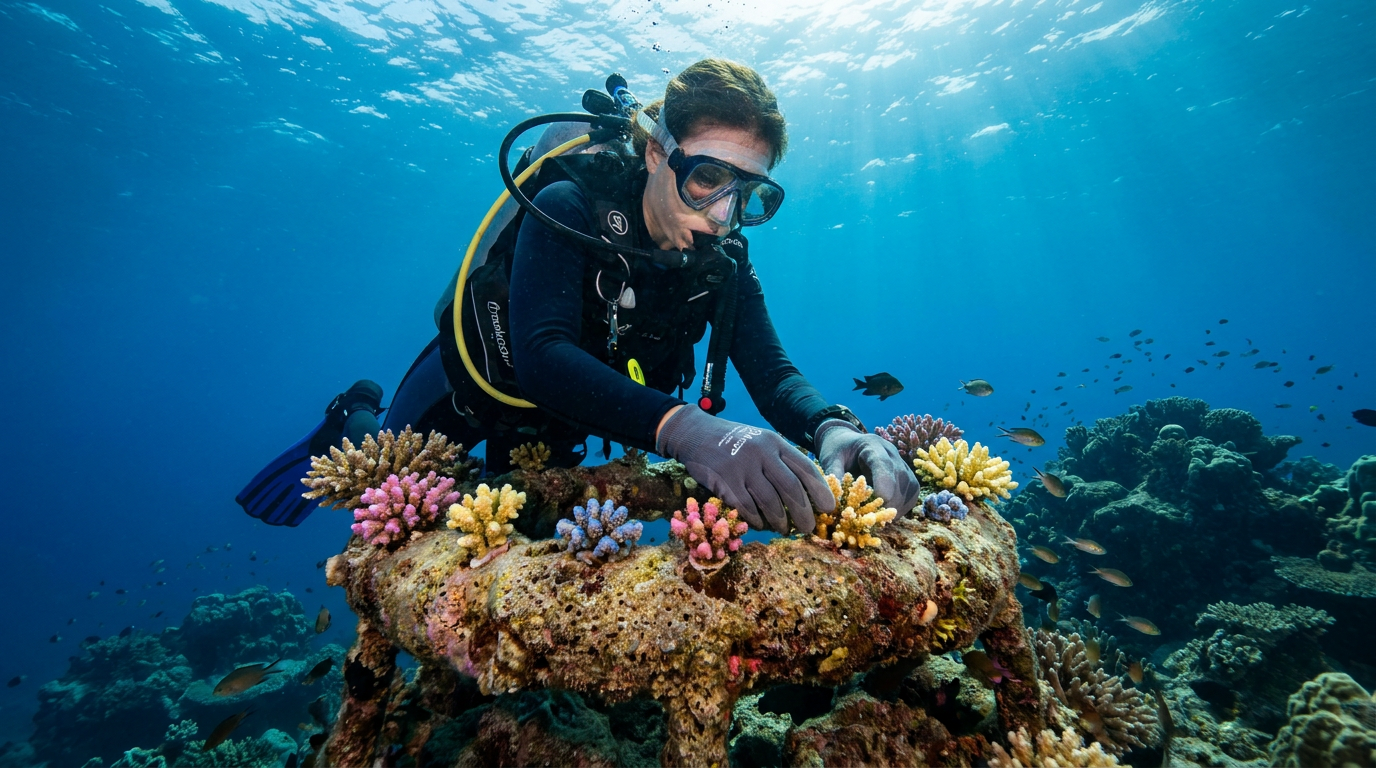
That structural bottleneck is now being bypassed by a technique called micro-fragmentation. Discovered almost by accident, marine biologists found that when massive corals are cut into tiny pieces—roughly one to three square centimeters—they enter an accelerated healing state. The trauma of the cut triggers a biological imperative to survive, causing the tissue to spread laterally over a substrate at an astonishing rate.[4]

Instead of growing a few millimeters a year, these micro-fragments grow 25 to 50 times faster than they would naturally in the wild. Because the fragments are genetically identical clones taken from the same donor colony, they do not compete with one another when placed side-by-side. As they rapidly expand, they eventually touch and fuse back together, forming a single, massive coral head in a fraction of the time it would take to grow from a single larva.[4]
This technique has moved rapidly from experimental laboratories to large-scale deployment. In January 2026, the Florida Aquarium reached a major milestone by transferring 9,000 juvenile massive corals—including great star and grooved brain corals—to restoration partners across the state. These corals, bred and micro-fragmented in land-based nurseries, represent a critical pipeline for restoring the Florida Reef Tract, which has been devastated by both thermal stress and stony coral tissue loss disease.[3]

This technique has moved rapidly from experimental laboratories to large-scale deployment.
But rebuilding the physical structure of the reef is only half the battle; the ecosystem must also be convinced to return. This is where the second major breakthrough, "acoustic enrichment," comes into play. If micro-fragmentation provides the bricks, acoustic enrichment provides the homing beacon. Researchers have begun deploying underwater loudspeakers in degraded reef zones, broadcasting the pre-recorded sounds of healthy, vibrant reefs to artificially recreate the sensory cues that marine life relies upon.[1]
The results of this "fake it until you make it" approach have been staggering. A landmark 2024 study by the Woods Hole Oceanographic Institution (WHOI) demonstrated that coral larvae actively respond to these acoustic cues. Despite lacking ears or a central nervous system, the larvae use exterior, hair-like cilia to sense acoustic vibrations in the water column, actively swimming toward the source of the sound.[1]
When researchers played healthy reef sounds in degraded areas, larval settlement rates skyrocketed. On average, coral larvae settled at rates 1.7 times higher in acoustically enriched environments, with some species showing settlement rates up to seven times higher than in silent, control areas. The WHOI researchers discovered that this acoustic sensitivity is highly time-dependent; the larvae are most responsive to sound during their first 36 hours in the water column. After that critical window, desperation sets in, and they will settle almost anywhere, regardless of the acoustic environment.[1]

Acoustic enrichment does not just attract coral larvae; it calls back the entire neighborhood. Earlier research published in Nature Communications found that playing healthy reef sounds doubled the overall abundance of fish in degraded habitats and increased species richness by 50 percent. As juvenile fish return and set up territories, they clean the substrate of algae, making it even easier for new corals to settle. The artificial sound kickstarts a genuine biological recovery, eventually allowing the speakers to be removed once the reef is loud enough to sustain itself.[2]
These dual technologies are now attracting significant international funding and being deployed in tandem. The Coral Research & Development Accelerator Platform (CORDAP) recently allocated $1.5 million to scale acoustic enrichment projects across the Caribbean and the Galápagos Islands. In the Galápagos, conservationists are currently monitoring a restoration site where 6,000 coral transplants are being supported by a Reef Acoustic Playback System, combining the physical outplanting of resilient corals with the auditory lure needed to rebuild the broader ecosystem.[4]

Despite these remarkable advances, marine biologists are quick to emphasize that technology cannot outpace fundamental ocean chemistry. Micro-fragmentation and acoustic enrichment are highly effective tools for rebuilding degraded habitats, but they do not make the corals immune to the boiling temperatures that killed the original reefs. If global carbon emissions continue unabated and ocean temperatures continue to shatter historical records, even the fastest-growing, acoustically-guided corals will eventually bleach and starve.[7]
To bridge this gap, scientists are adding a third layer to the restoration pipeline: assisted evolution. By selectively breeding corals that have survived recent mass bleaching events, researchers are cultivating "super corals" with higher thermal tolerances. When these heat-resistant genotypes are multiplied via micro-fragmentation and guided by acoustic enrichment, the resulting reefs have a fighting chance of surviving the warmer oceans of the mid-21st century.[7]
The narrative of coral reefs has long been one of inevitable decline, a tragic casualty of the Anthropocene. But the convergence of these new techniques offers a tangible, scalable blueprint for resilience. Conservationists are no longer just documenting the demise of the oceans; they are actively replanting the forests of the sea, armed with diamond-bladed saws, underwater loudspeakers, and a profound understanding of the sensory world of the reef. These interventions will not solve climate change, but they are buying the world's most biodiverse marine ecosystems the one thing they need most: time.[7]
How we got here
2015
Micro-fragmentation begins gaining traction as a viable method for cultivating slow-growing massive corals.
2019
Researchers publish data showing that playing healthy reef sounds can double the abundance of juvenile fish in degraded habitats.
2024
The Woods Hole Oceanographic Institution proves that coral larvae themselves actively swim toward the sounds of healthy reefs.
Jan 2026
The Florida Aquarium successfully deploys 9,000 land-grown massive corals, marking a major milestone in scaling restoration.
Viewpoints in depth
Marine Technologists' view
Active, high-tech intervention is the only way to scale coral restoration fast enough to matter.
This camp argues that passive conservation—simply protecting areas and hoping they recover—is no longer sufficient given the pace of climate change. By treating the ocean as an engineering challenge, technologists believe we can bypass natural biological bottlenecks. They point to the 50-fold increase in growth rates from micro-fragmentation and the 7-fold increase in settlement from acoustic enrichment as proof that human intervention can actively rebuild ecosystems. Their primary focus is on driving down the cost of these technologies and scaling them globally through automated nurseries and AI-monitored acoustic systems.
Conservation Ecologists' view
Restoration must focus on the entire ecosystem, not just the physical coral structure.
Ecologists emphasize that a reef is more than just living rock; it is a complex web of interactions. They champion acoustic enrichment because it addresses the behavioral ecology of the reef, bringing back the herbivorous fish that keep algae in check and create the conditions necessary for coral to thrive. This camp warns against creating 'sterile' restored reefs that lack genetic and species diversity. They advocate for combining coral outplanting with strict marine protected areas, ensuring that once the fish and corals are coaxed back, they are not immediately decimated by overfishing or local pollution.
Climate Realists' view
Technological interventions are temporary bandages if global carbon emissions are not drastically reduced.
While acknowledging the brilliance of micro-fragmentation and acoustic enrichment, this perspective warns against 'techno-optimism' becoming a distraction from the root cause of coral decline. If ocean temperatures continue to rise, even the most robust, acoustically-guided super corals will eventually succumb to mass bleaching. This camp argues that restoration projects, while vital for preserving genetic diversity and buying time, must be explicitly paired with aggressive global decarbonization. Without a cooler ocean, they argue, we are simply building highly engineered reefs that are destined to boil.
What we don't know
- Whether acoustically-enriched and micro-fragmented reefs will possess the genetic diversity required to survive future, more severe marine heatwaves.
- How long the acoustic speakers need to remain in place before a restored reef becomes loud enough to sustain its own recruitment cycle.
Key terms
- Micro-fragmentation
- A technique where slow-growing corals are cut into tiny pieces to stimulate a rapid healing response, increasing growth rates up to 50 times.
- Acoustic enrichment
- The practice of playing pre-recorded sounds of a healthy ecosystem through underwater speakers to attract marine life to a degraded area.
- Larval settlement
- The critical life stage where free-swimming coral larvae attach themselves to a hard surface to begin growing into a coral colony.
- Massive corals
- Slow-growing, boulder-like coral species (such as brain and star corals) that form the foundational physical structure of a reef.
- Benthic cover
- The proportion of the ocean floor covered by living organisms, such as coral or sponges, used as a metric for reef health.
Frequently asked
Does cutting the coral hurt it?
While it causes temporary trauma, the cutting triggers a natural biological healing response that forces the coral to grow exponentially faster to survive.
How do coral larvae hear without ears?
Coral larvae are covered in microscopic, hair-like structures called cilia, which can sense acoustic vibrations in the water and guide them toward the source.
Will these techniques save the reefs from climate change?
Not on their own. These methods buy crucial time and rebuild local resilience, but long-term survival requires halting the global ocean warming that causes mass bleaching.
Sources
Source coverage
7 outlets
3 viewpoints surfaced






[1]Woods Hole Oceanographic InstitutionMarine Technologists
Sonic Youth: Healthy Reef Sounds Increase Coral Settlement
Read on Woods Hole Oceanographic Institution →[2]Nature CommunicationsConservation Ecologists
Acoustic enrichment can enhance fish community development on degraded coral reef habitat
Read on Nature Communications →[3]The Florida AquariumMarine Technologists
Major Coral Restoration Milestone as 9,000 Coral Babies are Transferred to Reef Restoration Partners Across Florida
Read on The Florida Aquarium →[4]CORDAPMarine Technologists
Listening to corals to restore reefs
Read on CORDAP →[5]Earth.OrgConservation Ecologists
Can Soundscapes Save Coral Reefs?
Read on Earth.Org →[6]Great Barrier Reef FoundationConservation Ecologists
5 inspiring Reef stories you may have missed from 2025
Read on Great Barrier Reef Foundation →[7]Factlen Editorial TeamClimate Realists
Synthesis by Factlen editorial team
Read on Factlen Editorial Team →

Every angle. Every day.
Get environment stories with full source coverage and perspective breakdowns delivered to your inbox.