
How the UFC Built an Octagon on the South Lawn: Inside the Logistics of Freedom 250
UFC Freedom 250 marked the first time a major combat sports event was held at the White House, overcoming severe weather and unprecedented security hurdles. While deemed a massive cultural milestone for mixed martial arts, the extreme operational friction means the spectacle will likely remain a one-off event.
By Factlen Editorial Team
- MMA Executives & Promoters
- View the event as a monumental branding success but an operational nightmare that should never be repeated.
- Sports Business Analysts
- Focus on the financial realities, noting the event was a loss leader designed for prestige rather than live gate revenue.
- Cultural Commentators
- Analyze the event as the final step in MMA's journey from a banned, fringe activity to a fully mainstream American institution.
What's not represented
- · Local D.C. residents affected by the massive security perimeters
- · Secret Service agents tasked with securing the live broadcast
Why this matters
This event represents the ultimate mainstream validation for a sport once banned in multiple states, proving that mixed martial arts has achieved the highest level of cultural and institutional acceptance. However, the sheer operational friction of hosting live sports at a secure government facility sets a clear boundary on how far sports properties can integrate with federal landmarks.
Key points
- UFC Freedom 250 was the first major combat sports event held on the White House South Lawn.
- Unprecedented security clearances were required for all fighters, staff, and broadcast equipment.
- A severe rainstorm caused a three-hour delay, exposing the risks of outdoor events.
- UFC President Dana White stated the operational friction was too high to ever repeat the event.
- The broadcast served as a massive cultural milestone, finalizing MMA's mainstream acceptance.
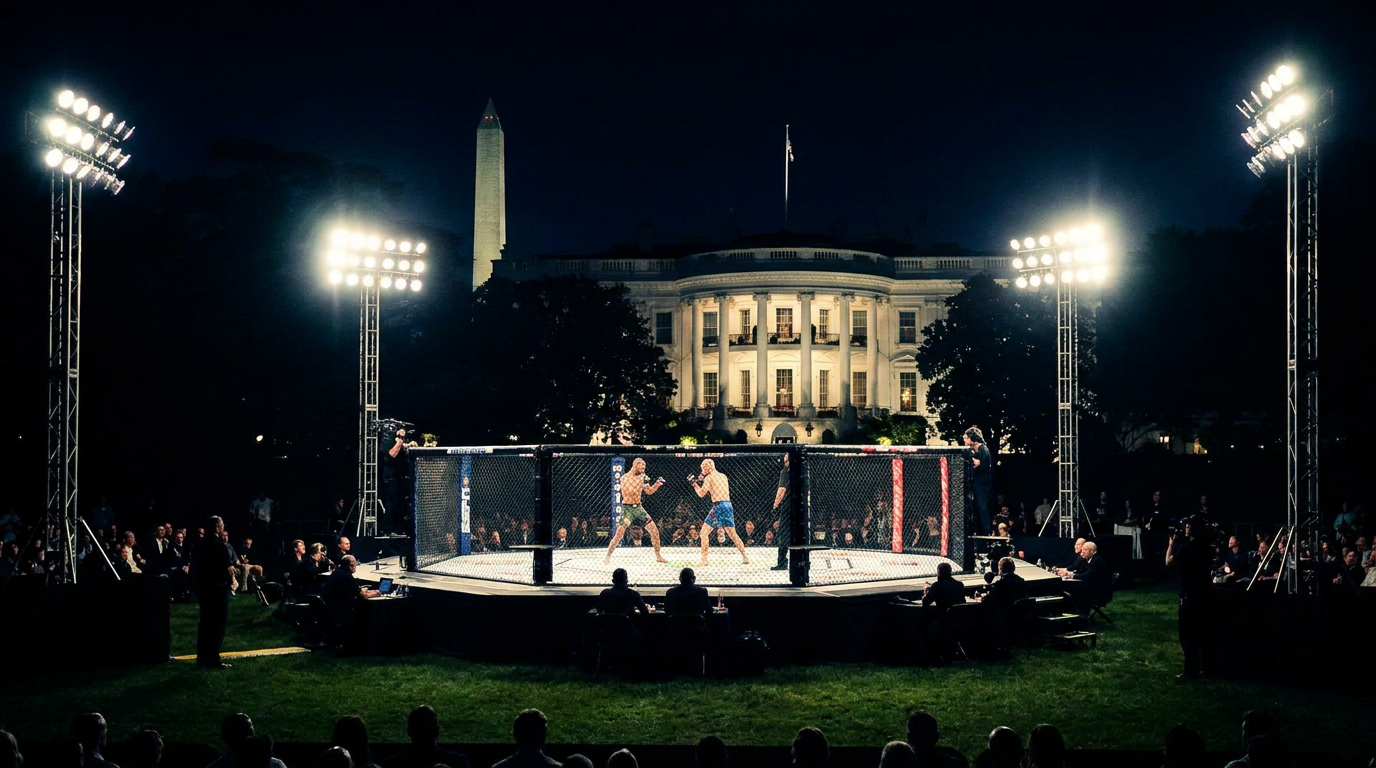
The visual was as surreal as it was historic: a 750-square-foot, eight-sided chain-link cage erected directly on the South Lawn of the White House, illuminated by stadium-grade lighting with the Washington Monument piercing the night sky in the background. UFC Freedom 250 was not merely a pay-per-view broadcast; it was a massive logistical flex that merged the gritty reality of combat sports with the highest echelons of American statecraft. For a sport that spent its infancy battling legislative bans and fighting for survival on the fringes of athletic commission regulations, arriving at 1600 Pennsylvania Avenue represented the absolute zenith of mainstream acceptance.[1][4]
But pulling off a live, globally broadcast sporting event at one of the most secure facilities on the planet required an operational mechanism unlike anything the Ultimate Fighting Championship had ever attempted. Standard arena load-ins typically take a few days, with fleets of semi-trucks backing into loading docks to deposit tons of steel, lighting rigs, and broadcast equipment. At the White House, every single piece of equipment—down to the last bolt of the Octagon and the canvas mat—had to be individually screened, cataloged, and cleared by the United States Secret Service weeks in advance.[3][6]
The human element proved even more complex than the hardware. A standard UFC pay-per-view requires a traveling circus of roughly 400 to 500 personnel, including fighters, cornermen, cutmen, broadcast technicians, makeup artists, and executives. For Freedom 250, every individual required a high-level background check. Fighters accustomed to bringing sprawling entourages were strictly limited to three licensed cornermen, fundamentally altering the backstage dynamic. The traditional fight-week rituals were entirely upended; weigh-ins, typically held in raucous arenas, were conducted in a heavily guarded executive briefing room, creating an atmosphere that fighters described as both deeply intimidating and profoundly historic.[3][7]
Financially, the event operated on a completely different model than a standard arena show. The UFC typically relies on massive live gates—often exceeding $10 million for major cards—driven by 15,000 to 20,000 ticket-buying fans. The South Lawn configuration allowed for a strictly capped attendance of just 4,500 people, consisting primarily of invited military personnel, government officials, and a small allocation of VIPs. Consequently, Freedom 250 functioned as a "loss leader" in terms of live revenue, designed entirely to maximize pay-per-view buys and elevate the brand's global prestige rather than turn a profit at the door.[5][6]

Nature, however, respects no security clearances. The most significant threat to the event was not logistical red tape, but a severe Atlantic storm front that stalled over Washington D.C. on fight night. Unlike traditional stadiums with retractable roofs or indoor arenas, the South Lawn setup was entirely exposed to the elements. As torrential rain began to fall just before the main card, the promotion faced a crisis that threatened to derail years of planning. The canvas of the Octagon, which becomes dangerously slick when wet, had to be protected at all costs to ensure fighter safety.[1]
The resulting three-hour weather delay tested the patience of the global broadcast audience and the live attendees alike. UFC production crews deployed massive custom-fitted tarps over the cage, while teams of workers stood by with industrial squeegees and high-powered fans. The broadcast team, huddled under temporary canopies, had to vamp on live television, interviewing politicians and military veterans to fill the dead air. It was a chaotic, unscripted stress test of the UFC's live-production capabilities, forcing them to adapt on the fly in an environment where they had zero control over the infrastructure.[1][3]
The resulting three-hour weather delay tested the patience of the global broadcast audience and the live attendees alike.
When the skies finally cleared and the fights resumed, the atmosphere was electric. The juxtaposition of elite mixed martial artists competing in front of the illuminated executive mansion created a broadcast aesthetic that immediately went viral across social media platforms. The fights themselves delivered on the hype, with the unique environment seemingly pushing the athletes to perform at their absolute peak. The echoes of strikes landing could be heard bouncing off the historic architecture, creating an acoustic environment entirely distinct from the roar of a traditional enclosed arena.[1][5]
Yet, despite the undeniable visual and cultural success of the broadcast, the sheer friction of the endeavor left a lasting mark on the promotion's leadership. UFC President Dana White, known for his aggressive expansion of the brand, was uncharacteristically blunt in the aftermath. While expressing immense pride in his team's ability to execute the event and praising the cooperation of the administration, White definitively stated that the promotion would "never do this again." The comment underscored a stark reality: the return on investment, measured in brand equity, was not worth the staggering operational toll.[2][8]

White elaborated that the restrictions placed on the production team fundamentally compromised the UFC's ability to control its own product. The inability to adjust lighting rigs on the fly, the strict curfews enforced by local D.C. ordinances, and the constant presence of federal security agents monitoring every movement created an environment of suffocating rigidity. For a live sports property that thrives on agility and the ability to pivot instantly during a broadcast, the bureaucratic weight of the White House was simply too heavy to bear a second time.[2][3][8]
The broader implications of Freedom 250 extend far beyond the UFC. The event served as a high-profile case study for other sports leagues considering "stunt" venues for major broadcasts. While the NHL has successfully executed outdoor Winter Classics and Major League Baseball has hosted the Field of Dreams game, those events occurred in environments explicitly designed or modified for sports. Attempting to force a massive live-production footprint into a working government facility proved that there is a hard ceiling on how far sports can integrate with federal landmarks.[4][6]
Culturally, however, the event's legacy is permanently cemented. In the late 1990s, mixed martial arts was famously derided by Senator John McCain as "human cockfighting," leading to its banishment from cable television and major venues across the United States. The sport was forced underground, surviving on VHS tapes and niche internet forums. To trace the arc from those dark days to a fully sanctioned, globally broadcast event hosted on the lawn of the American presidency is to witness one of the most remarkable rehabilitations in the history of sports business.[4][5]

The fighters who competed on the card immediately recognized their place in this historical continuum. Post-fight interviews were less about individual rankings or title aspirations and more about the surreal nature of the venue. Several athletes noted the profound emotional weight of making the walk to the Octagon while flanked by military honor guards, a stark departure from the usual gauntlet of screaming, beer-spilling fans. It elevated the stakes of the competition from mere athletic contest to a display of national pageantry.[5][7]
Moving forward, the UFC will return to its standard operating procedure: dominating massive indoor arenas in Las Vegas, New York, and international markets where they maintain absolute control over the environment. The promotion has mastered the science of the arena show, turning it into a highly profitable, easily replicable machine. The White House experiment was the antithesis of that machine—a bespoke, wildly inefficient, and deeply stressful endeavor that required reinventing the wheel for a single night.[6][8]

Ultimately, UFC Freedom 250 will be remembered as a spectacular anomaly. It was a necessary milestone for the sport to prove it belonged at the absolute center of American culture, but having proved the point, there is no need to make the argument again. The Octagon has been dismantled, the South Lawn has been re-sodded, and the sport of mixed martial arts moves forward, forever changed by the night it took over the capital.[2][4]
How we got here
Late 1990s
MMA is labeled 'human cockfighting' and banned in multiple US states.
2001
Zuffa purchases the UFC, implementing unified rules and beginning the push for regulation.
2016
New York becomes the final state to legalize professional mixed martial arts.
June 2026
The UFC successfully hosts Freedom 250 on the South Lawn of the White House.
Viewpoints in depth
MMA Executives & Promoters
View the event as a monumental branding success but an operational nightmare.
For the leadership of the UFC, Freedom 250 was a double-edged sword. On one hand, the visual of their brand integrated with the highest office in the land provided invaluable global prestige and marketing material that will be used for decades. On the other hand, the promotion is built on absolute control of its environment—from lighting to pacing to security. Handing that control over to federal agencies resulted in a rigid, stressful production environment that stifled their usual agility. This loss of autonomy is the primary reason leadership has vowed never to attempt a similar stunt.
Sports Business Analysts
Focus on the financial realities of sacrificing live gate revenue for brand equity.
Industry analysts point out that Freedom 250 defied standard combat sports economics. A typical major UFC pay-per-view relies heavily on a massive live gate, often pulling in excess of $10 million from 15,000 to 20,000 fans. By capping attendance at 4,500 and distributing tickets primarily to military and VIPs, the UFC intentionally absorbed a massive loss on the live event side. However, analysts argue this was a calculated 'loss leader' strategy; the sheer novelty of the venue likely drove pay-per-view buy rates significantly higher, offsetting the lost ticket revenue while permanently elevating the brand's corporate valuation.
Cultural Commentators
Analyze the event as the final step in MMA's journey to mainstream acceptance.
For those who have tracked the sociological arc of combat sports, the White House event represents the closing of a chapter. Thirty years ago, the sport was actively targeted by politicians seeking to outlaw it entirely, forcing promoters to host events on Native American reservations or in obscure international locales. Commentators note that seeing the sport embraced by the executive branch proves that the visceral nature of cage fighting has been fully sanitized and absorbed into the traditional American sports pantheon, sitting comfortably alongside baseball and football.
What we don't know
- The exact cost incurred by the UFC to meet the extreme security and logistical requirements of the venue.
- Whether other major sports leagues will attempt to negotiate similar events at federal landmarks in the future.
Key terms
- Octagon
- The trademarked eight-sided, chain-link cage in which UFC mixed martial arts bouts are contested.
- Live Gate
- The total amount of revenue generated from ticket sales for a live sporting event.
- Loss Leader
- A product or event offered at a financial loss to attract broader attention, build brand prestige, or drive secondary sales like pay-per-views.
Frequently asked
Why did Dana White say the UFC will never return to the White House?
The extreme security protocols, strict curfews, and inability to control the environment created an operational nightmare that outweighed the promotional benefits.
How many people attended the event?
Attendance was strictly capped at 4,500 people, consisting mostly of military personnel and government officials, rather than the typical 15,000+ arena crowd.
How did the weather impact the fights?
A severe rainstorm caused a three-hour delay, forcing crews to cover the Octagon with tarps and use squeegees to ensure the canvas was safe for the athletes.
Sources
Source coverage
8 outlets
3 viewpoints surfaced







[1]ESPNMMA Executives & Promoters
UFC at the White House beats the odds and the rain to put on big show
Read on ESPN →White: UFC at White House 'great,' never again
Read on ESPN →[3]MMA FightingCultural Commentators
The logistical nightmare of building an Octagon at 1600 Pennsylvania Avenue
Read on MMA Fighting →[4]The Washington PostCultural Commentators
Combat sports on the South Lawn: A cultural shift for a once-banned spectacle
Read on The Washington Post →[5]CBS SportsSports Business Analysts
UFC Freedom 250 results and historic impact of the White House event
Read on CBS Sports →[6]Sports Business JournalSports Business Analysts
The cost of building an arena at the White House: Why UFC 250 was a loss leader
Read on Sports Business Journal →[7]Yahoo SportsCultural Commentators
Fighters react to unprecedented White House weigh-ins and security protocols
Read on Yahoo Sports →[8]MMA JunkieMMA Executives & Promoters
Why Dana White says the UFC's greatest spectacle won't be repeated
Read on MMA Junkie →
More in sports
See all 6 stories →NBA Finals
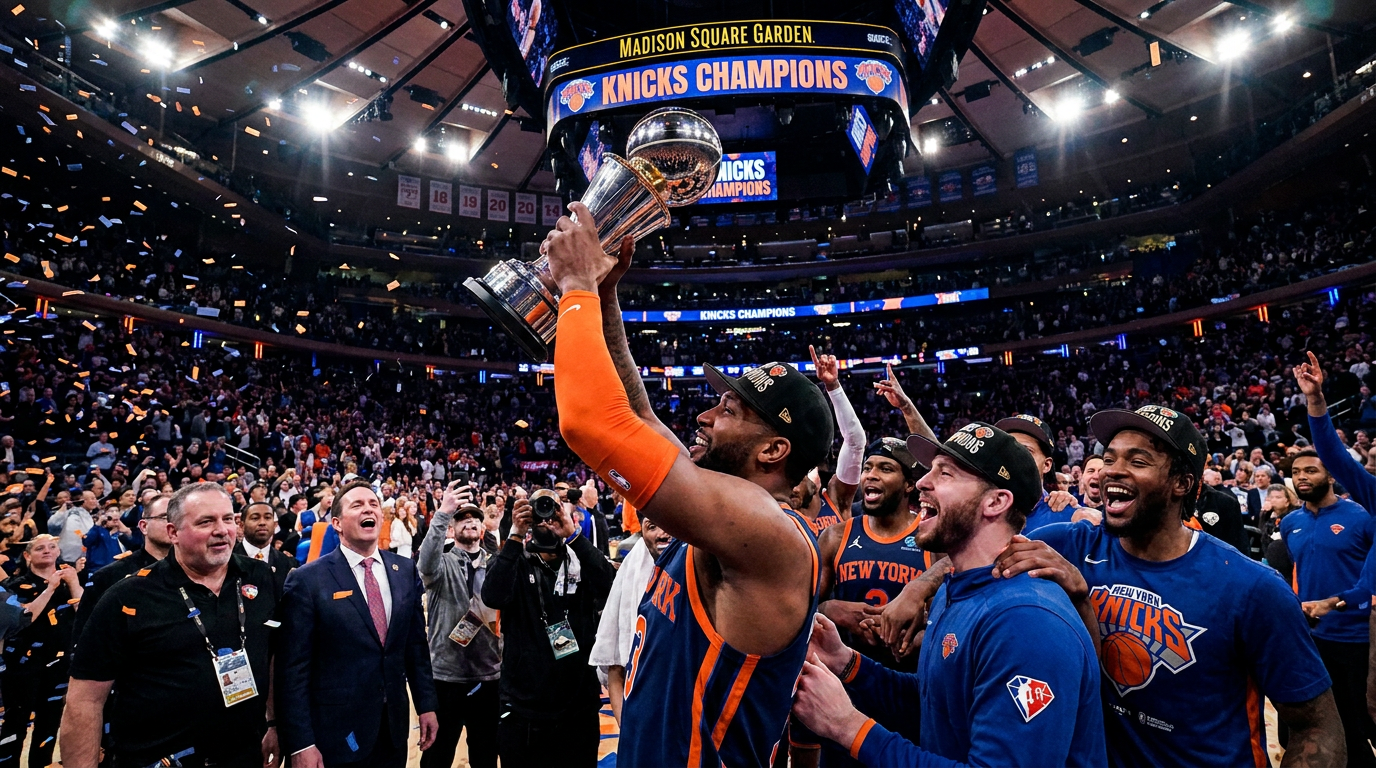
New York Knicks Win 2026 NBA Championship, Ending 53-Year Title Drought
0 sources
Avalanche Tech
How AI and Machine Learning Are Revolutionizing Avalanche Prediction
0 sources

Youth Football
FIFA Proposes Symbolic Israel-Palestine Match to Open New Under-15 Global Tournament
0 sources

Endurance Physiology
The Science of the 'Norwegian Method': How Double Threshold Training is Rewriting Endurance Physiology
0 sources

Every angle. Every day.
Get sports stories with full source coverage and perspective breakdowns delivered to your inbox.