
How 'Super Spikes' Rewrote the Track and Field Record Books
Advanced Footwear Technology, combining supercritical foam and carbon-fiber plates, has given runners a measurable 2% speed advantage, fundamentally altering the sport's biomechanics.
By Factlen Editorial Team
- Biomechanists & Researchers
- Focuses on the quantifiable energy return and mechanical advantages of the footwear.
- Elite Athletes & Coaches
- Focuses on race-day execution, performance gains, and competitive equity.
- Sports Physiotherapists
- Focuses on the altered kinetic loads and the emerging patterns of lower-leg injuries.
What's not represented
- · Shoe Manufacturers' R&D Teams
- · Amateur/High School Athletes priced out of the tech
Why this matters
Understanding the science behind super spikes explains why historical track records are falling so rapidly, and highlights the delicate balance between technological innovation and athlete safety in modern sports.
Key points
- Super spikes combine ultra-lightweight, resilient foam with rigid carbon-fiber plates.
- The technology provides a proven 2% improvement in running economy for middle-distance events.
- Athletes wearing the shoes take up to 21 fewer steps over a 1,500-meter race.
- World Athletics has capped track spike sole thickness at 20 millimeters to regulate the technology.
- Physiotherapists warn that the shoes shift mechanical load, increasing the risk of Achilles and bone stress injuries.
Over the past five years, the record books in track and field have been entirely rewritten. From the 100-meter dash to the 10,000-meter grind, long-standing global benchmarks have fallen with startling regularity. While training methods and track surfaces have improved, sports scientists point to a single, highly visible common denominator on the athletes' feet: the advent of "super spikes." These brightly colored, highly engineered shoes have permanently shifted the baseline of human speed, sparking a revolution in biomechanics and a fierce debate over fairness, accessibility, and injury risk.[1][7]
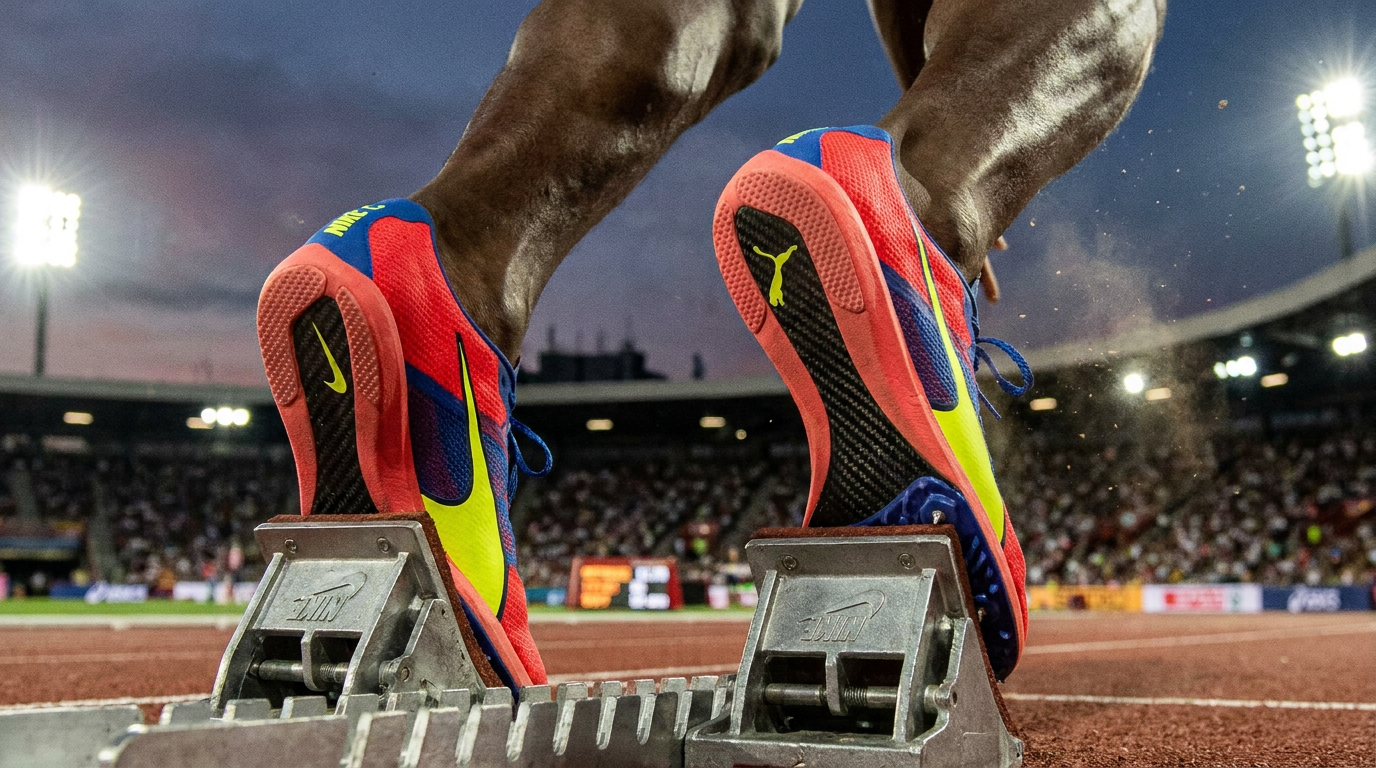
To understand the super spike era, one must first look at the traditional track shoe. For decades, the design philosophy for spikes was simple: make them as light as possible and attach metal pins for grip. They featured a paper-thin sole and a rigid plastic plate, offering zero cushioning. The modern super spike, scientifically classified as Advanced Footwear Technology (AFT), abandons that minimalist approach. Instead, it borrows the two key innovations that revolutionized road marathons: ultra-resilient "super foam" and a stiff carbon-fiber or composite plate embedded within the midsole.[2][4][6]
The magic begins with the foam. Traditional EVA foam is relatively heavy and dissipates a significant amount of the runner's mechanical energy as heat upon impact. Super spikes utilize supercritical foams, most commonly PEBA (polyether block amide), which are astonishingly lightweight and highly compliant. When a runner's foot strikes the track, the PEBA foam compresses deeply, absorbing the impact, and then rapidly expands, returning a massive percentage of that energy directly back into the runner's stride rather than losing it to the ground.[4][6]

However, a thick layer of ultra-bouncy foam is inherently unstable. This is where the carbon-fiber plate becomes crucial. The rigid plate acts as a stabilizing lever, allowing the athlete to apply force evenly across the entire volume of the super foam. Biomechanists explain that the plate also alters the mechanics of the metatarsophalangeal (MTP) joint—the joint at the base of the toes. By keeping the toes from bending excessively during the push-off phase, the plate prevents energy from being lost, effectively acting as a springboard that propels the runner forward.[2][6]
The performance gains provided by this combination of materials are not merely anecdotal; they are highly quantifiable and rigorously tested. A comprehensive biomechanical study led by researchers at the University of Massachusetts Amherst, which tested elite runners in various spike configurations, found that super spikes provide a measurable 2% improvement in running economy for middle-distance events like the 800-meter and 1,500-meter races. In a sport where Olympic medals and world records are routinely decided by hundredths of a second, a guaranteed 2% mechanical advantage is a monumental paradigm shift that no competitive athlete can afford to ignore.[1][3]
Translating that 2% metabolic efficiency into race times reveals the true scale of the disruption. For an elite 800-meter runner, the technology shaves roughly one to two seconds off their final time. Furthermore, the UMass researchers discovered that the shoes physically alter a runner's stride length. Over the course of a 1,500-meter race, athletes wearing super spikes took between 17 and 21 fewer steps than they did in traditional spikes, covering more ground with less mechanical effort and significantly delaying the onset of muscular fatigue.[1][2]

Translating that 2% metabolic efficiency into race times reveals the true scale of the disruption.
The technology is not one-size-fits-all; it is meticulously tuned to the specific demands of different events. Sprint spikes, designed for the explosive power of the 100-meter and 200-meter dashes, feature incredibly stiff plates and minimal foam to maximize raw power transfer and traction. Conversely, distance spikes prioritize a thicker bed of PEBA foam to reduce muscle fatigue over thousands of impacts, utilizing a slightly more flexible plate to accommodate the rolling motion of a distance runner's gait over multiple laps.[4]
Yet, this mechanical revolution comes with a significant biological catch. As athletes transitioned to super spikes, sports physiotherapists began noting a sharp rise in specific lower-leg injuries. Because the carbon plate alters the foot's natural flexion, it shifts the mechanical load away from the foot and higher up the biokinetic chain. Runners have frequently reported severe Achilles tendon pain, and more concerningly, an increase in navicular bone stress fractures—a serious injury that often requires prolonged rest, immobilization, or even surgery to correct.[3][5]
The injury risk is compounded by the aggressive geometry of the shoes. Many super spikes hold the foot in a constant state of dorsiflexion (toes pointed upward), which places continuous tension on the Achilles and calf muscles even when the athlete is standing still. Experts caution that while the shoes return energy, they also demand that the athlete's musculoskeletal system be robust enough to handle the altered kinetic forces. For developing teenage athletes, whose bones are still maturing, the risks of adopting stiff carbon plates too early are particularly acute.[3][5]

Faced with a technological arms race that threatened to render historical records obsolete, World Athletics—the global governing body for track and field—was forced to intervene. To prevent manufacturers from building increasingly massive "moon shoes," regulators instituted strict dimensional limits. Under the current rules, the maximum allowable stack height (midsole thickness) for track spikes is capped at 20 millimeters. Any shoe exceeding this height is illegal in professional competition, ensuring that the foam's energy return has a physical ceiling and that human effort remains the primary variable.[2][6]
While the 20-millimeter rule governs the Olympics and World Championships, it has created a strange dichotomy at the grassroots level. High school and collegiate athletic associations generally do not enforce World Athletics stack-height rules. Consequently, amateur athletes are technically free to race in thicker, non-compliant shoes. However, the prohibitive cost of super spikes—often exceeding $200 for a shoe that lasts only a single season—has sparked concerns about technological inequity, where victory might go to the best-funded athlete rather than the most talented.[2][4]

Looking ahead, the next frontier in track footwear is hyper-customization rather than broad standardization. Biomechanics researchers note that individual physiological responses to super spikes vary wildly; a shoe geometry that gives one runner a massive 3% efficiency boost might offer another runner with a different footstrike zero benefit. To maximize performance, major shoe brands are now utilizing advanced laboratory testing protocols to tune foam density, plate stiffness, and pin placement to the specific weight, stride mechanics, and race distance of individual elite athletes.[1][2][3]
Ultimately, Advanced Footwear Technology has permanently altered the landscape of track and field. While purists may lament the asterisk placed next to modern world records, the reality is that technological progression is an inherent part of athletic history—from cinder tracks to synthetic surfaces, and from heavy leather boots to PEBA foam. The shoes do not run the race, and they cannot replace rigorous training, but they have undeniably unlocked a new tier of human potential, allowing athletes to run faster, and fly further, than ever before.[6][7]
How we got here
1968
PUMA introduces the controversial 'brush shoe' with 68 tiny spikes, which is quickly banned.
2016
Carbon-plated 'super shoes' debut in road marathons, fundamentally changing distance running.
2019
The first generation of track-specific super spikes begins appearing on the feet of elite athletes.
2021
A wave of world records falls at the Tokyo Olympics, cementing the dominance of AFT spikes.
Nov 2024
World Athletics enforces a strict 20-millimeter maximum stack height for all track spikes.
Viewpoints in depth
Biomechanists & Researchers
Focuses on the quantifiable energy return and mechanical advantages of the footwear.
Sports scientists view super spikes as a fascinating leap in materials science. By measuring oxygen consumption, ground reaction forces, and stride length, researchers have quantified exactly how supercritical foams and carbon plates reduce the metabolic cost of running. For this camp, the shoes are a triumph of engineering that allows the human body to operate closer to its theoretical maximum efficiency.
Elite Athletes & Coaches
Focuses on race-day execution, performance gains, and competitive equity.
For those on the track, super spikes are an absolute necessity for survival at the elite level. Coaches note that the shoes not only yield faster times but also significantly reduce muscle fatigue, allowing athletes to recover faster between grueling workout sessions. However, this camp also worries about the 'arms race' aspect, where athletes sponsored by brands with inferior shoe technology may find themselves at a severe competitive disadvantage.
Sports Physiotherapists
Focuses on the altered kinetic loads and the emerging patterns of lower-leg injuries.
Medical professionals look at the super spike revolution with a degree of caution. Because carbon plates act as rigid levers, they shift the mechanical stress of running away from the foot and directly into the Achilles tendon and lower leg bones. Physiotherapists are seeing a rise in navicular stress fractures and tendonitis, arguing that athletes must carefully adapt their biokinetic chain to handle the unique forces generated by these highly propulsive shoes.
What we don't know
- Exactly why certain athletes experience a massive performance boost from the shoes while others see negligible gains.
- The long-term developmental impact of carbon-plated shoes on the growing bones of teenage athletes.
- How future iterations of track surfaces will interact with increasingly advanced shoe foams.
Key terms
- Advanced Footwear Technology (AFT)
- The scientific classification for modern running shoes that utilize highly resilient foams and rigid plates to improve running economy.
- Supercritical Foam
- A lightweight, highly responsive midsole material, often made of PEBA, that returns a high percentage of energy upon impact.
- Carbon-Fiber Plate
- A stiff, curved insert inside the shoe's midsole that acts as a lever to stabilize the foam and propel the runner forward.
- Stack Height
- The total thickness of the shoe's sole, measured from the bottom of the foot to the ground.
- Dorsiflexion
- The backward bending and contracting of the foot and toes upward toward the shin.
Frequently asked
Are super spikes considered cheating?
No. While they provide a measurable advantage, they are fully legal under World Athletics rules, provided they meet the 20-millimeter stack height limit and are available on the open market.
Can high school runners wear super spikes?
Yes. The strict stack height regulations generally only apply to elite professional and international competitions, though the high cost of the shoes remains a barrier for many amateur athletes.
Do super spikes cause injuries?
They can. The rigid plates alter a runner's natural biomechanics, shifting stress to the Achilles tendon and lower leg bones, which has led to an increase in specific stress injuries among athletes who do not adapt properly.
Sources
Source coverage
7 outlets
3 viewpoints surfaced







[1]ScienceDailyBiomechanists & Researchers
Super spikes give runners a 2% edge in middle-distance track races
Read on ScienceDaily →[2]Running WritingsElite Athletes & Coaches
The science of running in super spikes: New data on track shoes
Read on Running Writings →[3]Journal of Sports SciencesBiomechanists & Researchers
Can we quantify the benefits of 'Super Spikes' in track running?
Read on Journal of Sports Sciences →[4]Outside OnlineElite Athletes & Coaches
The Best Track Spikes of 2026
Read on Outside Online →[5]Canadian Running MagazineSports Physiotherapists
Are your carbon-plated shoes making you weaker?
Read on Canadian Running Magazine →[6]National Institutes of HealthBiomechanists & Researchers
The Biomechanics of Advanced Footwear Technology in Track and Field
Read on National Institutes of Health →[7]Factlen Editorial TeamElite Athletes & Coaches
Synthesis by Factlen editorial team
Read on Factlen Editorial Team →

More in sports
See all 6 stories →NBA Finals
New York Knicks Win 2026 NBA Championship, Ending 53-Year Title Drought
0 sources

Avalanche Tech
How AI and Machine Learning Are Revolutionizing Avalanche Prediction
0 sources

Youth Football
FIFA Proposes Symbolic Israel-Palestine Match to Open New Under-15 Global Tournament
0 sources

Endurance Physiology
The Science of the 'Norwegian Method': How Double Threshold Training is Rewriting Endurance Physiology
0 sources

Every angle. Every day.
Get sports stories with full source coverage and perspective breakdowns delivered to your inbox.