
How SpaceX Executed the Largest IPO in History and Reshaped the Space Economy
SpaceX's record-breaking $75 billion public debut bypassed traditional Wall Street norms, offering a new blueprint for mega-IPOs and opening the commercial space sector to everyday investors.
By Factlen Editorial Team
- Retail Investors
- Enthusiastic about finally gaining direct portfolio access to the defining aerospace company of the era.
- Institutional Underwriters
- Focused on the massive trading volume and advisory fees generated by the historic listing, despite its unconventional structure.
- Aerospace Analysts
- Evaluating the long-term fundamentals, specifically Starlink's cash flow and Starship's payload economics.
What's not represented
- · Legacy aerospace competitors facing margin compression
- · Astronomers concerned about satellite light pollution
Why this matters
For decades, the explosive growth of the commercial space industry was locked behind private equity doors. This public listing finally allows everyday retail investors to participate directly in the infrastructure that will define global telecommunications and orbital logistics for the next century.
Key points
- SpaceX executed the largest IPO in history, raising $75 billion and bypassing traditional Wall Street pricing models.
- The offering utilized a modified Dutch auction to ensure fair price discovery and allow broader retail investor participation.
- The company's valuation is heavily anchored by the recurring revenue generated by its Starlink satellite internet constellation.
- Major investment banks are still benefiting significantly from the massive trading volume and advisory fees generated by the listing.
- The successful debut is expected to encourage other highly valued private tech companies to accelerate their own public offerings.
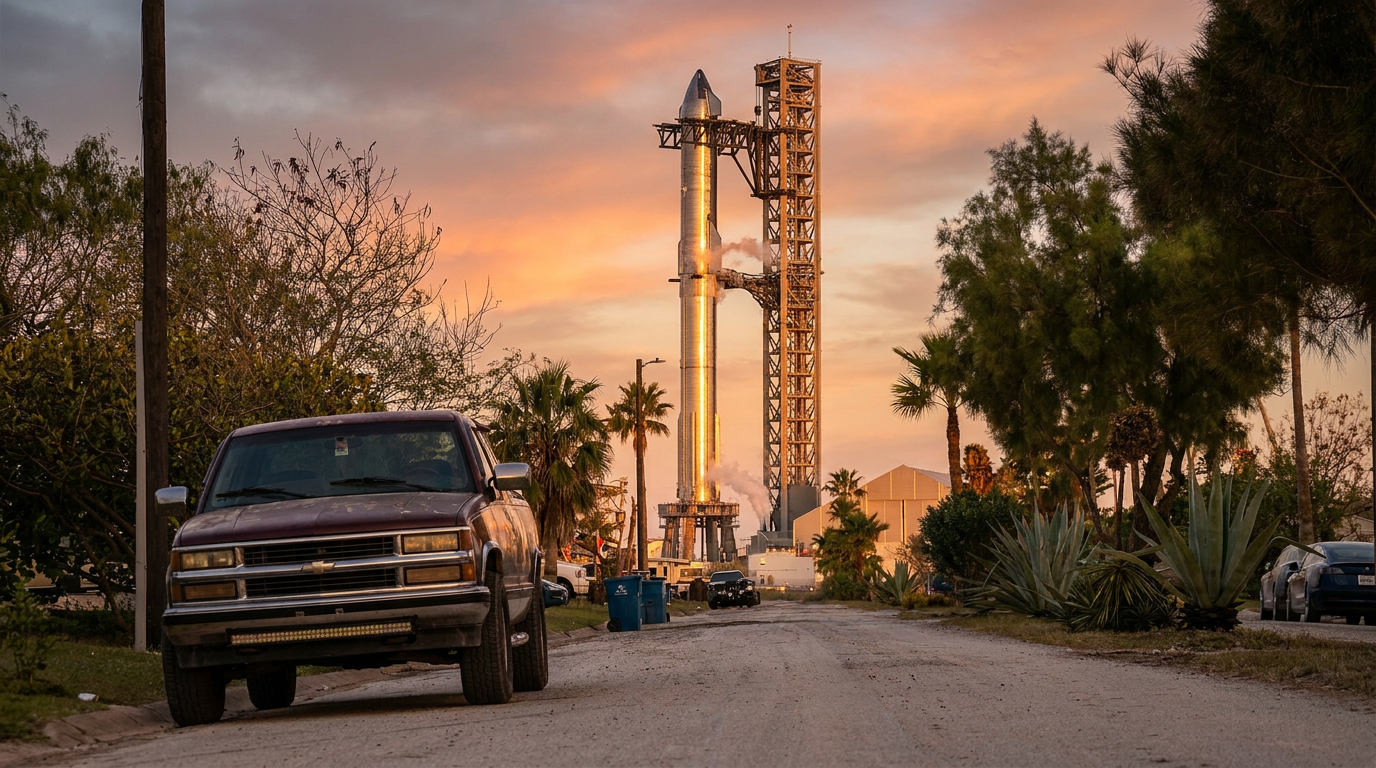
The wait is finally over. After more than two decades operating as a private juggernaut, Space Exploration Technologies Corp. has officially entered the public markets, executing a historic $75 billion initial public offering that fundamentally alters the financial landscape of the aerospace sector.[1][2]
The sheer scale of the debut has rewired expectations for late-stage private companies. By raising $75 billion, SpaceX easily bypassed the previous high-water marks set by state-backed giants like Saudi Aramco and e-commerce titans like Alibaba, cementing its status as the most anticipated public listing of the 21st century.[2][7]
But the significance of the event extends far beyond the headline numbers. For everyday investors, it represents the first direct opportunity to buy into the foundational infrastructure of the modern space economy—a sector that had previously been strictly gated behind venture capital, private equity, and accredited investor requirements.[1][8]
To understand how this monumental offering came together, it is essential to look at the mechanics of the deal itself. Rather than adhering strictly to the traditional Wall Street playbook, the company utilized a hybrid offering model that prioritized broad retail access alongside massive institutional allocations.[5][6]

According to the company's S-1 registration statement filed with the Securities and Exchange Commission, the offering was deliberately structured to minimize the typical first-day "pop" that often enriches institutional insiders at the direct expense of the company's balance sheet.[3]
By utilizing a modified Dutch auction system for a significant portion of the shares, price discovery was driven directly by market demand rather than conservative underwriter estimates. This allowed the company to capture a larger share of the capital raised while ensuring that early retail buyers were not immediately priced out by algorithmic trading.[5][7]
"I'm not sure that this could have gone much better," noted one prominent market analyst, highlighting how the company successfully bucked Wall Street norms without alienating the major financial institutions required to facilitate a deal of this unprecedented magnitude.[1]
The underlying engine driving this massive valuation is not just the futuristic promise of Mars exploration, but the highly lucrative reality of low-Earth orbit infrastructure. Starlink, the company's satellite internet constellation, has successfully transitioned from a capital-intensive research project into a massive, predictable cash-flow generator.[3][4]
Industry projections now place the global space economy on a trajectory to reach $1.2 trillion by the end of the decade. Satellite broadband and commercial launch services are serving as the primary growth vectors, moving the industry from government-dependent contracts to robust commercial revenue.[4][8]

Industry projections now place the global space economy on a trajectory to reach $1.2 trillion by the end of the decade.
SpaceX currently dominates both of these critical verticals. The successful deployment and rapid turnaround of the fully reusable Starship launch vehicle has drastically reduced the cost per kilogram to orbit, creating an almost insurmountable economic moat against legacy aerospace competitors.[4][6]
This dual dominance—controlling both the physical launch infrastructure and the most profitable payload in the form of Starlink—creates a vertically integrated ecosystem that public market investors have rarely seen since the industrial monopolies of the early 20th century.[5][8]
Despite the unconventional nature of the IPO's structure, traditional financial institutions are still reaping massive rewards. The sheer volume of the offering has generated a windfall of trading fees, underwriting commissions, and advisory revenue for the major investment banks that helped facilitate the listing.[1][2]
Market strategists point out that investors often overlook the upside that mega-IPOs provide to Wall Street banks themselves. The volatility and massive liquidity events associated with a $75 billion listing are expected to significantly boost second-quarter trading income across the broader financial sector.[1][6]

Furthermore, the success of the SpaceX debut is already acting as a powerful catalyst for the broader IPO market. Dozens of highly valued tech unicorns, which had previously delayed their public listings due to macroeconomic uncertainty, are now accelerating their timelines to capitalize on the renewed investor enthusiasm.[2][7]
However, investing in the space economy is not without its unique set of risks. The capital intensity required to maintain a global satellite constellation and develop interplanetary transport systems means that free cash flow could remain highly volatile in the coming years as capital expenditures fluctuate.[3][4]
Regulatory hurdles also remain a persistent headwind. The Federal Aviation Administration and international telecommunications regulators hold significant sway over the company's launch cadence and spectrum allocation, introducing unavoidable political and bureaucratic variables into the long-term investment thesis.[3][6]
How we got here
2002
SpaceX is founded with the goal of reducing space transportation costs to enable the colonization of Mars.
2008
The Falcon 1 becomes the first privately developed liquid-fueled launch vehicle to reach Earth orbit.
2020
SpaceX successfully launches its first crewed mission to the International Space Station.
2024
The Starship vehicle achieves full reusability milestones, drastically lowering the cost of orbital payload delivery.
June 2026
SpaceX executes a historic $75 billion IPO, opening the company to public market investors.
Viewpoints in depth
Retail Investors
Everyday investors view the IPO as a long-awaited democratization of the space economy.
For years, retail investors watched from the sidelines as venture capital firms and private equity funds reaped the rewards of SpaceX's exponential growth. The public listing is seen as a major victory for market accessibility, allowing standard brokerage accounts to hold equity in the infrastructure that powers global satellite internet and future interplanetary logistics. Proponents in this camp argue that the modified auction structure successfully prevented Wall Street insiders from hoarding the most lucrative early gains.
Institutional Underwriters
Financial institutions are capitalizing on the massive liquidity event despite the unconventional structure.
While SpaceX bypassed some traditional underwriting norms to retain more capital, major investment banks are far from losing out. The sheer scale of a $75 billion listing generates unprecedented trading volume, resulting in massive commission windfalls. Institutional analysts argue that this event proves Wall Street can adapt to hybrid offering models, providing the necessary plumbing for mega-cap private companies to transition smoothly into the public sphere without destabilizing broader indices.
Aerospace Analysts
Industry experts are focused on the underlying unit economics of Starlink and Starship rather than the IPO hype.
Beyond the financial spectacle, aerospace analysts are scrutinizing the company's S-1 filings to model long-term cash flows. Their primary focus is the synergy between Starship's low-cost launch capabilities and Starlink's high-margin subscription revenue. However, these experts also caution that the company's valuation prices in near-perfect execution. Any significant regulatory delays from the FAA or technical setbacks in maintaining the satellite constellation could introduce severe volatility to the stock in its first few quarters of public trading.
What we don't know
- How the stock will perform in its first earnings season when forced to report transparent quarterly cash flows.
- Whether the influx of public capital will accelerate or complicate the timeline for crewed Mars missions.
- How international regulators will respond to a publicly traded American monopoly dominating low-Earth orbit.
Key terms
- Mega-IPO
- An initial public offering that raises an exceptionally large amount of capital, typically in the tens of billions of dollars, fundamentally impacting broader market liquidity.
- Low-Earth Orbit (LEO)
- An Earth-centered orbit with an altitude of 2,000 km or less, which is the primary operational zone for satellite constellations like Starlink.
- S-1 Registration Statement
- The initial form a company must file with the U.S. Securities and Exchange Commission (SEC) before it can offer new securities to the public.
- Dutch Auction
- A public offering structure where the price of the offered shares is determined after taking in all bids to arrive at the highest price at which the total offering can be sold.
Frequently asked
Can anyone buy SpaceX stock now?
Yes. Following the IPO, SpaceX shares are publicly traded on major exchanges, allowing retail investors to purchase them through standard brokerage accounts.
Why did SpaceX wait so long to go public?
The company required years of capital-intensive research and development to perfect reusable rockets and deploy the Starlink network. Staying private allowed them to absorb early failures without public market pressure.
How does Starlink affect the company's valuation?
Starlink provides a massive, recurring revenue stream from consumer and enterprise internet subscriptions, which offsets the highly volatile and expensive nature of rocket manufacturing and launch services.
What is a modified Dutch auction?
It is a pricing mechanism where investors place bids for the number of shares they want and the price they are willing to pay, allowing market demand to set the final IPO price rather than investment banks.
Sources
Source coverage
8 outlets
3 viewpoints surfaced








[1]MarketWatchRetail Investors
How Elon Musk nailed the SpaceX IPO: ‘I’m not sure that this could have gone much better’
Read on MarketWatch →[2]CNBCInstitutional Underwriters
SpaceX shatters records with $75 billion public market debut
Read on CNBC →[3]SECAerospace Analysts
Form S-1 Registration Statement: Space Exploration Technologies Corp.
Read on SEC →[4]Morgan StanleyAerospace Analysts
The Global Space Economy 2026: Trillion-Dollar Trajectory
Read on Morgan Stanley →[5]Harvard Business ReviewInstitutional Underwriters
Bucking Wall Street: The Evolution of the Mega-IPO
Read on Harvard Business Review →[6]Factlen Editorial TeamAerospace Analysts
Synthesis by Factlen editorial team
Read on Factlen Editorial Team →[7]BloombergRetail Investors
SpaceX IPO Triggers Massive Retail Investor Influx
Read on Bloomberg →[8]MIT Technology ReviewAerospace Analysts
The economics of reusable rockets and the new space age
Read on MIT Technology Review →
More in finance
See all 5 stories →

Every angle. Every day.
Get finance stories with full source coverage and perspective breakdowns delivered to your inbox.