
How 'Regenerative' Travel is Replacing Sustainability as the New Standard in Luxury Tourism
High-end resorts are moving beyond simply minimizing their environmental footprint, instead using luxury premiums to actively restore coral reefs, rebuild habitats, and revive local cultures.
By Factlen Editorial Team
- Luxury Hospitality Industry
- View regenerative practices as a competitive necessity to meet the demands of high-net-worth travelers and justify premium pricing.
- Conservation Advocates
- Argue that tourism must move past 'do no harm' to active restoration, paying its ecological debt through measurable interventions.
- Academic & Policy Researchers
- Focus on systemic integrity, warning that without third-party audited metrics, 'regenerative' will become a meaningless greenwashing buzzword.
What's not represented
- · Budget Travelers
- · Local Residents Displaced by Development
Why this matters
As global tourism rebounds, the shift toward regenerative travel offers a viable blueprint for funding critical climate and biodiversity interventions. For travelers, it means vacation spending can directly subsidize the survival of the world's most fragile ecosystems.
Key points
- Luxury travel is shifting from 'sustainable' (minimizing harm) to 'regenerative' (actively restoring ecosystems).
- High-margin luxury resorts are uniquely positioned to fund capital-intensive conservation projects like coral reef banking.
- Major developments, such as Saudi Arabia's Red Sea project, are capping visitor numbers and running entirely on renewable energy.
- Industry watchdogs are pushing for third-party audited metrics to prevent 'regenerative' from becoming a greenwashing buzzword.
For decades, the pinnacle of luxury travel was defined by excess: sprawling resorts, private jet transfers, and environments engineered to isolate guests from the realities of their destination. But as the climate crisis accelerates and overtourism degrades global hotspots, affluent travelers are demanding a profound shift. The conversation in high-end hospitality has moved past "sustainable" travel—which merely seeks to minimize harm—and embraced a more ambitious paradigm known as "regenerative" tourism. This evolution reflects a growing recognition that simply maintaining the status quo in depleted environments is a failing strategy. Instead, the new gold standard requires properties to act as active agents of ecological and cultural healing.[7]
The distinction between the two concepts is fundamental to understanding the future of the industry. Sustainable tourism asks how the sector can use fewer resources, produce less waste, and leave no trace on the landscape. Regenerative tourism, by contrast, operates on the premise that leaving no trace is no longer enough. It asks how travel can actively heal damaged ecosystems, revive local cultures, and leave a destination measurably better than before the visitor arrived. It is the difference between a resort that merely offsets its carbon emissions and one that actively rebuilds a decimated mangrove forest.[3][4]
Academic researchers have recently formalized this shift in the literature, moving it from a niche philosophy to a recognized structural framework. A comprehensive 2024 review published in the journal MDPI defines regenerative tourism as a model that "enhances the natural, cultural and social capital of a destination to create net positive benefits for people and the planet." It requires treating destinations not as commodities to be passively consumed, but as complex, living systems where the hospitality sector, local communities, and the natural environment are inextricably linked and mutually dependent. This academic consensus underscores that regeneration is not merely a marketing trend, but a necessary paradigm shift for the industry's long-term viability.[2]

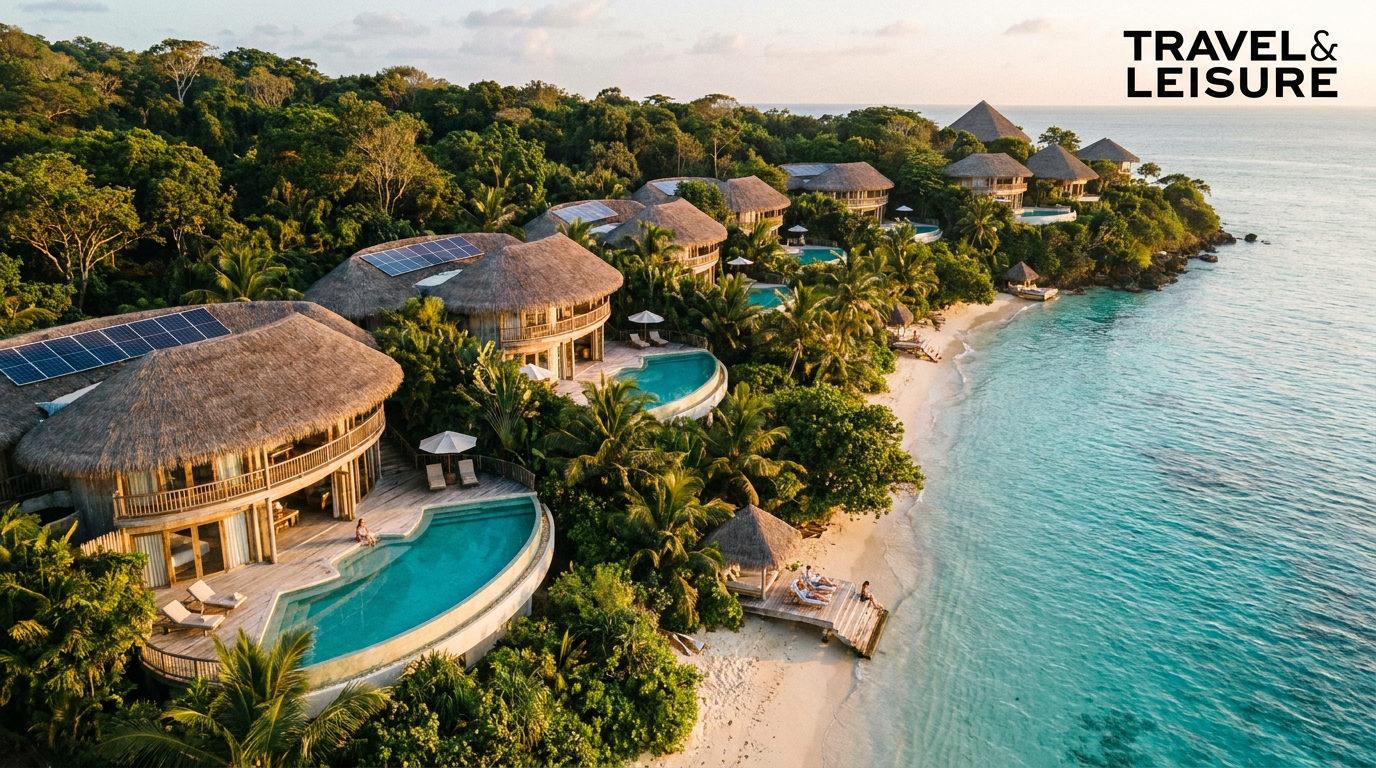
To understand how this works in practice, one must look at the mechanics of modern luxury eco-resorts. Because active ecological restoration is highly capital-intensive, the luxury sector is uniquely positioned to fund it. By adopting a "high-value, low-impact" model, premium properties can charge a premium that directly subsidizes conservation efforts. This effectively turns high-net-worth travelers into private funders for biodiversity projects, bridging the gap where government conservation budgets often fall short.[4][7]
Saudi Arabia’s ambitious Red Sea project illustrates this scale of intervention. Designed as a cornerstone of the country's economic diversification, the luxury destination spans an archipelago of pristine islands and fragile marine environments. To prevent the ecological degradation typical of coastal development, the project has capped annual visitors at one million. Furthermore, the entire infrastructure, including the dedicated international airport, is designed to run entirely on renewable energy, while active marine biology programs work to expand local coral reefs by millions of corals.[1]
Saudi Arabia’s ambitious Red Sea project illustrates this scale of intervention.
Marine conservation has become a primary laboratory for regenerative practices globally. At Chablé Maroma in Mexico, situated along the Mesoamerican Reef, guests do not simply snorkel over dying corals; they participate in an "Adopt a Coral" program. Working alongside resident marine biologists, visitors assist in the micro-fragmentation of corals, symbolically sponsoring fragments that are transplanted into underwater nurseries to rebuild the reef structure and restore local fish populations.[8]
Similarly, at VOMO Island in Fiji, the resort has partnered with the non-profit Counting Coral to install striking underwater sculptures that function as genetic marine banks. These installations are specifically designed to accelerate reef resilience against warming oceans by preserving diverse coral DNA. The initiative allows guests to dive alongside marine scientists and actively participate in the monitoring process, witnessing the intersection of ecological action and high-end hospitality. It proves that luxury experiences can directly facilitate critical climate interventions, transforming a standard tropical vacation into a meaningful conservation mission.[8]

In Asia, the regenerative movement is heavily intertwined with cultural preservation and community resilience. Properties like Song Saa Private Island in Cambodia and the Three Camel Lodge in Mongolia are redefining luxury by reviving heritage crafts and supporting local livelihoods. At these properties, interiors are crafted by local artisans using centuries-old techniques, and supply chains are reconfigured to support regional organic farming, ensuring that the economic benefits of tourism do not leak out of the host country to multinational corporations.[5]
Despite these inspiring examples, the rapid popularization of the term "regenerative" has sparked intense concern among industry watchdogs. Just as "eco-friendly" and "sustainable" were co-opted by marketing departments in the 2010s, regenerative travel faces a severe risk of greenwashing. If every boutique hotel claims to be healing the planet simply by eliminating single-use plastics or asking guests to reuse their towels, the concept loses its transformative power and betrays consumer trust.[3][4]
To combat this dilution, organizations like Regenera Luxury are pushing for rigorous, destination-scale measurement. They argue that regeneration only becomes credible when it is translated into verifiable, hard data. A property cannot simply claim to be regenerative; it must prove its impact through independent, third-party audits detailing specific metrics, such as the exact number of coral fragments planted, the hectares of forest restored, or the measurable improvement in local community incomes.[3][4]

This demand for strict accountability is increasingly driven by the consumers themselves. Industry surveys indicate that over three-quarters of high-income travelers are willing to pay a premium for genuinely sustainable options, but they are also highly skeptical of vague marketing claims. They want transparent dashboards, scientific partnerships, and the assurance that their luxury sabbatical is acting as a protective shield for fragile environments, rather than contributing to their decline.[7]
The transition from sustainable to regenerative travel represents a critical maturation of the tourism industry. With global tourism accounting for nearly 9% of greenhouse gas emissions prior to the pandemic, the sector can no longer afford to be a passive observer of ecological decline. By proving that flawless opulence and radical conservation are not mutually exclusive, the luxury market is establishing a blueprint that the rest of the travel industry must eventually follow to ensure its own survival.[3][8]
How we got here
2019
Global tourism reaches its peak, accounting for approximately 8.8% of global greenhouse gas emissions.
2020-2021
The pandemic forces a global pause in travel, prompting industry leaders to rethink the extractive 'overtourism' model.
2023
Saudi Arabia's Red Sea project begins welcoming guests, pioneering large-scale regenerative luxury tourism.
2024
The UN statistical system endorses a new framework for measuring the sustainability of tourism, moving toward standardized metrics.
2026
Regenerative travel transitions from a niche concept to a mainstream expectation among high-net-worth travelers.
Viewpoints in depth
Conservation Advocates
Argue that tourism must move past 'do no harm' to active restoration.
Environmental organizations and conservation-focused travel platforms argue that the tourism industry has extracted value from natural landscapes for decades and must now pay its ecological debt. They champion regenerative travel because it mandates measurable interventions—such as reef banking, reforestation, and wildlife monitoring—rather than passive observation. For this camp, a resort is only successful if the local biodiversity is quantifiably healthier than it was before the property was built.
Luxury Hospitality Industry
View regenerative practices as a competitive necessity to meet traveler demands.
For high-end hoteliers and developers, regenerative tourism is both an ethical imperative and a sharp business strategy. Industry data shows that high-net-worth individuals are increasingly demanding purpose-driven travel and are willing to pay a significant premium for it. By integrating active conservation into the guest experience, luxury brands can justify their pricing models, differentiate themselves in a crowded market, and ensure the long-term survival of the pristine environments their businesses rely upon.
Academic & Policy Researchers
Focus on systemic integrity and the severe risk of greenwashing.
Academic researchers and policy watchdogs caution that the rapid adoption of the term 'regenerative' threatens to dilute its meaning. They warn that without standardized, third-party audited metrics, the concept will become a meaningless marketing buzzword used to sell the same extractive tourism models under a new guise. This camp advocates for strict global frameworks that measure not just carbon output, but holistic impacts on local community wealth, cultural preservation, and net-positive biodiversity gains.
What we don't know
- Whether the high-margin, low-volume regenerative model can be successfully scaled to middle-market or budget tourism.
- How quickly international regulatory bodies will adopt and enforce standardized metrics to prevent greenwashing in the regenerative travel space.
Key terms
- Regenerative Tourism
- An approach to travel that actively restores and enhances the natural, cultural, and social capital of a destination.
- Greenwashing
- The practice of making misleading or unsubstantiated claims about the environmental benefits of a product, service, or company.
- Micro-fragmentation
- A marine biology technique used to accelerate the growth of corals by cutting them into small pieces, often utilized in reef restoration projects.
- Circular Economy
- An economic system aimed at eliminating waste and the continual use of resources, heavily applied in regenerative resort design.
Frequently asked
What is the difference between sustainable and regenerative travel?
Sustainable travel aims to minimize harm and leave no trace. Regenerative travel actively seeks to improve the destination by restoring ecosystems and supporting local communities.
Why is regenerative travel often more expensive?
Regenerative experiences typically cost more because a portion of the premium directly funds capital-intensive conservation work, such as coral reef restoration or reforestation.
How can travelers avoid greenwashing when booking a trip?
Travelers should look for properties that publish transparent, third-party verified data on their ecological impact, rather than relying on vague marketing terms like 'eco-friendly.'
Sources
Source coverage
8 outlets
3 viewpoints surfaced








[1]Arab NewsLuxury Hospitality Industry
How Saudi Arabia is leveraging regenerative tourism to blend luxury with sustainability
Read on Arab News →[2]MDPIAcademic & Policy Researchers
The Emergence of Regenerative Tourism as a New Paradigm
Read on MDPI →[3]Regenera LuxuryConservation Advocates
Why regenerative travel needs measurement and verification
Read on Regenera Luxury →[4]CanopiConservation Advocates
What Makes a Travel Company Truly Regenerative?
Read on Canopi →[5]Portfolio MagazineLuxury Hospitality Industry
The new frontier of high-end travel in Asia
Read on Portfolio Magazine →[6]Factlen Editorial TeamAcademic & Policy Researchers
Synthesis by Factlen editorial team
Read on Factlen Editorial Team →[7]Eclectic TrendsLuxury Hospitality Industry
Emerging Trends to Watch in 2026
Read on Eclectic Trends →[8]NewswireLuxury Hospitality Industry
Ownia Collection and Regenera Luxury Announce Strategic Partnership
Read on Newswire →
Every angle. Every day.
Get travel stories with full source coverage and perspective breakdowns delivered to your inbox.