
How Deliberative Polling and Participatory Budgeting Are Rewiring Local Democracy
Communities are moving beyond traditional voting by using structured deliberation and direct budget control to solve complex local problems and rebuild civic trust.

In short
- Participatory budgeting allows residents to directly allocate municipal funds for local projects.
- Deliberative polling measures public opinion after citizens are given time to study an issue and consult experts.
- Studies show these methods increase voter turnout by 14% and public trust by 25%.
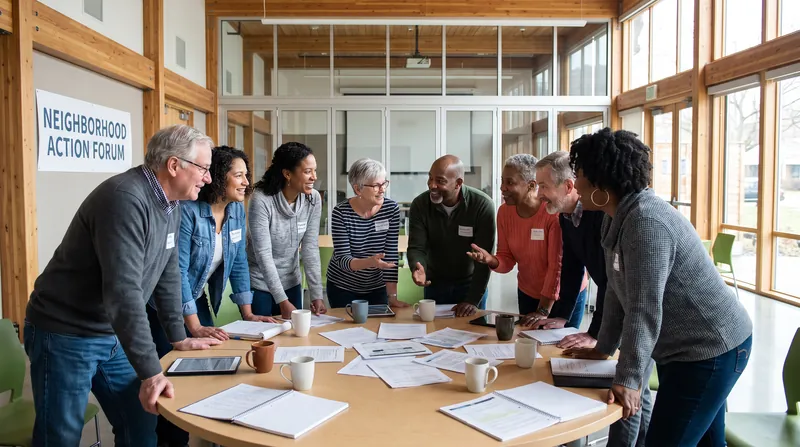
In an era where national politics often feels defined by intractable polarization and gridlock, a quiet revolution is taking root at the local level. Across the globe, municipalities are moving away from the traditional, passive model of citizenship—where engagement is limited to casting a ballot every few years—and embracing a more hands-on approach. This movement, broadly known as deliberative democracy, operates on a simple premise: when everyday people are given the time, resources, and structure to tackle complex issues, they are highly capable of solving them.[2]
Two primary mechanisms are driving this shift: participatory budgeting and deliberative polling. While they serve slightly different functions—one allocates public funds, the other shapes public policy—both are designed to rebuild fractured civic trust from the ground up. By inviting residents to sit at the table with experts, elected officials, and their neighbors, these processes transform political adversaries into collaborative problem-solvers.
Participatory budgeting, or PB, is perhaps the most visible of these tools. Pioneered in Porto Alegre, Brazil, in 1989 as a way to democratize resources after the end of military rule, the practice has since spread to thousands of cities worldwide. The process allows ordinary citizens to directly decide how to spend a designated portion of a municipal budget, shifting power away from closed-door committee meetings and into community centers.
The scale of these initiatives is growing rapidly. Earlier this year, over 93,000 New Yorkers cast ballots to decide how to allocate $30 million of the city's 2026 budget. Residents as young as 11 years old, regardless of immigration status, were invited to pitch, debate, and ultimately choose neighborhood investments. The winning projects often address immediate, tangible needs, such as upgrading air conditioning in local elementary schools or improving public outdoor spaces.
Crucially, participatory budgeting is not merely a suggestion box or a simple vote. It is a multi-stage deliberative process. It begins with idea generation, where community members gather to discuss local deficits. Volunteer delegates then work alongside city agencies to transform these raw ideas into concrete, feasible proposals. Only after this rigorous vetting process do the projects go to a community-wide vote.
While participatory budgeting gives citizens control over the purse strings, another tool—deliberative polling—aims to elevate the quality of public discourse on complex policy issues. Developed in 1988 by James Fishkin, who now directs the Deliberative Democracy Lab at Stanford University, the method was created as an antidote to the superficiality of traditional opinion polls.[1]
Conventional polls capture what the public thinks when they are largely uninformed or reacting to soundbites. Deliberative polling, by contrast, seeks to measure what the public would think if they had an adequate chance to deeply reflect on an issue. It is an attempt to use public opinion research in a constructive, educational way rather than merely taking a snapshot of existing prejudices.[1]
The process is highly structured. It begins by surveying a random, representative sample of a population on a targeted issue. This group is then invited to gather—often for an entire weekend—to discuss the topic in depth. Participants are provided with carefully balanced briefing materials and engage in small-group discussions led by trained moderators.[1]
During these sessions, the citizens develop questions that they then pose directly to competing experts and political leaders in plenary sessions. After days of rigorous debate and learning, the participants are polled again using the exact same questions from the baseline survey. The resulting changes in opinion provide policymakers with a roadmap of where a fully informed public would stand.[1]
The empirical results of these democratic innovations are striking. A 2023 study analyzing municipalities across the United States and Europe found that adopting participatory budgeting increased local voter turnout by an average of 14 percent. Even more significantly, public trust in local authorities rose by 25 percent in those same areas, proving that transparency and inclusion can actively repair civic alienation.
Beyond the hard numbers, researchers consistently note a profound shift in social capital. Participants in deliberative polls frequently report a gain in empathy and mutual understanding after engaging with neighbors from different socioeconomic or ideological backgrounds. When the problem is placed in the center of the room, rather than the person, citizens learn to listen across their differences and recognize the validity of competing needs.
Despite these successes, scaling deliberative democracy presents significant challenges. Participatory budgeting works exceptionally well in small geopolitical units—neighborhoods and medium-sized cities—where the impact of a new park or crosswalk is immediately visible. Translating that localized cooperation to a state or national budget, where the trade-offs are vastly more abstract, remains a logistical and political hurdle.
Inclusion is another persistent challenge. If a deliberative process requires giving up a weekend or attending multiple evening meetings, it risks excluding single parents, shift workers, and marginalized groups who lack the luxury of free time. Without careful, targeted recruitment and compensation for participants, these civic assemblies can inadvertently amplify the voices of the already privileged.
Without careful, targeted recruitment and compensation for participants, these civic assemblies can inadvertently amplify the voices of the already privileged.
To address these barriers, civic technologists are increasingly turning to digital solutions. The Stanford Online Deliberation Platform, for example, allows mass deliberations to take place efficiently over video, utilizing automated moderators to ensure equitable speaking time. These tools lower the barrier to entry, allowing high school students and busy professionals alike to participate from their living rooms.[1]
Ultimately, the rise of deliberative polling and participatory budgeting represents a fundamental reimagining of the citizen's role. It challenges the notion that democracy is merely a spectator sport punctuated by occasional elections. By demanding active responsibility and providing the infrastructure for meaningful dialogue, these tools offer a hopeful blueprint for a more resilient, collaborative society.[2]
Terms to know
- Participatory Budgeting (PB)
- A democratic process where ordinary community members directly decide how to spend a portion of a public budget.
- Deliberative Polling
- A research method that measures how public opinion changes after citizens are given balanced information and time to discuss an issue.
- Social Capital
- The networks of relationships, trust, and reciprocity among people who live and work in a particular society.
- Civic Assembly
- A representative group of citizens gathered to learn about, deliberate on, and make recommendations regarding a specific public issue.
Questions readers ask
How is a deliberative poll different from a normal poll?
Traditional polls measure top-of-mind reactions, often based on limited information. Deliberative polls measure what people think after they have studied briefing materials and debated with experts.
Who decides which projects get funded in participatory budgeting?
Community members brainstorm ideas, volunteer delegates turn them into feasible proposals, and then the entire community votes on the final ballot.
Are these methods used for national issues?
While most common at the local level, deliberative polling has been used for national issues like constitutional reform in Australia and energy policy in Japan.
Different angles
Democratic Innovators
Advocates who believe direct citizen deliberation is the cure for modern political apathy.
This camp argues that the traditional model of voting every few years is fundamentally broken and breeds alienation. By giving citizens direct control over real tax dollars and complex policy choices, they believe society can rebuild trust from the ground up. They point to the measurable increases in voter turnout and civic engagement in cities that adopt these methods as proof that people want to participate when their voices actually matter.
Academic Methodologists
Researchers focused on the scientific rigor and structured design of civic engagement.
For this group, the value of deliberation lies entirely in its structure. They caution that unstructured town halls often devolve into shouting matches dominated by the loudest voices. Instead, they advocate for strict random sampling, carefully balanced briefing materials, and trained moderators. Their goal is not just to gather opinions, but to discover what a truly informed and demographically representative public would decide if given the proper resources.
Traditional Representatives
Skeptics who defend the necessity of elected officials and professional expertise in governance.
While supportive of community input, this perspective warns against over-relying on direct democracy. They argue that elected representatives and civil servants are necessary to balance competing city-wide needs, manage long-term fiscal health, and protect minority rights. From this view, hyper-local participatory budgeting can sometimes lead to fragmented spending that ignores broader systemic issues that require centralized planning.
- Democratic Innovators
- Advocates who believe direct citizen deliberation is the cure for modern political apathy.
- Academic Methodologists
- Researchers focused on the scientific rigor and structured design of civic engagement.
- Traditional Representatives
- Skeptics who defend the necessity of elected officials and professional expertise in governance.
Perspectives this story doesn't cover
- Disenfranchised voters who lack time to participate
- City planners managing macro-level budgets
Sources
Source coverage
2 outlets
3 viewpoints surfaced


- [1]Stanford Deliberative Democracy LabAcademic Methodologists
Deliberative Polling®
Read on Stanford Deliberative Democracy Lab → - [2]Factlen Editorial TeamAcademic Methodologists
Synthesis by Factlen editorial team
Read on Factlen Editorial Team →
More in Community
See all →Climate Litigation
Local Governments' Climate Lawsuits Against Big Oil Head to Supreme Court on Key Jurisdiction Question
4 sources
Housing Policy
Cities Pivot to Aggressive Enforcement of Short-Term Rental Laws, Mandating Platform Cooperation
2 sources
Civic Trust
Half of Residents Believe Local Government Is Run by 'Insiders,' Sparking Push for Structural Reform
2 sources
Survey Methodology
Why Sudden Polling Swings Reflect Who Answers the Phone Rather Than Who Changed Their Mind
9 sources

Comments
Every angle. Every day.
Get Community stories with full source coverage and perspective breakdowns, free every day.