
How a 10-Day Shaolin Monk Retreat Helped Propel Victor Wembanyama to the NBA Finals
Following a grueling spiritual and physical retreat at China's Shaolin Temple last summer, the San Antonio Spurs star has showcased unprecedented focus and stamina during his historic sophomore season.
By Factlen Editorial Team
- Shaolin Practitioners
- Believe that physical endurance must be matched by mental awareness, using darkness and uneven terrain to build inner strength.
- NBA Analysts
- Focus on the biomechanical benefits of kung fu for a player of unprecedented height, specifically noting improvements in core stability.
- Global Fans
- View the retreat as a testament to unique curiosity and dedication, cementing his status as a global cultural icon.
What's not represented
- · Traditional NBA strength and conditioning coaches
- · Other NBA players who have attempted alternative offseason training
Why this matters
Wembanyama’s unconventional offseason highlights a growing trend of elite athletes looking beyond traditional sports science, turning to ancient mindfulness and martial arts to build mental resilience and physical longevity.
Key points
- Victor Wembanyama spent 10 days at China's Shaolin Temple following his rookie season.
- The 7-foot-4 center trained with a 34th-generation warrior monk to build mental and physical endurance.
- Training included 4:30 AM wake-ups, blindfolded night hikes, and the Shaolin 13 Fist Form.
- He led the San Antonio Spurs to the 2026 NBA Finals while winning unanimous Defensive Player of the Year.
- Analysts credit the martial arts focus for his unprecedented balance and stamina in the playoffs.
The spectacle of the 2026 Western Conference Finals was defined by a performance that defied standard basketball logic. San Antonio Spurs center Victor Wembanyama, playing in his first deep postseason run, logged an exhausting 48 minutes in a double-overtime thriller against the Oklahoma City Thunder. He recorded 41 points, 24 rebounds, and three blocks, ultimately sealing the victory with a deep, contested three-pointer. For a 7-foot-4 athlete, the sheer biomechanical toll of such a workload should have resulted in visible fatigue. Yet, as he navigated the final minutes of the second overtime, Wembanyama looked entirely unfazed, moving with a fluid, centered calm that left commentators and fans searching for an explanation.[2]
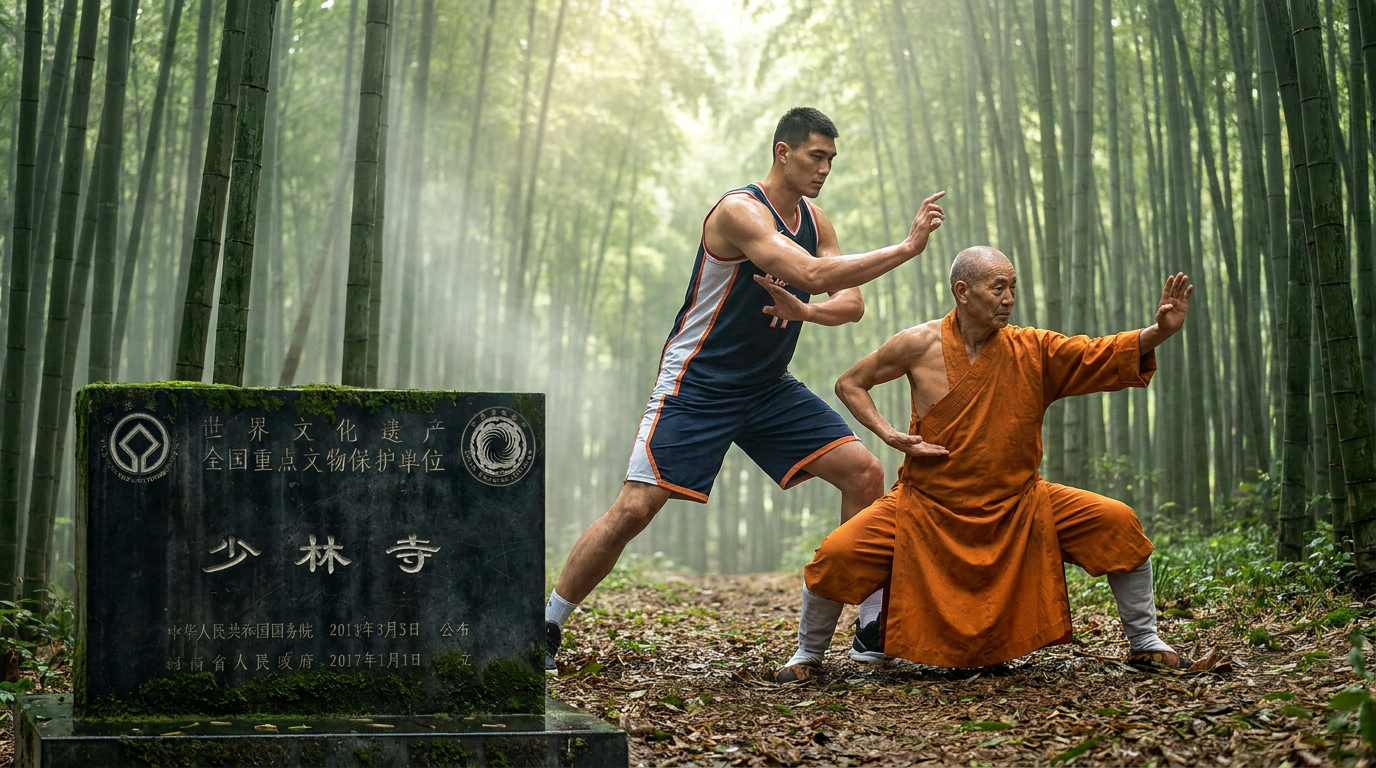
The secret to his unprecedented stamina and focus wasn't found in a state-of-the-art Texas weight room or a high-tech recovery chamber. Instead, the foundation for his historic sophomore season was laid thousands of miles away, during a quiet, grueling retreat in the mountains of China. In June 2025, shortly after concluding his Rookie of the Year campaign, Wembanyama embarked on a 10-day spiritual and physical immersion at the Shaolin Temple in Henan province. Widely considered the birthplace of Chan Buddhism and Shaolin Kung Fu, the monastery offered a stark departure from the pampered, highly optimized offseason routines typical of modern NBA superstars.[1][3]
Wembanyama did not travel to the temple as a casual tourist seeking a photo opportunity. Upon arrival, he fully committed to the monastic lifestyle. The first request the monks made was for him to shave his head—a directive he followed without hesitation. He traded his athletic gear for traditional robes and prepared to subject his body and mind to a curriculum refined over 1,500 years. "My goal going there was putting my body through things that it's not used to doing," Wembanyama later explained. "Kung fu. Everyday. It was like a vegan temple, monastery. I was isolated."[4][6]

His primary instructor was Master Yan'an, a 34th-generation warrior monk who has lived and trained at the Shaolin Temple since he was six years old. Fluent in English from years spent living in the United States, Master Yan'an recognized the unique challenge—and responsibility—of training a global sports icon. He understood that Wembanyama did not need to learn how to shoot a basketball or defend a pick-and-roll. Instead, the focus was on cultivating an unbreakable internal foundation. "I told him: You play basketball, and I do kung fu. If you want to be great, you have to do things that other people can't do," Master Yan'an recalled.[1][4]
The daily regimen was punishing, designed to strip away comfort and force the practitioner to find stability in exhaustion. Wembanyama's days began at 4:30 AM. The monks led him out of the temple and into the surrounding forests, utilizing the natural, uneven terrain as their training ground. Rather than running on a flat, predictable treadmill, he was instructed to perform frog jumps, full-speed sprints, and one-legged hops up and down steep, rocky hillsides. For a player of his unprecedented height, these exercises were excruciatingly difficult, demanding intense concentration to maintain balance and prevent injury.[1][4]
The daily regimen was punishing, designed to strip away comfort and force the practitioner to find stability in exhaustion.
In addition to the conditioning work, Wembanyama was taught the Shaolin 13 Fist Form. This foundational kung fu sequence is not primarily about combat; rather, it is a masterclass in biomechanics. The movements emphasize efficient weight shifts, core stability, and the precise transfer of kinetic energy from the ground up. By practicing these ancient striking principles, Wembanyama was inadvertently cross-training the exact micro-stabilizer muscles in his ankles, knees, and hips that are crucial for absorbing contact in the NBA paint and changing direction on the perimeter.[1][4]
However, the physical exertion was only half of the curriculum. The Shaolin philosophy dictates that true strength is impossible without a quiet, hyper-aware mind. "There are two parts to climbing the mountain," Master Yan'an explained to his towering student. "The daytime is for your body. Your endurance, your strength. The nighttime is for your mind. Your awareness." This philosophy was put to the ultimate test on the sixth night of the retreat, when Wembanyama was invited to join the monks for a hike to the Bodhidharma Cave, a sacred site located high above the monastery.[1][4]

The path to the cave consists of roughly 1,500 stone steps carved into Wuru Peak. None of the steps are uniform; some are narrow and shallow, while others are tall and jagged. During the day, it is a strenuous hike. At night, it is genuinely treacherous. There are no lights along the trail, and the group made the ascent in total darkness. "You can't see anything. The only way to go is step by step," Master Yan'an said. "Listen to your breath and listen to your heart. Feel each step with your foot. Use your awareness."[1][4]
The isolation of the retreat extended to Wembanyama's diet, though this presented a unique logistical hurdle. The temple adheres to strict Buddhist principles, serving a purely vegan menu that relies heavily on zucchini, rice noodles, and local vegetables. For a 245-pound professional athlete burning thousands of calories a day through intense martial arts training, the monastic diet was insufficient to maintain his playing weight. To solve this, his team arranged for a Sprinter van to periodically pull up outside the monastery walls, delivering high-protein meals from a local restaurant so he could sustain his massive frame.[4][6]
The results of this unconventional offseason have been nothing short of historic. Returning to the United States with a renewed sense of focus, Wembanyama dominated his sophomore campaign. He opened the season with a 40-point, 15-rebound performance against the Dallas Mavericks and never slowed down. By April 2026, he had been named the youngest and first unanimous Defensive Player of the Year in NBA history, leading the league in blocks while anchoring a San Antonio defense that suffocated opponents. He then carried that momentum into the playoffs, leading the Spurs to the NBA Finals.[5]

As Wembanyama's legend has grown during the 2026 postseason, international media and fans have eagerly connected the dots between his on-court dominance and his time at the monastery. Following his heroic Game 1 performance against the Thunder, Chinese social media platforms were flooded with references to his martial arts background. "He really learned something at the Shaolin Temple," one viral comment joked, capturing a broader sentiment that Wembanyama's "Alien" abilities are now augmented by a profound, ancient discipline. The narrative has only added to the mystique of a player who seems to operate on a different frequency than his peers.[2]
Wembanyama's journey to Henan highlights a fascinating, growing trend in the world of elite sports. As the margins for physical improvement become increasingly narrow, and as traditional sports science reaches a point of diminishing returns, generational talents are looking backward to move forward. By turning to ancient mindfulness practices and alternative movement disciplines, athletes are finding new ways to build mental resilience, improve joint longevity, and unlock the final, elusive percentages of their potential. For Wembanyama, the path to the NBA Finals didn't just require a basketball; it required 1,500 steps in the dark.[1][2][3]
How we got here
June 2025
Wembanyama travels to Henan, China, for a 10-day retreat at the Shaolin Temple.
October 2025
Opens his sophomore season with a 40-point, 15-rebound performance against Dallas.
April 2026
Named the youngest and first unanimous Defensive Player of the Year in NBA history.
May 2026
Plays 48 minutes in a double-overtime Western Conference Finals win, recording 41 points and 24 rebounds.
Viewpoints in depth
The Monastic Philosophy
Monks view physical exhaustion as a tool to strip away distraction and build mental clarity.
For the monks at the Shaolin Temple, physical strength is merely a prerequisite for mental expansion. Master Yan'an and his peers view the grueling physical tasks—like hopping up uneven hillsides or holding deep stances—not as athletic conditioning, but as a vehicle to strip away distraction. The true test occurs in the mind, particularly during sensory-deprived exercises like the blindfolded night hike, which forces a reliance on internal rhythm rather than external validation.
Sports Science Perspective
Analysts see kung fu as elite cross-training for joint health and proprioception.
From a biomechanical standpoint, traditional weightlifting can only do so much for a 7-foot-4 frame, where leverage and joint stress present unique challenges. Analysts note that the Shaolin 13 Fist Form emphasizes proprioception, core stability, and the efficient transfer of weight. By training on unpredictable, uneven terrain rather than a flat hardwood floor, an athlete strengthens the micro-stabilizer muscles in the ankles and knees, drastically reducing the risk of injury while improving lateral agility.
The Fan Mystique
The public views the retreat as evidence of a generational talent's unique intellectual curiosity.
In an era where most professional athletes spend their offseasons posting standard gym workout videos or playing in pro-am leagues, a 10-day silent retreat at a Buddhist monastery builds a unique cultural mythology. Fans and international media have latched onto the 'Alien' narrative, viewing the kung fu training as evidence of a player who is fundamentally different from his peers—not just in physical stature, but in his intellectual curiosity and approach to greatness.
What we don't know
- Whether Wembanyama plans to return to the Shaolin Temple or explore other global martial arts traditions in future offseasons.
- Exactly how much of his sophomore defensive leap is directly attributable to the monastery's balance training versus his natural physical maturation.
Key terms
- Shaolin Temple
- A renowned Buddhist monastery in China's Henan province, widely considered the birthplace of Chan Buddhism and Shaolin Kung Fu.
- Bodhidharma Cave
- A sacred site above the Shaolin Temple where the founder of Chan Buddhism is said to have meditated for nine years.
- Shaolin 13 Fist Form
- A foundational martial arts sequence designed to teach efficient weight shifts, stability, and striking principles.
- Proprioception
- The body's ability to sense its location, movements, and actions, crucial for balance and coordination.
Frequently asked
Did Victor Wembanyama become a monk?
No. While he shaved his head and wore traditional robes to fully immerse himself, the retreat was for personal reflection and physical training, not religious ordination.
What did he eat at the monastery?
He primarily ate the monks' strict vegan diet of zucchini and rice noodles, but his team arranged for high-protein meals to be delivered to maintain his 245-pound playing weight.
Who trained him during the retreat?
He was trained by Master Yan'an, an English-speaking, 34th-generation warrior monk who has lived at the temple since he was six years old.
Sources
Source coverage
6 outlets
3 viewpoints surfaced






[1]ESPNShaolin Practitioners
How 34 generations of ancient warrior training shaped Victor Wembanyama
Read on ESPN →[2]South China Morning PostNBA Analysts
Victor Wembanyama's dominant showing in Spurs win attributed to Shaolin Temple stint
Read on South China Morning Post →[3]Olympics.comGlobal Fans
Victor Wembanyama has embarked on a ten-day spiritual retreat at a Shaolin temple
Read on Olympics.com →[4]TSNShaolin Practitioners
One of the most recognizable athletes on the planet was training in kung fu with Shaolin monks
Read on TSN →[5]WikipediaNBA Analysts
Victor Wembanyama
Read on Wikipedia →[6]RedditGlobal Fans
Victor Wembanyama on his experience at the Shaolin Temple in Dengfeng, China
Read on Reddit →
More in sports
See all 10 stories →Preview
England's 2026 World Cup Outlook: Inside Thomas Tuchel's High-Stakes Group L Campaign
0 sources
College Baseball
Troy Trojans Complete Historic Cinderella Run to Reach First Men's College World Series
0 sources
MLB Preview
San Diego Padres Look to Snap Road Skid Against Baltimore Orioles in Interleague Clash
0 sources
Grassroots Tech
How 'Drop-In' Sports Apps Are Rewiring Urban Communities and Fighting Loneliness
0 sources
Every angle. Every day.
Get sports stories with full source coverage and perspective breakdowns delivered to your inbox.