
How $50,000 'Micro-Volumes' Are Bringing Virtual Production to Indie Filmmakers
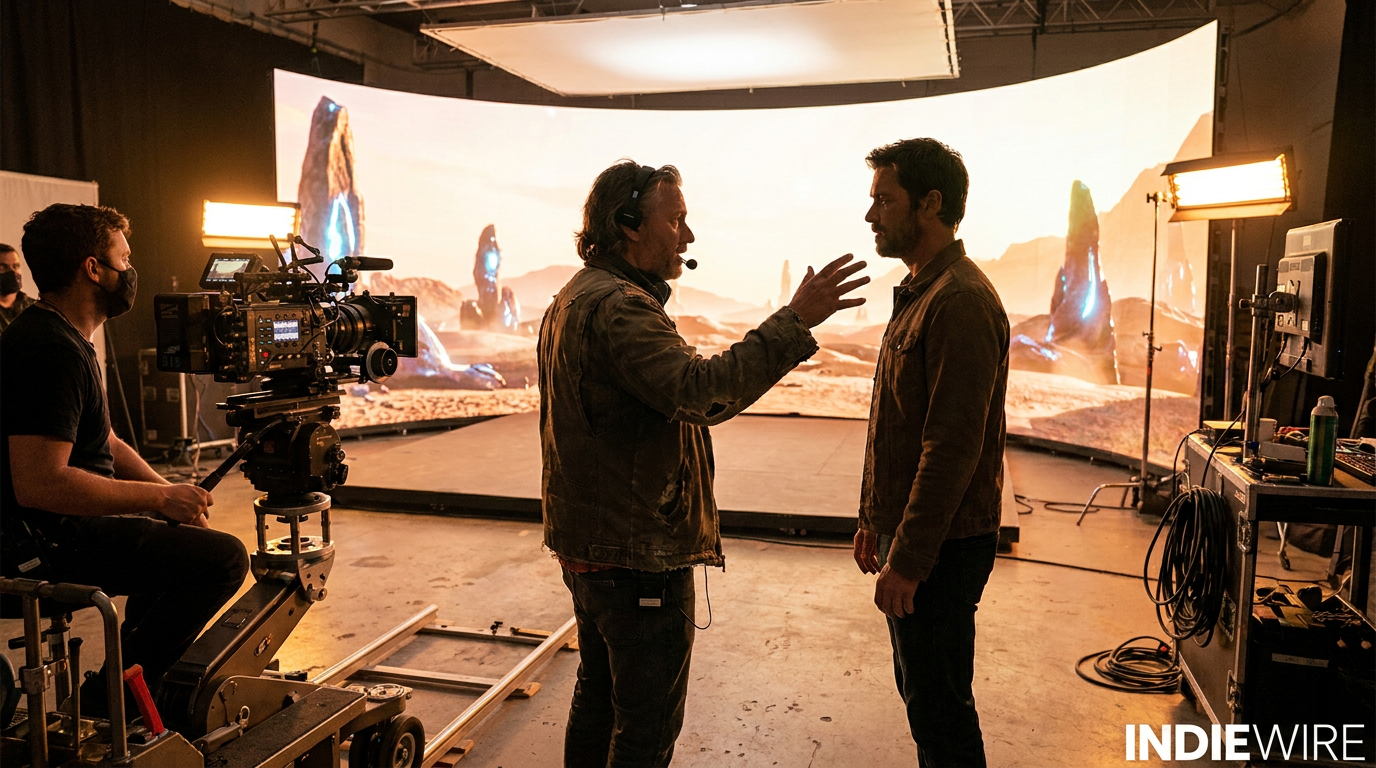
The LED wall technology that revolutionized blockbuster filmmaking is finally trickling down to the independent sector. In 2026, affordable micro-volumes and real-time rendering are allowing indie directors to shoot complex environments for a fraction of the traditional cost.
By Factlen Editorial Team
- Independent Filmmakers
- Focused on the creative liberation and budget savings of micro-volumes.
- Virtual Production Technologists
- Focused on the hardware realities, software pipelines, and the shift to pre-production.
- Studio & Infrastructure Providers
- Focused on scaling the technology and the economics of stage rentals.
- Sustainability & Education Advocates
- Focused on the environmental benefits and the need to train the next generation.
What's not represented
- · Traditional set builders and location scouts whose jobs are displaced by virtual environments.
- · Independent actors adapting to performing in front of digital screens rather than physical sets.
Why this matters
For decades, high-end visual effects and sprawling locations were exclusively reserved for massive studio tentpoles. The democratization of virtual production means independent creators can now execute ambitious, world-building scripts on a fraction of the budget, fundamentally leveling the playing field in Hollywood.
Key points
- Indie filmmakers are increasingly using 'micro-volumes' to shoot complex scenes for a fraction of traditional costs.
- A small LED setup now starts around $50,000, compared to the $15 million required for a Hollywood-scale stage.
- The technology shifts visual effects work from post-production to pre-production, requiring environments to be built before filming begins.
- Up to 65% of virtual production work involves simple 2D plate playback for car driving scenes, saving massive logistical headaches.
- By eliminating crew travel and diesel generators, virtual production drastically reduces the carbon footprint of filmmaking.
For decades, the most insurmountable barrier in independent cinema wasn't a lack of imagination—it was the brutal reality of the budget. If a script called for a sprawling sci-fi metropolis, a sweeping historical battlefield, or even just a perfectly lit car chase at dusk, the project was often dead on arrival. Independent filmmakers were forced to compromise, rewriting ambitious scenes into contained rooms or relying on green screens that inevitably led to costly, time-consuming post-production nightmares. The visual gap between a $2 million indie and a $200 million studio tentpole was a chasm that raw talent alone could rarely cross.[8]
In 2026, that chasm is rapidly closing. The technology that revolutionized blockbuster filmmaking—specifically the massive, immersive LED "volumes" popularized by Disney's The Mandalorian—is finally trickling down to the independent sector. What was once a $100 million playground exclusively reserved for Marvel and Star Wars has fractured into a highly adaptable, scalable ecosystem. Across New York, London, and Los Angeles, a new wave of "micro-volumes" is allowing indie directors to shoot complex, otherworldly environments for a fraction of the traditional cost.[1]
At the heart of this shift is the maturation of real-time rendering software, most notably Epic Games' Unreal Engine 5.5, paired with increasingly modular LED panel technology. Instead of acting out scenes in front of a blank green void, actors perform inside a curved wall of ultra-high-definition screens displaying photorealistic, 3D-mapped environments. Because the software tracks the physical camera's movement, the digital background shifts in perfect perspective, providing authentic lighting and reflections directly onto the actors and props in real-time.[1][4]

The financial math has changed dramatically. Just a few years ago, building a Hollywood-scale virtual production stage could easily exceed $15 million in hardware alone. Today, while those massive 80-foot diameter stages still command premium rates, a 40-square-meter LED micro-volume designed for indie filmmaking can be assembled or rented for roughly $50,000 to $150,000. For a modest production, renting a localized pop-up volume for a few days is now entirely within reach, completely altering the calculus of independent budgeting.[2][7]
This accessibility is forcing a fundamental rewiring of how independent films are made. The traditional Hollywood mantra of "we'll fix it in post"—where visual effects are layered in months after the shoot—is being replaced by a mandate to "get it right in-camera." Because the digital environments must be built and loaded onto the LED walls before the actors ever step on set, the bulk of the visual effects budget is shifted from post-production into pre-production.[1][3]
Operating these stages requires a new breed of crew member. Enter the "Brain Bar"—the on-set team of technicians, Unreal Engine operators, and digital artists who sit just off-camera. They are not traditional IT support, nor are they standard VFX artists; they function as digital gaffers. If a director wants to move a virtual mountain slightly to the left to catch the digital sunset, or change the weather from overcast to a torrential downpour, the Brain Bar executes the change in seconds, right in the middle of a take.[1]

Enter the "Brain Bar"—the on-set team of technicians, Unreal Engine operators, and digital artists who sit just off-camera.
The logistical savings of this workflow are staggering. On a recent independent sci-fi thriller shot in New York City, the production saved an estimated $15,000 in travel, lodging, and location permit costs simply by scanning a Utah desert environment and projecting it onto a micro-volume inside a Brooklyn warehouse. The crew didn't have to battle the elements, lose the light, or transport dozens of people across the country. They simply loaded the desert onto the wall and started rolling.[1]
While sprawling sci-fi landscapes grab the headlines, the true bread-and-butter of virtual production is far more mundane: people sitting in cars. Industry experts estimate that up to 65% of the virtual production work currently being done involves 2D plate playback for driving scenes. Instead of shutting down city streets, hiring police escorts, and towing a picture car on a dangerous flatbed trailer, filmmakers simply park the car inside a volume. The LED screens provide perfect, moving reflections on the windshield and the actors' faces, turning a logistical nightmare into a controlled, air-conditioned studio day.[4][7]

The hardware revolution is also colliding with the generative AI boom, further driving down costs. In 2026, independent creators are utilizing multimodal AI pipelines to generate hyper-accurate storyboards and conceptualize 3D backgrounds before they ever rent an LED stage. By integrating these automated tools into their pre-production workflows, some indie productions are slashing their overall visual effects and development budgets by up to 50%, compressing weeks of conceptual revisions into mere hours.[3]
However, the democratization of virtual production is not without its hurdles. While the panel costs have dropped, the infrastructure stack remains complex. Filmmakers must navigate the hidden costs of massive power draws, specialized camera tracking systems, and the "pixel pitch"—the density of the LEDs. If an indie production rents cheaper panels with a wide pixel pitch, the camera can capture a distracting moiré pattern, breaking the illusion entirely. Careful depth-of-field strategies are required to make a $500-a-day LED rental look like a seven-figure studio.[1][2]

Beyond the budget, this shift is quietly triggering one of the most significant environmental wins in the history of the entertainment industry. Traditional location shooting is notoriously carbon-intensive. Historically, up to 51% of a blockbuster film's CO2 emissions came from crew transport, with another 15% generated by the massive diesel generators required to power remote sets. By moving these shoots indoors to virtual volumes, productions are drastically cutting their carbon footprints and eliminating the dumpsters full of physical set materials that usually head to landfills after a wrap.[6]
Recognizing that this is the new standard, educational institutions are racing to train the next generation of creators. Programs like the UCLA Emerging Filmmakers Virtual Production Workshop are now putting the exact same LED wall technology used on massive studio tentpoles into the hands of film students. By teaching the convergence of cinematography, production design, and real-time rendering, these universities are ensuring that the filmmakers of tomorrow view spatial computing not as a luxury, but as a baseline tool.[5]
Ultimately, the rise of the micro-volume in 2026 represents a profound leveling of the playing field. The technology is no longer replacing filmmaking problems; it is simply relocating them to a space where independent creators have the control to solve them. With the financial barriers to world-building finally falling away, the only limit left for an indie filmmaker is the scale of their own imagination.[8]
How we got here
2019
Disney's The Mandalorian popularizes the massive LED volume, setting a new standard for big-budget virtual production.
2020–2022
Pandemic travel restrictions accelerate the adoption of virtual production as location shooting becomes difficult.
2024
Smaller pop-up volumes and rental stages begin to emerge, though costs remain prohibitive for most independent creators.
2026
Unreal Engine 5.5 and affordable $50,000 'micro-volumes' push virtual production into the mainstream indie market.
Viewpoints in depth
Independent Filmmakers
Focused on the creative liberation and budget savings of micro-volumes.
For indie directors and producers, the primary appeal of virtual production is the democratization of scale. By utilizing micro-volumes and AI-driven pre-production pipelines, they can slash location and travel budgets by up to 50%. This camp views the technology not as a luxury, but as a survival tool that allows them to punch above their financial weight and execute ambitious sci-fi or period scripts that would have been unproducible just five years ago.
Virtual Production Technologists
Focused on the hardware realities, software pipelines, and the shift to pre-production.
The technicians and digital gaffers operating the 'Brain Bar' emphasize that virtual production does not eliminate work—it simply moves it. They argue that the industry's old 'fix it in post' mentality must be entirely discarded in favor of rigorous pre-visualization. For this camp, the success of an indie volume shoot relies entirely on mastering Unreal Engine, managing pixel pitch to avoid moiré patterns, and understanding that lighting a digital environment requires a fundamentally different skill set than traditional cinematography.
Studio & Infrastructure Providers
Focused on scaling the technology and the economics of stage rentals.
Hardware manufacturers and stage operators look at the economics of the LED panels themselves. They note that while a massive $15 million Hollywood volume is out of reach for indies, the rise of $50,000 pop-up stages and modular rentals is expanding their customer base. This camp highlights that 65% of the actual demand isn't for complex alien worlds, but for simple 2D plate playback for car driving scenes, making medium-sized, affordable stages a highly lucrative and rapidly growing market segment.
Sustainability & Education Advocates
Focused on the environmental benefits and the need to train the next generation.
Environmental groups and academic institutions view virtual production as a necessary evolution for a notoriously wasteful industry. By eliminating the need to fly crews around the world and run massive diesel generators on remote locations, virtual production cuts the carbon footprint of a standard shoot drastically. Consequently, film schools are rapidly integrating LED volume training into their core curriculums, ensuring that sustainable, spatial computing practices become the default for the next generation of creators.
What we don't know
- Whether the cost of high-end, tight pixel-pitch LED panels will drop fast enough to make micro-volumes ubiquitous for all indie budgets.
- How traditional below-the-line crew roles like location scouts and set builders will adapt to the shrinking demand for physical sets.
- If audiences will begin to notice the 'uncanny valley' effect of lower-budget virtual environments as the technology proliferates.
Key terms
- LED Volume
- A system of linked LED panels used as a backdrop to display real-time 3D environments during filming.
- Micro-volume
- A scaled-down, more affordable LED wall setup designed specifically for independent or lower-budget productions.
- Unreal Engine
- A real-time 3D creation tool originally built for video games, now widely used to render virtual production backgrounds.
- Brain Bar
- The on-set team of technicians and digital artists who operate the real-time rendering engine and LED wall during a shoot.
- Pixel Pitch
- The distance between the center of one LED pixel and the center of the next; a lower pitch means higher resolution but higher cost.
Frequently asked
Does virtual production replace green screens entirely?
No. Green screens are still cheaper to set up on day one, but virtual production often saves money overall by capturing visual effects in-camera and drastically reducing post-production work.
Can you shoot an entire movie in a micro-volume?
While possible, most independent productions use micro-volumes for specific, complex scenes—like car interiors or sci-fi environments—rather than the entire film.
What is the biggest hidden cost of virtual production?
Beyond the LED panels, productions must budget for specialized crew (the 'Brain Bar'), high-end camera tracking systems, and significant electrical power draw.
Sources
Source coverage
8 outlets
4 viewpoints surfaced








[1]FilmPlatformsVirtual Production Technologists
The 2026 Reality of Micro-Volumes for Indie Film
Read on FilmPlatforms →[2]Royal DisplayStudio & Infrastructure Providers
Virtual production LED wall price ranges from $50K to $15M+
Read on Royal Display →[3]The Table Read MagazineIndependent Filmmakers
Production: Virtual Scouting and AI Backgrounds
Read on The Table Read Magazine →[4]VFX VoiceVirtual Production Technologists
Has virtual production revolutionized filmmaking?
Read on VFX Voice →[5]UCLASustainability & Education Advocates
Emerging Filmmakers Virtual Production Workshop
Read on UCLA →[6]Sustainable FilmSustainability & Education Advocates
Virtual production is reducing carbon footprints too
Read on Sustainable Film →[7]CopilotcoStudio & Infrastructure Providers
How expensive is virtual production? A Cost Breakdown
Read on Copilotco →[8]Factlen Editorial TeamIndependent Filmmakers
Synthesis by Factlen editorial team
Read on Factlen Editorial Team →
Every angle. Every day.
Get entertainment stories with full source coverage and perspective breakdowns delivered to your inbox.