
Dolly Parton's Imagination Library Surpasses 314 Million Books Gifted as Landmark Study Proves Literacy Impact
The country music icon's philanthropic program now mails 3.4 million free books monthly to children worldwide. A new international study of 86,000 families confirms that receiving just ten books significantly boosts early childhood literacy and family engagement.
By Factlen Editorial Team
- Early Childhood Educators
- Educators focus on the program's ability to close the 'word gap' and improve kindergarten readiness.
- Literacy Researchers
- Researchers emphasize the empirical data showing behavioral shifts and measurable cognitive improvements.
- Public Policy Advocates
- Advocates champion the public-private partnership model as a scalable blueprint for government-backed educational infrastructure.
What's not represented
- · Children who age out of the program at five
- · Communities without local funding partners
Why this matters
Early childhood literacy is one of the strongest predictors of future academic and economic success. By removing cost barriers and delivering books directly to homes, this initiative is actively closing the vocabulary gap for millions of children before they even enter a classroom.
Key points
- The Imagination Library has gifted over 314 million books globally since its founding in 1995.
- A new 12-month study of 86,000 caregivers shows that receiving just 10 books significantly improves a child's vocabulary and phonological awareness.
- The program currently reaches 14% of all children under the age of five in the United States.
- Researchers found the monthly book deliveries fundamentally alter household routines, increasing interactive reading and family bonding.
Dolly Parton’s cultural legacy is often defined by her record-breaking country music career, her songwriting prowess, and her iconic Tennessee theme park, but her most profound and lasting impact is currently arriving in the mailboxes of millions of toddlers worldwide. In the spring of 2026, her philanthropic literacy initiative, the Imagination Library, crossed a staggering operational milestone, having officially gifted over 314 million free books to children across five countries since its inception. The scale of the operation has reached an industrial, global magnitude that rivals major logistics companies, transforming a localized charity into a worldwide educational powerhouse. Every single month, the program ships 3.4 million age-appropriate books directly to the homes of registered children, serving them continuously from the month of their birth until their fifth birthday.[1][4]
The sheer reach of the Imagination Library has made it a ubiquitous part of early childhood for a significant portion of the population. In the United States alone, the program now reaches approximately 14 percent of all children under the age of five, operating entirely without income requirements, demographic restrictions, or registration fees for the participating families. By removing the financial barriers to book ownership and eliminating the friction of having to visit a physical library or bookstore, the initiative ensures that high-quality literature is placed directly into the hands of children during their most critical window of brain development. This universal access model was designed specifically to avoid the stigma sometimes associated with means-tested charity programs, creating a shared cultural experience for children across diverse socioeconomic backgrounds.[1][2][7]
Beyond the impressive volume of distribution, the 2026 milestone is anchored by groundbreaking new evidence of the program's tangible educational impact. A newly released international study—now recognized by academics as the largest dataset ever collected on shared early childhood book reading—has quantified exactly how these monthly deliveries alter cognitive development. Led by literacy researcher Dr. Claire Galea, the 12-month longitudinal study tracked more than 86,000 caregivers across the United States, Canada, the United Kingdom, Australia, and the Republic of Ireland. The researchers were looking to measure the precise inflection point where access to physical books translates into measurable academic advantages, providing empirical data to back up decades of anecdotal praise from parents and educators.[1][3][5]

The findings of the international study revealed a striking and highly encouraging threshold for early childhood intervention. According to the data, children who received just ten books through the Imagination Library demonstrated significantly stronger early literacy skills compared to their unenrolled peers. These improvements were most notable in advanced vocabulary development and phonological awareness—the ability to recognize and manipulate the spoken parts of sentences and words. "My dream has always been to help children love books and love learning, no matter where they live," Parton noted in a statement accompanying the research release. "It warms my heart to know this research shows the difference a book can make." The data confirms that the program is actively closing educational gaps that often begin to form long before a child ever sets foot inside a kindergarten classroom.[1][4][5]
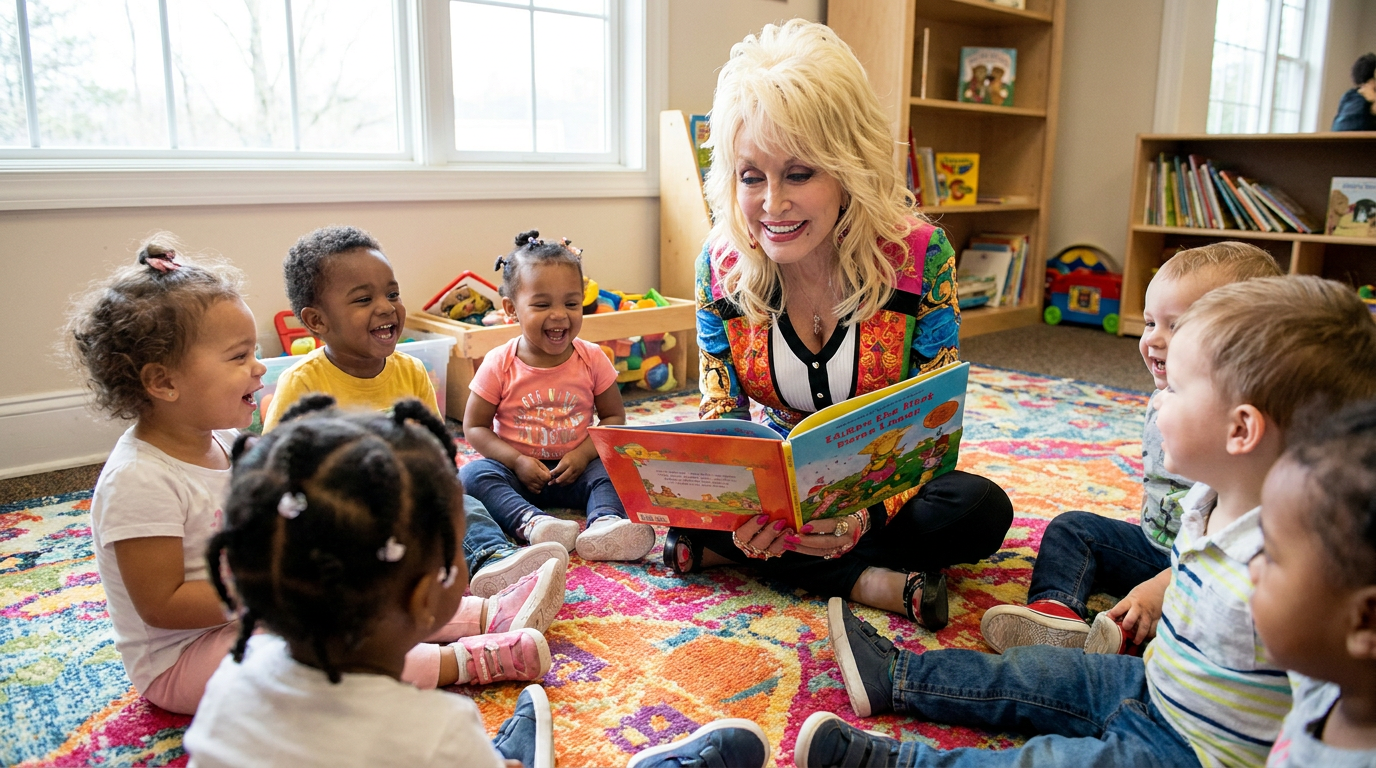
The mechanism of this educational success extends far beyond the physical books themselves; it fundamentally alters the behavioral dynamics and daily routines within the home. Researchers found that the regular arrival of a package addressed specifically to the child creates a recurring event that incentivizes household reading routines and builds anticipation. Caregivers enrolled in the Imagination Library reported substantially higher rates of interactive reading behaviors compared to the control groups. They were more likely to establish consistent bedtime reading habits, actively discuss the illustrations and narratives with their children, and encourage toddlers to hold, turn pages, and explore the books independently. This deep engagement transforms reading from a passive listening activity into an interactive developmental exercise.[5][6][7]
Caregivers enrolled in the Imagination Library reported substantially higher rates of interactive reading behaviors compared to the control groups.
This behavioral shift in the home is widely considered by early childhood educators to be a crucial factor in closing the "word gap." The word gap refers to the well-documented disparity in the number of words children from different socioeconomic backgrounds hear during their formative years, which often dictates their readiness and confidence upon entering school. By providing a steady stream of new, engaging material, the Imagination Library gives parents the tools they need to foster a language-rich environment. Furthermore, the study highlighted that the program strengthens family connections, providing caregivers with a dedicated, screen-free activity that promotes bonding and focused attention during a critical period of emotional development.[5][7]

The logistics behind this massive distribution network rely on a highly effective, decentralized public-private partnership model that has allowed the program to scale globally without collapsing under its own weight. At the top level, the Dollywood Foundation manages the centralized infrastructure, which includes maintaining the secure database for the book order system, negotiating wholesale book purchasing at massive discounts, and coordinating the complex mailing logistics. Meanwhile, local community partners—ranging from rotary clubs and local school districts to state governments and regional nonprofits—secure the funding to cover the wholesale cost and postage for the children in their specific zip codes. This hybrid model ensures that the program remains deeply rooted in local communities while benefiting from the efficiency of a global supply chain.[1][7]
Publishing giant Penguin Random House has served as a core partner in this endeavor since 2001, working closely with the Foundation's international book committee to curate the monthly selections. The committee is tasked with choosing titles that are not only age-appropriate but also culturally diverse, visually engaging, and capable of holding a toddler's attention. The curation process is highly deliberate, ensuring that the books reflect a wide range of experiences and introduce foundational concepts like numbers, colors, and emotional regulation. By partnering directly with a major publisher, the Imagination Library guarantees that the books distributed are of the highest physical and literary quality, rather than relying on discarded or remaindered inventory.[2][7]
The program's origins were remarkably local and deeply personal, rooted in Parton's own family history in the Great Smoky Mountains. Parton launched the initiative in 1995 in her native Sevier County, Tennessee, inspired by her father, Robert Lee Parton. Despite being highly intelligent and hardworking, her father never had the opportunity to learn to read or write, a fact that Parton has frequently cited as the driving force behind her literacy advocacy. That initial local order in 1995 consisted of just 1,760 books for the children of Sevier County. The transformation from a small-town tribute to a global literacy juggernaut underscores the universal appeal and fundamental necessity of the program's core mission.[1][3][4]

Today, the program's integration into public infrastructure is unprecedented for a celebrity-founded charity. Entire states, including Tennessee, Ohio, and Colorado, have passed legislation to guarantee that every child within their borders has access to the program, heavily subsidizing the local community costs through state education budgets. Having celebrated its 30th anniversary in 2025, the Imagination Library's trajectory shows no signs of slowing as it moves through 2026. As the program continues to expand its footprint across the United Kingdom, Australia, and beyond, it stands as a premier example of how a simple, well-executed philanthropic vision can scale to create generational change, proving that the right book at the right time can alter the course of a child's life.[1][6][7]
The international expansion of the Imagination Library has required careful cultural adaptation to ensure the books resonate with children in different countries. In Australia, Canada, and the United Kingdom, the program works with regional publishing experts to include titles from local authors and illustrators, ensuring that the vocabulary and cultural touchstones are relevant to the children receiving them. For instance, the inclusion of Indigenous stories in the Canadian and Australian distributions has been praised by educators for promoting cultural representation and early awareness of diverse heritage. This localized approach within a global framework has been instrumental in securing partnerships with international postal services and educational ministries.[1][6][7]
Looking ahead, the Imagination Library is increasingly being viewed not just as a charity, but as a critical piece of early childhood infrastructure. Educational policymakers are closely analyzing Dr. Galea's 2026 study to understand how universal book distribution could be integrated into broader public health and education initiatives. As school districts worldwide grapple with post-pandemic reading deficits and the pervasive influence of digital screens, the simple, analog intervention of a mailed physical book has proven remarkably resilient. Dolly Parton’s vision has effectively democratized access to early literacy, cementing her legacy as one of the most consequential educational philanthropists of the modern era.[3][5][7]
How we got here
1995
Dolly Parton launches the Imagination Library in Sevier County, Tennessee, gifting 1,760 books in its first order.
2000
The program begins its national replication effort, allowing communities across the United States to adopt the model.
2004
Tennessee becomes the first state to pledge statewide coverage for all children under five.
2025
The Imagination Library officially celebrates its 30th anniversary.
Spring 2026
The program surpasses 314 million books gifted globally, accompanied by a landmark international impact study.
Viewpoints in depth
Early Childhood Educators
Educators focus on the program's ability to close the 'word gap' and improve kindergarten readiness.
For early childhood educators, the Imagination Library is a critical tool in the fight against the 'word gap'—the disparity in vocabulary exposure between children of different socioeconomic backgrounds. Teachers report that children who enter kindergarten having received the monthly books are noticeably more comfortable with physical texts, understand how to hold a book and turn pages, and possess a wider foundational vocabulary. This baseline readiness allows educators to spend less time on basic book mechanics and more time on active reading comprehension.
Literacy Researchers
Researchers emphasize the empirical data showing behavioral shifts and measurable cognitive improvements.
Academic researchers view the program as a massive, successful longitudinal experiment in behavioral nudging. The 2026 study by Dr. Claire Galea highlights that the true intervention isn't just the book itself, but the recurring event of its arrival. The monthly package acts as a prompt that disrupts passive household routines, encouraging caregivers to engage in interactive reading. Researchers note that this consistent, screen-free engagement is vital for developing phonological awareness and emotional regulation during the brain's most plastic developmental window.
Public Policy Advocates
Advocates champion the public-private partnership model as a scalable blueprint for educational infrastructure.
From a policy perspective, the Imagination Library represents a highly efficient model of decentralized public service. Policy advocates point out that by centralizing the database and wholesale purchasing through the Dollywood Foundation, the program achieves massive economies of scale. Local governments and community groups can then fund the 'last mile' delivery at a fraction of what it would cost to run an independent literacy program. This hybrid approach has inspired lawmakers in several states to fully integrate the program into their early education budgets.
What we don't know
- How the program plans to maintain its massive supply chain and postage subsidies if global shipping costs continue to rise.
- Whether the long-term academic advantages observed in the 12-month study persist through high school graduation.
Key terms
- Phonological Awareness
- The ability to recognize and manipulate the spoken parts of sentences and words, which is a key precursor to learning how to read.
- Word Gap
- The disparity in the number of words children from different socioeconomic backgrounds hear during their early years, which affects school readiness.
- Longitudinal Study
- A research design that involves repeated observations of the same variables over long periods of time to track changes and developments.
- Public-Private Partnership
- A collaborative arrangement between government entities and private organizations to fund and deliver public services.
Frequently asked
Who is eligible for the Imagination Library?
Any child from birth to age five living in a participating community is eligible, regardless of family income or demographic background.
How much does the program cost families?
The program is completely free for registered families. There are no registration fees or shipping costs.
How is the program funded?
The Dollywood Foundation covers overhead and database management, while local community partners and state governments fund the wholesale cost of the books and postage for their specific areas.
What kind of books do the children receive?
Children receive high-quality, age-appropriate books selected by an international committee of early childhood experts, published in partnership with Penguin Random House.
Sources
Source coverage
7 outlets
3 viewpoints surfaced







[1]Dolly Parton's Imagination LibraryEarly Childhood Educators
Dolly Parton's Imagination Library Celebrates Spring Impact and Global Research Milestone
Read on Dolly Parton's Imagination Library →[2]Penguin Random HousePublic Policy Advocates
Dolly Parton's Imagination Library Now Serves Over 10% of Children Under 5 in the U.S.
Read on Penguin Random House →[3]The GuardianLiteracy Researchers
Dolly Parton's book gifting scheme hailed as 'transformative' in new global study
Read on The Guardian →[4]Southern LivingEarly Childhood Educators
Dolly Parton's Imagination Library Hits 314 Million Books Donated
Read on Southern Living →[5]Early Childhood Research QuarterlyLiteracy Researchers
Global Impact of Shared Book Reading: A 12-Month Longitudinal Study of 86,000 Caregivers
Read on Early Childhood Research Quarterly →[6]BBC NewsPublic Policy Advocates
Dolly Parton's free books scheme expands across UK libraries
Read on BBC News →[7]Factlen Editorial TeamLiteracy Researchers
Synthesis by Factlen editorial team
Read on Factlen Editorial Team →
Every angle. Every day.
Get entertainment stories with full source coverage and perspective breakdowns delivered to your inbox.