
Comparing Induction and Gas Cooktops: Performance, Health, and Cost Trade-Offs in 2026
As induction technology matures and health concerns surrounding gas emissions grow, the debate over kitchen appliances has shifted from culinary preference to a major household infrastructure decision. Here is a definitive look at the trade-offs between the two cooking methods.
By Factlen Editorial Team
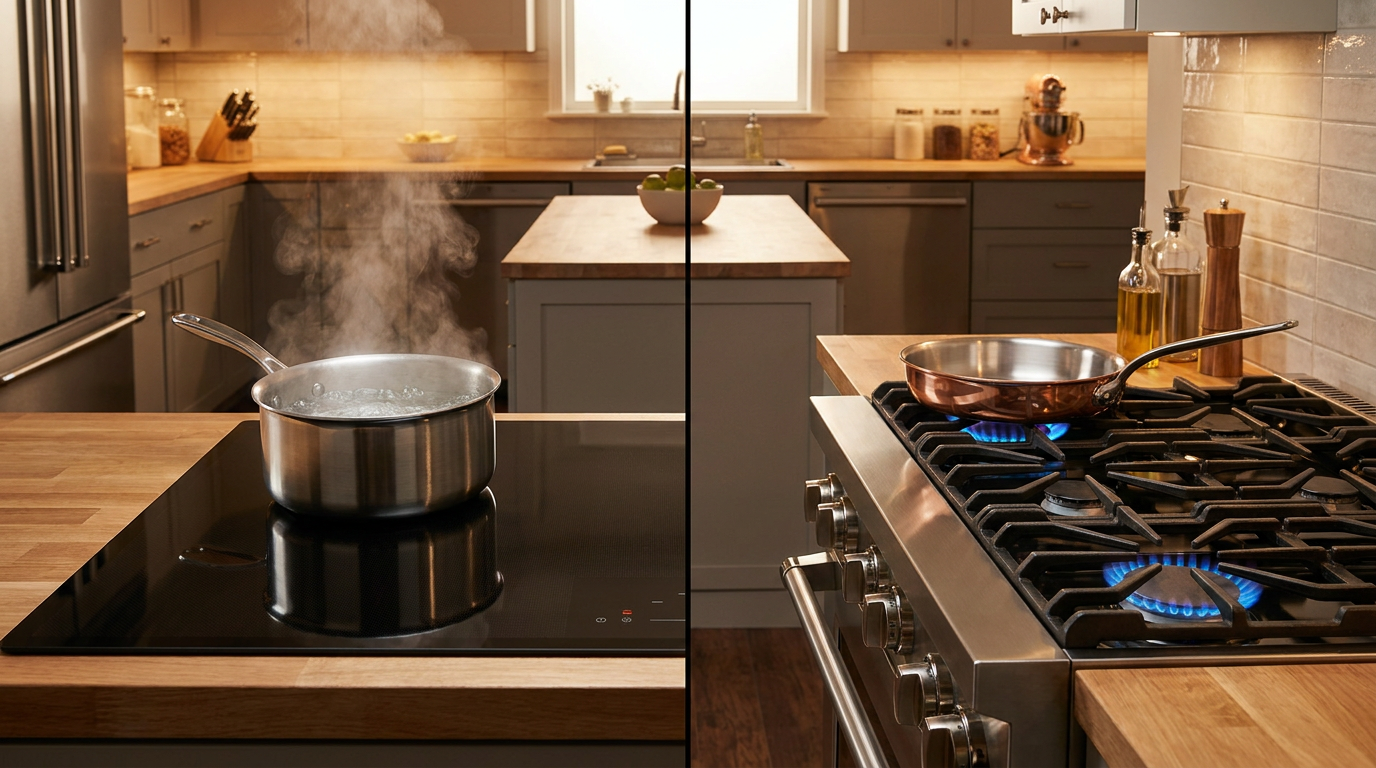
- Health & Environment Advocates
- Prioritizes the elimination of indoor combustion and the reduction of greenhouse gas emissions.
- Traditional Home Cooks
- Values the tactile feedback, visual control, and universal cookware compatibility of open-flame cooking.
- Efficiency & Tech Adopters
- Focuses on the rapid heating speed, precise digital control, and thermodynamic efficiency of modern appliances.
What's not represented
- · Renters who have no control over their kitchen appliances
- · Electricians and contractors managing the logistical bottlenecks of home electrical upgrades
Why this matters
Choosing between induction and gas impacts more than just how quickly water boils; it dictates a home's indoor air quality, long-term energy bills, and daily safety. With new health data emerging and appliance technology rapidly advancing, this decision directly affects both a family's respiratory health and their renovation budget.
Key points
- Induction cooktops achieve 84–90% energy efficiency by heating cookware directly, compared to 32–40% for gas.
- Gas stoves emit nitrogen dioxide and fine particulate matter, which are linked to increased risks of childhood asthma.
- Induction boils water significantly faster and offers precise digital temperature control, while gas provides intuitive visual flame feedback.
- Switching to induction often requires a dedicated 220-volt electrical circuit, adding to the upfront installation costs.
- Gas ranges work with all cookware materials, whereas induction requires pots and pans with a magnetic base.
The debate over how to power the American kitchen has evolved from a matter of culinary preference into a major infrastructure decision. In 2026, as millions of households consider upgrading their appliances, the choice between traditional gas ranges and modern induction cooktops sits at the intersection of performance, health, and economics. For decades, the blue flame of a gas stove was the undisputed symbol of a serious home chef. Today, induction technology has matured from a premium niche into a formidable mainstream contender. Shoppers are no longer just comparing burner outputs; they are weighing indoor air quality, long-term energy efficiency, and the upfront costs of electrical retrofits. With local building codes shifting and appliance technology advancing rapidly, understanding the concrete trade-offs between these two cooking methods is essential for making an informed, future-proof investment.[1][2]
At the core of the comparison is a stark difference in thermodynamic efficiency. The case for induction rests on its use of electromagnetic fields to heat the cookware directly, rather than heating the air beneath it. This direct transfer allows induction cooktops to achieve an energy efficiency of 84 to 90 percent. The case against gas centers on its inherent heat loss; because it relies on an open flame, a significant portion of the energy escapes into the surrounding room, resulting in an efficiency of just 32 to 40 percent. The evidence is compelling: industry analyses demonstrate that induction uses roughly 50 to 60 percent less primary energy per meal than gas. For households focused on lowering their overall energy footprint, induction offers a clear mathematical advantage, converting nearly all of its drawn power into usable cooking heat.[1][7]

When it comes to daily cooking performance, the trade-offs revolve around speed versus tactile feedback. The argument for induction highlights its sheer velocity and precision; it can boil a pot of water significantly faster than the highest-BTU gas burner and offers exact, repeatable digital temperature control. The argument against induction—and for gas—is that gas provides instant visual confirmation. Cooks can see the flame and intuitively adjust it, a sensory experience that many traditionalists find irreplaceable. Evidence from extensive Consumer Reports testing confirms that induction burners consistently outperform gas in both rapid high-heat tasks and steady low-heat simmering. However, gas remains highly versatile, working seamlessly during electrical blackouts and accommodating aggressive pan-tossing without breaking a glass surface.[2][3][6]
Perhaps the most significant shift in the 2026 appliance market is the growing awareness of indoor air quality and the chemistry of combustion. The case for induction is bolstered by its zero-emission profile; because it uses electromagnetism, it produces no combustion byproducts whatsoever. The case against gas is rooted in the unavoidable reality of burning fossil fuels indoors. Gas stoves emit nitrogen dioxide, benzene, and fine particulate matter directly into the kitchen environment. The evidence has become difficult to ignore: researchers at Columbia University found a 56 percent reduction in daily nitrogen dioxide concentrations when households swapped their gas stoves for induction models. During controlled cooking tests, background nitrogen dioxide in gas homes spiked from 18 parts per billion to 197 parts per billion, while remaining negligible in induction homes.[1][4]

The presence of these emissions translates directly into measurable health outcomes, shifting the debate from preference to public health. The argument against gas highlights that standard range hoods often fail to capture the majority of these pollutants, leaving them to circulate through the home. The evidence is stark: public health data and meta-analyses link gas stove usage to a 42 percent increased risk of childhood asthma, attributing hundreds of thousands of current asthma cases to indoor cooking exposure. Furthermore, benzene exposure from a gas stove can rival the ambient levels found in homes with secondhand smoke. For families with young children, elderly residents, or individuals with respiratory sensitivities, the health benefits of eliminating indoor combustion often outweigh traditional cooking preferences, making induction a proactive wellness choice.[1][3]
The presence of these emissions translates directly into measurable health outcomes, shifting the debate from preference to public health.
The professional culinary world, long a bastion of gas-burner loyalty, is also experiencing a quiet revolution. The case for induction in commercial kitchens focuses on operational efficiency: it creates a drastically cooler working environment, reduces the strain on HVAC systems, and allows for grueling cleanup to be completed with a simple wipe-down. The case against induction in this setting is that it struggles to replicate the sheer radiant heat blast required for authentic wok cooking, where the flames must lick the sides of a round-bottom pan to achieve 'wok hei.' Evidence from the restaurant industry shows that while gas remains essential for specific regional cuisines, a growing number of chefs are embracing induction for its repeatability and safety. They note that the ability to hit the exact same simmer across multiple shifts reduces errors and improves overall kitchen morale.[5][9]

When transitioning between the two technologies, cookware compatibility remains a primary friction point for buyers. The case for gas is its universal flexibility; a gas flame will heat aluminum, copper, cast iron, and glass equally well, allowing cooks to retain their entire existing culinary arsenal. The case against induction is its strict requirement for ferromagnetic cookware. Because the system relies on magnetic fields to generate heat, if a magnet does not stick firmly to the bottom of a pan, the stove simply will not turn on. Evidence from consumer testing shows that while most modern stainless steel and all cast iron work perfectly, homeowners often have to replace beloved anodized aluminum or pure copper pieces. Shoppers must factor the potential cost of a new pot and pan set into their overall upgrade budget.[2][7]
Beyond the cookware, the economics of installation and long-term operation present a complex calculus. The case for gas is its lower upfront purchase price and the ease of simply sliding a new unit into an existing gas line. The case against induction involves the often-hidden costs of electrical retrofits. While the price of induction cooktops has fallen significantly, transitioning from gas often requires hiring an electrician to cap the gas line and install a dedicated 220-volt electrical circuit. Evidence from appliance retailers indicates this electrical work can add hundreds or even thousands of dollars to the project. However, induction's 90 percent energy efficiency means that, depending on local utility rates, the day-to-day operating costs are frequently lower, eventually helping to offset the steeper initial investment over the lifespan of the appliance.[7][8]
Safety and daily maintenance present another clear divergence between the two technologies. The case for induction emphasizes its inherently cool surface; because the cooktop only heats the magnetic pan, the surrounding glass remains safe to touch, dramatically reducing the risk of accidental burns. This also means that inevitable spills do not bake onto the surface, making cleanup a matter of a quick swipe with a damp cloth. The case against gas highlights the risks of open flames, potential gas leaks, and the cumbersome nature of cleaning. Scrubbing a gas range involves removing heavy cast-iron grates, cleaning around delicate igniters, and degreasing burner caps. For busy households, the operational safety and low-maintenance nature of induction provide a compelling daily quality-of-life improvement.[2][7]

Ultimately, there is no single winner without conditions; the right choice depends entirely on a household's specific infrastructure and cooking habits. Induction fits well when a homeowner prioritizes indoor air quality, rapid heating, and effortless cleanup, particularly if they are already upgrading their electrical panel, have young children, or live in a highly insulated home where excess ambient heat is undesirable. Conversely, gas fits well when a shopper frequently cooks with non-magnetic copper or aluminum pans, relies heavily on traditional visual flame control, regularly uses round-bottom woks, or lives in an area prone to frequent power outages where an existing gas line provides reliable resilience. By matching the technology to their daily realities, consumers can ensure their kitchen upgrade serves them effectively for years to come.[1][2][7][8]
Viewpoints in depth
Public Health Advocates
Focuses on the respiratory risks associated with indoor combustion.
This camp argues that the kitchen stove is the only unvented fossil-fuel appliance legally allowed inside the home. Citing data that links gas stoves to a 42 percent increase in childhood asthma rates, public health experts emphasize that even low-level exposure to nitrogen dioxide and benzene carries long-term consequences. They view the transition to induction not just as an appliance upgrade, but as a critical public health intervention, particularly for vulnerable populations living in smaller, poorly ventilated spaces.
Traditional Culinary Professionals
Defends the tactile feedback and versatility of open-flame cooking.
Traditionalists maintain that cooking is an inherently sensory experience. They argue that the visual feedback of a gas flame allows for intuitive adjustments that digital touchpads cannot replicate. Furthermore, this camp points out that certain culinary techniques—most notably the creation of 'wok hei' in traditional Asian cuisine—rely on the radiant heat of flames licking the sides of a round-bottom pan. For these cooks, the perfect sear and the ability to use legacy copper or aluminum cookware justify the lower energy efficiency.
Efficiency & Tech Adopters
Champions the thermodynamic superiority and precision of electromagnetic heating.
This perspective views the gas stove as an antiquated technology that wastes more than half of its energy heating the surrounding air. Tech adopters celebrate induction for its ability to boil water in a fraction of the time and maintain exact temperatures for delicate tasks like melting chocolate or simmering sauces. They argue that the initial learning curve and the cost of replacing non-magnetic cookware are minor hurdles compared to the daily benefits of a cooler kitchen, effortless cleanup, and significantly lower primary energy usage.
What we don't know
- How quickly the electrical grid in various regions will decarbonize to maximize the source-energy benefits of induction.
- Whether specialized high-power induction woks will eventually replicate the exact flavor profile of traditional gas wok cooking.
- How future local building codes and potential appliance rebate programs will affect the long-term cost parity between the two technologies.
Key terms
- Electromagnetic Induction
- A process where a magnetic field generates electric currents directly inside magnetic cookware, heating the pan itself rather than the stove's surface.
- Nitrogen Dioxide (NO2)
- A harmful gas produced by the combustion of fossil fuels, including natural gas stoves, which is linked to respiratory issues and asthma.
- BTU (British Thermal Unit)
- A traditional measure of heat output used to rate the power of gas burners.
- Wok Hei
- A complex, smoky flavor achieved in traditional Asian cooking when oil droplets catch fire from the intense radiant heat of a gas wok burner.
- Primary Energy
- The total raw energy consumed to perform a task, including the energy lost during electricity generation and transmission.
Frequently asked
Do I need to buy all new pots and pans for an induction stove?
Not necessarily. Induction requires magnetic cookware, so cast iron and most stainless steel pans will work perfectly. If a refrigerator magnet sticks firmly to the bottom of your current pan, it is compatible with induction. Aluminum, copper, and glass cookware will not work.
Will an induction cooktop increase my electricity bill?
While it uses electricity instead of gas, induction is highly efficient, converting up to 90% of its energy directly into heat. Depending on local utility rates, this high efficiency often offsets the cost of electricity, making the day-to-day operating costs comparable to or cheaper than gas.
Is it expensive to switch from gas to induction?
The upfront cost can be higher. In addition to purchasing the induction range, most homes require an electrician to cap the gas line and install a dedicated 220-volt electrical circuit, which can add several hundred dollars to the installation cost.
Do induction cooktops scratch easily?
Induction cooktops are made of durable glass-ceramic, which is tough but can be scratched by sliding heavy cast-iron pans or dropping hard objects. However, because the surface stays cool, food doesn't bake on, meaning you rarely need to use abrasive scrubbers that cause micro-scratches.
Sources
Source coverage
9 outlets
3 viewpoints surfaced









[1]Energy SolutionsHealth & Environment Advocates
Induction vs Gas Cooktops: The Definitive Health, Efficiency & Economic Analysis
Read on Energy Solutions →[2]Consumer ReportsEfficiency & Tech Adopters
An introduction to induction
Read on Consumer Reports →[3]The Washington PostHealth & Environment Advocates
The health impact of kitchen choices: Gas vs. induction cooking
Read on The Washington Post →[4]Columbia UniversityHealth & Environment Advocates
Switching from Gas to Electric Stoves Cuts Indoor Air Pollution
Read on Columbia University →[5]The GuardianEfficiency & Tech Adopters
'I use it because it's better': why chefs are embracing the electric stove
Read on The Guardian →[6]House DigestEfficiency & Tech Adopters
The Cooktop Appliance Brand That Tops Consumer Reports' Test
Read on House Digest →[7]Stahl KitchensTraditional Home Cooks
Induction vs Gas Cooktops: Which One Is the Better Choice in 2026?
Read on Stahl Kitchens →[8]Baron's Major Brands AppliancesTraditional Home Cooks
Induction vs Gas Cooking: Which Is Better?
Read on Baron's Major Brands Appliances →[9]Restaurant BusinessEfficiency & Tech Adopters
Why chefs are switching from gas to induction cooking
Read on Restaurant Business →
Every angle. Every day.
Get shopping stories with full source coverage and perspective breakdowns delivered to your inbox.