
Commercial Shipping Returns to Wind Power to Slash Global Emissions
The maritime industry is reviving a centuries-old power source using high-tech rigid sails and spinning rotors to cut fuel consumption and meet aggressive new climate targets.
By Factlen Editorial Team
- Maritime Engineers & Innovators
- Focuses on the aerodynamic breakthroughs and the seamless integration of automation that make modern wind power viable.
- Shipowners & Operators
- Views wind-assist primarily as a risk-mitigation tool against volatile fuel prices and looming carbon taxes.
- Environmental Advocates
- Argues that wind power offers the only immediate, scalable way to stop millions of tons of CO2 from entering the atmosphere today.
What's not represented
- · Port Authorities & Stevedores
- · Global Supply Chain Managers
Why this matters
Shipping moves 90% of global goods but produces 3% of global emissions. Because zero-carbon fuels like green ammonia are still years away from scale, wind-assisted propulsion offers an immediate, proven way to decarbonize the global supply chain without disrupting trade.
Key points
- Commercial shipping is reviving wind power to cut emissions and meet strict new international climate regulations.
- Modern wind-assist systems are fully automated and include rigid airplane-like wings, spinning rotor sails, and high-altitude kites.
- Wind-assisted propulsion can reduce a cargo ship's fuel consumption by up to 30 percent on optimized routes.
- The technology serves as a critical bridge to decarbonization while the industry waits for zero-carbon alternative fuels to scale.
For more than two centuries, the commercial shipping industry has relied on the brute force of combustion engines to move the global economy. Coal gave way to heavy fuel oil, and the romantic era of towering canvas sails faded into history. But in a striking twist of technological irony, the maritime industry is now looking backward to move forward. Driven by urgent climate mandates and volatile fuel costs, modern cargo ships are once again harnessing the wind. This is not a return to the age of wooden masts and rigging; it is a high-tech renaissance known as Wind-Assisted Ship Propulsion (WASP), featuring automated rigid wings, spinning composite cylinders, and high-altitude kites.[7]
The scale of the decarbonization challenge facing the maritime sector is immense. Approximately 90 percent of all global trade by volume is transported across the oceans, making shipping the invisible backbone of modern civilization. However, this massive logistical network comes with a steep environmental cost. The global shipping fleet produces roughly one billion tons of carbon dioxide every year, accounting for nearly 3 percent of all global greenhouse gas emissions—a footprint roughly equivalent to that of the entire aviation industry. As other sectors of the global economy rapidly decarbonize, shipping’s share of global emissions is projected to rise unless drastic interventions are made.[3]
Regulatory pressure is forcing the industry's hand. The International Maritime Organization (IMO) has implemented strict new environmental mandates, including the Carbon Intensity Indicator (CII) rating system, which grades ships on their operational efficiency. Vessels that fail to meet these tightening standards face severe penalties and could eventually be barred from operating altogether. The IMO has set an aggressive target to reduce the carbon intensity of international shipping by at least 40 percent by 2030, compared to 2008 levels, with an ultimate goal of reaching net-zero emissions by or around 2050. For shipowners, the mandate to cut emissions is no longer a distant theoretical goal; it is an immediate operational necessity.[5]

While the industry widely acknowledges that zero-carbon alternative fuels—such as green ammonia, methanol, and hydrogen—are the ultimate long-term solution, these technologies face significant hurdles. They currently lack the global bunkering infrastructure required to refuel ships at thousands of ports worldwide. Furthermore, these alternative fuels have lower energy densities than heavy fuel oil, meaning ships would need to sacrifice valuable cargo space for larger fuel tanks to complete long-haul ocean crossings. Even under the most optimistic projections, a fully scaled green fuel supply chain is still years, if not decades, away from maturity.[7]
This gap between immediate regulatory deadlines and the delayed arrival of alternative fuels has created the perfect opening for wind power. Unlike green ammonia or methanol, wind is abundant, entirely free, and requires no complex global supply chain or port infrastructure. It is available immediately on the open ocean. Consequently, Wind-Assisted Ship Propulsion has rapidly transitioned from a fringe concept to a mainstream commercial reality. Industry analysts project that the global commercial fleet will surpass 100 large-scale wind-assisted vessels by the end of 2025 or early 2026, marking a critical tipping point for the technology's adoption.[4]
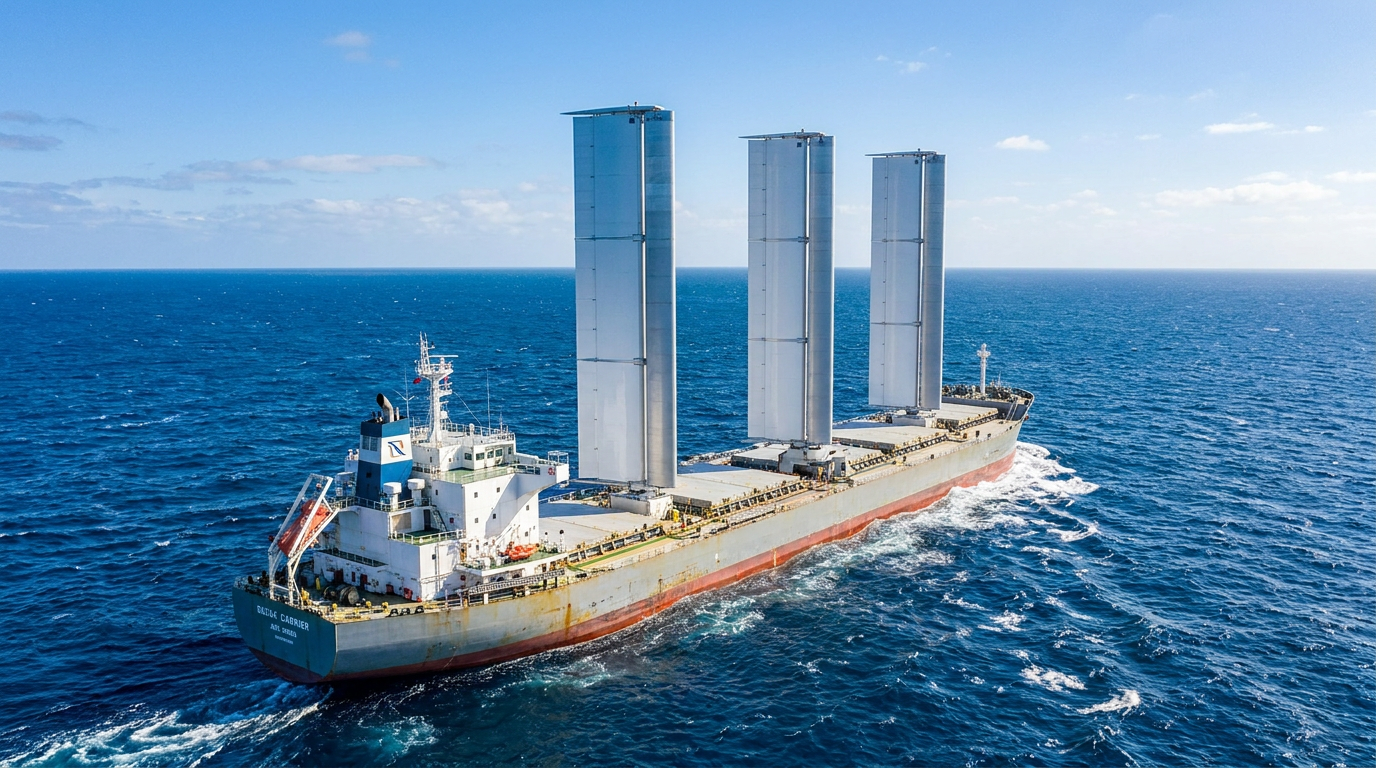
One of the most visually striking and effective technologies leading this renaissance is the rigid wing sail. Modeled heavily on the aerodynamic principles of airplane wings, these massive structures—such as the WindWings developed by BAR Technologies—are constructed from steel and composite materials. Standing up to 150 feet tall on the deck of a bulk carrier, these rigid sails are fully computer-controlled. They automatically pivot and adjust their camber to capture the optimal angle of the wind, generating forward thrust with remarkable efficiency. When a ship encounters severe weather or needs to pass under a bridge, the wings can be folded down flat against the deck.[1][3]
The performance metrics for these rigid wing systems have moved beyond theoretical models and into verified operational data. On optimized global trade routes, a single rigid wing can save a commercial vessel approximately 1.5 to 1.6 tonnes of fuel per day. For a large bulk carrier equipped with three or four of these wings, the cumulative fuel savings can reach up to 30 percent. At current marine fuel prices, this translates to hundreds of thousands of dollars in annual operational savings per vessel, while simultaneously preventing thousands of tons of carbon dioxide from entering the atmosphere each year.[5]
The performance metrics for these rigid wing systems have moved beyond theoretical models and into verified operational data.
Alongside rigid wings, Rotor Sails—also known as Flettner rotors—have emerged as a highly popular and proven wind-assist technology. First invented in the 1920s by German engineer Anton Flettner, the concept was largely abandoned due to the cheap abundance of fossil fuels. Today, companies like Norsepower and Anemoi have revived and modernized the design. A rotor sail looks like a tall, smooth vertical cylinder standing on the ship's deck. An internal electric motor spins the cylinder continuously. While it may not look like a traditional sail, it interacts with the wind to generate a massive amount of propulsive force.[1][2]

Rotor sails operate on a principle of fluid dynamics known as the Magnus effect—the same physical phenomenon that causes a tennis ball with topspin to curve downward, or a spinning soccer ball to bend around a wall of defenders. As the wind hits the spinning cylinder, the air on one side is accelerated, while the air on the opposite side is slowed down. This creates a stark pressure differential: low pressure on one side and high pressure on the other. This pressure imbalance generates a powerful perpendicular thrust that pushes the ship forward, effectively converting wind energy into kinetic motion.[7]

While rigid wings and rotor sails dominate the deck, other innovators are looking higher up for solutions. Companies like the French startup Airseas have developed massive, automated kites designed to tow commercial vessels. Deployed from the bow of the ship, these parafoils fly up to 1,000 feet above the ocean surface. At this altitude, the kites can capture winds that are significantly stronger and more consistent than those at sea level. The kite flies in a continuous figure-eight pattern to maximize aerodynamic pull, potentially reducing fuel consumption by up to 20 percent on favorable transatlantic routes.[6]
A crucial factor driving the adoption of these diverse wind technologies is their operational simplicity for the crew. Modern commercial seafarers are engineers and navigators, not traditional sailors; they do not have the training or the manpower to manually rig canvas sails. Fortunately, today's wind-assist systems are entirely automated. Sensors continuously monitor wind speed, direction, and sea state, feeding data into onboard computers that automatically adjust the wings, spin the rotors, or fly the kites. The crew simply monitors the system from the bridge, often controlling the entire apparatus with the push of a single button.[3]
To maximize the benefits of wind propulsion, the shipping industry is also revolutionizing how it navigates. Historically, cargo ships have prioritized the shortest, most direct route between two ports to minimize travel time. However, vessels equipped with wind-assist technologies are increasingly utilizing advanced AI-driven weather routing software. These systems analyze global meteorological data to chart routes that intentionally seek out favorable wind patterns. While this might add slight distance to the journey, the massive reduction in fuel consumption provided by the wind more than compensates for the detour, optimizing the overall efficiency of the voyage.[5]

The economic case for retrofitting existing ships is becoming increasingly compelling. Fuel costs typically account for roughly half of a commercial vessel's total operating expenses. By installing rotor sails or rigid wings, shipowners can drastically cut these daily costs. Furthermore, as international regulators begin to implement carbon pricing and emissions taxes on the maritime sector, the financial penalty for burning heavy fuel oil will only increase. For many operators, the upfront capital expenditure required to install wind-assist technology pays for itself within a few years through accumulated fuel savings and avoided regulatory fines.[2]
Despite the overwhelming optimism, the transition to wind-assisted shipping is not without its challenges. Wind is inherently intermittent; a ship traversing the equatorial doldrums may experience days without a usable breeze. Because of this unpredictability, wind cannot serve as the sole source of power for massive, modern cargo ships—they will always require a primary engine to maintain strict delivery schedules. Additionally, the upfront costs of retrofitting older vessels can be substantial, and the physical footprint of the sails can complicate cargo loading and unloading operations at busy ports.[6]
Ultimately, the return of wind power to the high seas represents a pragmatic, hybrid approach to the climate crisis. Wind-assisted propulsion is not a silver bullet that will single-handedly decarbonize global trade, nor is it a temporary gimmick. Instead, it is a permanent, highly effective bridge technology. As the maritime industry slowly builds the infrastructure for zero-carbon fuels over the coming decades, the wind will be there—free, abundant, and ready to push the global economy toward a more sustainable future, one nautical mile at a time.[7]
How we got here
1926
German engineer Anton Flettner successfully crosses the Atlantic using a ship powered by spinning rotor sails.
2018
Norsepower installs modern rotor sails on a commercial tanker, proving the technology's viability for the 21st century.
2023
The Pyxis Ocean becomes the first cargo ship retrofitted with massive rigid WindWings to set sail on a commercial voyage.
2025-2026
The global commercial fleet is projected to surpass 100 large-scale vessels equipped with wind-assisted propulsion systems.
Viewpoints in depth
Maritime Engineers & Innovators
Focuses on the aerodynamic breakthroughs and the seamless integration of automation.
For the engineering community, the return to wind is a triumph of modern fluid dynamics and computer science rather than a nostalgic throwback. They argue that 19th-century sailors could never have achieved the efficiencies unlocked by today's rigid wings and spinning rotors. By pairing these aerodynamic structures with AI-driven weather routing and fully automated control systems, engineers have transformed the unpredictable wind into a reliable, high-tech asset that requires zero traditional sailing expertise from the crew.
Shipowners & Operators
Focuses on the harsh economic realities of global trade and regulatory compliance.
Shipowners view wind-assist primarily through the lens of risk mitigation and return on investment. With fuel accounting for roughly half of their operating costs, and international regulators preparing to implement steep carbon taxes, operators are desperate for immediate solutions. For this camp, the success of WASP hinges entirely on the math: the upfront capital expenditure of retrofitting a vessel must be quickly recouped through daily fuel savings and avoided regulatory fines, all without disrupting strict cargo loading schedules.
Environmental Advocates
Focuses on the immediate, absolute reduction of greenhouse gases in the atmosphere.
Environmental groups argue that the shipping industry cannot afford to wait decades for perfect zero-carbon fuels like green ammonia to scale globally. They point out that wind power offers the only viable, immediate way to stop millions of tons of CO2 from entering the atmosphere today. Consequently, this camp is pushing for international regulators to mandate the consideration of wind-assist technologies on all new commercial vessel builds, ensuring that the industry maximizes every available tool to fight the climate crisis.
What we don't know
- How quickly global port infrastructure will adapt to accommodate ships with towering 150-foot rigid sails on their decks.
- Whether the upfront capital costs of retrofitting will remain a barrier for smaller shipping operators in developing nations.
- How the widespread adoption of AI weather routing will impact the strict 'just-in-time' delivery schedules of global supply chains.
Key terms
- WASP
- Wind-Assisted Ship Propulsion; the use of modern wind technologies to supplement a commercial vessel's main engine.
- Rotor Sail
- A tall, spinning vertical cylinder installed on a ship's deck that uses fluid dynamics to generate forward thrust.
- Rigid Wing Sail
- A solid, foldable sail modeled after an airplane wing, designed to capture wind efficiently without the need for canvas or rigging.
- Magnus Effect
- A physical phenomenon where a spinning object in an airstream creates a pressure difference, generating a perpendicular propulsive force.
- Carbon Intensity Indicator (CII)
- An international environmental rating system that grades commercial ships based on how efficiently they transport goods.
Frequently asked
Can these ships sail entirely on wind power?
No. Modern commercial ships are too heavy to rely solely on wind; these systems act as an assist to the main engine, reducing fuel use rather than replacing it.
Do the crews need traditional sailing skills?
No. The systems are fully automated, using sensors and computers to adjust the sails or rotors based on real-time wind conditions.
What happens when there is no wind?
The ship simply relies entirely on its conventional engines, just like a standard vessel, ensuring delivery schedules are maintained.
Can these systems be added to existing ships?
Yes. Many wind-assist technologies, particularly rotor sails, are designed to be retrofitted onto the decks of existing bulk carriers and tankers.
Sources
Source coverage
7 outlets
3 viewpoints surfaced






[1]DNVMaritime Engineers & Innovators
Rotor sails – a proven technology
Read on DNV →[2]Lloyd's RegisterShipowners & Operators
Retrofitting with wind-assisted ship propulsion
Read on Lloyd's Register →[3]European CommissionEnvironmental Advocates
Wind-powered cargo ships take to the seas
Read on European Commission →[4]Royal Institution of Naval ArchitectsMaritime Engineers & Innovators
Wind Propulsion 2026 Conference
Read on Royal Institution of Naval Architects →[5]CM EnergyShipowners & Operators
Annual Report on WAPS Adoption in Commercial Shipping
Read on CM Energy →[6]More Than ShippingShipowners & Operators
Could wind power help power tomorrow's shipping vessels?
Read on More Than Shipping →[7]Factlen Editorial TeamEnvironmental Advocates
Synthesis by Factlen editorial team
Read on Factlen Editorial Team →
Every angle. Every day.
Get transportation stories with full source coverage and perspective breakdowns delivered to your inbox.