
Beyond Farm-to-Table: How 'Regenerative Food Tourism' is Healing Destinations
A new era of culinary travel is moving past basic sustainability, focusing instead on dining experiences that actively restore soil health, boost biodiversity, and empower local communities.
By Factlen Editorial Team
- Hospitality & Tourism Industry
- Focuses on the business case for regeneration, using agrobiodiversity to create premium, exclusive guest experiences.
- Community & Cultural Advocates
- Emphasizes food sovereignty, decolonizing food systems, and ensuring tourism dollars empower local farmers.
- Market & Editorial Analysts
- Tracks the economic growth and consumer demand driving the shift toward purpose-driven travel.
What's not represented
- · Conventional industrial farmers who may face economic pressure as the hospitality industry shifts toward localized, regenerative sourcing.
- · Budget-conscious travelers who are currently priced out of premium regenerative culinary experiences.
Why this matters
As the global travel industry rebounds, the shift toward regenerative gastronomy offers a blueprint for how tourism can actively heal the planet rather than deplete it. For travelers, understanding this trend means the power to direct vacation spending toward communities and ecosystems that are actively fighting climate change.
Key points
- Regenerative gastronomy tourism moves beyond "sustainable" travel by actively restoring local ecosystems and communities.
- The sustainable and regenerative food travel market is booming, projected to grow at an 18% compound annual growth rate.
- Hotels are abandoning monocropped ingredients in favor of agrobiodiversity, creating climate-resilient local supply chains.
- Circular food economies in resort kitchens eliminate waste by composting scraps and repurposing byproducts.
- Initiatives like Vanuatu's "Regenerative Vanua" are decolonizing food systems by centering Indigenous agricultural knowledge.
- The movement faces challenges with "greenwashing" and the high premium costs currently associated with luxury eco-travel.
For decades, the culinary traveler’s itinerary was defined by extraction: checking off Michelin-starred restaurants, hunting down viral street food, and consuming a destination’s resources before flying home. Then came the "farm-to-table" movement, which shortened supply chains and introduced a baseline of environmental awareness. But today, a more profound shift is quietly transforming the hospitality industry. Welcome to the era of regenerative gastronomy tourism.[6]
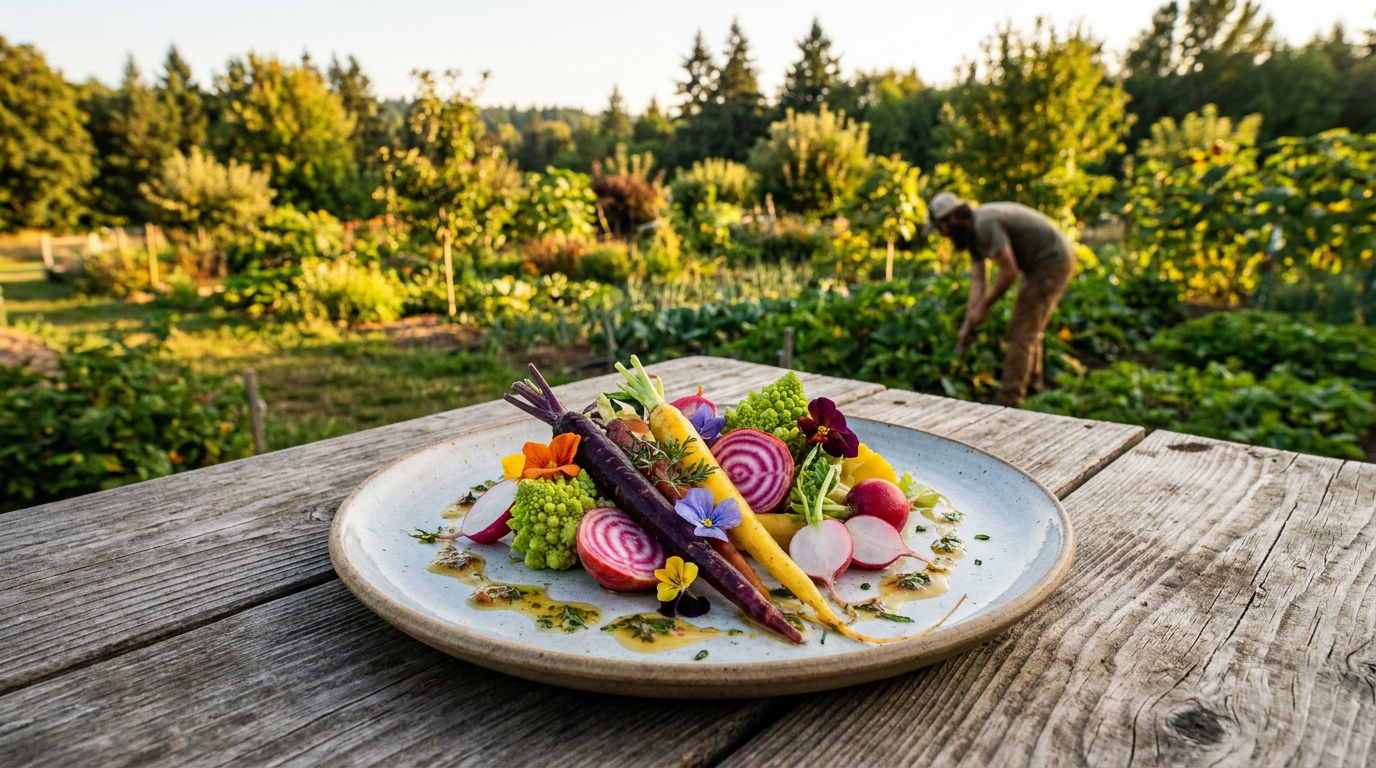
Regenerative food tourism asks a radical question: What if the simple act of eating on vacation could actively heal the destination? Rather than merely minimizing harm, this emerging travel philosophy focuses on renewal. It envisions a food system where every meal served to a visitor restores soil health, increases local biodiversity, and builds wealth within indigenous and rural communities.[3][6]
The distinction between "sustainable" and "regenerative" is crucial. Sustainability is fundamentally about maintaining the status quo—achieving a neutral footprint, reducing carbon emissions, and "leaving no trace." Regeneration, however, is about leaving a place measurably better than you found it. It is an active process of repairing ecosystems that have been degraded by decades of industrial agriculture and mass tourism.[3][6]

This philosophy is rapidly moving from niche eco-lodges to the center of the global travel economy. According to market analysts at the IMARC Group, sustainable and regenerative food travel is currently growing at a staggering 18% compound annual growth rate (CAGR). This makes it one of the highest-growth investment vectors in the entire hospitality sector through 2034, outpacing traditional culinary tourism.[1]
The financial momentum is driven by a post-pandemic shift in consumer values. Travelers are increasingly seeking out purpose-driven experiences where their spending aligns with environmental stewardship. They want to know that the premium they pay for a luxury farm stay or a tasting menu is directly funding the restoration of the landscape they are visiting.[1][6]

At the heart of this movement is the concept of agrobiodiversity. For generations, industrial farming has relied on monocropping—planting vast fields of a single, genetically uniform crop to maximize yield. While efficient, monocropping strips the soil of nutrients, requires heavy chemical inputs, and leaves food systems highly vulnerable to climate shocks and superbugs.[4]
Regenerative hospitality actively combats this by championing agrobiodiversity. Hotels and resorts are partnering with local farmers to cultivate a wide variety of heirloom cultivars and native edible species that are rarely found in commercial supermarkets. By creating a reliable market for these diverse, climate-resilient crops, the tourism industry provides farmers with the financial security needed to abandon monoculture.[4]
For hoteliers, agrobiodiversity is not just an environmental imperative; it is a powerful differentiator. By transforming rare, locally adapted ingredients into exclusive culinary experiences, properties can command premium pricing while offering guests a genuine "taste of place" that cannot be replicated anywhere else in the world.[4]
For hoteliers, agrobiodiversity is not just an environmental imperative; it is a powerful differentiator.
Beyond the fields, regenerative dining relies on the principles of a circular food economy. In a truly regenerative kitchen, the concept of "waste" is eliminated. Food scraps are composted to create nutrient-rich fertilizer for the next harvest, invasive species are creatively integrated into menus to protect native ecosystems, and every byproduct is repurposed.[3]

A striking example of this philosophy in action is unfolding in the Pacific island nation of Vanuatu. Recently named the World Region of Gastronomy for 2027 by the International Institute of Gastronomy, Culture, Arts and Tourism (IGCAT), Vanuatu is pioneering a national framework centered entirely on regenerative food systems.[5]
Through initiatives like "Regenerative Vanua," the island nation is drawing a sharp contrast between extractive industrial tourism and community-led stewardship. Their model fosters intercultural experiences—such as foraging walks through edible food forests and traditional harvesting with tribal communities—that actively decolonize the local food system.[5]
By honoring natural cycles and Indigenous knowledge, Vanuatu’s approach ensures that tourism serves the host community, rather than forcing the community to reshape itself for the convenience of the tourism industry. It cultivates a reciprocal relationship where visitors learn ancestral foodways and locals retain sovereignty over their land and culture.[5]
Destination Management Organizations (DMOs) worldwide are taking note of these successes. Forward-thinking DMOs are now acting as facilitators, building networks that connect small-scale regenerative farmers directly with hotels and tour operators. This localized supply chain dramatically reduces the carbon emissions associated with transporting food across the globe.[2]
More importantly, these localized networks ensure that tourism dollars remain within the community. When a resort commits to sourcing exclusively from local regenerative producers, it creates a resilient micro-economy that supports small businesses, protects unique culinary heritage, and incentivizes the preservation of traditional farming methods.[2]

However, the rapid commercialization of regenerative travel is not without its challenges. As the term gains marketing cachet, industry analysts warn of "greenwashing"—instances where hospitality brands slap a regenerative label on basic recycling programs or superficial farm-to-table menus without committing to the rigorous, systemic work of ecological restoration.[1][6]
There is also the challenge of accessibility. Currently, many of the most authentic regenerative food experiences are concentrated in the luxury travel sector, where high operating costs translate to premium price tags. Expanding these practices so they are accessible to mid-range and budget travelers remains a critical hurdle for the industry.[1][6]
Despite these growing pains, the trajectory is clear. The culinary traveler’s mindset has fundamentally shifted from passive consumption to active participation. Whether it is planting herbs with a cooperative in the Andes, learning fermentation techniques in rural Japan, or dining at a zero-waste resort in the Caribbean, visitors are discovering that the most memorable meals are those that give back.[3][6]
Ultimately, regenerative gastronomy proves that luxury and environmental stewardship do not have to be mutually exclusive. By transforming the dining table into a site of ecological healing and cultural preservation, the travel industry is proving that we can, in fact, eat our way to a better world.[6]
How we got here
1990s
The rise of the celebrity chef and destination dining turns culinary travel into a major global industry.
2010s
The "Farm-to-Table" movement mainstreams local sourcing and introduces environmental awareness to fine dining.
2019
The concept of "circular food economies" gains significant traction within the global hospitality sector.
2025
Regenerative food travel emerges as a dominant trend, growing at an estimated 18% compound annual growth rate.
2027
Vanuatu is set to be officially recognized as the World Region of Gastronomy for its pioneering regenerative model.
Viewpoints in depth
Hospitality Industry's view
Focuses on the business case for regeneration and supply chain resilience.
For hoteliers and destination management organizations, regenerative gastronomy is both an ethical imperative and a lucrative business strategy. By investing in agrobiodiversity and localized supply chains, resorts can offer exclusive, premium culinary experiences that differentiate them in a crowded market. Furthermore, moving away from monocropped imports protects their food supply from global climate shocks and superbugs.
Community Advocates' view
Emphasizes food sovereignty, cultural preservation, and decolonization.
Indigenous leaders and cultural advocates argue that true regenerative tourism must go beyond environmental metrics to address social equity. They champion models that decolonize food systems by honoring ancestral agricultural knowledge. In this view, success is measured by whether tourism dollars empower local farmers and fishers to retain sovereignty over their land and traditions, rather than forcing them to adapt to foreign tastes.
Market Analysts' view
Highlights the massive consumer demand driving the shift toward purpose-driven travel.
Financial analysts view regenerative travel as one of the most compelling investment vectors in the modern economy. Driven by a post-pandemic shift in consumer values, travelers are increasingly willing to pay a premium for experiences that align with environmental stewardship. Analysts project that this sector will continue to outpace traditional culinary tourism, provided the industry can successfully self-regulate against greenwashing.
What we don't know
- How quickly mid-range and budget travel sectors can adopt regenerative supply chains without pricing out average consumers.
- Whether global certification standards will emerge to effectively police "greenwashing" in the regenerative hospitality space.
- The long-term measurable impact of hotel-driven agrobiodiversity on global crop resilience.
Key terms
- Regenerative Agriculture
- A holistic farming approach that actively restores soil health, protects biodiversity, and strengthens ecosystems rather than just extracting from them.
- Agrobiodiversity
- The practice of cultivating a wide variety of heirloom crops and native species to build climate resilience and protect against crop collapse.
- Circular Food Economy
- A system where food waste is eliminated, byproducts are repurposed, and nutrients are continuously returned to the soil.
- Greenwashing
- The deceptive marketing practice of labeling standard or superficial sustainability efforts as "regenerative" to attract eco-conscious consumers.
Frequently asked
What is the difference between sustainable and regenerative travel?
Sustainable travel focuses on minimizing harm and leaving a neutral footprint. Regenerative travel goes a step further by actively restoring ecosystems and leaving the destination better than it was found.
Is regenerative food tourism more expensive?
Currently, many authentic regenerative experiences are found in the luxury sector due to the high costs of overhauling supply chains, but the industry is working to make these practices more accessible at all price points.
How does agrobiodiversity help the environment?
By moving away from monocropping (planting a single crop), agrobiodiversity restores soil nutrients, reduces the need for chemical fertilizers, and makes local food systems more resilient to climate change.
Sources
Source coverage
6 outlets
3 viewpoints surfaced






[1]IMARC GroupMarket & Editorial Analysts
Culinary Tourism Market Report
Read on IMARC Group →[2]GDS-MovementHospitality & Tourism Industry
Regenerative Food Tourism: How Sustainability and Gastronomy Can Thrive Together
Read on GDS-Movement →[3]Regenerative TravelHospitality & Tourism Industry
Defining the Taste of Place
Read on Regenerative Travel →[4]Hospitality NetHospitality & Tourism Industry
The Next Step for Regenerative Tourism
Read on Hospitality Net →[5]International Institute of Gastronomy, Culture, Arts and TourismCommunity & Cultural Advocates
Building Regenerative Gastronomy through Verified Food Systems
Read on International Institute of Gastronomy, Culture, Arts and Tourism →[6]Factlen Editorial TeamMarket & Editorial Analysts
Synthesis by Factlen editorial team
Read on Factlen Editorial Team →

More in travel
See all 27 stories →Astrotourism
The Mechanics of Astrotourism: How Dark Sky Parks Are Saving the Night
8 sources

Altitude Physiology
The Science of High-Altitude Acclimatization: How the Human Body Adapts to Mountain Travel
6 sources

Astrotourism
How Astrotourism and Dark Sky Parks Are Saving the Night Sky
8 sources

Astrotourism
The Billion-Dollar Business of Darkness: How Astrotourism is Reshaping Travel
7 sources

Every angle. Every day.
Get travel stories with full source coverage and perspective breakdowns delivered to your inbox.