
Beyond Calories: How the 'Food Matrix' is Rewriting the Rules of Nutrition
Nutrition science is shifting its focus from simple calorie counts to the 'food matrix'—the physical structure of what we eat. Emerging research shows that how a food is built dictates how our bodies absorb its nutrients, regulate our appetite, and feed our microbiome.
By Factlen Editorial Team
- Whole-Food Advocates
- Argue that maintaining the natural physical structure of food is the most critical factor in human nutrition.
- Metabolic Researchers
- Focus on how food structure alters hormonal responses, caloric absorption, and the thermic effect of digestion.
- Food Technologists
- Study how industrial processing destroys the matrix, but also explore how to engineer healthier, slow-digesting matrices into packaged foods.
What's not represented
- · Agricultural producers
- · Food policy regulators
Why this matters
Understanding the food matrix frees you from obsessive calorie counting. By focusing on the physical structure of your food rather than just its macronutrients, you can naturally regulate your appetite, improve your gut health, and absorb fewer calories without eating less volume.
Key points
- The physical structure of food (the matrix) is just as important as its macronutrient content.
- Intact cell walls in whole foods act as microscopic vaults, slowing digestion and reducing total calorie absorption.
- Matrix-intact foods trigger satiety hormones like GLP-1 more effectively than processed foods.
- Undigested food particles that survive the upper GI tract are essential fuel for the gut microbiome.
- Ultra-processing destroys the food matrix, creating 'pre-digested' foods that lead to rapid absorption and overeating.
For decades, the fundamental rule of nutrition was simple arithmetic: calories in, calories out. A carbohydrate was a carbohydrate, whether it came from a lentil or a lollipop, and a fat was a fat. This reductionist approach made diet tracking mathematically straightforward, but it often failed to explain why people felt vastly different on diets with identical macronutrient profiles.[6]
But a quiet revolution in nutritional science is dismantling that old paradigm. Researchers are increasingly focusing not just on what is in our food, but on how it is built. This architectural framework is known as the "food matrix"—the complex physical and chemical structure in which nutrients are bound together in nature.[2]
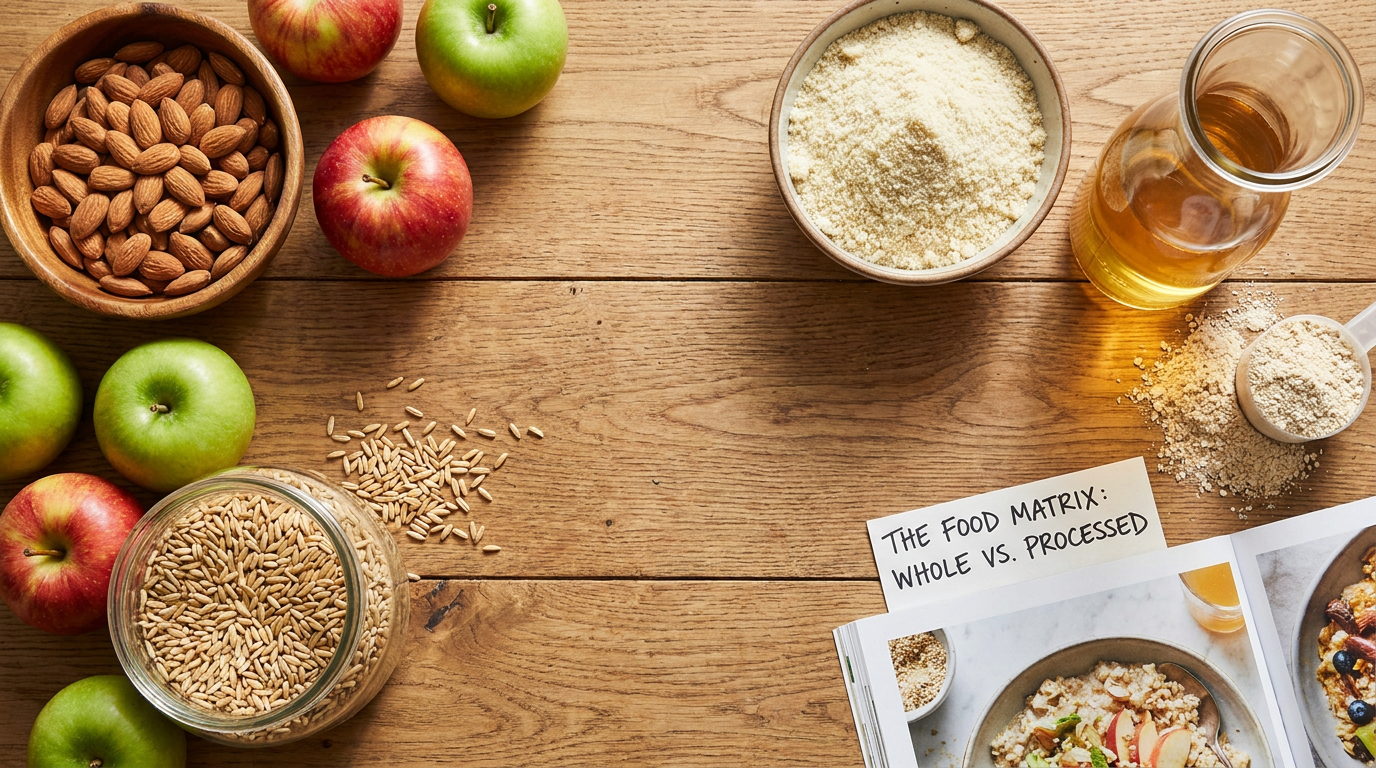
The matrix explains a phenomenon that calorie-counting could never quite solve: why our bodies react entirely differently to the exact same nutrients depending on their physical form. It is the reason why eating whole almonds results in fewer absorbed calories than eating the equivalent amount of almond butter, and why a whole apple satisfies hunger in a way that apple juice cannot.[1]
To understand the food matrix, one must look at food at the cellular level. In whole plant foods, nutrients like sugars and fats are locked inside sturdy plant cell walls made of dietary fiber. When we chew and swallow these foods, many of those microscopic cell walls remain intact, acting as tiny vaults that protect their contents from being immediately broken down by digestive enzymes in the stomach and small intestine.[4]

This structural barrier fundamentally alters caloric absorption. Studies have consistently shown that when people consume whole nuts, for example, they excrete up to 30% of the fat calories. The body simply cannot break down the fibrous matrix fast enough to absorb all the energy before it passes through the digestive tract.[5]
However, when that same nut is milled into a fine flour or ground into a creamy butter, the mechanical processing shatters those cell walls. The "vaults" are broken open before the food ever enters the mouth. The body can now easily access and absorb nearly 100% of the calories and fats, leading to a completely different metabolic outcome despite identical macronutrient profiles on the nutrition label.[2]
Beyond absorption, the food matrix plays a critical role in the hormonal regulation of appetite. The physical act of chewing matrix-rich foods sends early satiety signals to the brain. Because these foods take longer to break down in the stomach, they slow the rate of gastric emptying, keeping the stomach physically fuller for longer.[1]
This delayed digestion provides a steady, slow release of nutrients into the bloodstream, preventing the sharp spikes and subsequent crashes in blood glucose that trigger rebound hunger. More importantly, the slow transit of intact food particles triggers the release of satiety hormones like GLP-1 and PYY further down the digestive tract, signaling to the brain that it is time to stop eating.[4]
In contrast, when the food matrix is destroyed through heavy processing—such as turning whole grains into refined white flour—the food becomes "pre-digested." It dissolves rapidly in the stomach, flooding the bloodstream with glucose. The body responds with a surge of insulin, and the satiety hormones are barely triggered, leaving the eater feeling hungry again shortly after a high-calorie meal.[5]

The body responds with a surge of insulin, and the satiety hormones are barely triggered, leaving the eater feeling hungry again shortly after a high-calorie meal.
The implications of the food matrix extend far beyond the stomach and small intestine, reaching all the way to the colon, home to the gut microbiome. The trillions of bacteria residing there rely entirely on the food that escapes digestion higher up in the gastrointestinal tract.[2]
When we eat foods with an intact matrix, the undigested particles—protected by their fibrous cell walls—travel safely to the large intestine. Here, they serve as a vital feast for beneficial gut bacteria. The microbes ferment these particles, producing short-chain fatty acids (SCFAs) like butyrate, which reduce inflammation, strengthen the gut lining, and regulate the immune system.[4]
If a diet consists primarily of ultra-processed foods where the matrix has been obliterated, virtually all nutrients are absorbed in the upper digestive tract. The colon is left starved of its necessary fuel. This starvation of the lower gut microbiome is increasingly linked by researchers to a host of modern metabolic and inflammatory conditions.[6]
This structural perspective provides a new lens for evaluating ultra-processed foods (UPFs). The danger of UPFs may not merely be the addition of sugar, salt, and preservatives, but the systematic destruction of the original food matrix.[3]
Modern food manufacturing utilizes techniques like extrusion, high-pressure milling, and chemical separation to break whole ingredients down into their isolated molecular components, which are then reassembled into hyper-palatable products. This process creates foods that require almost no biological energy to digest.[3]

The "thermic effect of food"—the energy the body expends simply digesting a meal—is significantly lower for heavily processed foods. One landmark study demonstrated that individuals burn roughly 50% fewer calories digesting a meal of processed cheese and white bread compared to a meal of whole-grain bread and cheddar cheese, even when the meals contain the exact same number of total calories and macronutrients.[5]
Understanding the food matrix empowers consumers to make simpler, more effective dietary choices without obsessing over spreadsheets and calorie trackers. It shifts the nutritional focus from "how many carbohydrates am I eating?" to "what is the physical state of the carbohydrates I am eating?"[6]
Nutritionists increasingly advise that the most impactful dietary change a person can make is not necessarily cutting out specific macronutrients, but rather swapping matrix-depleted foods for matrix-intact alternatives. Choosing steel-cut oats over instant oat powder, whole fruit over fruit juice, or intact grains over refined flours fundamentally changes how the body processes the meal.[1]
The food matrix paradigm is a profoundly optimistic development in nutritional science. It suggests that our bodies are not broken, but rather that they are operating exactly as evolved—efficiently extracting energy from foods that have been artificially pre-digested for us. By simply returning structural complexity to our plates, we can naturally regulate appetite, nourish our microbiome, and improve our metabolic health.[6]
How we got here
1990s
Nutrition science largely focuses on isolating macronutrients, leading to the low-fat diet era.
2000s
The focus shifts heavily to calorie counting and energy balance equations.
2010s
Researchers begin identifying the gut microbiome as a critical player in human metabolism.
2020s
The 'food matrix' emerges as a unifying theory explaining why whole foods outperform processed foods regardless of calorie counts.
Viewpoints in depth
Whole-Food Advocates
Argue that maintaining the natural physical structure of food is the most critical factor in human nutrition.
This perspective, championed by public health institutions and preventative cardiologists, suggests that the modern obesity epidemic is primarily a structural problem, not a willpower problem. They point to evidence that humans are simply not adapted to consume foods that have been mechanically pre-digested by industrial machinery. Their primary recommendation is to return to foods in their original, intact forms—prioritizing the physical integrity of the ingredient over its specific carbohydrate or fat content.
Metabolic Researchers
Focus on how food structure alters hormonal responses, caloric absorption, and the thermic effect of digestion.
Clinical researchers focus on the measurable physiological differences that occur when the matrix is altered. They highlight studies showing that the body expends significantly more energy digesting whole foods (the thermic effect) and that intact matrices trigger a robust release of GLP-1 and PYY. For this camp, the food matrix is the missing variable in the 'calories in, calories out' equation, explaining why a 500-calorie meal of whole foods results in a completely different metabolic state than a 500-calorie meal of ultra-processed foods.
Food Technologists
Study how industrial processing destroys the matrix, but also explore how to engineer healthier, slow-digesting matrices into packaged foods.
While acknowledging the harms of ultra-processing, food scientists and technologists argue that processing is necessary to feed a global population. Instead of simply demonizing all processed foods, this camp focuses on 'matrix engineering.' They are researching ways to process foods for safety and shelf-life while intentionally preserving or recreating cellular structures that slow digestion, lower glycemic impact, and ensure nutrients reach the lower gut microbiome.
What we don't know
- Exactly how much of the food matrix is destroyed by common household cooking methods like boiling or roasting.
- Whether 'matrix-engineered' processed foods can fully replicate the microbiome benefits of natural whole foods.
- How individual differences in chewing habits and digestive enzymes alter the impact of the food matrix from person to person.
Key terms
- Food Matrix
- The complex physical and chemical structure of a food, including cell walls and fiber networks, which dictates how nutrients are digested and absorbed.
- Thermic Effect of Food
- The amount of energy (calories) the body expends to chew, digest, and process a meal.
- Ultra-Processed Foods (UPFs)
- Foods created through industrial processes that break down whole ingredients into isolated components and reassemble them, typically destroying the original food matrix.
- Short-Chain Fatty Acids (SCFAs)
- Beneficial compounds produced when gut bacteria ferment undigested food particles in the colon, known to reduce inflammation.
- GLP-1
- A hormone released in the gut during digestion that signals fullness to the brain and regulates blood sugar.
Frequently asked
Does blending a smoothie destroy the food matrix?
Blending mechanically breaks down plant cell walls, which partially destroys the food matrix. While a smoothie retains all the fiber and vitamins of whole fruit, it is digested faster and causes a quicker blood sugar spike than eating the fruit whole.
Are all processed foods bad for the matrix?
No. Basic processing like cooking, chopping, or fermenting can make nutrients more accessible without entirely destroying the matrix. The concern is primarily with 'ultra-processing'—techniques like extrusion and high-pressure milling that reduce food to isolated molecular components.
Does cooking destroy the food matrix?
Cooking softens the matrix, making food easier to chew and digest, which is why humans evolved to cook. However, it generally leaves enough of the cellular structure intact to provide satiety and feed the microbiome, unlike industrial ultra-processing.
Sources
Source coverage
6 outlets
3 viewpoints surfaced






[1]Harvard T.H. Chan School of Public HealthWhole-Food Advocates
The Nutrition Source: Understanding the Food Matrix
Read on Harvard T.H. Chan School of Public Health →[2]National Institutes of HealthMetabolic Researchers
The role of the food matrix in health and disease
Read on National Institutes of Health →[3]Nature FoodFood Technologists
Food processing and the structural matrix
Read on Nature Food →[4]American Society for NutritionFood Technologists
Why the Food Matrix Matters
Read on American Society for Nutrition →[5]The American Journal of Clinical NutritionMetabolic Researchers
Effects of food form on appetite and energy intake
Read on The American Journal of Clinical Nutrition →[6]Factlen Editorial TeamWhole-Food Advocates
Synthesis by Factlen editorial team
Read on Factlen Editorial Team →

Every angle. Every day.
Get health stories with full source coverage and perspective breakdowns delivered to your inbox.