
BEV vs. PHEV in 2026: Which Electrified Vehicle Fits Your Life?
As electric vehicle ranges expand and plug-in hybrids hit new milestones, choosing the right powertrain comes down to your daily commute and charging access.
By Factlen Editorial Team
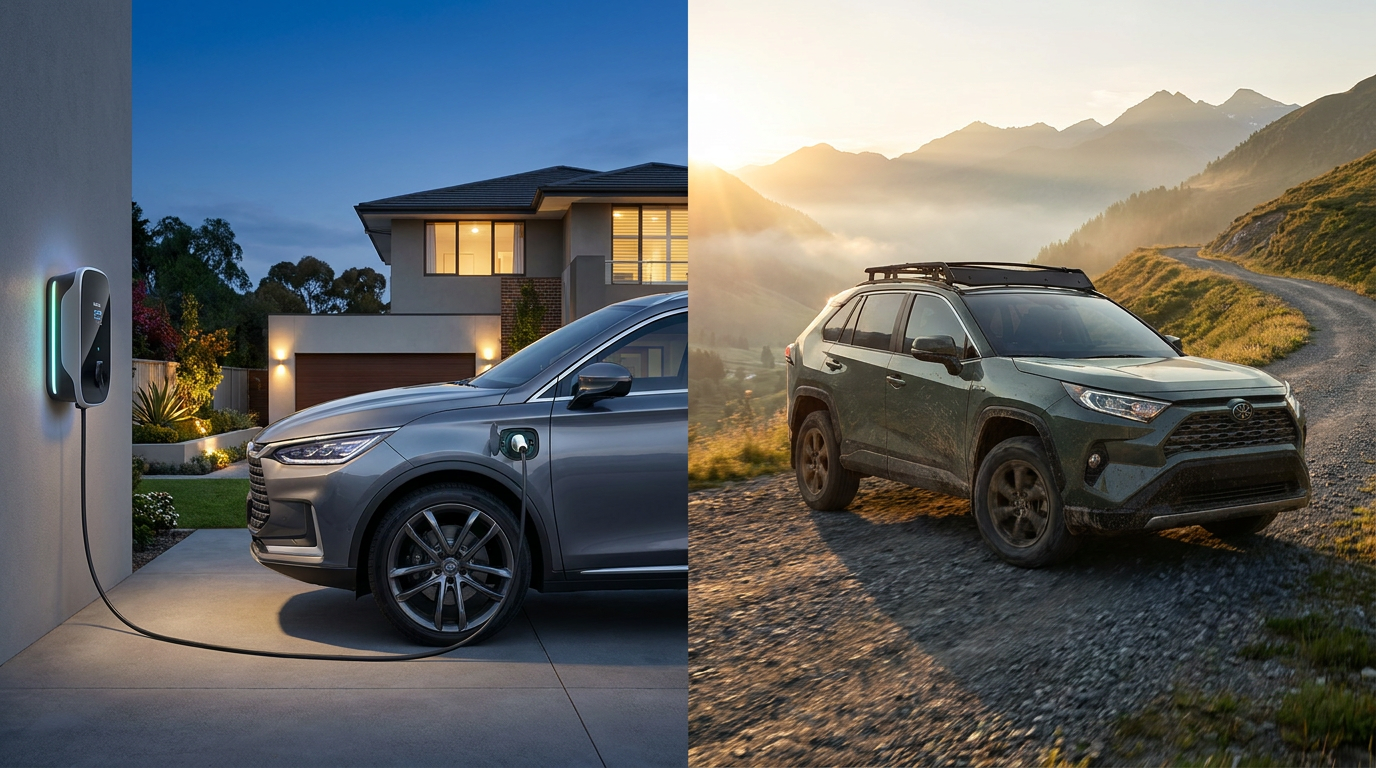
- Pure Electric Advocates
- Focus on zero emissions and the elimination of fossil fuel reliance.
- Pragmatic Transitioners
- Value PHEVs as a practical bridge that eliminates range anxiety today.
- Infrastructure Realists
- Highlight the current gaps in public charging that make BEVs difficult for some.
What's not represented
- · Apartment dwellers who rely entirely on public charging infrastructure.
- · Used car buyers navigating the secondary market for older battery technology.
Why this matters
With global electric vehicle sales projected to hit 23 million this year, millions of drivers are facing the choice between going fully electric or relying on a hybrid bridge. Making the right choice dictates your long-term maintenance costs, daily convenience, and actual environmental impact.
Key points
- Global EV sales are projected to reach 23 million in 2026, making up 28% of the new car market.
- BEVs offer zero emissions and minimal maintenance, but rely entirely on charging infrastructure.
- PHEVs provide 40-60 miles of electric range for daily commutes, plus a gas engine for road trips.
- Public charging points surpassed 7 million globally, with ultra-fast 350 kW stations becoming standard.
- PHEVs require traditional engine maintenance like oil changes, unlike fully electric vehicles.
- Home charging access remains the most critical factor in deciding between a BEV and a PHEV.
By the end of 2026, the global automotive market will cross a staggering threshold: an estimated 23 million electric vehicles are projected to be sold this year alone, accounting for nearly 28 percent of all new car purchases worldwide. As the internal combustion engine slowly yields its century-long dominance, consumers are no longer asking whether they will electrify their driveway, but how. For most buyers, the decision boils down to a head-to-head comparison between two dominant architectures: the Battery Electric Vehicle (BEV) and the Plug-in Hybrid Electric Vehicle (PHEV).[1][7]
The fundamental difference lies in how each vehicle sources its power. A BEV operates entirely on electricity stored in a massive battery pack, completely eliminating the gasoline engine, tailpipe emissions, and traditional mechanical complexities. A PHEV, conversely, offers a compromise. It features a smaller battery pack capable of handling short daily commutes on pure electric power, paired with a conventional gasoline engine that seamlessly takes over for long-distance road trips. Understanding the trade-offs between these two approaches is essential for maximizing both financial savings and environmental benefits.[4][7]
For advocates of pure electrification, the BEV represents the ultimate destination. Without an internal combustion engine, a BEV requires remarkably little maintenance. There are no oil changes, no spark plugs to replace, no timing belts to snap, and no transmission fluid to flush. Furthermore, regenerative braking systems—which use the electric motor to slow the vehicle while recapturing energy—drastically extend the life of brake pads. Over a five-year ownership period, these reduced maintenance requirements combine with the lower cost of electricity to create a highly compelling total cost of ownership.[7]

The historical drawback of the BEV—range anxiety—is rapidly fading in 2026. Modern battery chemistry has pushed the baseline range of most new BEVs well past the 300-mile mark, making them more than capable of handling daily life. However, the true test of a BEV remains the public charging infrastructure. While the International Energy Agency reports that the global stock of public charging points surpassed 7 million at the end of 2025, deployment remains uneven. Drivers in major metropolitan areas enjoy abundant access, while those in rural corridors or emerging economies still face significant charging deserts.[1][6]
When BEV drivers do find a station, the experience is vastly improved. The industry is rapidly deploying ultra-fast chargers rated at 350 kilowatts or higher, capable of adding nearly 180 kilometers (about 112 miles) of range in just 15 minutes. Yet, relying exclusively on public fast-charging can be expensive, sometimes rivaling the cost of gasoline. For a BEV to truly shine financially and logistically, the owner needs access to a Level 2 charger at home or work, allowing the vehicle to replenish its battery overnight at low residential electricity rates.[1][5]

When BEV drivers do find a station, the experience is vastly improved.
This infrastructure reality is exactly why the PHEV remains a powerful alternative. For drivers who cannot install a home charger, or those who frequently embark on cross-country road trips into areas with sparse charging networks, the PHEV acts as the ultimate bridge technology. It eliminates range anxiety entirely. You can drive purely on electricity for your Tuesday commute, and then drive 500 miles on gasoline on Saturday without ever opening a smartphone app to locate a compatible charging station.[3][7]
The 2026 model year has brought remarkable breakthroughs in PHEV battery capacity, making them more electric than ever before. The 2026 Mercedes-Benz GLC 350e 4Matic, for instance, now boasts an impressive 54 miles of electric-only range, effectively covering the daily driving needs of the vast majority of commuters. Similarly, the 2026 Toyota RAV4 Plug-In Hybrid delivers up to 50 miles of electric range. If your daily round-trip is under 40 miles and you plug in every night, you might go months without the gasoline engine ever turning on.[2][3]
However, the PHEV's dual nature is also its greatest liability. Because it houses both an electric motor and a gasoline engine, it carries the maintenance burden of both. Owners must still schedule regular oil changes and engine servicing. Furthermore, a PHEV is carrying the dead weight of a gasoline engine while driving on electricity, and the dead weight of a battery pack while driving on gas. This inherent inefficiency means that when the battery is depleted, a PHEV often gets worse fuel economy than a standard, non-plug-in hybrid.[4][7]

The environmental impact of a PHEV is also highly dependent on human behavior. A BEV guarantees zero tailpipe emissions regardless of how it is driven. A PHEV is only green if the owner diligently plugs it in. Industry studies have repeatedly shown that a significant percentage of PHEV owners rarely charge their vehicles, treating them simply as heavy gasoline cars. In these cases, the environmental benefits vanish, and the premium paid for the larger battery is entirely wasted.[7]
When comparing the upfront purchase price, PHEVs often present a more accessible entry point than long-range BEVs, though the gap is closing. High-end BEVs still command a premium due to the sheer size and cost of their battery packs, which often exceed 80 kilowatt-hours. A PHEV, utilizing a much smaller 15-to-25 kilowatt-hour battery, can keep manufacturing costs lower. However, buyers must carefully weigh this initial saving against the BEV's superior long-term savings on fuel and mechanical upkeep.[2][4]

Ultimately, the decision requires an honest assessment of your living situation and driving habits. A BEV fits perfectly when you have reliable access to overnight charging, predictable daily routes, and a desire to completely sever ties with the gas station and the mechanic. It is the definitive choice for maximizing environmental impact and embracing the frictionless, low-maintenance future of transportation.[7]
Conversely, a PHEV does not fit well if you lack a place to plug it in daily; without regular charging, you are simply driving a compromised gas car. But for a one-car household that wants to commute on clean electricity all week while retaining the freedom to explore remote, charger-free wilderness on the weekends, the 2026 PHEV lineup offers a masterful, anxiety-free compromise.[3][7]
How we got here
Early 2010s
The first mass-market BEVs and PHEVs, like the Nissan Leaf and Chevy Volt, introduce consumers to plug-in technology.
2020
BEV ranges begin to consistently cross the 250-mile threshold, reducing daily range anxiety.
2024
Major automakers shift focus to ultra-fast 350 kW charging architectures to speed up road trips.
Late 2025
The global network of public EV charging points officially surpasses 7 million installations.
2026
Next-generation PHEVs hit the market, offering over 50 miles of pure electric range, covering the vast majority of daily commutes.
Viewpoints in depth
Pure Electric Advocates
Drivers and environmentalists who believe transitioning fully to BEVs is the only way to achieve zero emissions.
This camp argues that PHEVs are a half-measure that prolongs our reliance on fossil fuels. They point to data showing that many PHEV owners fail to plug their vehicles in regularly, effectively turning them into heavy, inefficient gas cars. For pure electric advocates, the rapidly expanding network of 350 kW fast chargers and the 300-plus mile range of modern BEVs have already solved the range anxiety problem, making the mechanical complexity of a dual-powertrain PHEV unnecessary and obsolete.
Pragmatic Transitioners
Consumers and industry analysts who view PHEVs as the perfect bridge technology for the current decade.
Pragmatists argue that while a fully electric future is ideal, the present reality of public charging infrastructure is still too fragmented for many households, particularly those in rural areas or apartment buildings. They champion the PHEV because it allows drivers to complete 90 percent of their daily driving on electricity without the stress of planning road trips around charging stops. By using smaller batteries, PHEVs also allow automakers to electrify more vehicles using the same limited supply of critical battery minerals.
Infrastructure Realists
Urban planners and grid operators focused on the logistical hurdles of mass electrification.
This perspective highlights the immense strain that millions of new BEVs place on local power grids and public charging networks. Infrastructure realists note that while 7 million public chargers exist globally, they are heavily concentrated in wealthy metropolitan hubs. They advocate for a mixed approach, suggesting that until ultra-fast charging is as ubiquitous and reliable as the corner gas station, pushing every consumer into a pure BEV will result in gridlock at charging stations and widespread consumer frustration.
What we don't know
- How quickly emerging economies and rural corridors will close the gap in public fast-charging infrastructure.
- Whether future regulations will penalize PHEVs if real-world data proves owners aren't plugging them in.
- How the resale value of 2026 PHEVs will hold up in the 2030s as the market shifts entirely toward pure electrics.
Key terms
- BEV (Battery Electric Vehicle)
- A vehicle powered entirely by electricity stored in a large battery pack, with no gasoline engine or tailpipe emissions.
- PHEV (Plug-in Hybrid Electric Vehicle)
- A vehicle that combines a rechargeable battery for short electric trips with a traditional gasoline engine for extended range.
- Level 2 Charging
- A home or public charging standard using a 240-volt outlet, typically adding 20 to 30 miles of range per hour.
- Ultra-Fast Charging (DC Fast)
- High-powered public charging stations (often 150 kW to 350 kW) capable of rapidly recharging a BEV battery in 15 to 30 minutes.
- Regenerative Braking
- A system that uses the electric motor to slow the vehicle, converting kinetic energy back into electricity to recharge the battery.
Frequently asked
Do I still need oil changes with a PHEV?
Yes. Because a PHEV still has a traditional gasoline engine, it requires standard mechanical maintenance, including oil changes, spark plug replacements, and engine filter swaps.
Can I charge a BEV or PHEV using a regular wall outlet?
Yes, using a standard 120-volt outlet (Level 1 charging) works, but it is very slow, adding only 3 to 5 miles of range per hour. It is generally sufficient for overnight PHEV charging but too slow for a fully depleted BEV.
What happens if I don't plug in my PHEV?
The vehicle will operate like a standard gas-powered hybrid. However, because you are carrying the extra weight of an unused battery, your fuel economy will likely be worse than a non-plug-in hybrid.
Are BEVs cheaper to maintain than gas cars?
Significantly. BEVs have far fewer moving parts, require no engine fluids, and use regenerative braking, which drastically extends the life of the brake pads.
Sources
Source coverage
7 outlets
3 viewpoints surfaced







[1]International Energy AgencyInfrastructure Realists
Global EV Outlook 2026: Charging Infrastructure Trends
Read on International Energy Agency →[2]TopSpeedInfrastructure Realists
The 2026 Mercedes-Benz GLC 350e 4Matic Is The Benchmark For Electric-Range In PHEVs
Read on TopSpeed →[3]Road & TrackPragmatic Transitioners
The Best Plug-In Hybrids for 2026
Read on Road & Track →[4]EdmundsPragmatic Transitioners
Best Plug-in Hybrid Cars for 2026
Read on Edmunds →[5]Grand View ResearchInfrastructure Realists
Electric Vehicle Charging Infrastructure Market Summary 2026
Read on Grand View Research →[6]C40 CitiesInfrastructure Realists
New report highlights USD 4 billion EV charging investment opportunity
Read on C40 Cities →[7]Factlen Editorial TeamPure Electric Advocates
Synthesis by Factlen editorial team
Read on Factlen Editorial Team →


Every angle. Every day.
Get guides stories with full source coverage and perspective breakdowns delivered to your inbox.