
A New 'Base Editing' Technique Corrects Genetic Diseases in Human Embryos Without CRISPR's Damage
Researchers have successfully used a highly precise technique called base editing to alter DNA in human embryos, bypassing the severe chromosomal damage caused by traditional CRISPR and bringing the prevention of inherited diseases closer to reality.
By Factlen Editorial Team
- Genetic Researchers & Innovators
- Advocate for advancing base editing to safely cure inherited diseases.
- Bioethicists & Religious Objectors
- Oppose human embryo experimentation and warn against eugenics.
- Scientific Watchdogs & Safety Advocates
- Urge extreme caution regarding mosaicism, off-target effects, and commercialization.
What's not represented
- · Families currently undergoing IVF for genetic screening
- · Regulatory bodies overseeing reproductive technology
Why this matters
If perfected, base editing could allow doctors to erase devastating inherited conditions like cystic fibrosis and sickle cell anemia before a child is even born, fundamentally changing the future of human health.
Key points
- Columbia University researchers successfully used base editing to alter specific genes in human embryos.
- Unlike traditional CRISPR, base editing changes a single DNA letter without severing the double helix.
- The technique avoided the severe chromosomal abnormalities and large deletions previously seen in embryo editing.
- Technical hurdles like mosaicism and off-target edits remain, meaning the technology is not yet ready for clinical use.
- The breakthrough has reignited ethical debates over human embryo experimentation and the potential for 'designer babies.'
The human genome is often compared to a master blueprint, a sprawling manual of life written in three billion chemical letters. For most people, this code functions flawlessly, guiding the development and operation of the body. But for an estimated 400 million people worldwide, a single typographical error—one incorrect letter among billions—can trigger devastating inherited conditions like cystic fibrosis, sickle cell anemia, or severe metabolic disorders. For decades, the ultimate dream of genetic medicine has been to intercept these diseases before they ever manifest, correcting the blueprint at the earliest stages of life. Now, a landmark breakthrough has brought that reality significantly closer.[1]
In early June 2026, a team of researchers at Columbia University, led by developmental cell biologist Dieter Egli, announced that they had successfully altered the DNA of human embryos with unprecedented precision. Publishing their findings on the preprint server bioRxiv, the scientists demonstrated the first use of a next-generation technique called "base editing" in early human embryos. The results represent a massive leap forward in genetic engineering, proving that it is possible to correct disease-causing mutations at the dawn of embryonic development without triggering the catastrophic genetic damage that has plagued previous gene-editing efforts.[1][3]
The Columbia team focused their efforts on specific, well-understood genetic targets to prove the technology's viability. They successfully converted the DNA base adenine (A) into guanine (G) within the PCSK9 gene, which plays a critical role in regulating cholesterol levels, and the HBG1 and HBG2 genes, which are intimately involved in the production of fetal hemoglobin and are key targets for treating blood disorders like sickle cell disease and beta-thalassemia. By demonstrating that these specific letters could be rewritten in a human embryo, the researchers provided a powerful proof-of-concept for intercepting a wide array of monogenic—or single-gene—diseases.[3][7]
To understand the magnitude of this achievement, it is necessary to look at the limitations of the first-generation gene-editing marvel, CRISPR-Cas9. Traditional CRISPR operates like a pair of molecular scissors. When programmed to find a specific genetic sequence, the Cas9 enzyme physically severs both strands of the DNA double helix. The cell is then forced to repair the break, and scientists can theoretically insert a corrected sequence during this mending process. While revolutionary for laboratory research and certain adult therapies, this brute-force cutting mechanism relies on the cell's natural repair pathways, which are often unpredictable and error-prone.[1][4]

In the delicate environment of an early human embryo, the double-strand breaks induced by traditional CRISPR-Cas9 have proven highly problematic. Previous experiments revealed that embryos struggle to repair these severed strands cleanly. The process frequently results in large, unintended deletions of genetic material, severe chromosomal abnormalities, and widespread genome instability. These genotoxic consequences effectively halted the clinical application of embryo editing, as the risk of creating entirely new, catastrophic genetic defects far outweighed the potential benefits of correcting an inherited disease.[3][6]
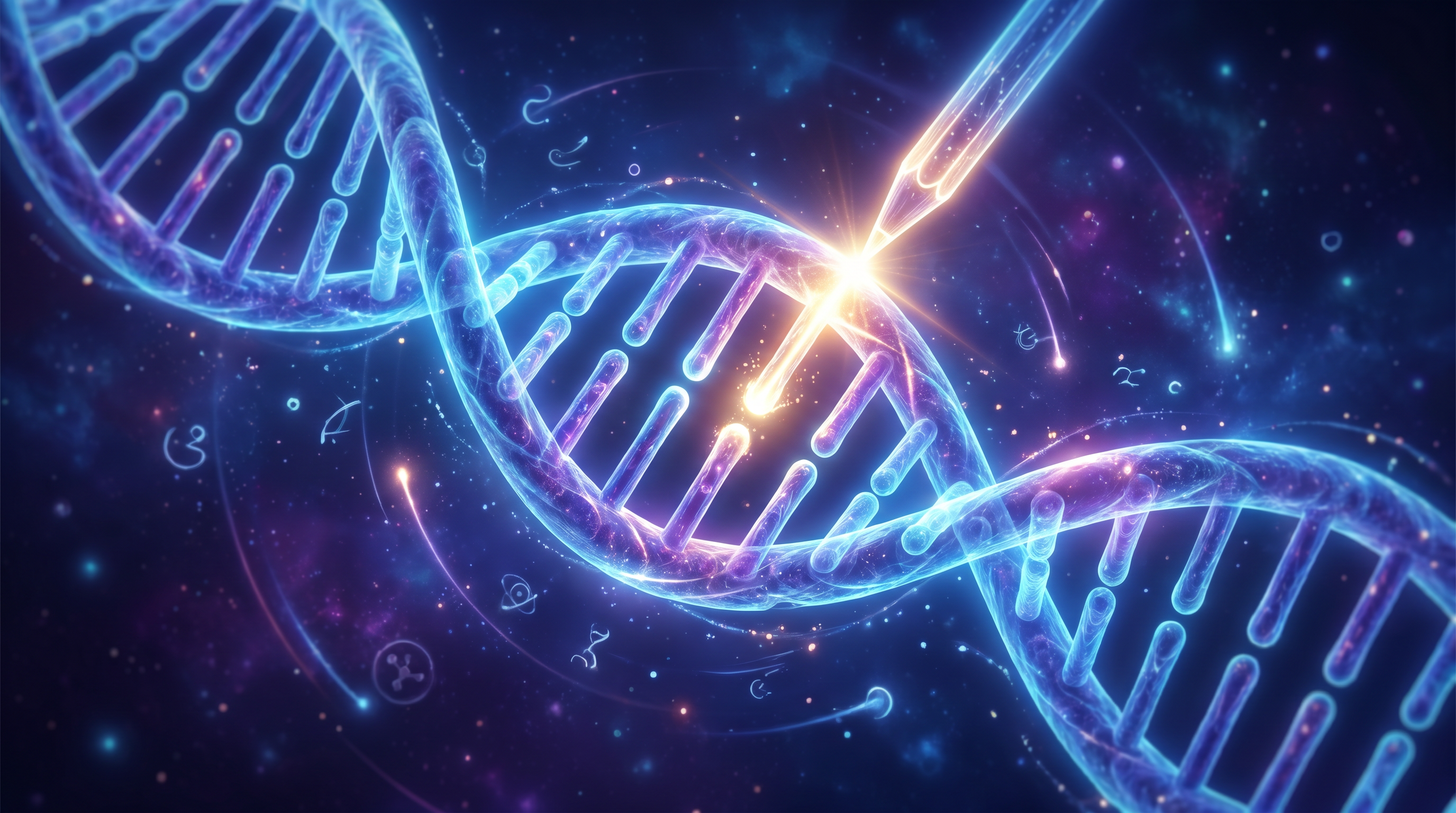
Base editing, originally developed in 2016 by David R. Liu's laboratory at the Broad Institute, offers an elegant solution to this problem. If CRISPR-Cas9 is a pair of scissors, base editors are more akin to a molecular pencil and eraser. Instead of severing the DNA helix, base editors use a deactivated form of CRISPR simply to navigate to the correct location. Once there, an attached enzyme chemically converts one specific DNA letter directly into another—changing an A to a G, or a C to a T—while leaving the overall structure of the DNA strand intact.[1][8]
Liu's laboratory at the Broad Institute, offers an elegant solution to this problem.
The results of the Columbia study starkly illustrate the advantages of this gentler approach. The researchers reported that base editing in the human embryos was highly efficient and, crucially, did not produce the large deletions or chromosomal chaos associated with Cas9-induced double-strand breaks. Embryos that received the base-editing treatment developed normally to the blastocyst stage, allowing the team to derive embryonic stem cell lines that carried the intended genetic corrections. The study proved that DNA nicks and mismatches created by base editors are efficiently and safely repaired by the embryo.[3][7]
This success in embryos builds upon a wave of recent momentum for base editing in living patients. In 2025, the technology moved from the laboratory to the bedside when an infant named KJ Muldoon became the first person to receive a customized, in vivo base-editing therapy. Suffering from a rare, life-threatening metabolic disorder, the infant received a bespoke treatment that successfully corrected a disease-causing mutation in his liver cells, ultimately saving his life. That milestone proved the profound clinical potential of base editing for somatic (non-reproductive) cells, setting the stage for the embryo research.[8]

Despite the triumphant proof-of-concept, the Columbia researchers were quick to highlight persistent technical hurdles that must be overcome before embryo editing can be considered for clinical use. Chief among these challenges is a phenomenon known as mosaicism. In the study, the base correction did not occur uniformly across all the cells as the embryo divided. Some cells successfully adopted the corrected gene, while others remained in their original, mutated state. If such an embryo were to develop into a child, their body would be a mosaic of corrected and uncorrected cells, potentially leaving them vulnerable to the very disease the procedure aimed to prevent.[2][3][7]
Furthermore, while base editing is vastly more precise than traditional CRISPR, it is not yet flawless. The researchers observed that the base editor occasionally introduced "unexpected new letters" or off-target edits at unintended locations in the genome. The frequency of these off-target effects varied substantially depending on the specific guide RNA used to direct the editor. While newer, refined base editors are rapidly driving these bystander mutation rates down—in some animal models, dropping them from 60 percent to less than 1 percent—absolute precision is a prerequisite for heritable genome editing.[2][4]
Unsurprisingly, the technical success of the Columbia study has reignited a fierce, global bioethical debate. Because changes made to an early embryo are germline edits—meaning they will be incorporated into the individual's sperm or egg cells and passed down to all future generations—the stakes are permanently high. Proponents argue that if the technology can be perfected, it is a moral imperative to use it, offering families plagued by devastating inherited disorders a way to ensure their children are born healthy, effectively eradicating certain genetic diseases from the human gene pool.[1][6]

Conversely, religious organizations and conservative bioethicists have voiced strong opposition to the research itself. Ethicists at institutions like the National Catholic Bioethics Center argue that creating and experimenting on human embryos is inherently unethical, regardless of the scientific insights gained. They contend that the foundational research required to optimize base editing should be strictly confined to animal models and adult human cells, arguing that the complex science of genetic modification still poses unacceptable risks to the unborn.[5]
Beyond the moral status of the embryo, critics across the political spectrum fear the slippery slope of commercialization. If base editing becomes a safe, routine part of in vitro fertilization (IVF) for disease prevention, the line between therapy and enhancement could quickly blur. Watchdogs warn that the technology could eventually be co-opted to create "designer babies," where parents pay to select for specific traits such as height, intelligence, or athletic ability, exacerbating societal inequalities and fundamentally altering the nature of human reproduction.[4][7]
For now, lead researcher Dieter Egli and his colleagues emphasize that their work is strictly a laboratory study and is nowhere near ready for clinical application in IVF clinics. The lingering issues of mosaicism and off-target activity require years of rigorous safety testing and refinement. Nevertheless, the demonstration that the fundamental barrier of CRISPR-induced chromosomal damage can be bypassed marks a paradigm shift. The transition from cutting DNA to rewriting it offers a profound new tool for humanity, keeping the hope alive that devastating inherited diseases might one day be erased before they begin.[2][6]
How we got here
2016
David R. Liu's laboratory at the Broad Institute develops the first base editor, expanding the capabilities of CRISPR.
2020
Researchers begin collaborating to identify optimal base editors for treating rare metabolic diseases.
February 2025
An infant with a rare metabolic disorder becomes the first patient to receive a life-saving, custom base-editing therapy.
June 2026
Columbia University researchers publish the first successful demonstration of base editing in human embryos.
Viewpoints in depth
Genetic Researchers & Innovators
Scientists focused on the potential to safely eradicate inherited diseases.
Researchers view base editing as the necessary evolution of CRISPR. By proving that single-letter mutations can be corrected without severing the DNA helix, they believe the scientific community can eventually overcome the genotoxic barriers that stalled embryo editing. Their ultimate goal is to provide a safe clinical pathway for families carrying severe genetic mutations to have healthy children, effectively removing diseases like cystic fibrosis from the gene pool.
Bioethicists & Religious Objectors
Critics who oppose human embryo experimentation on moral grounds.
Conservative bioethicists and religious organizations argue that creating and experimenting on human embryos is a fundamental violation of human dignity. They contend that the embryo is a human patient that cannot consent to high-risk genetic modifications. Furthermore, they argue that the foundational research required to perfect these tools should be restricted entirely to animal models and adult somatic cells, rather than treating human embryos as disposable research materials.
Scientific Watchdogs & Safety Advocates
Experts warning against premature commercialization and the 'designer baby' slippery slope.
While acknowledging the technical achievement, watchdogs emphasize the unresolved safety flaws, particularly mosaicism and off-target mutations. They warn that if the technology is rushed into IVF clinics before it is flawless, it could result in children born with novel, unpredictable genetic defects. Additionally, they raise alarms about the lack of global regulatory frameworks to prevent the technology from being used for genetic enhancement and the creation of 'designer babies.'
What we don't know
- Whether the issue of mosaicism—where only some cells in the embryo receive the edit—can be completely eliminated.
- The long-term health consequences of potential off-target mutations introduced by base editors.
- How global regulatory bodies will govern the eventual clinical use of heritable genome editing.
Key terms
- Base editing
- A precision gene-editing technology that chemically changes a single DNA letter (nucleotide) into another without breaking the DNA strand.
- CRISPR-Cas9
- A first-generation gene-editing tool that uses an enzyme to cut both strands of the DNA double helix at a specific location.
- Double-strand break
- A severe form of DNA damage where both strands of the double helix are severed, often leading to unpredictable repair outcomes.
- Mosaicism
- A condition where an individual's body contains a mixture of cells with different genetic makeups, often complicating genetic therapies.
- Germline editing
- Genetic modifications made to embryos, sperm, or egg cells, which are permanently passed down to all future generations.
- Blastocyst
- An early stage of embryonic development, occurring a few days after fertilization, consisting of a rapidly dividing ball of cells.
Frequently asked
What is base editing?
Base editing is a highly precise genetic engineering technique that acts like a molecular pencil, chemically converting a single DNA letter into another without cutting the DNA double helix.
How is it different from traditional CRISPR?
Traditional CRISPR-Cas9 acts like molecular scissors, cutting both strands of DNA to insert changes, which can cause chromosomal damage. Base editing only alters one strand, making it significantly safer for delicate cells like embryos.
What is mosaicism?
Mosaicism occurs when a genetic edit does not apply uniformly as an embryo divides. This results in an organism that has a mix of both corrected and uncorrected, mutated cells.
Can parents use this in IVF clinics today?
No. The technology is strictly in the laboratory research phase. Scientists must overcome significant safety hurdles, including mosaicism and off-target edits, before it can be considered for clinical use.
Sources
Source coverage
8 outlets
3 viewpoints surfaced








[1]The New York TimesGenetic Researchers & Innovators
A Newer Approach to Editing Embryos Ignites Debate
Read on The New York Times →[2]CRISPR Medicine NewsScientific Watchdogs & Safety Advocates
First use of CRISPR-derived base editing to make precise DNA changes in human embryos
Read on CRISPR Medicine News →[3]bioRxivGenetic Researchers & Innovators
Efficient base editing and development in human embryos without chromosomal alterations
Read on bioRxiv →[4]Polskie RadioGenetic Researchers & Innovators
Scientists have edited human embryos using a new technology for the first time
Read on Polskie Radio →[5]Catholic World ReportBioethicists & Religious Objectors
Genetic researchers are experimenting on unborn children in trials that could have been done on animal embryos
Read on Catholic World Report →[6]TechFrontScientific Watchdogs & Safety Advocates
Researchers Advance Embryo Gene Editing With New Precision Technique, Reigniting Ethical Debate
Read on TechFront →[7]ChosunScientific Watchdogs & Safety Advocates
New base correction technique offers disease prevention potential but faces mosaicism and ethical risks
Read on Chosun →[8]Broad InstituteGenetic Researchers & Innovators
Base editing corrects disease-causing mutation in the PEX1 gene in human cells and mice
Read on Broad Institute →
More in health
See all 47 stories →Movement Therapy
The Evidence for Exercise as a Primary Treatment for Depression
7 sources

Peptide Therapy
How Peptides Moved From Underground Biohacking to Mainstream Medicine
7 sources
Cellular Therapy
‘Immune Reset’ Breakthrough: CAR-T Cell Therapy Puts Severe Lupus Into Drug-Free Remission
6 sources
Lupus Breakthrough
‘Immune Reset’ Therapy Puts Severe Lupus Patients Into Remission in Breakthrough NHS Trial
6 sources
Every angle. Every day.
Get health stories with full source coverage and perspective breakdowns delivered to your inbox.