
Why the 'No-Dig' Gardening Movement is Transforming Soil Health and Crop Yields
By abandoning the traditional spade and leaving soil undisturbed, a growing movement of gardeners is leveraging fungal networks to increase yields, suppress weeds, and lock carbon in the ground.
By Factlen Editorial Team
- Horticultural Science
- Focuses on the measurable biological and ecological benefits of undisturbed soil.
- Regenerative Growers
- Advocates for minimal intervention to maximize yields and reduce physical labor.
- Home Gardeners
- Seeks practical, low-maintenance ways to grow food in backyard settings.
What's not represented
- · Commercial agricultural equipment manufacturers
Why this matters
Traditional tilling degrades soil health and releases carbon into the atmosphere. Adopting no-dig methods allows home growers to produce more food with less labor and water, while actively rebuilding the local ecosystem and sequestering carbon.
Key points
- No-dig gardening involves layering compost over the soil rather than tilling or turning it.
- Leaving soil undisturbed protects delicate mycorrhizal fungal networks that help plants absorb nutrients.
- Long-term trials show no-dig beds consistently produce 10% to 12% higher yields than dug beds.
- The practice suppresses up to 90% of weeds and significantly improves the soil's ability to retain water during droughts.
For generations, the arrival of spring in the garden has been heralded by the rhythmic thrust of a spade. Turning the soil—breaking up clods, burying weeds, and loosening the earth for new roots—has been treated as an unquestionable horticultural commandment.[7]
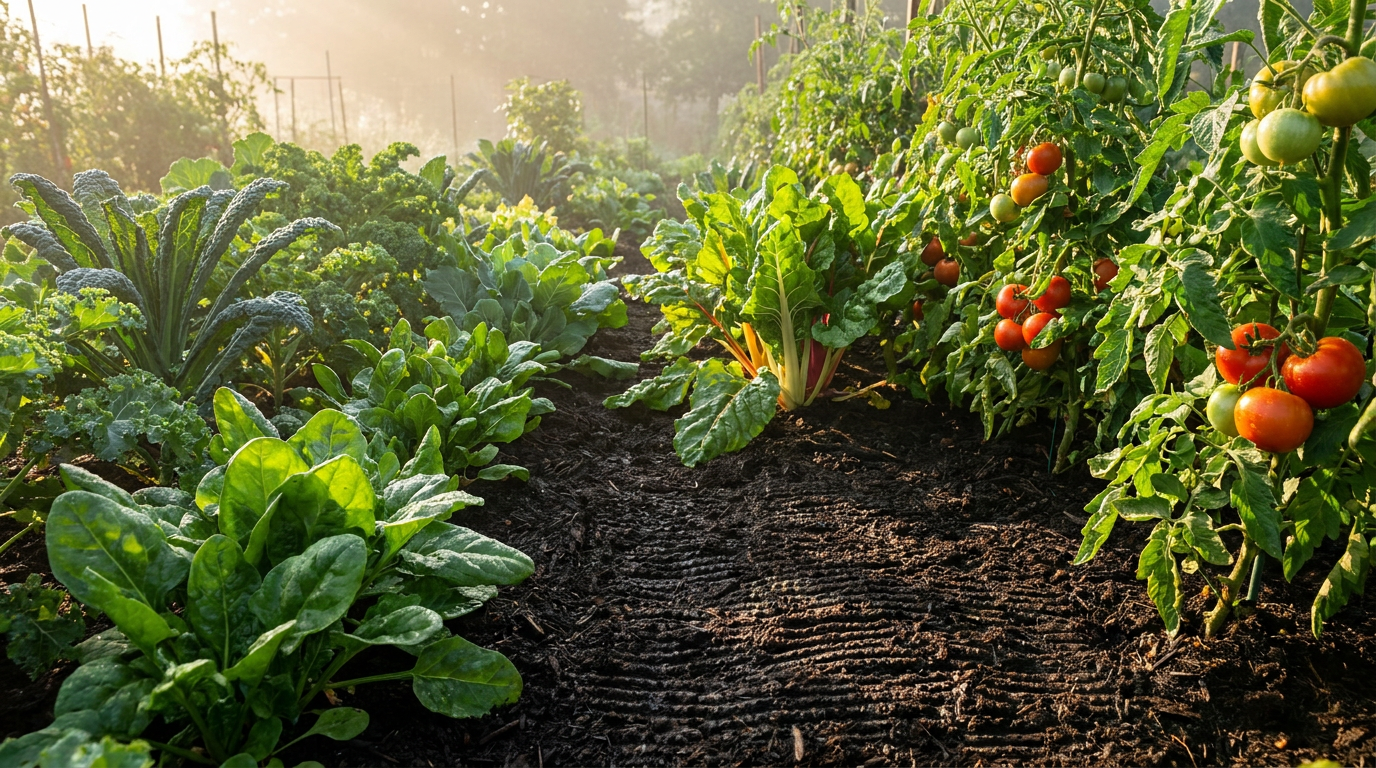
But a quiet revolution is taking over backyards and market gardens in 2026. Known as "no-dig" gardening, or sheet mulching, the practice asks growers to put down their forks and leave the earth entirely undisturbed. Instead of tilling, gardeners simply layer organic matter, like compost or leaf mold, directly on top of the soil surface.[2][3]
The core claim of the no-dig movement is counterintuitive: doing less physical labor actually produces healthier plants, higher yields, and fewer weeds. By treating the soil as a complex, living ecosystem rather than an inert medium to be manipulated, the method relies on natural biological processes to do the heavy lifting.[4][7]
The mechanism behind this success lies in soil architecture. When a spade slices through the earth, it destroys the microscopic "house" that soil organisms have spent months building. Digging collapses the delicate pores and tunnels created by earthworms and insects, which are essential for oxygen flow and water drainage.[1][2]
More critically, tilling severs the vast, invisible networks of mycorrhizal fungi. These microscopic fungal threads form a symbiotic relationship with plant roots, effectively acting as a massive secondary root system. The fungi reach into tiny crevices that plant roots cannot access, extracting water and essential minerals like phosphorus.[1][3][6]

In a traditional dug garden, these fungal networks are routinely shredded. Plants are forced to rely solely on their own limited root systems, making them highly dependent on synthetic fertilizers and constant watering to survive. In a no-dig system, a seedling can simply "plug in" to the established fungal grid, gaining immediate access to a vast reservoir of nutrients.[1][5][6]
The method also fundamentally changes weed management. Every cubic inch of garden soil contains thousands of dormant weed seeds waiting for a flash of sunlight to germinate. Digging continuously brings these buried seeds to the surface. By leaving the soil intact and covering it with a light-blocking mulch, no-dig gardening suppresses up to 90% of potential weed growth.[2][4]
Every cubic inch of garden soil contains thousands of dormant weed seeds waiting for a flash of sunlight to germinate.
The evidence for these claims has moved from anecdotal to empirical. Charles Dowding, a pioneering organic grower in Somerset, UK, has run a meticulous side-by-side trial of dug versus no-dig beds for 13 years. Both beds receive the exact same amount of compost and the same crop plantings each season.[4][6]
The results are striking. Over the trial period, the no-dig bed has consistently produced a harvest that is, on average, 10% to 12% higher than the dug bed. The divergence becomes particularly pronounced during extreme weather; the undisturbed soil retains moisture far better during droughts, keeping plants productive when traditional beds dry out.[4][6]

Soil microscopy backs up the harvest data. Independent analysis of Dowding's trial beds revealed that the undisturbed soil possessed significantly stronger aggregates—clumps of earth bound together by organic glues—and a richer diversity of active biology compared to the dug soil. The dug soil, by contrast, showed weaker structure and more loose, unbound debris.[5]
This data has prompted major horticultural institutions to change their practices. The Royal Horticultural Society (RHS) adopted the no-dig method from the outset when establishing its World Food Garden at Wisley, noting that the undisturbed soil ecosystem naturally controls pests and eliminates the need for added fertilizers.[1]
Beyond the backyard, the practice has profound implications for climate resilience. Traditional tilling exposes buried carbon to the air, where it oxidizes and releases carbon dioxide into the atmosphere. No-dig gardening locks that carbon safely underground, turning the vegetable patch into a localized carbon sink.[1][4]
The undisturbed structure also acts as a powerful sponge. The intact pores and worm channels allow heavy rainfall to sink in slowly rather than running off, while the surface mulch prevents evaporation during heatwaves. As summer droughts become more frequent, this built-in water retention is becoming a critical survival mechanism for crops.[2][7]
However, the transition to no-dig is not without friction. The primary barrier to entry is the sheer volume of material required in the first year. Establishing a new bed over grass requires laying down cardboard and topping it with four to six inches of compost—a heavy and sometimes expensive upfront investment for large spaces.[2][3]

There are also edge cases where the method requires adaptation. In damp climates, thick layers of compost can create an ideal habitat for slugs, requiring gardeners to be vigilant about removing lower leaves and minimizing wooden bed borders where pests can hide.[4]
Additionally, root crops like potatoes and carrots can sometimes yield slightly less in the very first year of a no-dig bed, as the underlying soil has not yet been fully loosened by worm activity. But by year two or three, as the soil structure naturally softens, root harvests typically match or exceed those of dug beds.[4][7]
How we got here
1940s
F.C. King and A. Guest publish early works advocating for gardening without digging.
1982
Market gardener Charles Dowding begins formal trials of no-dig methods in the UK.
2013
Dowding launches a meticulous side-by-side trial comparing dug and no-dig beds.
2026
No-dig and sheet mulching become dominant trends as gardeners prioritize climate resilience and soil health.
Viewpoints in depth
Horticultural Science
Focuses on the measurable biological benefits of undisturbed soil.
Scientific institutions like the Royal Horticultural Society emphasize the microscopic mechanisms at play in no-dig systems. By analyzing soil aggregates and fungal biomass, researchers have demonstrated that undisturbed soil maintains a complex architecture that tilling destroys. This intact ecosystem naturally regulates pests, cycles nutrients without synthetic fertilizers, and sequesters carbon that would otherwise be released into the atmosphere.
Regenerative Growers
Emphasizes the practical benefits of reduced labor and working in harmony with nature.
For market gardeners and regenerative farmers, the appeal of no-dig lies in its efficiency. Proponents argue that traditional digging is a massive waste of human energy that ultimately degrades the growing medium. By simply feeding the soil surface with compost, growers report spending significantly less time weeding and watering, while enjoying higher, more resilient yields even during extreme weather events.
Traditional Gardeners
Maintains that some initial digging is necessary to establish a garden.
Some traditionalists argue that while no-dig is a worthy goal, it cannot be universally applied on day one. They point out that heavily compacted urban soils or dense clay may require an initial mechanical loosening or double-digging before a no-dig system can be successfully established. Furthermore, they note the logistical challenge of sourcing the massive volumes of compost required to start a sheet-mulched bed.
What we don't know
- Exactly how long it takes for severely degraded or chemically treated soils to rebuild their fungal networks under a no-dig regime.
- Whether the massive compost inputs required for large-scale no-dig farming can be sustainably sourced without depleting nutrients from other ecosystems.
Key terms
- Mycorrhizal Fungi
- Beneficial fungi that form a symbiotic relationship with plant roots, extending their reach for water and nutrients.
- Sheet Mulching
- A no-dig technique involving layering cardboard and organic matter over existing soil or grass to create a new bed.
- Soil Aggregates
- Clumps of soil particles held together by organic matter and fungal threads, crucial for drainage and aeration.
- Humus
- Dark, organic material that forms in soil when plant and animal matter decays.
Frequently asked
Do I need to buy special soil to start a no-dig garden?
No. You can layer cardboard directly over grass or weeds, then top it with standard compost, well-rotted manure, or leaf mold.
Won't the soil become hard and compacted if I never dig it?
Surprisingly, no. Earthworms and soil organisms naturally aerate the soil, creating a firm but porous structure that roots easily penetrate.
Can I grow root vegetables like carrots in a no-dig bed?
Yes, though they may yield slightly less in the first year. As the soil structure improves over time, root crops thrive in the loose compost layer.
How do I deal with weeds if I can't dig them out?
The thick layer of compost suppresses most weeds. Any that do appear are easily pulled by hand because the soil surface remains loose and crumbly.
Sources
Source coverage
7 outlets
3 viewpoints surfaced







[1]Royal Horticultural Society (RHS)Horticultural Science
What's the deal with no-dig gardening?
Read on Royal Horticultural Society (RHS) →[2]Garden OrganicHorticultural Science
What is no dig gardening?
Read on Garden Organic →[3]Soil AssociationRegenerative Growers
What is no-dig gardening?
Read on Soil Association →[4]Saga MagazineHome Gardeners
The benefits of no-dig gardening
Read on Saga Magazine →[5]MikrolivHorticultural Science
Comparing dig vs. no dig soil in a market garden
Read on Mikroliv →[6]Charles DowdingRegenerative Growers
No Dig Growing
Read on Charles Dowding →[7]Factlen Editorial TeamRegenerative Growers
Synthesis by Factlen editorial team
Read on Factlen Editorial Team →
More in home
See all 5 stories →
Every angle. Every day.
Get home stories with full source coverage and perspective breakdowns delivered to your inbox.