
Why Gas Prices Are Falling Following the U.S.-Iran Peace Framework
A 60-day ceasefire and the reopening of the Strait of Hormuz are driving down global crude oil prices, offering consumers relief at the pump and easing macroeconomic inflation pressures.
By Factlen Editorial Team
- Energy Market Analysts
- Emphasize structural supply issues and the long-term logistics of crude pricing.
- Consumer Advocates
- Focus on the immediate need for relief at the gas pump and the cost of living.
- Macroeconomic Observers
- Focus on the Federal Reserve, interest rates, and the bond market's reaction.
What's not represented
- · Environmental groups advocating for a faster transition away from fossil fuels regardless of price fluctuations.
- · Independent gas station owners who face margin pressures when wholesale prices are volatile.
Why this matters
Falling energy costs act as a direct tax cut for consumers, freeing up household budgets while giving the Federal Reserve room to potentially lower interest rates.
Key points
- A tentative 60-day ceasefire and the reopening of the Strait of Hormuz are driving down global crude oil prices.
- Retail gas prices, currently hovering just over $4 a gallon, are expected to drop gradually over the next two to four weeks.
- Returning to $67-a-barrel oil could take years due to elevated shipping costs and the need for excess global crude supplies.
- The $30 trillion Treasury market is watching closely to see how falling energy costs will impact the Federal Reserve's interest rate decisions.
The geopolitical breakthrough in the Middle East is sending immediate ripples through global energy markets. Following a tentative framework deal to extend the U.S.-Iran ceasefire by 60 days, the critical Strait of Hormuz is slated to reopen to commercial shipping, unblocking one of the world's most vital energy arteries.[1][2]
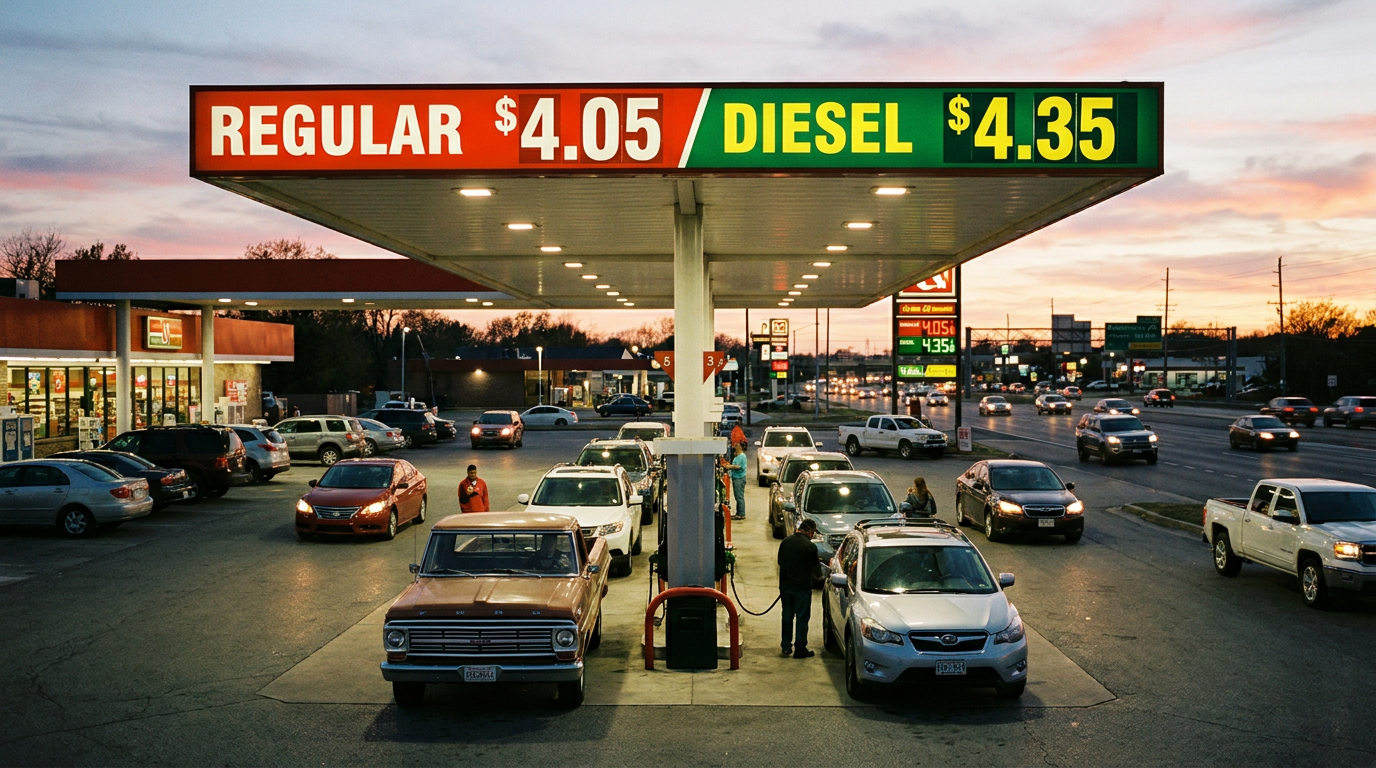
For American consumers, the most visible consequence of this diplomatic thaw is playing out on the marquee signs of local gas stations. With retail regular gasoline hovering just over the psychologically significant $4-per-gallon mark, the prospect of increased global crude supply offers a tangible glimmer of relief for household budgets.[1][4]
However, the transmission mechanism from a geopolitical headline to a cheaper fill-up is neither instantaneous nor perfectly linear. When crude oil prices drop on international exchanges, retail gasoline prices typically experience a delayed reaction—a phenomenon economists often describe as "rockets and feathers," where prices shoot up quickly during a crisis but float down slowly during a resolution.[4][7]
The U.S. Energy Information Administration notes that the cost of crude oil accounts for roughly half the price of a gallon of regular gasoline. The remainder of the cost is dictated by refining operations, distribution logistics, marketing, and a combination of federal and state taxes.[4]

Because gas station operators purchase their fuel inventory days or weeks in advance, they are currently selling gasoline refined from crude oil bought at higher, pre-ceasefire prices. Consequently, it typically takes two to four weeks for a sustained drop in wholesale crude prices to fully materialize at the consumer pump.[1][4]
While the immediate trajectory for fuel costs points downward, returning to an era of truly cheap energy remains a distant prospect. Market analysts caution that it could take years for crude oil to return to the $67-a-barrel baseline seen before the conflict escalated.[2]
The World Bank's recent Commodity Markets Outlook underscores the structural challenges ahead. Even with the Strait of Hormuz reopening, the global energy market remains tightly wound, requiring a sustained accumulation of excess crude supplies to build a comfortable buffer against future macroeconomic shocks.[2][5]
The World Bank's recent Commodity Markets Outlook underscores the structural challenges ahead.
Furthermore, the logistical scars of the conflict will take time to heal. Shipping costs, which surged as vessels were forced to take longer, more expensive routes to avoid contested waters, will not normalize overnight. Insurance premiums for tankers navigating the region also remain elevated, adding friction to the global supply chain.[2][5]

Beyond the gas pump, the drop in oil prices is triggering a profound recalibration across the broader U.S. economy, particularly within the $30 trillion Treasury market. Bond investors are closely monitoring how this sudden deflationary pressure will influence monetary policy in the coming months.[3]
Energy costs are a primary driver of headline inflation, cascading through the economy by affecting the price of manufacturing, transportation, and consumer goods. A sustained drop in oil prices effectively acts as a broad tax cut for consumers, freeing up discretionary income while simultaneously cooling the overall rate of price increases.[3][6]
This dynamic places the Federal Reserve in a complex position as it navigates its dual mandate of price stability and maximum employment. The central bank's primary tool for combating inflation is the federal funds rate, which influences borrowing costs for mortgages, auto loans, and corporate debt across the economy.[6]
All eyes are now on Kevin Warsh, who is preparing to preside over his first meeting as Federal Reserve chair. The central bank must determine whether the drop in energy prices provides enough disinflationary momentum to pause or reverse its current interest rate trajectory.[3][6]

Historically, the Federal Reserve tends to look past volatile food and energy prices, focusing instead on "core" inflation to gauge underlying economic trends. However, when energy prices remain elevated for extended periods, they can seep into core inflation by driving up the cost of services and logistics, making the current price drop highly relevant to policymakers.[6][7]
If the peace framework holds and energy markets continue to stabilize, the Fed may find the breathing room necessary to adopt a more accommodative stance. Conversely, if the ceasefire falters, renewed inflationary pressure could force the central bank to maintain elevated rates, risking a broader economic slowdown.[3][7]
How we got here
Pre-Conflict
Global crude oil prices hovered around a baseline of $67 a barrel.
Conflict Escalation
Disruptions in the Strait of Hormuz caused shipping costs and crude oil prices to spike, pushing U.S. gas prices over $4 a gallon.
June 2026
A tentative peace framework extends the U.S.-Iran ceasefire by 60 days, prompting an immediate drop in wholesale oil prices.
Viewpoints in depth
Consumer Advocates
Focus on the immediate need for relief at the gas pump and the cost of living.
Consumer advocacy groups argue that the "rockets and feathers" pricing model unfairly penalizes drivers. They emphasize that while gas stations are quick to raise prices at the first sign of geopolitical trouble, they are notoriously slow to pass savings along when wholesale crude prices drop. These advocates are calling for greater transparency in retail fuel pricing to ensure that the economic benefits of the ceasefire reach household budgets without unnecessary delay.
Energy Market Analysts
Emphasize structural supply issues and the long-term logistics of crude pricing.
Industry analysts caution against irrational exuberance, noting that a 60-day ceasefire does not instantly repair a fractured global supply chain. They point out that shipping companies are still paying elevated insurance premiums and navigating complex logistical hurdles. Until there is a sustained accumulation of excess crude inventory globally, these analysts argue that a return to the pre-conflict baseline of $67 a barrel is highly unlikely in the near term.
Macroeconomic Observers
Focus on the Federal Reserve, interest rates, and the bond market's reaction.
For bond traders and economists, the drop in oil prices is primarily a story about inflation and monetary policy. This camp views falling energy costs as a crucial disinflationary force that could give incoming Federal Reserve Chair Kevin Warsh the justification needed to pause or cut interest rates. They argue that sustained relief in the energy sector will eventually cool core inflation by lowering transportation and manufacturing costs across the board.
What we don't know
- Whether the 60-day ceasefire will hold or evolve into a permanent resolution.
- Exactly how much of the wholesale crude price drop gas station operators will pass on to consumers.
- How incoming Federal Reserve Chair Kevin Warsh will weigh the drop in energy prices during his first policy meeting.
Key terms
- Strait of Hormuz
- A critical waterway between the Persian Gulf and the Gulf of Oman through which a significant portion of the world's oil supply passes.
- Rockets and Feathers
- An economic concept describing how retail gas prices tend to shoot up quickly when crude oil rises, but float down slowly when crude oil falls.
- Headline Inflation
- The raw inflation figure reported through the Consumer Price Index, which includes volatile components like food and energy.
- Federal Funds Rate
- The target interest rate set by the Federal Reserve, which influences borrowing costs for consumers and businesses across the economy.
Frequently asked
Why haven't gas prices dropped immediately?
Gas stations purchase their fuel inventory in advance. They are currently selling gas refined from crude oil bought at higher prices before the ceasefire was announced.
When will I see savings at the pump?
It typically takes two to four weeks for a sustained drop in wholesale crude oil prices to fully reflect in retail gasoline prices.
Will oil return to $67 a barrel soon?
Analysts say it could take years to return to that level, as the market needs to build excess crude supplies and shipping costs remain elevated.
How does this affect the Federal Reserve?
Falling energy prices help cool overall inflation, which may give the Federal Reserve room to pause or lower interest rates.
Sources
Source coverage
7 outlets
3 viewpoints surfaced




[1]MarketWatchMacroeconomic Observers
Here’s when gas prices will go down now that there’s a deal to end the Iran war
Read on MarketWatch →It could take years for oil prices to return to $67 a barrel. Here’s why.
Read on MarketWatch →All eyes are now on the bond market as oil prices fall. Will the Fed hike rates?
Read on MarketWatch →[4]U.S. Energy Information AdministrationEnergy Market Analysts
Gasoline and Diesel Fuel Update
Read on U.S. Energy Information Administration →[5]World BankEnergy Market Analysts
Commodity Markets Outlook, April 2026
Read on World Bank →[6]Federal ReserveMacroeconomic Observers
How does the Federal Reserve affect inflation and employment?
Read on Federal Reserve →[7]Factlen Editorial TeamConsumer Advocates
Synthesis by Factlen editorial team
Read on Factlen Editorial Team →

More in finance
See all 5 stories →Space Economy
SpaceX Reaches $2.1 Trillion Valuation Following Historic IPO and $10.7 Billion Greenshoe Option
0 sources

Social Security
How to Work in Retirement Without Losing Your Social Security Benefits
0 sources

Strait of Hormuz
Global Markets Rally as U.S.-Iran Peace Framework Promises Energy Relief
0 sources
Every angle. Every day.
Get finance stories with full source coverage and perspective breakdowns delivered to your inbox.