
Valve Prepares for Summer Launch of 'Steam Frame' VR Headset Following Massive US Shipments
Import records reveal Valve has shipped 13 tons of its highly anticipated standalone VR headset to the United States. The 'Steam Frame' aims to challenge Meta's dominance by natively running PC games on a mobile chipset.
By Factlen Editorial Team
- PC VR Enthusiasts
- Eager for a high-end, wire-free upgrade that natively supports their existing Steam libraries.
- Standalone VR Developers
- Seeking a viable, high-performance competitor to Meta's dominant Quest storefront.
- Hardware Analysts
- Cautious about the headset's final price point and Valve's ability to navigate global memory shortages.
What's not represented
- · Meta Executives and Strategists
- · Budget-Conscious Casual Gamers
Why this matters
For years, VR users have had to choose between the frictionless, wire-free experience of Meta's Quest ecosystem and the high-fidelity, massive library of PC VR. By bringing the Steam library directly to a standalone headset, Valve could fundamentally reshape the VR hardware market and break Meta's near-monopoly on untethered virtual reality.
Key points
- Valve has imported 13 tons of its unreleased 'Steam Frame' VR headset into the United States.
- The standalone headset features a Snapdragon 8 Gen 3 chip, 16GB of RAM, and dual 2160x2160 displays.
- Using SteamOS and compatibility layers, the device can natively run both VR and traditional PC games.
- A dedicated 6GHz wireless adapter enables high-fidelity, low-latency streaming from a host PC.
- The headset is part of a broader summer hardware launch that includes the Steam Machine console.
On June 10, the German container ship Posen docked at the Port of Los Angeles after a two-week voyage from Shanghai, carrying a payload that could reshape the virtual reality landscape. According to import records managed by logistics firm Ceva, the vessel offloaded nearly 32 metric tons of "Virtual Reality Devices" destined for Valve Corporation. Once adjusted for the weight of the shipping containers, the delivery translates to approximately 13 tons of actual product. The massive shipment signals that Valve is stockpiling inventory for the imminent summer launch of the Steam Frame, its highly anticipated standalone VR headset.[1][4][5][8]
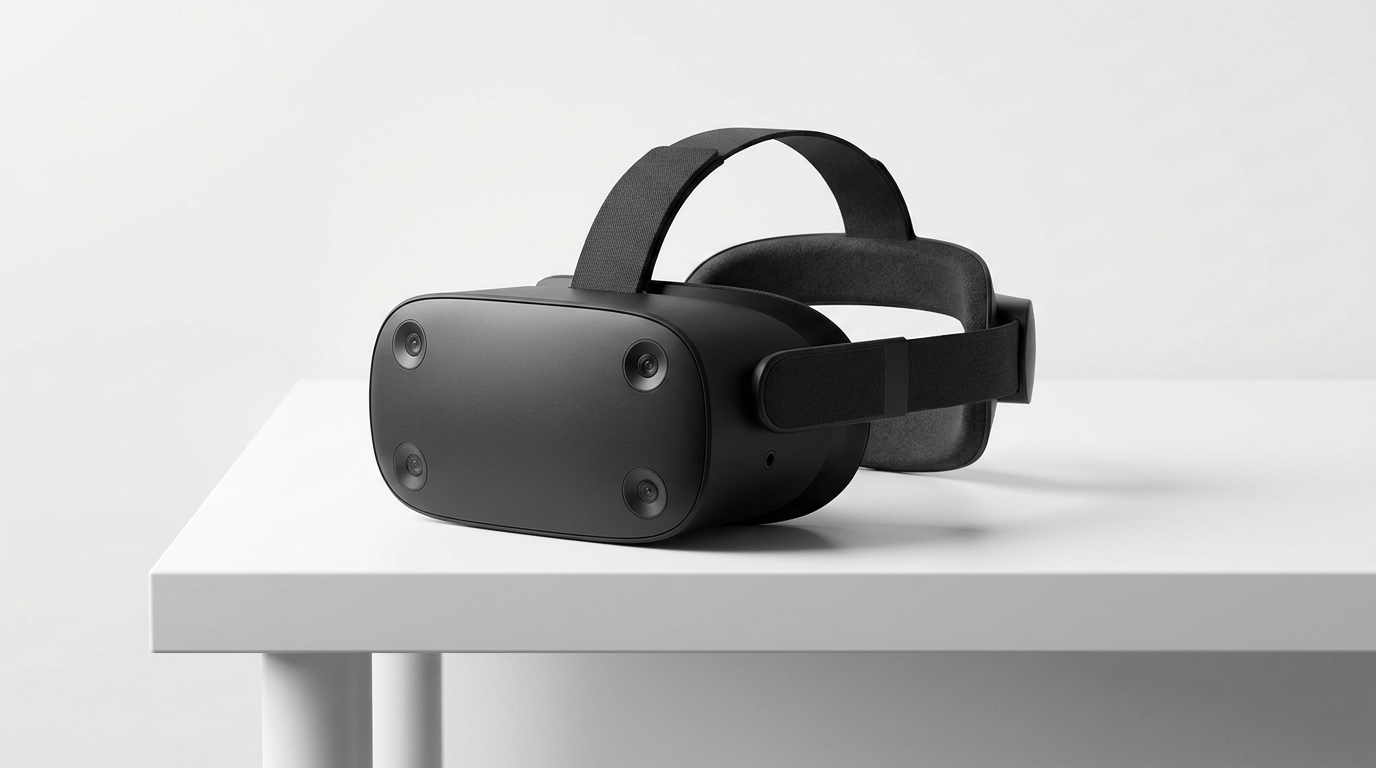
The Steam Frame represents Valve's first foray into VR hardware since the release of the tethered Valve Index in 2019. Unlike its predecessor, which required a high-end gaming PC and external tracking beacons, the Steam Frame is a fully standalone device. It utilizes inside-out tracking via four high-resolution monochrome cameras and is powered by an onboard Qualcomm Snapdragon 8 Gen 3 processor paired with 16GB of LPDDR5X memory. This positions the device as a direct competitor to Meta's dominant Quest lineup, offering a wire-free experience but with the backing of the PC gaming industry's largest storefront.[2][3]
The hardware specifications suggest a premium tier of standalone performance. The headset features dual custom LCD panels delivering a resolution of 2160 by 2160 pixels per eye, with refresh rates scaling up to an experimental 144Hz. Custom 'pancake' lenses provide edge-to-edge sharpness while keeping the headset's overall profile remarkably slim. At just 440 grams with the battery and headstrap attached, the Steam Frame undercuts the weight of the Meta Quest 3, a crucial metric for user comfort during extended, multi-hour play sessions.[2][3]

But the Steam Frame's true differentiator lies in its software architecture. The headset runs on SteamOS, Valve's Arch Linux-based operating system. To bridge the gap between the headset's ARM-based mobile processor and a library of games built for Windows PCs, Valve has integrated a sophisticated stack of compatibility layers. The system utilizes Proton to translate Windows commands to Linux, and FEX to emulate x86 architecture on the Snapdragon chip. This allows the headset to natively download and run a vast swath of the existing Steam library—both VR and traditional 'flatscreen' games—without requiring developers to port their titles.[3][4]
But the Steam Frame's true differentiator lies in its software architecture.
For games that are simply too graphically demanding to run natively on a mobile chipset, the Steam Frame leans heavily into its advanced wireless streaming capabilities. The headset ships with a plug-and-play 6GHz wireless adapter designed to connect directly into a host PC. The Steam Frame utilizes dual Wi-Fi 7 radios to intelligently split network traffic: one radio maintains the standard internet connection for multiplayer data, while the other establishes a dedicated, interference-free link to the PC strictly for streaming high-fidelity audio and visuals.[2][4]
To maximize the efficiency of this wireless link, Valve has introduced a novel feature called 'Foveated Streaming.' Utilizing the headset's built-in eye-tracking cameras, the system dynamically concentrates the highest quality pixels exactly where the user is actively looking, while heavily compressing the peripheral image. Valve claims this technique, which operates entirely invisibly in the background, yields a tenfold improvement in effective bandwidth and image quality, ensuring that demanding PC VR games feel completely native and latency-free without the need for a physical tether.[2][3]

The Steam Frame's controllers also reflect a hybrid approach to gaming. Tracked in three-dimensional space by the headset's cameras, the controllers feature capacitive finger tracking for immersive VR interactions. However, they also incorporate a 'split gamepad' layout, complete with a D-pad, ABXY buttons, thumbsticks, triggers, and bumpers. This ensures that users can seamlessly transition from playing a room-scale VR title to sitting back and playing a traditional non-VR PC game on a massive virtual screen, all without changing their input device.[2][6]
The headset's arrival in the United States is part of a broader, ambitious hardware rollout for Valve. Import data from recent months shows the company has also been stockpiling tens of thousands of units of its upcoming 'Steam Machine' living-room console and the new Steam Controller. Valve originally targeted an early 2026 release for the hardware trio, but the timeline was disrupted by a global semiconductor and memory shortage that caused RAM and storage prices to skyrocket across the industry.[4][5][7]

With the logistics pipeline now flowing, the final remaining mysteries are the exact release date and the price. Valve has previously stated that the Steam Frame will cost less than the $999 launch price of the Valve Index, but industry estimates still place it in the premium tier, likely between $500 and $800. If Valve can deliver on its promise of frictionless PC VR and robust standalone performance at a competitive price, the Steam Frame could successfully apply the 'Steam Deck playbook' to virtual reality, giving developers a lucrative new target and breaking Meta's stranglehold on the untethered VR market.[3][4]
How we got here
June 2019
Valve releases the Index, its first first-party PC VR headset, setting a high bar for enthusiast VR.
February 2022
Valve launches the Steam Deck, proving that a portable Linux-based device can successfully run the Windows PC gaming library.
November 2025
Valve officially announces the Steam Frame, alongside the Steam Machine and a new Steam Controller.
Spring 2026
Global memory shortages force Valve to delay the planned early-2026 launch of its new hardware trio.
June 10, 2026
A container ship arrives in Los Angeles carrying 13 tons of Steam Frame headsets, signaling an imminent launch.
Viewpoints in depth
PC VR Enthusiasts
Long-time VR users seeking a high-fidelity upgrade path from aging tethered headsets.
For years, the PC VR community has felt somewhat abandoned as the industry pivoted toward lower-fidelity, mobile-chipset headsets like the Meta Quest. Enthusiasts view the Steam Frame as the long-awaited successor to the 2019 Valve Index. By offering uncompressed, foveated wireless streaming and native SteamOS integration, the headset promises to deliver the high-end, uncompromising visual fidelity of PC VR without the cumbersome cables and external tracking lighthouses that defined the previous generation.
Standalone VR Developers
Game creators looking for a viable competitor to Meta's dominant Quest storefront.
Developers have increasingly relied on Meta's Quest ecosystem for revenue, effectively granting Meta a near-monopoly on standalone VR distribution. The Steam Frame represents a massive opportunity to reach a new audience without necessarily having to downgrade their games' graphical assets. Because the headset utilizes Proton and FEX to run existing PC code, developers can potentially sell their high-fidelity PC VR games to Steam Frame users without undertaking an expensive, ground-up mobile port.
Hardware Analysts
Industry observers tracking supply chain constraints and market viability.
While the technology is universally praised, analysts remain cautious about the Steam Frame's market penetration. The ongoing global memory shortage—dubbed 'RAMageddon'—has already delayed Valve's broader hardware rollout and forced the company to reevaluate its pricing models. Analysts note that if the Steam Frame launches closer to the $800 mark, it may struggle to pull casual consumers away from the heavily subsidized, $500 Meta Quest 3, relegating Valve's headset to a premium, enthusiast-only niche.
What we don't know
- The exact retail price of the Steam Frame, which is expected to be lower than the $999 Valve Index but higher than the Meta Quest 3.
- The specific summer release date for the headset and its companion hardware.
- How severely the ongoing global memory shortage will impact initial inventory levels and availability.
Key terms
- Standalone VR
- A virtual reality headset that contains its own processor, battery, and storage, requiring no external computer or console to function.
- Inside-out tracking
- A system where cameras built directly into the headset track the user's movement and controllers, eliminating the need for external sensors placed around the room.
- Foveated streaming
- A technique that uses eye-tracking to stream the highest quality graphics only to the exact spot the user is looking, drastically reducing bandwidth requirements.
- Proton
- A software compatibility layer developed by Valve that allows games originally built for Microsoft Windows to run seamlessly on Linux-based operating systems.
- x86 emulation
- The process of translating software designed for traditional desktop computer processors so that it can run on the mobile-style ARM processors used in standalone headsets.
Frequently asked
Do I need a gaming PC to use the Steam Frame?
No. The Steam Frame is a standalone headset with its own processor, meaning it can download and play games natively. However, it can also connect wirelessly to a PC to play more demanding titles.
Can it play non-VR games?
Yes. The headset runs SteamOS and allows users to play traditional 'flatscreen' PC games on a large virtual display, using the controllers' built-in gamepad buttons.
Is it heavier than the Meta Quest 3?
No. At 440 grams with the battery and strap attached, the Steam Frame is significantly lighter than the 515-gram Meta Quest 3.
When will the Steam Frame be available to buy?
Valve has confirmed a Summer 2026 release window, though an exact date and price have not yet been announced.
Sources
Source coverage
8 outlets
3 viewpoints surfaced








[1]The VergeStandalone VR Developers
Valve just imported 13 tons of VR headsets in one day
Read on The Verge →[2]VRcompare
Steam Frame: Full Specification
Read on VRcompare →[3]VR.orgPC VR Enthusiasts
Everything Riding on Steam Frame
Read on VR.org →[4]Road to VRPC VR Enthusiasts
Steam Frame is Poised for Launch as Units Begin Reaching the US
Read on Road to VR →[5]ShiftDeleteHardware Analysts
Valve Imports 13 Tons of New VR Headsets for Launch
Read on ShiftDelete →[6]PCMagStandalone VR Developers
Valve Steam Frame, Steam Machine, Steam Controller: I Demoed Every Steam Thing Coming in 2026
Read on PCMag →[7]WiretelHardware Analysts
Valve just imported 50 tons of game consoles in two days
Read on Wiretel →[8]IntellectiaHardware Analysts
Valve Imports 13 Tons of VR Headsets in a Single Day
Read on Intellectia →

Every angle. Every day.
Get technology stories with full source coverage and perspective breakdowns delivered to your inbox.