
U.S. Military Strike Kills Tren de Aragua Leader Niño Guerrero in Venezuela
President Trump announced that a U.S. military strike in Venezuela killed Héctor Rusthenford Guerrero Flores, the leader of the transnational Tren de Aragua gang. The operation was closely coordinated with Venezuelan security forces, marking a significant step in U.S.-Venezuelan cooperation following the capture of former President Nicolás Maduro earlier this year.
By Factlen Editorial Team
- U.S. Administration
- Argues that aggressive military action is required to eliminate transnational criminal threats and protect American borders.
- Venezuelan Interim Government
- Values U.S. military and intelligence support to dismantle armed gangs, restore state control over mining regions, and normalize international relations.
- Legal & Human Rights Observers
- Warns that the reliance on lethal military strikes and mass deportations without due process violates international law and human rights norms.
- Regional Security Analysts
- Focuses on the structural evolution of Tren de Aragua and cautions that decapitating the leadership may lead to unpredictable splintering and regional violence.
What's not represented
- · Venezuelan Diaspora / Migrants
- · Local Residents of Bolívar State
Why this matters
The targeted killing of Niño Guerrero eliminates the head of a transnational criminal organization blamed for widespread violence and drug trafficking across the Americas. The joint operation also underscores a dramatic shift in U.S.-Venezuelan relations, demonstrating unprecedented military and intelligence cooperation just months after U.S. forces captured former Venezuelan President Nicolás Maduro.
Key points
- A U.S. military strike in Venezuela killed Héctor Rusthenford Guerrero Flores, the leader of the Tren de Aragua gang.
- The operation was closely coordinated with Venezuelan security forces in the southeastern Bolívar state.
- Guerrero Flores, alias "Niño Guerrero," was wanted by the U.S. on charges of narco-terrorism and racketeering.
- The strike highlights growing military cooperation between the U.S. and Venezuela's interim government following the capture of Nicolás Maduro.
- Tren de Aragua originated in a Venezuelan prison and expanded into a transnational syndicate involved in human trafficking and extortion.
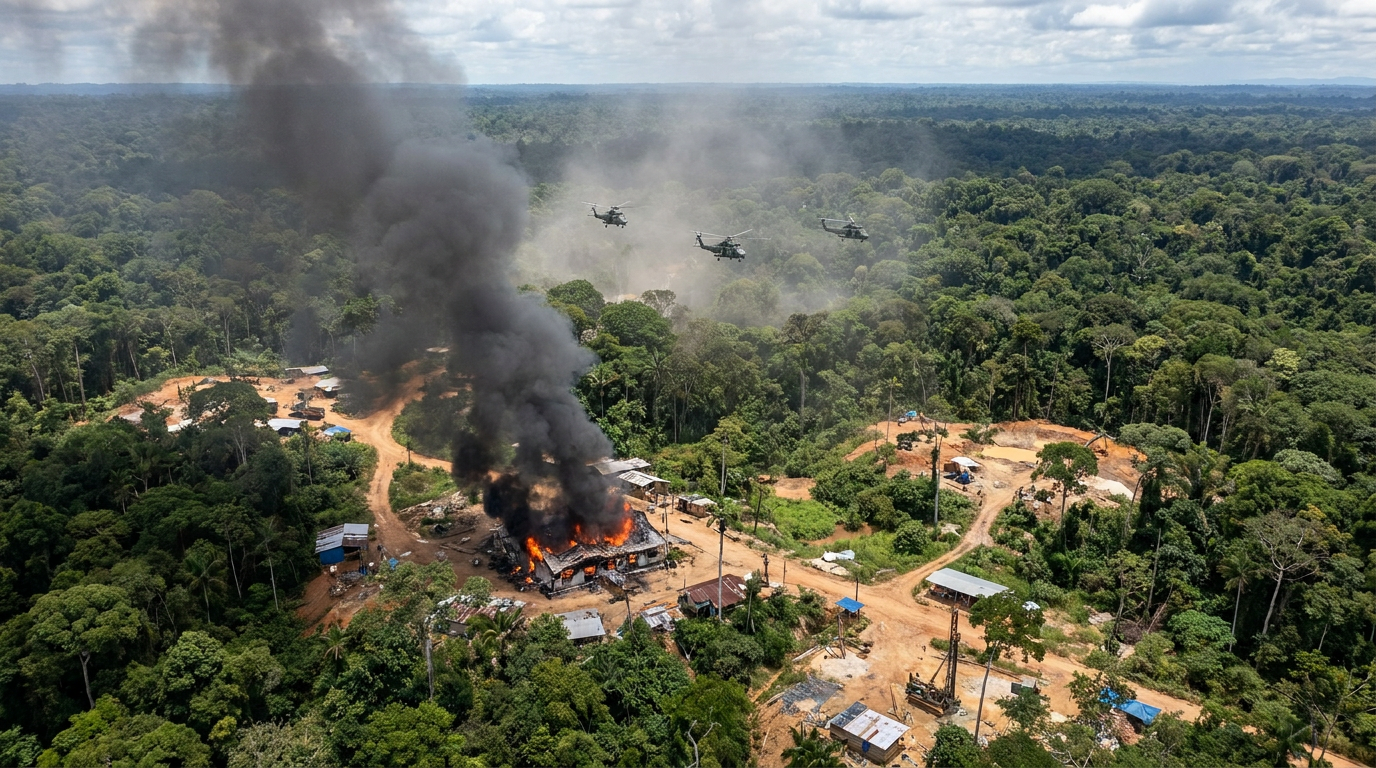
President Donald Trump announced late Friday that a "swift and lethal kinetic" U.S. military strike successfully eliminated Héctor Rusthenford Guerrero Flores, the notorious leader of the transnational Tren de Aragua gang. The targeted attack, which took place in Venezuela's southeastern Bolívar state, marks the decapitation of one of the hemisphere's most expansive criminal syndicates. Video footage shared by the president on social media showed a projectile obliterating a green-roofed compound, sending a massive plume of smoke into the air. The strike represents a dramatic escalation in the administration's aggressive military campaign against organizations it has designated as narco-terrorist threats.[1][2][3]
The operation was executed by the U.S. Southern Command and relied on unprecedented coordination with Venezuelan security forces. Defense Secretary Pete Hegseth confirmed that the strike occurred earlier in the week on a known Tren de Aragua compound, emphasizing that the mission utilized specialized technological support and deep intelligence sharing between the two nations. Hegseth framed the joint operation as a testament to a shared commitment to denying safe havens to violent cartels in the Americas. Reports indicate that the CIA worked closely with Venezuelan forces on the ground to pinpoint Guerrero Flores's exact location before the missile was launched.[2][3][6]
Guerrero Flores, universally known in the criminal underworld by his alias "Niño Guerrero," had been a high-value fugitive for years. The U.S. State Department had offered a $5 million reward for information leading to his capture or conviction. Late last year, he was indicted in a New York federal court on a sweeping array of charges, including racketeering, cocaine conspiracy, and providing material support to terrorists. U.S. prosecutors alleged that under his leadership, Tren de Aragua evolved from a localized prison gang into a sophisticated enterprise responsible for countless acts of violence, extortion, and drug trafficking across North America, South America, and Europe.[1][2][4]
The Venezuelan Ministry of Communications, operating under the administration of acting President Delcy Rodríguez, released a formal statement confirming that Guerrero Flores was "neutralized" during clashes with criminal structures. The government reaffirmed its commitment to dismantling organized crime, particularly in the lawless, gold-rich mining region of Bolívar state, where Tren de Aragua has heavily entrenched its illicit operations. In recent days, Venezuelan military helicopters and ground troops had been deployed to the area, signaling a renewed domestic offensive against the gang's lucrative illegal mining and extortion rackets.[3][6][8]

The joint military action underscores a profound and rapid geopolitical shift in the region. Just five months ago, in January 2026, U.S. special operations forces launched a daring nighttime raid on Caracas to capture then-President Nicolás Maduro. Maduro and his wife were extracted to New York to face federal narco-terrorism charges, effectively decapitating the socialist government that had long maintained an adversarial relationship with Washington. The fact that U.S. forces are now conducting coordinated missile strikes inside Venezuelan territory highlights the stark transformation of bilateral relations since Maduro's dramatic ouster.[2][4][7]
The joint military action underscores a profound and rapid geopolitical shift in the region.
Following Maduro's removal, acting President Rodríguez has strategically pivoted toward cooperation with Washington, despite her previous role in the socialist administration. The successful strike on Guerrero Flores illustrates the rapid development of military and intelligence ties between the U.S. and the new Venezuelan interim government. For Rodríguez, collaborating with U.S. military assets provides crucial support in regaining state control over violent mining regions, while simultaneously signaling to foreign investors and the international community that Venezuela is open for business and committed to stabilizing its internal security apparatus.[1][8]
The rise of Tren de Aragua is deeply intertwined with Venezuela's decade-long economic collapse. The syndicate originated inside the notoriously lawless Tocorón Penitentiary in Venezuela's central Aragua state. Taking advantage of severe government neglect and systemic corruption, Guerrero Flores and his associates essentially conquered the facility. They transformed the prison into a fortified, self-sustaining headquarters complete with a zoo, a baseball field, a casino, and restaurants, establishing a brutal system that controlled the entire inmate population through force and extortion while directing criminal enterprises on the outside.[2][3]
From that impregnable prison base, the gang expanded into a sprawling transnational criminal syndicate. As millions of desperate Venezuelans fled the country's economic ruin, Tren de Aragua embedded itself within the massive migration flows. The organization established violent operational cells in Colombia, Peru, Chile, and eventually the United States. Along these migration routes, the gang ruthlessly exploited vulnerable refugees, engaging in human trafficking, kidnapping, contract killings, and organized retail theft, while violently clashing with local cartels for territorial control.[1][5]

The Trump administration officially designated Tren de Aragua a foreign terrorist organization last year, elevating the gang to a primary focus of U.S. national security and border enforcement. The president and top administration officials have repeatedly blamed the syndicate for driving violence and illicit drug distribution in American cities. By framing the gang as an invading narco-terrorist army, the administration has justified an increasingly militarized approach to border security and international law enforcement, culminating in the lethal kinetic strike that eliminated its top commander.[1][4][6]
The broader campaign against Tren de Aragua has included aggressive and highly controversial military tactics beyond the borders of Venezuela. Over the past several months, the U.S. military has conducted numerous lethal strikes on small boats in the Caribbean Sea and the eastern Pacific Ocean that were suspected of smuggling drugs for the gang. These maritime operations have resulted in dozens of casualties, drawing intense scrutiny from legal experts and human rights organizations who have characterized the attacks as extrajudicial killings that violate international maritime law.[1][4]

Domestically, the administration's crackdown has also tested legal boundaries. Invoking the wartime Alien Enemies Act of 1798, the U.S. government has summarily deported hundreds of Venezuelan men to a maximum-security prison in El Salvador, accusing them of affiliation with Tren de Aragua. This mass deportation campaign has provoked fierce backlash from civil rights advocates, who argue that the migrants are being denied fundamental due process and that the administration is relying on sweeping, unsubstantiated claims to bypass the standard judicial immigration system.[1][2][4]
While the targeted elimination of Niño Guerrero marks a major tactical victory for both the U.S. and Venezuelan governments, the long-term impact on Tren de Aragua's decentralized operations remains highly uncertain. The syndicate's sprawling, cellular network across the Americas may fracture without its central architect, potentially triggering violent power struggles among remaining lieutenants. Security analysts warn that decapitating the leadership of such a deeply entrenched organization rarely neutralizes the threat immediately, and could instead spark a new wave of regional instability as rival factions vie for control of the gang's lucrative trafficking routes.[1][5]
How we got here
2013
Guerrero Flores returns to Tocorón Penitentiary, where he and other inmates eventually take full control of the facility, founding Tren de Aragua.
September 2023
Venezuelan authorities raid Tocorón Penitentiary, but Guerrero Flores and other top leaders escape beforehand.
December 2023
A New York federal court indicts Guerrero Flores on charges of racketeering and narco-terrorism.
January 3, 2026
U.S. forces capture Venezuelan President Nicolás Maduro, leading to Delcy Rodríguez assuming the role of acting president.
June 2026
A coordinated U.S. military strike in Venezuela's Bolívar state kills Guerrero Flores.
Viewpoints in depth
U.S. Administration's View
The strike is a decisive victory in the war against transnational narco-terrorism.
Trump and Defense Secretary Hegseth frame the operation as proof that the U.S. will aggressively hunt down criminal threats anywhere in the hemisphere. They argue that eliminating Guerrero Flores disrupts a major pipeline of drugs and violence entering American cities, validating their hardline military approach to border security and international crime.
Venezuelan Interim Government's View
Cooperation with the U.S. is necessary to restore domestic security and sovereignty.
Acting President Delcy Rodríguez's administration views the joint operation as a critical step in regaining control over lawless mining regions like Bolívar state. By collaborating with U.S. intelligence and military assets, the interim government aims to legitimize its authority, dismantle violent syndicates that challenge state power, and pave the way for foreign investment in the country's resource sectors.
Human Rights & Legal Observers
The aggressive military tactics and deportations raise severe due process concerns.
While acknowledging the brutality of Tren de Aragua, legal experts and rights advocates warn that the U.S. strategy relies on extrajudicial killings and legally dubious deportations. Critics point to the lethal strikes on suspected drug boats and the summary deportation of hundreds of Venezuelans to El Salvador under the Alien Enemies Act as dangerous precedents that bypass the judicial system.
What we don't know
- Who will succeed Guerrero Flores as the leader of Tren de Aragua, and whether his death will cause the syndicate to fracture.
- The exact nature of the U.S. military assets used in the strike, though reports suggest Joint Special Operations Command forces fired a missile.
- How the elimination of the gang's top leader will impact its operations and cells currently active in the United States and other Latin American countries.
Key terms
- Tren de Aragua
- A transnational criminal organization that originated in a Venezuelan prison, known for human trafficking, extortion, and drug smuggling across the Americas.
- Kinetic Strike
- A military attack involving active weaponry, such as missiles or bombs, used to physically destroy a target.
- Narco-terrorism
- Terrorism funded by or associated with the trafficking of illegal drugs.
- Alien Enemies Act of 1798
- A U.S. law that allows the president to apprehend and deport non-citizens from a hostile nation during times of war, recently invoked to deport alleged gang members.
Frequently asked
Who was Héctor Rusthenford Guerrero Flores?
He was the notorious leader of the Tren de Aragua gang, operating under the alias "Niño Guerrero," who transformed a Venezuelan prison gang into a transnational criminal empire.
Why did the U.S. conduct a strike in Venezuela?
The U.S. targeted Guerrero Flores as part of a broader military and law enforcement campaign against transnational narco-terrorism, coordinating the strike with the Venezuelan interim government.
How is the U.S. working with Venezuela?
Following the U.S. capture of former President Nicolás Maduro in January 2026, the new interim government led by Delcy Rodríguez has pivoted to cooperate with U.S. intelligence and military forces to combat organized crime.
Sources
Source coverage
8 outlets
4 viewpoints surfaced








[1]The Washington PostLegal & Human Rights Observers
U.S. forces kill Venezuelan Tren de Aragua gang leader, Trump says
Read on The Washington Post →[2]CBS NewsU.S. Administration
Trump says U.S. killed Tren de Aragua leader in airstrike in Venezuela
Read on CBS News →[3]Associated PressU.S. Administration
Trump says US military strike killed leader of Tren de Aragua gang with help from Venezuela
Read on Associated Press →[4]The GuardianLegal & Human Rights Observers
Trump says leader of Venezuelan Tren de Aragua gang killed in US strike
Read on The Guardian →[5]ReutersRegional Security Analysts
Trump says US military strike killed leader of Venezuela's Tren de Aragua gang
Read on Reuters →[6]DWVenezuelan Interim Government
US, Venezuela say Tren de Aragua leader killed in strike
Read on DW →[7]Al JazeeraRegional Security Analysts
Trump says US strike killed Tren de Aragua gang boss with Venezuela help
Read on Al Jazeera →[8]Latin America ReportsVenezuelan Interim Government
Interim-president Delcy Rodríguez signals intention to re-open Venezuelan mining to foreign companies
Read on Latin America Reports →

More in news politics
See all 5 stories →Middle East Diplomacy
US and Iran Near Interim Agreement to Halt Hostilities: What the Deal Contains
0 sources
Union Contracts
House Passes Sweeping Labor Bill Mandating Strict Timelines for First Union Contracts
0 sources

US-Iran Deal
US and Iran on the Brink of Historic Interim Peace Agreement to End War
0 sources

Every angle. Every day.
Get news politics stories with full source coverage and perspective breakdowns delivered to your inbox.