
U.S. Military Strike Kills Tren de Aragua Gang Leader in Venezuela
A coordinated U.S. missile strike in Venezuela has killed Héctor 'Niño' Guerrero, the fugitive leader of the transnational criminal organization Tren de Aragua.
By Factlen Editorial Team
- U.S. National Security Apparatus
- Focuses on neutralizing transnational threats and leveraging new geopolitical alliances to project power.
- Venezuelan State Security
- Focuses on stabilizing the country post-Maduro and eliminating domestic criminal fiefdoms.
- Human Rights & Regional Analysts
- Focuses on the root causes of the gang's rise, the exploitation of migrants, and the risk of splinter violence.
What's not represented
- · Venezuelan civilians living in Bolívar state
- · Migrants currently being exploited by Tren de Aragua
Why this matters
The assassination of the hemisphere's most notorious gang leader marks a historic escalation in how the U.S. targets organized crime, applying Middle East-style counter-terrorism strikes to South America. It also serves as the first major test of the new U.S.-Venezuela security alliance following the removal of Nicolás Maduro.
Key points
- U.S. JSOC forces killed Tren de Aragua leader Héctor 'Niño' Guerrero in a missile strike in Venezuela's Bolívar state.
- The operation was closely coordinated with Venezuelan security forces and relied on intelligence provided by the CIA.
- Guerrero Flores had a $5 million U.S. bounty and was indicted in New York for racketeering and supporting terrorism.
- The strike highlights a dramatic shift in U.S.-Venezuela relations following the American military operation that removed Nicolás Maduro in January 2026.
- Security analysts warn the assassination could cause the decentralized gang to splinter into competing, violent factions.
The U.S. military has assassinated Héctor Rusthenford Guerrero Flores, the notorious leader of the Venezuelan transnational gang Tren de Aragua, in a targeted missile strike within Venezuela. President Donald Trump announced the operation late Friday, describing it as a "swift and lethal kinetic strike" executed by the United States Southern Command. The operation marks a significant escalation in Washington's campaign against Latin American organized crime and serves as the highest-profile counter-terrorism action in the hemisphere this year.[1][2]
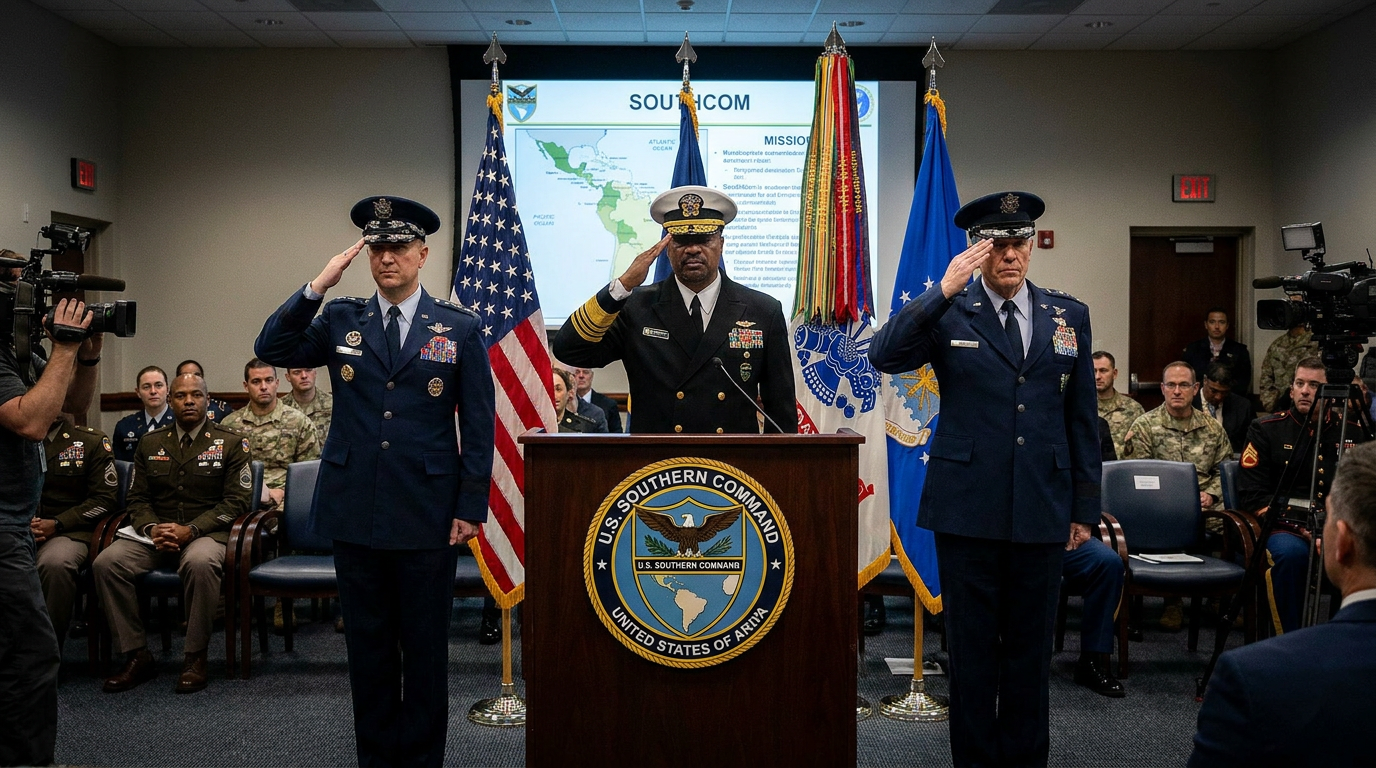
The strike took place earlier this week at a compound in Venezuela's southeastern Bolívar state. According to Defense Secretary Pete Hegseth, the mission was a "combined operation" conducted in full collaboration with Venezuelan security forces. The Joint Special Operations Command (JSOC) carried out the attack using a precision missile, while the CIA provided critical intelligence and coordinated with Venezuelan operatives on the ground. Video footage shared by the president on social media showed a projectile obliterating a building, which erupted in a massive fireball.[2][4]
Guerrero Flores, widely known by his alias "Niño Guerrero" (The Boy Warrior) or "The Big Eyebrow," had been the subject of a massive international manhunt. The U.S. State Department had previously offered a $5 million reward for information leading to his capture. In December, federal prosecutors in New York indicted the 43-year-old on charges of racketeering, cocaine conspiracy, and providing material support to terrorists. U.S. Southern Command described him as a wanted fugitive who directed acts of violence and extortion across the Americas.[2][3][6]

The successful targeting of Guerrero Flores underscores a dramatic geopolitical realignment between Washington and Caracas. The joint nature of the operation highlights the shifting U.S. relationship with Venezuela following the unprecedented American military intervention in January 2026 that removed former Venezuelan President Nicolás Maduro from power. Maduro was extracted to New York to face federal drug trafficking charges, paving the way for a new Venezuelan administration that has proven highly cooperative with U.S. military and intelligence agencies.[1][2]
"The operation underscores the shared U.S. and Venezuelan commitment to take the fight to narco-terrorists and deny them any safe haven in our hemisphere," Hegseth stated following the strike. General Francis Donovan, the head of U.S. Southern Command, publicly thanked Venezuelan security forces for their role in the joint operation, emphasizing that transnational criminal networks can no longer rely on the country as a sanctuary. The Venezuelan ministry of communications quickly corroborated the U.S. account, confirming that Guerrero Flores was "neutralized" during clashes with security structures.[2][4][5]
Tren de Aragua's evolution from a local prison gang to a hemispheric threat is a central piece of this narrative. The organization originated more than a decade ago inside the notoriously lawless Tocorón Penitentiary in Venezuela's central Aragua state. Guerrero Flores, who was in and out of the prison for years, effectively took over the facility, transforming it into a luxury compound equipped with a zoo, a nightclub, and a swimming pool. From his prison stronghold, he directed a sprawling criminal enterprise that collected fees from illicit activities on the outside.[2][3]
Tren de Aragua's evolution from a local prison gang to a hemispheric threat is a central piece of this narrative.
As Venezuela's economy collapsed over the past decade, millions of citizens fled the country, and Tren de Aragua followed the migration routes. The gang systematically expanded its footprint across Colombia, Peru, Chile, and eventually the United States. The U.S. State Department designated the group as a foreign terrorist organization, citing its involvement in human smuggling, kidnapping, extortion, and the assassination of a Venezuelan opposition figure. The gang ruthlessly exploited vulnerable migrants, forcing many into sex trafficking or using them as drug mules.[3][4]

Guerrero Flores's grip on the organization appeared to slip in late 2023 when Venezuelan authorities finally raided the Tocorón prison. However, the gang leader had been tipped off and managed to escape before the raid commenced, remaining a ghost until this week's strike. His ability to evade capture for years while managing a transnational empire from the shadows made him a symbol of the impunity enjoyed by organized crime syndicates operating in failed or transitioning states.[2][4]
The domestic political implications of the strike are already reverberating through Washington. President Trump immediately seized on the successful operation to validate his administration's aggressive border and security policies. In his announcement, Trump framed the assassination as a decisive victory over a "foreign army" that he claimed had been allowed to infiltrate the United States under the previous administration. "Tren de Aragua terrorists no longer have safe haven in Venezuela or anywhere else," the president declared.[1][3]
The rhetoric surrounding Tren de Aragua has been a potent political weapon. For months, Trump and his allies have consistently blamed the gang for driving violent crime and illicit drug distribution in American cities. The president had previously invoked the Alien Enemies Act to justify the expedited deportation of alleged gang members without standard due process, claiming that the group operated under the direct control of the Maduro regime—a claim that declassified U.S. intelligence assessments had previously disputed.[3][4]
The intelligence community's role in the strike highlights a sophisticated, multi-agency effort to dismantle the gang's leadership structure. A senior administration official confirmed that the CIA provided the precise geolocation data that enabled the JSOC missile strike. This level of intelligence integration suggests that U.S. assets have deeply penetrated the gang's communications networks, likely aided by the new Venezuelan government's willingness to share domestic surveillance and informant data with American handlers.[4]

Despite the tactical success of eliminating Guerrero Flores, security analysts caution that the long-term impact on Tren de Aragua remains uncertain. Transnational criminal organizations often operate with decentralized, cellular structures. While the loss of a charismatic and deeply connected founder is a severe blow, it can also trigger violent internal succession battles or cause the gang to splinter into smaller, more unpredictable factions. The immediate aftermath may see a spike in violence as lieutenants vie for control of the lucrative human smuggling and extortion rackets.[2][4]
Furthermore, the strike raises complex questions about the future of U.S. military engagement in South America. The use of a kinetic missile strike within a sovereign South American nation—even with the host government's permission—sets a modern precedent for how Washington pursues non-state actors in the hemisphere. It signals a shift toward counter-terrorism tactics traditionally reserved for the Middle East and North Africa, applying them directly to the drug and gang wars of the Americas.[1][4]
As the dust settles in Bolívar state, the focus will inevitably shift to the remaining leadership of Tren de Aragua and the gang's sprawling network of operatives. The U.S. Justice Department continues to pursue indictments against other high-ranking members, and the State Department's reward programs remain active. For now, the assassination of Niño Guerrero stands as a stark warning to transnational syndicates, demonstrating that the geopolitical realignments of 2026 have fundamentally altered the security landscape of the Western Hemisphere.[2][3]
How we got here
2012-2013
Guerrero Flores escapes Tocorón prison, is recaptured, and begins consolidating control over the facility.
2018
Guerrero Flores is sentenced to 17 years in prison but continues to run Tren de Aragua from inside.
September 2023
Venezuelan authorities raid Tocorón prison; Guerrero Flores escapes and goes into hiding.
January 2026
U.S. military operation removes Nicolás Maduro from power, fundamentally altering U.S.-Venezuela relations.
June 2026
U.S. JSOC forces, coordinating with the new Venezuelan government, kill Guerrero Flores in a missile strike.
Viewpoints in depth
U.S. Administration's View
Argues the strike is a decisive victory for border security and validates the aggressive military posture in the hemisphere.
For the U.S. administration, the assassination of Niño Guerrero is a vindication of its aggressive approach to border security and transnational crime. Officials view the strike as proof that the U.S. military can and will project power deep into South America to neutralize threats before they reach American soil. By framing the gang as a 'foreign army,' the administration uses the operation to justify its broader immigration crackdowns and the controversial invocation of the Alien Enemies Act.
Venezuelan Government's View
Frames the joint operation as a successful step in reclaiming national sovereignty from organized crime.
The post-Maduro Venezuelan government views the operation as a critical milestone in re-establishing state control over territories long dominated by criminal fiefdoms. By actively coordinating with the CIA and U.S. Southern Command, Caracas is signaling its reliability as a regional security partner. The government hopes that dismantling Tren de Aragua's leadership will help stabilize the country's interior and encourage international investment following years of economic collapse.
Security Analysts' View
Warns that while eliminating the leader is a tactical win, decentralized gangs often splinter into more violent factions.
Regional security experts and human rights observers caution against viewing the strike as a silver bullet. They point out that transnational criminal organizations like Tren de Aragua operate with highly decentralized, cellular structures. The sudden removal of a foundational leader often triggers bloody succession battles among mid-level lieutenants. Analysts warn that the structural drivers of the gang's power—namely, the mass migration of vulnerable people and the lucrative nature of human smuggling—remain entirely intact.
What we don't know
- Whether the elimination of Guerrero Flores will fatally cripple Tren de Aragua or trigger a violent succession battle among its lieutenants.
- The exact nature of the intelligence-sharing agreement between the CIA and the new Venezuelan government.
- How other South American nations dealing with Tren de Aragua cells will respond to the precedent of a U.S. kinetic strike on the continent.
Key terms
- Tren de Aragua
- A transnational criminal organization that originated in a Venezuelan prison and expanded across the Americas, specializing in extortion, human smuggling, and drug trafficking.
- Joint Special Operations Command (JSOC)
- A component of the U.S. military responsible for studying special operations requirements and conducting covert, high-stakes counter-terrorism strikes.
- Alien Enemies Act
- A U.S. law invoked to justify the expedited deportation of alleged gang members without standard due process during periods of declared hostility.
- Kinetic Strike
- Military terminology for an attack involving active, explosive weaponry, such as a missile, rather than cyber or electronic warfare.
Frequently asked
Where did the strike take place?
The missile strike occurred at a compound in Venezuela's southeastern Bolívar state.
Did the U.S. act alone?
No. The operation was closely coordinated with Venezuelan security forces, and the CIA worked with operatives on the ground.
Who was Niño Guerrero?
Héctor Rusthenford Guerrero Flores was the foundational leader of Tren de Aragua, who built the gang into a transnational empire from inside a Venezuelan prison.
What happens to Tren de Aragua now?
Security analysts warn the gang may splinter into competing, violent factions as lieutenants fight for control of its lucrative smuggling and extortion networks.
Sources
Source coverage
6 outlets
3 viewpoints surfaced






[1]The GuardianHuman Rights & Regional Analysts
Trump says leader of Venezuelan Tren de Aragua gang killed in US strike
Read on The Guardian →[2]CBS NewsU.S. National Security Apparatus
Trump says U.S. killed Tren de Aragua leader in airstrike in Venezuela
Read on CBS News →[3]Associated PressU.S. National Security Apparatus
Trump says US military strike killed leader of Tren de Aragua gang with help from Venezuela
Read on Associated Press →[4]The Washington PostU.S. National Security Apparatus
U.S. forces kill Venezuelan Tren de Aragua gang leader, Trump says
Read on The Washington Post →[5]Al JazeeraVenezuelan State Security
Trump claims US kills Venezuela’s Tren de Aragua gang leader
Read on Al Jazeera →[6]U.S. Southern CommandU.S. National Security Apparatus
U.S. Forces Conduct Strike in Venezuela Targeting Transnational Criminal Organization
Read on U.S. Southern Command →

More in news politics
See all 5 stories →Middle East Diplomacy
US and Iran Near Interim Agreement to Halt Hostilities: What the Deal Contains
0 sources

Union Contracts
House Passes Sweeping Labor Bill Mandating Strict Timelines for First Union Contracts
0 sources

US-Iran Deal
US and Iran on the Brink of Historic Interim Peace Agreement to End War
0 sources

Every angle. Every day.
Get news politics stories with full source coverage and perspective breakdowns delivered to your inbox.