
The Solid-State Era Begins: How the 'Holy Grail' of EV Batteries is Finally Hitting the Road
After a decade of laboratory research, solid-state batteries are entering pilot production in 2026, promising to double electric vehicle ranges and cut charging times to minutes.
By Factlen Editorial Team
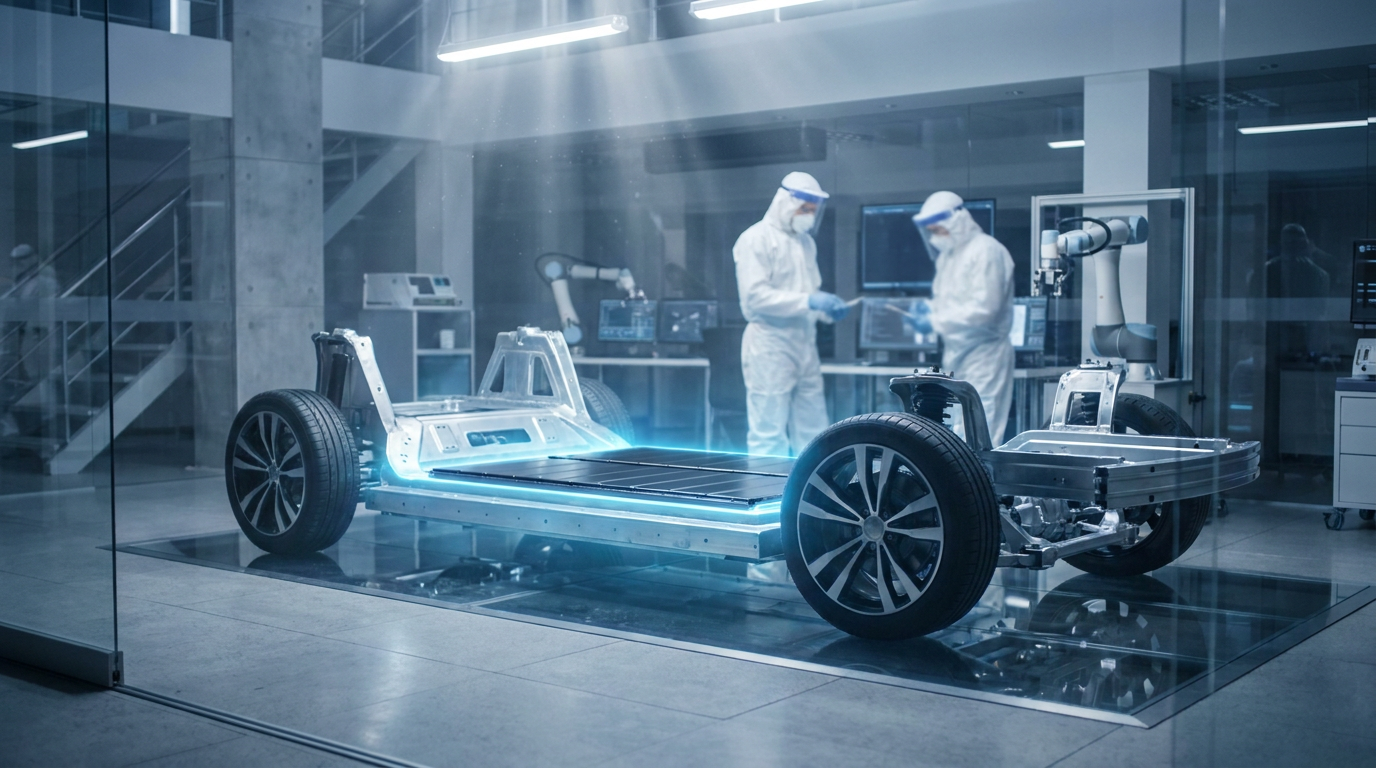
- Solid-State Pioneers
- Believe the technology is ready to scale and will revolutionize the industry by solving range and charge time.
- Chinese Incumbents
- Pushing aggressive timelines to maintain their dominance in the global battery supply chain.
- Industry Skeptics
- Emphasize that building a lab prototype is easy, but scaling to gigawatt-hour production with high yields is notoriously difficult.
What's not represented
- · Lithium-ion manufacturers defending current tech
- · Raw material mining operators
Why this matters
Solid-state batteries solve the two biggest remaining hurdles to electric vehicle adoption: range anxiety and long charging stops. By making EVs capable of traveling over 600 miles and recharging in the time it takes to pump gas, this technology could effectively end the internal combustion engine era.
Key points
- Solid-state batteries replace flammable liquid electrolytes with stable solid materials like ceramic or sulfide.
- The technology allows for lithium-metal anodes, drastically increasing energy density and vehicle range.
- Toyota, Nissan, and QuantumScape are launching pilot production lines in 2026 to prove manufacturing viability.
- Early estimates suggest ranges over 700 miles and charging times as low as 10 minutes.
- High initial costs mean the technology will likely debut in luxury vehicles before reaching the mass market.
Range anxiety and charging times have long been the twin hurdles of electric vehicle adoption. But in 2026, the automotive industry is crossing a critical threshold that promises to erase those compromises forever.
The "holy grail" of battery technology—the solid-state battery—is officially moving from laboratory benches to pilot production lines. Companies across the globe are racing to commercialize cells that promise to double driving ranges, slash charging times to mere minutes, and drastically improve vehicle safety.
To understand why this is a generational leap, one must look at the anatomy of current EV batteries. Traditional lithium-ion cells rely on a liquid electrolyte—the chemical medium that allows ions to flow—to shuttle energy between a graphite anode and a metal-oxide cathode.[7][8]
While effective, liquid electrolytes are inherently flawed. They are flammable, prone to degradation at extreme temperatures, and limit how densely energy can be packed into the cell without risking a thermal runaway event.[3][7]
Solid-state batteries replace this volatile liquid with a stable solid material, such as a ceramic or sulfide glass. This single material swap unlocks a cascade of engineering advantages that fundamentally alter what an electric vehicle can do.[3][7][8]

Most crucially, a solid electrolyte allows manufacturers to replace bulky graphite anodes with pure lithium metal—or eliminate the manufactured anode entirely, allowing it to form in-situ during the first charge. This drastically increases the battery's energy density, meaning more power in a smaller, lighter package.[7][8]
The performance claims are staggering. Toyota, which recently received validation from Japan's Ministry of Economy, Trade, and Industry to begin production in 2026, estimates its solid-state EVs could achieve a range of 745 miles (1,200 kilometers) on a single charge.[2][6]

Charging speeds are equally transformative. Because solid electrolytes resist the formation of "dendrites"—microscopic metal spikes that can short-circuit liquid batteries during rapid charging—solid-state cells can safely absorb massive amounts of power. Toyota and US-based QuantumScape are targeting 10-to-15-minute charge times to reach 80% capacity.[2][7]
Toyota and US-based QuantumScape are targeting 10-to-15-minute charge times to reach 80% capacity.
Safety and durability also see massive improvements. Chinese automaker Dongfeng recently subjected its solid-state cells to extreme testing, proving they could survive 338°F heat without smoking and retain 74% of their charge in -22°F winter conditions.[3]
The race to industrialize this technology is fiercely competitive. In California, QuantumScape recently inaugurated its "Eagle Line," a pilot manufacturing facility in San Jose. CEO Siva Sivaram likened the milestone to the company's "Kitty Hawk moment," signaling the transition from research to automated production.[1]
In Japan, Nissan showcased its under-construction pilot line in Yokohama, aiming to launch its first solid-state EV by 2028. Nissan claims its 23-layer stacked cells will double energy density and cut charging times by two-thirds compared to its current lineup.[4][8]

Meanwhile, China's automotive sector is pushing even more aggressive timelines. Dongfeng plans to begin mass production and vehicle integration in the second half of 2026, while battery giants like BYD and CATL are scaling up their own solid-state technologies for a 2027 rollout.[3][5]
Despite the momentum, significant uncertainties remain. Manufacturing solid-state batteries requires entirely new supply chains, pristine clean-room environments, and extreme precision that the automotive industry is still learning to master at scale.[5][6]
The cost of these early cells will be astronomical compared to mature lithium-ion technology. Initial solid-state batteries will likely be reserved for flagship luxury vehicles and high-performance sports cars until economies of scale can drive prices down over the next decade.[2][6]

Furthermore, while pilot lines prove the chemistry works in small batches, scaling to gigawatt-hour production with high yields and long-term durability over thousands of charge cycles remains an unproven industrial feat.[1][5]
Nevertheless, the investments being made in 2026 suggest the transition is inevitable. If automakers can successfully scale solid-state technology, it will effectively erase the remaining compromises of electric mobility, redefining the competitive boundary between EVs and internal combustion engines forever.
How we got here
2020-2023
Automakers and startups announce major laboratory breakthroughs in solid-state chemistry.
Early 2025
Nissan opens its first all-solid-state EV battery pilot line in Yokohama, Japan.
Early 2026
QuantumScape inaugurates its 'Eagle Line' pilot manufacturing facility in California.
Late 2026
Toyota and Dongfeng target the start of early mass production for vehicle integration.
2027-2028
The first commercial EVs equipped with solid-state batteries are expected to hit the consumer market.
Viewpoints in depth
Solid-State Pioneers
Companies like QuantumScape and Toyota believe the technology is finally ready to graduate from the lab to the assembly line.
For the pioneers who have invested billions into solid-state research over the last decade, 2026 represents the ultimate vindication. Companies like QuantumScape and Toyota argue that the fundamental chemistry problems—such as dendrite formation and interface resistance—have been solved. Their focus has now shifted entirely to industrialization. By proving that solid ceramic and sulfide separators can be manufactured at scale on automated pilot lines, these companies believe they are unlocking the final barrier to universal EV adoption, offering a product that matches the convenience of gas cars with zero emissions.
Chinese Battery Giants
Incumbents like CATL and BYD are pushing aggressive timelines to ensure they don't lose their dominance in the next battery generation.
China currently dominates the global supply chain for traditional lithium-ion batteries, and its domestic champions are determined not to be leapfrogged by Japanese or American solid-state innovations. Automakers like Dongfeng and battery titans like CATL are accelerating their own solid-state programs, often backed by state-sponsored innovation consortiums. Their strategy relies on rapidly iterating through semi-solid and full-solid designs, leveraging China's massive existing battery manufacturing infrastructure to drive down costs faster than Western competitors can scale.
Manufacturing Skeptics
Industry analysts warn that building a perfect battery in a lab is vastly different from producing millions of them profitably.
While the performance metrics of solid-state cells are undeniable, manufacturing experts caution against premature celebration. Skeptics point out that solid-state batteries require entirely new supply chains, exotic materials, and manufacturing environments with near-zero moisture tolerances. The transition from a megawatt-hour pilot line to a gigawatt-hour factory is fraught with challenges related to yield rates and quality control. Until these companies can prove their batteries can survive thousands of charge cycles in real-world conditions while remaining cost-competitive with rapidly cheapening lithium-ion cells, skeptics argue that solid-state will remain a niche luxury product.
What we don't know
- Exactly how much a solid-state battery pack will cost when the first commercial vehicles launch.
- Whether the new solid electrolytes can withstand a decade of real-world automotive vibration and thermal cycling without degrading.
- Which specific solid-state chemistry (sulfide, oxide, or polymer) will ultimately become the industry standard.
Key terms
- Solid-State Battery
- A battery that uses a solid electrolyte instead of a liquid or gel, enabling higher energy density and eliminating the risk of liquid chemical fires.
- Electrolyte
- The chemical medium inside a battery that allows lithium ions to flow between the cathode and anode during charging and discharging.
- Anode-Free Architecture
- A battery design where the bulky graphite anode is eliminated; instead, a pure lithium-metal anode forms naturally inside the cell during its first charge.
- Energy Density
- The amount of energy a battery can store relative to its weight or volume, which directly dictates how far an EV can drive.
- Dendrites
- Microscopic, needle-like metal structures that can grow inside liquid batteries during fast charging, potentially causing short circuits.
Frequently asked
What is a solid-state battery?
It is a battery that replaces the liquid or gel electrolyte found in traditional lithium-ion batteries with a solid material, like ceramic or sulfide glass. This makes the battery safer and more energy-dense.
How much range will solid-state EVs have?
Automakers like Toyota and Dongfeng estimate that early solid-state vehicles could achieve ranges between 620 and 745 miles on a single charge.
When can I buy a car with a solid-state battery?
While pilot production is beginning in 2026, the first commercial vehicles equipped with these batteries are expected between 2027 and 2028, likely starting with high-end luxury models.
Are solid-state batteries safer?
Yes. Because they do not contain flammable liquid electrolytes, they are highly resistant to catching fire or exploding, even when punctured or exposed to extreme heat.
Sources
Source coverage
8 outlets
3 viewpoints surfaced








[1]InsideEVsSolid-State Pioneers
QuantumScape Kicks Off Pilot Production Of Solid-State EV Batteries
Read on InsideEVs →[2]CBT NewsSolid-State Pioneers
Toyota to launch solid-state battery production by 2026
Read on CBT News →[3]ArenaEVChinese Incumbents
Dongfeng targets late 2026 for mass production of long-range solid-state batteries
Read on ArenaEV →[4]Just-AutoSolid-State Pioneers
Nissan advances solid-state EV battery towards 2028 production
Read on Just-Auto →[5]CarsGuideChinese Incumbents
Groundbreaking EV battery tech coming soon: The latest on BYD, Chery, Mercedes-Benz and more car brands' solid-state battery plans for 2026 and beyond
Read on CarsGuide →[6]ElectrekIndustry Skeptics
Toyota partner breaks ground on solid electrolyte plant for all-solid-state EV batteries
Read on Electrek →[7]QuantumScapeSolid-State Pioneers
Solid-State Battery Technology
Read on QuantumScape →[8]Nissan GlobalSolid-State Pioneers
All-Solid-State Batteries
Read on Nissan Global →

Every angle. Every day.
Get automotive stories with full source coverage and perspective breakdowns delivered to your inbox.