
The Solid-State Battery Era Arrives: How 2026 Became the Tipping Point for EV Range
After decades of laboratory research, solid-state batteries are officially entering mass production in 2026. By replacing flammable liquid electrolytes with solid materials, the new cells promise to double electric vehicle range, slash charging times, and virtually eliminate fire risks.
By Factlen Editorial Team
- Battery Innovators
- Argue that solid-state technology is ready for commercialization and represents a necessary leap to overcome the physical limits of liquid electrolytes.
- Automotive Industry Analysts
- Emphasize that while the technology works, high manufacturing costs will restrict solid-state batteries to luxury vehicles for the foreseeable future.
- Supply Chain Strategists
- Focus on the broader ecosystem, noting that premium solid-state tech must be balanced with abundant, low-cost alternatives like sodium-ion.
What's not represented
- · Lithium Mining Communities
- · Independent Auto Mechanics
Why this matters
If solid-state batteries scale successfully, they will eliminate the two biggest hurdles to global electric vehicle adoption: range anxiety and charging times. A car that can drive 600 miles on a single charge and recharge in the time it takes to pump gas fundamentally changes the economics of transportation.
Key points
- Solid-state batteries replace flammable liquid electrolytes with stable solid materials.
- The structural change eliminates fire risks and allows for energy-dense lithium metal anodes.
- Early 2026 production cells boast energy densities of 400 Wh/kg, enabling 600+ mile ranges.
- Major manufacturers like GBT, Dongfeng, and Chery are launching mass production this year.
- High initial manufacturing costs mean the technology will debut in luxury vehicles first.
- Cheaper sodium-ion batteries are simultaneously scaling up to serve the mass market and grid storage.
For the past decade, the electric vehicle industry has been powered by a single, dominant technology: the liquid-electrolyte lithium-ion battery. It is the workhorse that brought EVs to the masses, but it is rapidly approaching its physical and chemical limits. Now, in 2026, the industry is crossing a long-awaited threshold. Solid-state batteries—often described as the "holy grail" of energy storage—are finally moving out of research laboratories and onto commercial production lines. This transition marks a fundamental upgrade in how vehicles store and deploy energy, promising to reshape the automotive landscape over the next decade.[1]
To understand why this shift is monumental, one must look at the anatomy of a battery. Traditional lithium-ion cells rely on a liquid electrolyte—a chemical soup that shuttles lithium ions back and forth between the cathode and the anode during charging and discharging. While effective, this liquid is highly flammable. If the battery is punctured in a collision, overcharged, or exposed to extreme heat, the liquid can ignite, leading to a dangerous and difficult-to-extinguish chain reaction known as thermal runaway.[1][5]
Solid-state batteries eliminate this vulnerability entirely. Instead of a volatile liquid, they use a solid material—typically a ceramic, polymer, or sulfide glass—to transport the ions. This structural change makes the battery inherently stable. In rigorous physical compression tests conducted earlier this year, solid-state cells remained fully operational even after heavy machinery deformed their shape by 50 percent. In separate thermal endurance trials, the internal components survived direct heat exposure at 338 degrees Fahrenheit without a single wisp of smoke or sign of combustion.[4]

But safety is only the baseline. The true prize of the solid-state architecture is energy density. Because the solid electrolyte is so robust, engineers can replace the traditional graphite anode with pure lithium metal. In a liquid battery, a lithium metal anode would quickly grow microscopic, needle-like structures called dendrites, which pierce the battery's internal separator and cause catastrophic short circuits. A solid electrolyte acts as a physical wall, suppressing dendrite growth and allowing the battery to safely harness the immense energy potential of lithium metal.[1][3]
The numbers reflect a generational leap in performance. Today's best liquid lithium-ion batteries max out at an energy density of roughly 250 to 300 watt-hours per kilogram (Wh/kg). The first wave of commercial solid-state cells rolling off production lines in 2026 are hitting 400 Wh/kg, with next-generation prototypes already testing at 600 Wh/kg. For the consumer, this translates directly into driving range. Vehicles equipped with these advanced cells are projected to comfortably exceed 600 miles on a single charge, effectively eliminating range anxiety for long-distance travel.[3][7]

The benefits extend directly to the charging station. Because solid-state cells generate significantly less heat under stress, they can accept massive amounts of electrical current without degrading the internal chemistry. Manufacturers are targeting charge times of five to ten minutes to reach 80 percent capacity—bringing the EV charging experience to parity with filling a gas tank. Furthermore, the absence of a liquid electrolyte means the battery does not freeze or become sluggish in winter. Recent testing demonstrated that solid-state packs retain more than 74 percent of their charge even at a punishing 22 degrees below zero Fahrenheit.[4][8]
For years, skeptics dismissed solid-state technology as a perpetual "five years away" promise. However, 2026 has delivered concrete industrialization. In April, Greater Bay Technology (GBT), a battery manufacturer backed by China's GAC Group, announced that its first A-sample all-solid-state battery cells had successfully rolled off the production line. The company confirmed that it is actively scaling for gigawatt-hour-level mass production and in-vehicle use before the end of the year, moving the technology from the laboratory to the factory floor.[3][7]
For years, skeptics dismissed solid-state technology as a perpetual "five years away" promise.
The momentum is not isolated to a single supplier. Dongfeng Motor has publicly targeted the second half of 2026 for the mass production and vehicle integration of its own solid-state battery technology, promising a 620-mile range. Meanwhile, Chery Automobile recently unveiled its "Golden Bell" all-solid-state battery, claiming an astonishing 932-mile range under testing conditions, with trial installations slated for the third quarter. Even smaller mobility sectors are adopting the tech; electric motorcycle manufacturer Verge announced that its 2026 models are already shipping with solid-state packs developed by Donut Lab.[4][8]

While Chinese manufacturers are currently leading the charge into mass production, the race is fiercely global. Toyota, a long-time pioneer in solid-state patents, is accelerating its own commercialization timeline, while Western automakers like Volkswagen and Ford are heavily backing solid-state startups such as QuantumScape and Solid Power. The stakes are geopolitical as much as they are commercial; dominating the next generation of battery chemistry is viewed as a critical national security imperative for the United States, Europe, and China alike.[1][6]
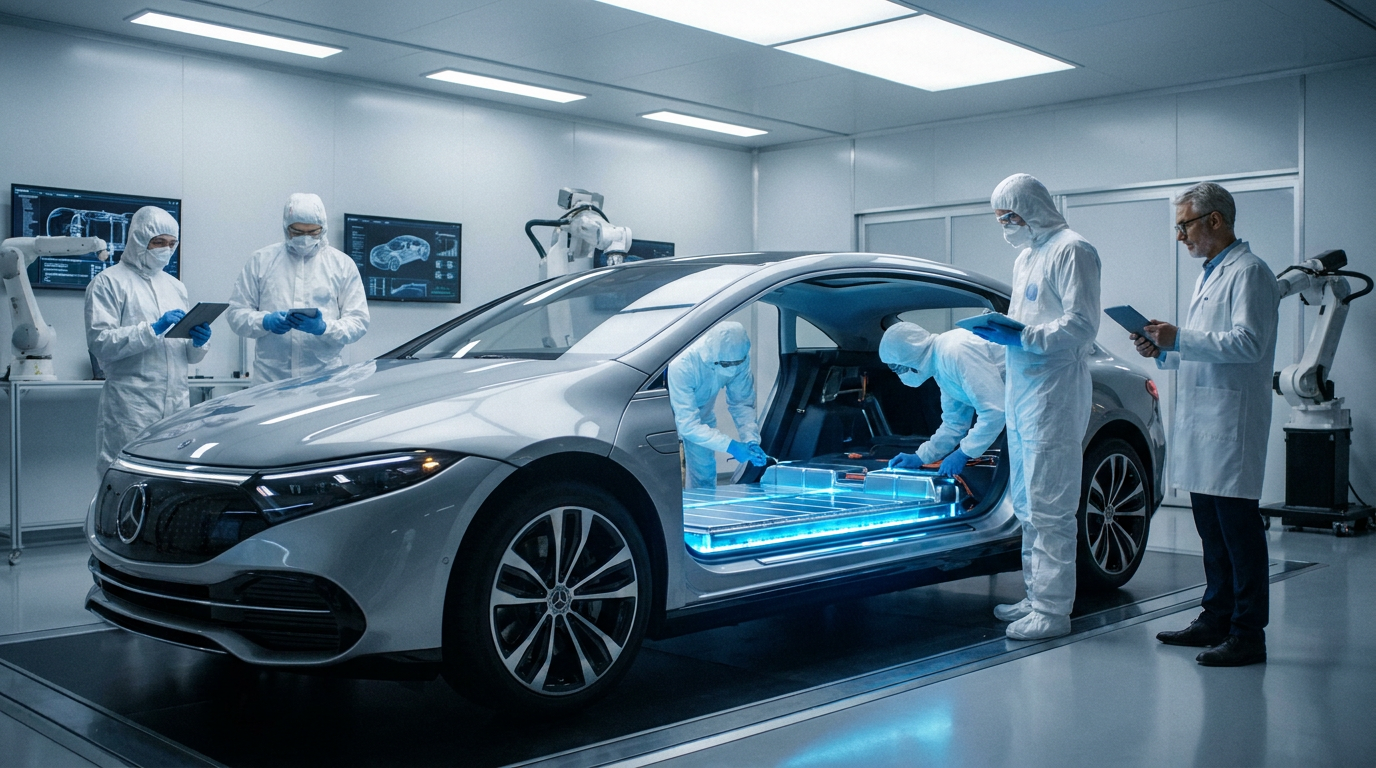
Despite the undeniable breakthroughs, the transition will not be instantaneous. The primary headwind facing solid-state batteries in 2026 is manufacturing cost. Building a solid-state cell requires entirely new production lines, specialized ultra-dry clean rooms, and complex manufacturing techniques that have not yet achieved the economies of scale enjoyed by liquid lithium-ion factories. As a result, the first solid-state batteries will carry a significant premium, limiting their initial reach.[1][3]
Because of this cost premium, industry analysts expect a bifurcated market for the remainder of the decade. Solid-state batteries will initially be reserved for flagship luxury vehicles, high-performance sports cars, and commercial fleets where maximum range and rapid turnaround times justify the higher price tag. For the mass market, highly optimized, low-cost liquid chemistries—particularly lithium iron phosphate (LFP)—will remain the dominant standard for everyday commuter vehicles.[1][3]
Interestingly, as solid-state technology pushes the ceiling of EV performance, another chemistry is raising the floor. Sodium-ion batteries, which use cheap, abundant salt instead of expensive lithium, are also entering mass production in 2026. While sodium-ion cells have lower energy density and cannot compete with solid-state for range, they are vastly cheaper and rely on a more secure supply chain. Automakers like General Motors are already pivoting to sodium-ion for stationary energy storage, freeing up premium lithium resources for advanced EV applications.[2][5][6]

The simultaneous maturation of solid-state and sodium-ion technologies marks the end of the "one size fits all" era for batteries. The industry is moving toward a diversified ecosystem where the chemistry is tailored specifically to the use case. Premium long-haul vehicles will utilize solid-state, mass-market cars will rely on LFP, and grid storage will lean heavily on sodium-ion. This diversification makes the entire energy transition more resilient to supply chain shocks.[1][2]
The environmental impact of solid-state batteries also presents a complex picture that the industry is just beginning to navigate. On one hand, their extended lifespan—capable of enduring thousands of charge cycles with minimal degradation—means fewer battery replacements over the life of a vehicle. On the other hand, the reliance on pure lithium metal and advanced sulfide or ceramic materials requires energy-intensive refining processes. Recycling frameworks for solid-state architectures are still in their infancy, prompting researchers to urge the industry to design for circularity before millions of these packs hit the road.[1][2]
Ultimately, 2026 will be remembered as the inflection point. The transition from liquid to solid electrolytes is akin to the computing industry's shift from vacuum tubes to solid-state transistors—a foundational upgrade that redefines what the hardware can achieve. While it will take years for the technology to trickle down to affordable commuter cars, the proof of concept is now rolling off assembly lines. The electric vehicle has officially entered its next era, and the limits of battery performance have been permanently redrawn.[1][5]
How we got here
2010s
Solid-state batteries remain largely confined to university laboratories and small-scale prototypes, plagued by low cycle life and manufacturing hurdles.
2020–2024
Billions of dollars in venture capital and automotive investment flow into solid-state startups, yielding significant breakthroughs in dendrite suppression and ceramic electrolytes.
January 2026
Donut Lab unveils the world's first production-ready solid-state battery at CES, powering the 2026 Verge electric motorcycle.
April 2026
Greater Bay Technology (GBT) announces its A-sample all-solid-state cells have rolled off the production line, targeting gigawatt-hour mass production.
June 2026
Dongfeng Motor and Chery Automobile confirm trial installations and mass production targets for solid-state EVs boasting ranges over 600 miles.
Viewpoints in depth
Battery Innovators' View
Solid-state technology is the definitive solution to EV limitations and is ready to scale.
For the engineers and startups driving this transition, the liquid-electrolyte era is effectively over. They point to the successful deployment of A-sample cells and the elimination of thermal runaway as proof that solid-state architectures are no longer theoretical. By suppressing dendrite growth and unlocking pure lithium metal anodes, these innovators argue they have solved the fundamental chemistry problem. Their current focus is entirely on scaling gigawatt-hour production lines and proving that the manufacturing yields can meet the aggressive timelines set by global automakers.
Industry Analysts' View
Cost and manufacturing complexity will delay mass-market adoption despite technical success.
Market analysts acknowledge the technical breakthroughs but remain cautious about the economic realities. Building a solid-state battery requires entirely new manufacturing infrastructure, including ultra-dry clean rooms and high-pressure assembly techniques. Analysts argue that these capital-intensive requirements will keep solid-state cells at a steep price premium for years. Consequently, they predict a bifurcated market where solid-state batteries serve as a luxury differentiator for high-end vehicles, while highly optimized, low-cost lithium iron phosphate (LFP) batteries continue to power the vast majority of consumer EVs.
Supply Chain Strategists' View
The EV transition requires a diversified battery ecosystem, not just a single "holy grail."
Resource economists and grid strategists view the solid-state breakthrough as just one piece of a larger puzzle. They warn that relying exclusively on high-performance, lithium-heavy solid-state batteries could strain global supply chains and exacerbate geopolitical tensions over critical minerals. Instead, they advocate for a multi-chemistry approach. By deploying cheap, abundant sodium-ion batteries for stationary grid storage and short-range urban vehicles, the industry can reserve premium solid-state technology for applications that genuinely require maximum energy density, ensuring a more resilient global energy transition.
What we don't know
- How quickly manufacturing costs will fall to make solid-state batteries viable for entry-level commuter cars.
- Whether the global supply chain can sustainably scale the production of pure lithium metal required for these anodes.
- How effectively these new solid-state architectures can be recycled at the end of their lifecycle.
Key terms
- Solid-State Battery
- A type of battery that uses a solid electrolyte—such as ceramics or polymers—instead of a liquid to transport ions between the anode and cathode.
- Electrolyte
- The medium inside a battery that allows electrical charge (ions) to flow between the positive and negative terminals.
- Energy Density
- A measure of how much energy a battery can store relative to its weight, typically expressed in watt-hours per kilogram (Wh/kg).
- Thermal Runaway
- A dangerous, unstoppable chain reaction inside a battery where excess heat causes further heating, often resulting in a fire or explosion.
- Dendrites
- Microscopic, needle-like metallic structures that can grow inside a battery over time, potentially piercing internal barriers and causing short circuits.
- Lithium Iron Phosphate (LFP)
- A popular, low-cost, and durable liquid-electrolyte battery chemistry that currently dominates the mass-market EV sector.
Frequently asked
What is a solid-state battery?
It is a battery that replaces the flammable liquid electrolyte found in traditional lithium-ion cells with a stable solid material, allowing for higher energy density and improved safety.
How much farther can an EV drive with a solid-state battery?
Early 2026 production models are targeting ranges of 600 to over 900 miles on a single charge, roughly double the capacity of current standard EVs.
Do solid-state batteries charge faster?
Yes. Because they generate less heat and resist degradation under stress, solid-state batteries are designed to reach an 80 percent charge in just five to ten minutes.
Will solid-state batteries be affordable?
Not initially. Due to complex manufacturing requirements, the first wave of solid-state batteries will be expensive and likely reserved for luxury and high-performance vehicles.
Are solid-state batteries safer in a crash?
Yes. By eliminating the volatile liquid electrolyte, solid-state cells virtually eliminate the risk of thermal runaway and battery fires, even if the cell is punctured or crushed.
Sources
Source coverage
8 outlets
3 viewpoints surfaced








[1]Factlen Editorial TeamSupply Chain Strategists
Synthesis by Factlen editorial team
Read on Factlen Editorial Team →[2]International Energy AgencySupply Chain Strategists
Could sodium-ion batteries ease the EV industry's battery supply challenge?
Read on International Energy Agency →[3]ElectrekAutomotive Industry Analysts
Solid-state EV batteries are coming sooner than expected after another breakthrough
Read on Electrek →[4]GSMArenaAutomotive Industry Analysts
Dongfeng targets late 2026 for mass production of long-range solid-state batteries
Read on GSMArena →[5]Car and DriverSupply Chain Strategists
GM to Develop Sodium-Ion Battery Cells—for Energy Storage, Not EVs
Read on Car and Driver →[6]The Washington PostSupply Chain Strategists
Battery breakthroughs will lessen AI's demand on the electricity grid
Read on The Washington Post →[7]Greater Bay Technology (GBT)Battery Innovators
GBT Achieves A-Sample All-Solid-State Battery Milestone
Read on Greater Bay Technology (GBT) →[8]Donut LabBattery Innovators
Donut Lab Introduces the Future of Electrification at CES
Read on Donut Lab →

Every angle. Every day.
Get technology stories with full source coverage and perspective breakdowns delivered to your inbox.