
The Science of the Maillard Reaction: How Heat Transforms Flavor in Home Cooking
The Maillard reaction is the chemical process responsible for the deep flavors and brown crusts of roasted, seared, and baked foods. Understanding its temperature and moisture thresholds can fundamentally elevate everyday home cooking.
By Factlen Editorial Team
- Culinary Scientists
- Focus on mapping the chemical pathways and molecular structures that generate specific flavor compounds.
- Professional Chefs
- Focus on practical techniques to manipulate heat and moisture to maximize browning in the kitchen.
- Health & Nutrition Researchers
- Focus on the dietary implications of high-heat cooking, including the formation of acrylamide and antioxidants.
What's not represented
- · Home appliance manufacturers
- · Industrial food flavorists
Why this matters
Mastering the Maillard reaction is the single most effective way to transition from following recipes blindly to cooking with intuition. By controlling heat and moisture, home cooks can unlock restaurant-quality depth, aroma, and texture in their everyday meals.
Key points
- The Maillard reaction is a chemical process between amino acids and reducing sugars that creates hundreds of savory flavor compounds.
- The reaction requires temperatures between 285°F and 330°F (140°C to 165°C) to proceed rapidly.
- Surface moisture prevents browning because water evaporates at 212°F (100°C), capping the food's temperature below the Maillard threshold.
- Different combinations of proteins and sugars produce entirely different flavor profiles, explaining why roasted coffee and seared steak taste distinct.
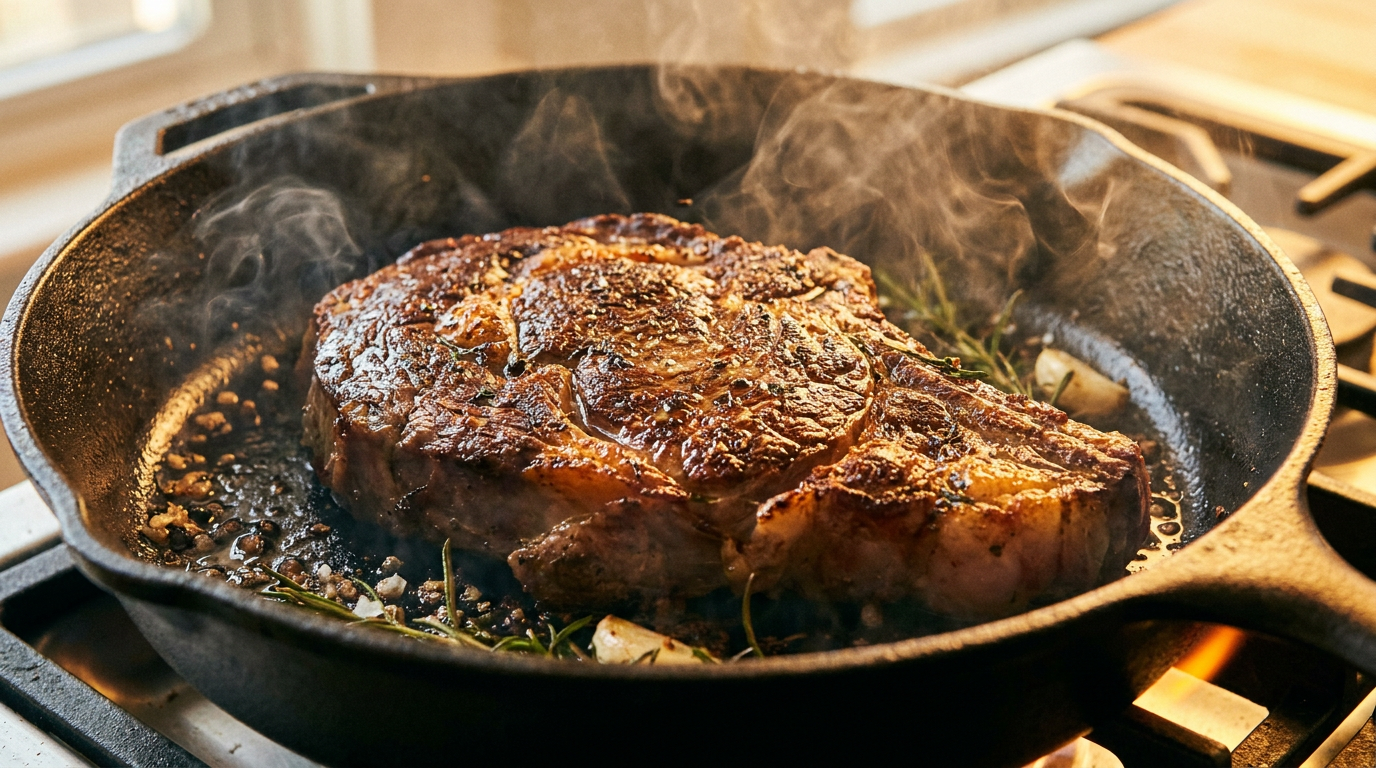
The sizzle of a steak hitting a hot cast-iron skillet, the golden crust of a freshly baked artisan loaf, and the intoxicating aroma of roasted coffee beans all share a singular, unifying secret. They are the delicious results of the Maillard reaction, a chemical cascade that transforms raw ingredients into complex, deeply flavorful foods. For generations, home cooks have relied on intuition to achieve these results, often simply referring to the process as "browning." However, understanding the precise mechanics behind this transformation is the key to unlocking restaurant-quality depth and aroma in everyday meals.[7]
While colloquially known as the browning reaction, culinary scientists argue that this label drastically undersells its importance. In professional kitchens and food laboratories, it is more accurately described as the "flavor reaction." The visual cue of a browned crust is merely the byproduct of a microscopic structural shift that generates hundreds of new, highly potent aromatic compounds. These molecules are responsible for the characteristic smells of roasting, baking, and frying that signal to the human brain that food is savory, safe, and ready to eat.[1]
The phenomenon is named after Louis-Camille Maillard, a French chemist who first described the process in 1912. Maillard was not actually studying cooking at the time; he was attempting to reproduce biological protein synthesis in a laboratory setting. During his experiments, he observed that heating sugars and amino acids together resulted in a distinct brown color and a rich, savory smell. It took several more decades for the scientific community to fully map the staggering complexity of the pathways Maillard had inadvertently stumbled upon.[2][4]
At its core, the Maillard reaction is a form of non-enzymatic browning that occurs when heat is applied to a mixture of amino acids—the building blocks of proteins—and reducing sugars, such as glucose or fructose. When the temperature of the food rises sufficiently, the reactive carbonyl group of the sugar binds with the nucleophilic amino group of the amino acid. This initial collision is the spark that ignites a sprawling chain reaction, fundamentally altering the chemical architecture of the food's surface.[2][6]

Once that initial bond is formed, the resulting unstable chemical, known as a glycosylamine, rapidly rearranges itself into a ketosamine. This intermediate stage acts as a biochemical crossroads, setting off a cascade of further reactions that produce a dizzying array of new substances. Depending on the specific proteins and sugars involved, the reaction spawns pyrazines that deliver toasted notes, furans that taste meaty, and sweet furanones. These volatile compounds are produced in minute quantities, but their impact on the human olfactory system is immense.[4][6]
As the cascade reaches its final stages, the smaller flavor compounds begin to link together, forming large, complex polymer molecules called melanoidins. These melanoidins are the dark pigments that give seared meats, roasted vegetables, and crusty breads their signature brown color. They also contribute to the physical texture of the food, providing the satisfying crunch of a bread crust or the firm, structured exterior of a perfectly grilled burger.[2][4]
The most critical factor in triggering the Maillard reaction is temperature. The chemical process proceeds at a sluggish, nearly imperceptible pace at room temperature, but it accelerates rapidly when the surface of the food reaches between 285 and 330 degrees Fahrenheit (140 to 165 degrees Celsius). This specific thermal window is the sweet spot for flavor development. If the cooking environment is too cool, the reaction stalls; if it is too hot, the food bypasses flavor development and moves directly into burning.[2][3]
The most critical factor in triggering the Maillard reaction is temperature.
This temperature threshold highlights the greatest enemy of the Maillard reaction: moisture. Water boils and evaporates at 212 degrees Fahrenheit (100 degrees Celsius). As long as there is liquid water present on the surface of a piece of food, the thermal energy from the pan or oven is entirely consumed by the process of evaporation. Consequently, the surface temperature of the food cannot rise above the boiling point of water, falling well short of the 285-degree minimum required for significant browning.[5]

This thermodynamic reality explains why boiling, steaming, or poaching will never produce a browned crust or roasted flavor profile. It also underscores the single most important technique in savory cooking: thoroughly drying the surface of proteins before they hit the pan. Patting a steak dry with paper towels removes surface moisture, allowing the meat's exterior to immediately surpass the boiling point and enter the Maillard zone, rather than steaming in its own juices.[1][5]
Home cooks frequently confuse the Maillard reaction with caramelization, but the two are distinct chemical processes. Caramelization involves the pyrolysis, or thermal decomposition, of sugars in the absence of proteins. It produces sweet, nutty, and slightly bitter flavors, and typically requires higher temperatures—often starting around 338 degrees Fahrenheit (170 degrees Celsius) for common table sugar. While both reactions produce a brown color and can occur simultaneously in sugar-rich, protein-containing foods, the Maillard reaction is uniquely responsible for savory, meaty, and roasted profiles.[2]
The sheer diversity of flavors produced by the Maillard reaction is due to the infinite combinations of amino acids and sugars found in different foods. The specific amino acids present in a cut of beef are vastly different from those in a coffee bean or a ball of dough. When heat is applied, each unique combination spawns its own distinct set of aromatic compounds. This is why a seared steak, a toasted marshmallow, and a dark stout beer are all products of the exact same chemical mechanism, yet taste and smell entirely different.[5]
While dry heat is the traditional catalyst, modern culinary science has found ways to manipulate the reaction in wet environments. Pressure cookers, for example, trap steam and raise the internal pressure of the vessel, which in turn raises the boiling point of water well above 212 degrees Fahrenheit. At these elevated temperatures, Maillard browning can actually occur in liquids, allowing chefs to produce deeply caramelized, complex soups and stocks in a fraction of the time it would take on a stovetop.[1]

The reaction can also be accelerated by altering the pH of the cooking environment. The Maillard process thrives in alkaline conditions because the amino groups are deprotonated, making them more reactive. Adding a small pinch of baking soda to onions as they cook, or boiling pretzels in an alkaline lye bath before baking, dramatically speeds up the browning process and intensifies the resulting flavors.[1][2]
However, the pursuit of browning requires careful monitoring, as pushing the temperature too high leads to diminishing returns. When surface temperatures exceed 355 degrees Fahrenheit (180 degrees Celsius), a different chemical process called pyrolysis takes over. Pyrolysis is the final breakdown of the molecules, leading to burning, charring, and the development of acrid, bitter flavors that can easily ruin a dish.[1][3]
Beyond flavor, the Maillard reaction also has nutritional and health implications. At very high temperatures, the reaction between reducing sugars and the amino acid asparagine can produce acrylamide, a compound classified as a probable human carcinogen. This byproduct is most commonly found in starchy foods cooked at high heat, such as french fries and toasted bread. While health agencies monitor acrylamide levels in the food supply, researchers note that the Maillard reaction simultaneously produces beneficial antioxidant compounds.[2][6]
Ultimately, mastering the Maillard reaction is the dividing line between merely following a recipe and truly understanding the craft of cooking. By controlling heat, managing moisture, and recognizing the visual and aromatic cues of chemical transformation, home cooks can harness this culinary superpower. It is a daily, edible reminder that the kitchen is a laboratory, and that a basic grasp of science can make every meal exponentially more delicious.[7]
How we got here
1912
French chemist Louis-Camille Maillard first describes the reaction between amino acids and sugars.
1953
Chemist John E. Hodge publishes the definitive mechanism of the reaction, mapping its complex pathways.
2002
Researchers discover that acrylamide, a probable carcinogen, can form during high-heat Maillard reactions in starchy foods.
Viewpoints in depth
Culinary Scientists
Focus on mapping the chemical pathways and molecular structures that generate specific flavor compounds.
For food scientists and chemists, the Maillard reaction is a sprawling, microscopic puzzle. They focus on isolating the specific volatile compounds—like pyrazines, furans, and thiophenes—that are produced when different amino acids and sugars collide. By mapping these pathways, scientists can understand exactly why a baked potato tastes different from a roasted coffee bean, and they use this data to develop artificial flavors for the commercial food industry.
Professional Chefs
Focus on practical techniques to manipulate heat and moisture to maximize browning in the kitchen.
In the professional kitchen, the Maillard reaction is a tool to be wielded. Chefs are less concerned with the molecular nomenclature and more focused on environmental control: maintaining ripping-hot cast iron, thoroughly drying proteins, and utilizing alkaline ingredients like baking soda to accelerate browning. For this camp, mastering the reaction is about consistency, ensuring that every dish leaving the pass has the maximum possible depth of flavor and structural texture.
Health & Nutrition Researchers
Focus on the dietary implications of high-heat cooking, including the formation of acrylamide and antioxidants.
Nutritionists and public health officials view the Maillard reaction through a lens of dietary safety. While acknowledging that the process creates beneficial antioxidant compounds, they also monitor the formation of acrylamide—a probable carcinogen that develops when starchy foods are subjected to high heat. This perspective advocates for moderation, encouraging cooks to aim for a golden-brown color rather than a dark char to minimize potential health risks.
What we don't know
- Scientists are still mapping the complete catalog of the hundreds of volatile flavor compounds generated during the later stages of the reaction.
- The exact long-term health impacts of consuming high levels of Maillard byproducts like acrylamide remain a subject of ongoing nutritional study.
Key terms
- Maillard reaction
- A chemical reaction between amino acids and reducing sugars that gives browned food its distinctive flavor.
- Amino acids
- Organic compounds that serve as the building blocks of proteins, crucial for initiating the browning process.
- Reducing sugars
- Simple sugars, such as glucose and fructose, that act as the chemical partner to amino acids in the reaction.
- Melanoidins
- Large, complex polymer molecules formed at the end of the Maillard reaction that give food a brown color.
- Pyrolysis
- The thermal decomposition of food at extremely high temperatures, resulting in burning and bitter flavors.
- Caramelization
- The browning of pure sugars under high heat, a distinct process from the protein-dependent Maillard reaction.
Frequently asked
Why doesn't boiled meat turn brown?
Water boils at 212°F (100°C), which prevents the meat's surface from reaching the 285°F (140°C) threshold required for the Maillard reaction.
Is caramelization the same as the Maillard reaction?
No. Caramelization involves only the breakdown of sugars, while the Maillard reaction requires both sugars and proteins (amino acids).
Why should I pat my steak dry before cooking?
Removing surface moisture allows the meat to immediately heat past the boiling point of water, triggering the browning reaction faster and preventing the meat from steaming.
Can the Maillard reaction happen in liquids?
Yes, but typically only in a pressure cooker, which raises the boiling point of water high enough to reach Maillard temperatures.
Sources
Source coverage
7 outlets
3 viewpoints surfaced







[1]Modernist CuisineCulinary Scientists
The Maillard Reaction: A Culinary Superpower
Read on Modernist Cuisine →[2]WikipediaHealth & Nutrition Researchers
Maillard reaction
Read on Wikipedia →[3]WebstaurantStoreProfessional Chefs
What is the Maillard Reaction?
Read on WebstaurantStore →[4]Science FocusCulinary Scientists
How does the Maillard reaction work?
Read on Science Focus →[5]A Matter of NourishmentCulinary Scientists
The Science of Heat and Flavor
Read on A Matter of Nourishment →[6]National Institutes of HealthHealth & Nutrition Researchers
The Maillard Reaction in Food Chemistry
Read on National Institutes of Health →[7]Factlen Editorial TeamProfessional Chefs
Synthesis by Factlen editorial team
Read on Factlen Editorial Team →
Every angle. Every day.
Get food drink stories with full source coverage and perspective breakdowns delivered to your inbox.