
SpaceX Raises Record $85.7 Billion in Historic IPO, Reaching $2.1 Trillion Valuation
Following a massive greenshoe overallotment, SpaceX's public debut shattered global records, cementing the vertically integrated space and AI conglomerate as the sixth most valuable U.S. company.
By Factlen Editorial Team
- Growth Investors
- This camp focuses on the massive addressable market of space and AI, willing to pay a premium for Elon Musk's track record.
- Space Economy Analysts
- This camp views the historic capital raise as a permanent validation of the commercial space sector.
- Value Skeptics
- This camp warns that the $2.1 trillion valuation is priced for absolute perfection and ignores significant capital burn.
What's not represented
- · Traditional Aerospace Competitors
- · Index Fund Managers
Why this matters
This historic capital raise proves that public markets are willing to fund the staggering infrastructure costs of the AI and commercial space eras. For investors, the inevitable inclusion of SpaceX in major indices means that nearly every retirement account will soon have direct exposure to the orbital economy.
Key points
- SpaceX raised a record $85.7 billion after underwriters exercised their greenshoe option.
- The stock closed its first day of trading up 19%, giving the company a $2.1 trillion valuation.
- The public entity is a conglomerate that includes SpaceX, Starlink, xAI, and X.
- The massive valuation officially made CEO Elon Musk the world's first trillionaire.
- The capital raise proves public markets are willing to fund massive AI and space infrastructure.
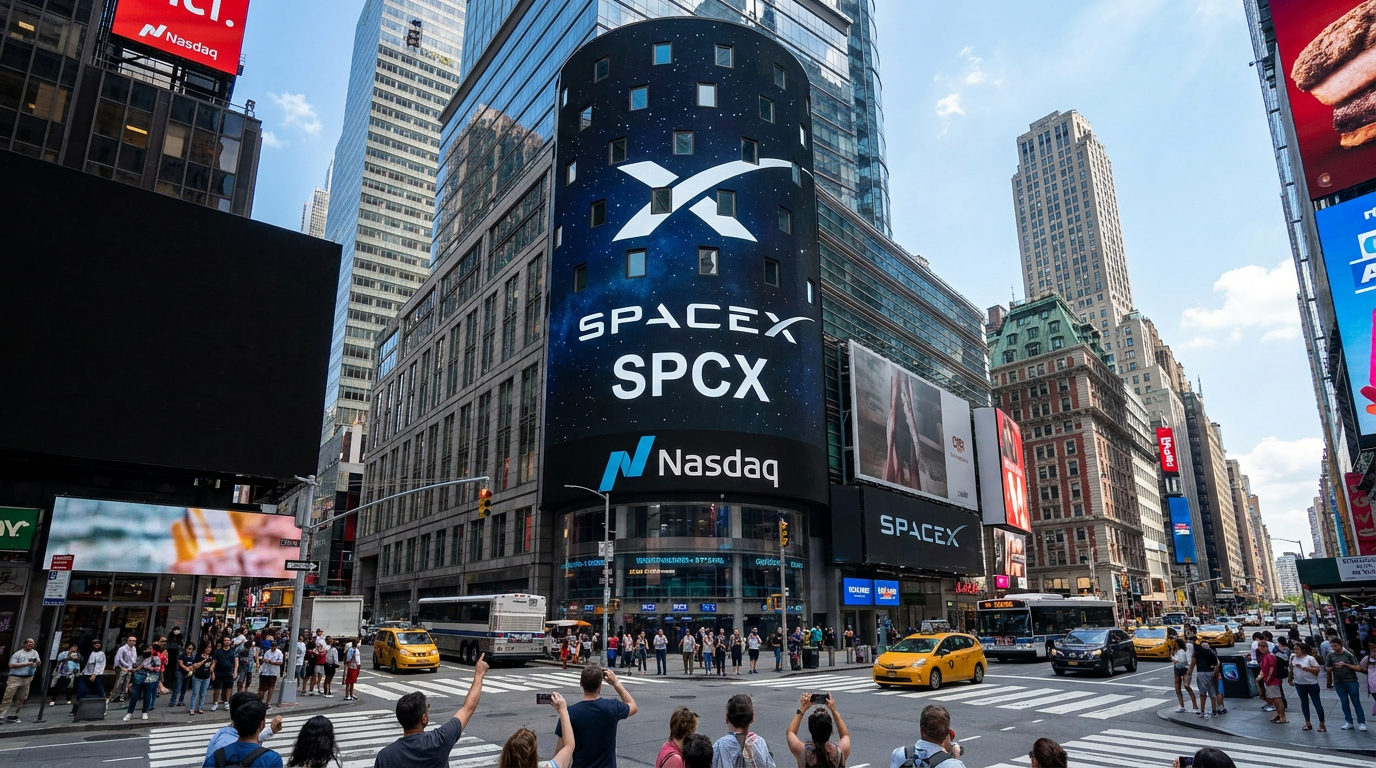
The most anticipated public market debut of the decade has officially rewritten the record books. On June 12, 2026, Space Exploration Technologies Corp. began trading on the Nasdaq under the ticker symbol SPCX, instantly achieving a market capitalization of $2.1 trillion. The debut catapulted the aerospace manufacturer into the ranks of the six most valuable companies in the United States, placing it ahead of legacy tech giants and fundamentally reshaping the public equity landscape.[2][4]
While the initial offering was already historic, the sheer scale of investor appetite pushed the capital raise even higher in the days following the debut. Underwriters for the offering fully exercised their "greenshoe" option, purchasing an additional 83.3 million shares at the fixed IPO price of $135. This overallotment maneuver injected another $10.7 billion into the company's coffers, bringing the total proceeds of the public offering to an unprecedented $85.7 billion.[1]
To contextualize that figure, SpaceX has now raised nearly three times the capital of the previous global record holder. In 2019, Saudi Arabia's state-owned oil giant, Saudi Aramco, raised $29.4 billion in its public debut. By eclipsing that mark so thoroughly, SpaceX has demonstrated that the gravitational pull of artificial intelligence and commercial space infrastructure can command sovereign-wealth levels of capital from the public markets.[1][7]

Crucially, the entity that listed on the Nasdaq is not merely a rocket manufacturer. In a massive corporate consolidation earlier in 2026, SpaceX absorbed xAI—Elon Musk’s artificial intelligence startup—as well as the social media platform X. Investors buying SPCX shares are acquiring a vertically integrated conglomerate that spans orbital launch logistics, global satellite broadband, frontier AI foundation models, and a major digital advertising network.[3][7]
The strategic rationale for this mega-merger hinges on infrastructure synergies. SpaceX requires advanced artificial intelligence to manage Starlink’s autonomous satellite coordination and to develop the self-navigating systems necessary for future Mars missions. Conversely, xAI requires massive, globally distributed compute infrastructure to train its next-generation models—a physical footprint that Starlink’s constellation is uniquely positioned to support.[7]
Financially, the combined company enters the public sphere with accelerating momentum. Total revenue reached approximately $18.6 billion in 2025, representing a 40% year-over-year growth rate. While the core launch business provides a steady foundation, the high-margin Starlink broadband service has evolved into the dominant driver of the company's financial performance, subsidizing the capital-intensive research required for the Starship program.[3][5]

Financially, the combined company enters the public sphere with accelerating momentum.
The mechanics of the trading debut reflected overwhelming demand. After pricing at $135 per share, SPCX opened trading late Friday morning at $150. The stock climbed steadily throughout the session, completely avoiding the technical glitches that marred high-profile debuts of the past, and closed its first day at $160.95. More than 510 million shares changed hands, representing roughly $84 billion in trading volume in a single session.[2][4]
Market analysts characterized the 19% first-day jump as a "Goldilocks" debut. A flat or negative performance would have signaled that the $1.77 trillion initial valuation was pure hype, while a massive 50% or 100% pop would have indicated that the company left tens of billions of dollars on the table by underpricing the shares. The steady, double-digit gain provided early investors with a healthy return while validating the underwriters' pricing strategy.[1][6]
The soaring valuation also triggered a historic milestone in personal wealth. With his 42% equity stake in the newly public conglomerate, Elon Musk officially became the world’s first trillionaire, with his net worth estimated at $1.1 trillion at the close of trading. This concentration of wealth underscores the immense premium that public markets are currently placing on visionary founders operating at the intersection of AI and hard tech.[2]

Institutional conviction played a major role in stabilizing the massive float. BlackRock reportedly placed a $5 billion anchor order, while retail investors—driven by brand loyalty and the cultural phenomenon of the space race—requested more than $100 billion in shares before the books closed. This retail allocation, which was significantly higher than typical tech IPOs, ensured a deep pool of buyers ready to support the stock on the open market.[3][7]
From a macroeconomic perspective, the SpaceX IPO signals a shift in the artificial intelligence boom from a product cycle to a capital cycle. Building the physical infrastructure for the next decade of AI requires balance-sheet events of staggering proportions. By successfully raising $85.7 billion, SpaceX has proven that public markets are willing to fund these massive capital expenditures, paving the way for anticipated mega-listings from AI competitors like Anthropic and OpenAI.[7]
Despite the euphoria, the valuation leaves little room for execution errors. At $2.1 trillion, SpaceX is trading at nearly 100 times its 2025 revenue—a multiple that dwarfs even the most richly valued software companies. Skeptics note that the company's aggressive expansion into AI consumed $6.4 billion in capital expenditures last year, and the ongoing development of the Starship rocket continues to generate substantial operating losses.[3][5]

The sheer gravity of the SPCX listing also created a temporary vacuum in the broader space economy. Shares of smaller publicly traded space companies experienced mid-single-digit pullbacks on Friday, as institutional portfolio managers reallocated capital to ensure they had sufficient exposure to the new undisputed heavyweight of the sector.[7]
Looking ahead, the stock's trajectory will be heavily influenced by passive flows. Given its massive market capitalization, SpaceX is on an accelerated path for inclusion in the Nasdaq-100 and eventually the S&P 500. As index funds are forced to purchase shares to match their benchmarks, the company's $85.7 billion war chest will be put to work, funding a future where artificial intelligence and interplanetary infrastructure are inextricably linked.[4][7]
How we got here
February 2026
SpaceX completes a mega-merger, absorbing xAI and the social platform X into a single corporate entity.
April 2026
The company confidentially files its draft S-1 registration statement with the SEC.
June 11, 2026
SpaceX prices its initial public offering at $135 per share, officially raising $75 billion.
June 12, 2026
Shares debut on the Nasdaq under the ticker SPCX, closing up 19% and pushing the valuation past $2.1 trillion.
June 15, 2026
Underwriters fully exercise their greenshoe option, adding $10.7 billion to bring the total capital raised to $85.7 billion.
Viewpoints in depth
Growth Investors
This camp argues that traditional valuation metrics fail to capture the potential of a vertically integrated space and AI monopoly.
Proponents point to the $28.5 trillion total addressable market claimed in the company's prospectus. They argue that by combining Starlink's global data network with xAI's compute capabilities, SpaceX is building an unassailable infrastructure moat. For these investors, the 100x revenue multiple is a necessary premium to access the only company capable of dominating both the orbital economy and the next generation of artificial intelligence.
Value Skeptics
This camp warns that the $2.1 trillion valuation is priced for absolute perfection and ignores significant capital burn.
Skeptics highlight the immense capital expenditures required to sustain both the Starship program and the xAI buildout. With $6.4 billion spent on AI infrastructure alone in the past year, they argue the company will need flawless execution to justify its market cap. Furthermore, analysts express concern over the governance structure, noting that public shareholders have virtually no voting power to check management decisions.
Space Economy Analysts
This camp views the historic capital raise as a permanent validation of the commercial space sector.
Industry watchers argue that raising $85.7 billion proves the space economy is no longer a niche venture capital play, but a core pillar of global infrastructure. While the IPO temporarily drew liquidity away from smaller space stocks, analysts believe SpaceX's eventual inclusion in major indices will permanently elevate the baseline valuation of the entire aerospace sector, forcing institutional capital to take orbital logistics seriously.
What we don't know
- Whether the company can achieve the unprecedented revenue growth required to justify its 100x multiple.
- How quickly SpaceX will be added to major indices like the S&P 500.
- The exact timeline for Starship to achieve full commercial reusability and profitability.
Key terms
- Greenshoe Option
- A provision that allows underwriters to sell more shares than originally planned if public demand is exceptionally high, helping to stabilize the stock price.
- Market Capitalization
- The total value of a publicly traded company's outstanding shares, calculated by multiplying the current share price by the total number of shares.
- Addressable Market
- The total revenue opportunity available for a product or service if it achieves 100% market share in its sector.
- Capital Expenditure (CapEx)
- Funds used by a company to acquire, upgrade, and maintain physical assets such as servers, rockets, or industrial facilities.
- Float
- The regular shares a company has issued to the public that are available for investors to trade, excluding restricted shares held by insiders.
Frequently asked
What exactly went public in the SpaceX IPO?
The public entity includes SpaceX's core rocket and Starlink businesses, plus xAI and X (Twitter), which were merged into the company earlier in 2026.
How much money did the IPO raise?
With the underwriters fully exercising their greenshoe option, the IPO raised a record-shattering $85.7 billion, more than double the previous global record.
Did Elon Musk become a trillionaire?
Yes. The debut pushed SpaceX's valuation above $2.1 trillion, elevating Musk's personal net worth to an estimated $1.1 trillion.
Why did the company merge with xAI?
SpaceX requires advanced AI for autonomous satellite coordination, while xAI needs the massive, globally distributed compute infrastructure that Starlink can provide.
Sources
Source coverage
7 outlets
3 viewpoints surfaced







[1]MarketWatchGrowth Investors
SpaceX’s stock jumps as the company reveals its IPO has raised another $10.7 billion
Read on MarketWatch →[2]ReutersSpace Economy Analysts
SpaceX surges past $2 trillion in Nasdaq debut, closes in on Amazon
Read on Reuters →[3]U.S. Securities and Exchange Commission
Form S-1 Registration Statement: Space Exploration Technologies Corp.
Read on U.S. Securities and Exchange Commission →[4]Nasdaq
SPCX Initial Public Offering and Market Debut Data
Read on Nasdaq →[5]Morningstar ResearchValue Skeptics
SpaceX SPCX Valuation and Moat Rating Analysis
Read on Morningstar Research →[6]Renaissance CapitalGrowth Investors
2026 Global IPO Market Review and SpaceX Greenshoe Analysis
Read on Renaissance Capital →[7]Factlen Editorial TeamSpace Economy Analysts
Synthesis by Factlen editorial team
Read on Factlen Editorial Team →



Every angle. Every day.
Get finance stories with full source coverage and perspective breakdowns delivered to your inbox.