
Fact-Checking the Impact of Universal Free School Meals on Student Success
As more states adopt universal free school lunch programs, a review of recent economic and pediatric data reveals strong evidence for improved attendance and math scores, though impacts on childhood obesity remain inconclusive.
By Factlen Editorial Team
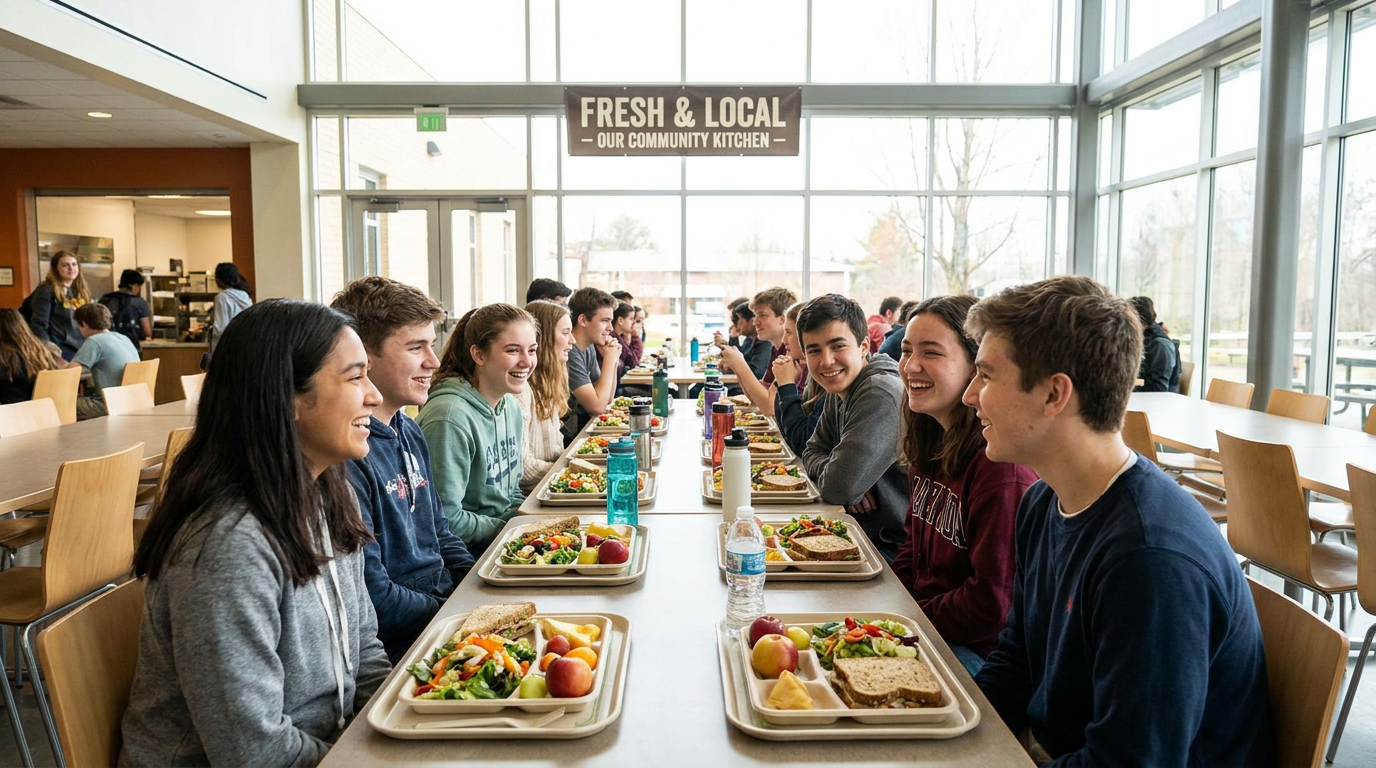
- Education Economists
- Focuses on measurable returns on investment, such as test scores, attendance rates, and administrative efficiency.
- Public Health & Equity Advocates
- Prioritizes baseline nutrition, the elimination of social stigma, and overall childhood food security.
- Federal Policy Administrators
- Analyzes program costs, nationwide participation rates, and the logistics of implementation.
- Factlen Synthesis
- Weighs the evidence across disciplines to provide a neutral assessment of policy claims.
What's not represented
- · Private school administrators
- · Commercial school food vendors
Why this matters
As more states debate funding universal school meals, understanding the actual data on test scores, behavior, and health allows voters and parents to evaluate whether the policy is a worthwhile investment of tax dollars.
Key points
- Universal free school meals lead to statistically significant improvements in math scores.
- Schools implementing the policy see an 11% average reduction in student suspensions.
- Removing income requirements eliminates the 'lunch stigma' that previously caused students to skip meals.
- Evidence regarding the policy's impact on childhood obesity remains mixed and inconclusive.
- Universal programs save districts money by eliminating the administrative burden of processing eligibility forms and chasing lunch debt.
Over the last few years, a quiet revolution has transformed American public education: the transition toward universal free school meals. What began as a temporary pandemic-era emergency measure has now been codified into permanent law in multiple states, fundamentally shifting how schools approach student nutrition.[6]
Advocates argue that food is essential school infrastructure, no different from textbooks, Wi-Fi, or heating. Critics, however, question the fiscal wisdom of subsidizing meals for affluent families who can afford to pack a lunch, arguing that state funds should be strictly targeted toward the most vulnerable.[3]
To separate political rhetoric from measurable outcomes, we reviewed the accumulated data from economists, pediatricians, and federal agencies. The evidence presents a nuanced but largely positive picture of what happens when schools feed everyone without asking for proof of income.[1]
The first major claim we evaluated is that universal meals boost academic performance. The evidence here is surprisingly robust, particularly in quantitative subjects.[2]

According to research published by the National Bureau of Economic Research, schools that implement universal free meals see a measurable, statistically significant increase in standardized test scores across the student body.[2]
Interestingly, the academic boost is not distributed evenly across all subjects. Math scores consistently show a higher degree of improvement—typically a +0.03 to +0.08 standard deviation boost—compared to reading scores.[2]
Education economists hypothesize that mathematics requires a type of sustained, intensive cognitive focus that is highly sensitive to blood sugar levels and short-term nutritional deficits. When a student is hungry, their ability to process complex equations degrades much faster than their reading comprehension.[3]

The second major claim is that universal meals improve student behavior and attendance. The data supporting this claim is classified as strong by multiple academic reviews.[7]
A comprehensive study published in the Journal of Public Economics found that schools adopting universal meals experienced an 11% reduction in suspension rates.[7]
A comprehensive study published in the Journal of Public Economics found that schools adopting universal meals experienced an 11% reduction in suspension rates.
Teachers frequently report fewer classroom disruptions in the hours immediately following lunch. The mechanism is straightforward: reducing "hanger" (hunger-induced anger) directly translates to better emotional regulation among adolescents, leading to fewer disciplinary infractions.[7]
Furthermore, attendance rates show marginal but statistically significant improvements, particularly among students from low-income households who may rely on the school for their primary daily nutrition. Knowing that a guaranteed meal is waiting serves as a powerful incentive to get to school.[5]

The third claim is that universal meals eliminate the "lunch stigma." The evidence for this sociological benefit is overwhelming and consistently documented across multiple states.[1][3]
Under the traditional tiered system of free, reduced-price, and full-price meals, students acutely aware of their socioeconomic status often skipped meals rather than face the stigma of standing in the "free lunch" line.[3]
By making meals universal, the cafeteria becomes a great equalizer. The USDA notes that overall participation in school lunch programs jumps dramatically when the financial and social barriers are removed, indicating that many students who previously needed food were opting out due to embarrassment.[5]
The fourth claim—that universal meals reduce childhood obesity—is where the evidence becomes mixed and largely inconclusive.[4]
The American Academy of Pediatrics notes that while universal meals drastically reduce food insecurity, they do not automatically translate to a lower Body Mass Index (BMI) across the general student population.[4]
The nutritional quality of the school meals themselves is the determining factor. When schools replace highly processed items with fresh, scratch-cooked meals, health outcomes improve; when they serve standard institutional fare, the obesity impact remains negligible.[4]

Finally, there is the question of administrative efficiency. Brookings Institution analysis highlights that means-testing—chasing down parents for unpaid lunch debt and processing complex eligibility forms—costs school districts significant time and money.[3]
Eliminating the paperwork allows school nutrition staff to focus entirely on food quality and service, rather than acting as debt collectors for the district.[3]
How we got here
1946
President Harry Truman signs the National School Lunch Act, establishing the modern federal program.
2010
The Healthy, Hunger-Free Kids Act introduces the Community Eligibility Provision for high-poverty districts.
March 2020
Congress issues pandemic waivers allowing all public schools to serve free meals to all students regardless of income.
June 2022
Federal pandemic waivers expire, returning most states to the tiered income-based system.
2022-2026
Several individual states pass legislation to permanently fund universal free school meals at the state level.
Viewpoints in depth
Education Economists
Focuses on measurable returns on investment, such as test scores, attendance rates, and administrative efficiency.
Economists evaluating school meal programs tend to view nutrition as an input for human capital development. Their research consistently highlights that the cost of providing universal meals is often offset by the administrative savings of eliminating means-testing and the long-term economic benefits of higher test scores. They point to the robust data showing that well-fed students perform significantly better in math and are suspended less frequently, arguing that food is as essential to the learning environment as a qualified teacher.
Public Health & Equity Advocates
Prioritizes baseline nutrition, the elimination of social stigma, and overall childhood food security.
For pediatricians and equity advocates, the primary victory of universal school meals is the elimination of the 'lunch stigma.' They argue that forcing children to identify themselves as low-income in the cafeteria line causes psychological harm and leads to students skipping meals entirely. This camp emphasizes that schools are uniquely positioned to guarantee that every child in the country receives at least one nutritionally balanced meal a day, serving as a critical safety net against broader societal food insecurity.
What we don't know
- Whether the academic benefits of universal meals compound over a student's entire K-12 career.
- How the long-term costs of state-funded universal programs will hold up during economic downturns or budget shortfalls.
Key terms
- Means-testing
- The process of determining whether an individual or family is eligible for government assistance based on their income level.
- Community Eligibility Provision (CEP)
- A federal program that allows the nation's highest-poverty schools and districts to serve breakfast and lunch at no cost to all enrolled students without collecting individual applications.
- Standard Deviation
- A statistical measure used in education research to quantify the amount of variation or dispersion of a set of test scores.
Frequently asked
Do universal free meals improve test scores?
Yes, economic data shows a measurable boost in standardized test scores, particularly in math, as students maintain better cognitive focus without hunger.
Does the policy reduce childhood obesity?
The evidence is mixed. While it reduces food insecurity, obesity impacts depend entirely on whether the school serves fresh, scratch-cooked meals or highly processed institutional food.
Why not just give free meals to low-income students?
Means-testing creates a 'lunch stigma' that causes many eligible students to skip meals out of embarrassment, and processing the eligibility paperwork creates significant administrative costs for schools.
Sources
Source coverage
7 outlets
4 viewpoints surfaced







[1]Factlen Editorial TeamFactlen Synthesis
Synthesis by Factlen editorial team
Read on Factlen Editorial Team →[2]National Bureau of Economic ResearchEducation Economists
The Educational Impacts of Universal School Meals
Read on National Bureau of Economic Research →[3]Brookings InstitutionEducation Economists
The economic case for universal free school meals
Read on Brookings Institution →[4]American Academy of PediatricsPublic Health & Equity Advocates
Universal Free School Meals and Student Health Outcomes
Read on American Academy of Pediatrics →[5]USDA Economic Research ServiceFederal Policy Administrators
National School Lunch Program: Participation and Costs
Read on USDA Economic Research Service →[6]Education WeekPublic Health & Equity Advocates
Which States Provide Universal Free School Meals?
Read on Education Week →[7]Journal of Public EconomicsEducation Economists
School meals and student behavior: Evidence from the Community Eligibility Provision
Read on Journal of Public Economics →

More in news politics
See all 5 stories →Post-War Economy
Economic Rebound in Focus as U.S.-Iran Conflict Winds Down
0 sources

Strait of Hormuz
U.S. and Iran Reach Framework Deal for 60-Day Ceasefire and Reopening of Strait of Hormuz
0 sources

Cognitive Immunity
Does 'Prebunking' Actually Work? The Evidence Behind the Psychological Vaccine for Misinformation
0 sources

Every angle. Every day.
Get news politics stories with full source coverage and perspective breakdowns delivered to your inbox.