
The Science of Induction Cooking: Why Electromagnetism is Replacing the Gas Stove
Induction cooktops use magnetic fields to heat pans directly, offering 90% energy efficiency and eliminating the indoor air pollutants associated with gas stoves.
By Factlen Editorial Team
- Health & Environmental Advocates
- Focuses on the elimination of indoor air pollution and the reduction of fossil fuel reliance.
- Appliance Industry Analysts
- Views the shift as a major market trend driven by smart home integration and dropping costs.
- Scientific Explainers
- Focuses on the physics of electromagnetism and Joule heating.
- Culinary Traditionalists
- Values the tactile control and versatility of traditional gas cooking.
What's not represented
- · Natural Gas Industry Representatives
- · Landlords managing older buildings with limited electrical capacity
Why this matters
Switching to an induction cooktop drastically reduces indoor air pollution while cutting energy waste in half. Understanding how the technology works helps households make informed decisions about kitchen upgrades, health, and energy efficiency.
Key points
- Induction cooktops use electromagnetic fields to heat cookware directly, rather than relying on a hot surface or open flame.
- The technology operates at roughly 90% thermal efficiency, compared to just 40% for traditional gas stoves.
- By eliminating indoor combustion, induction cooking removes harmful pollutants like nitrogen dioxide from the kitchen air.
- Cookware must contain ferromagnetic materials, such as cast iron or magnetic stainless steel, to function on an induction burner.
- The global market for induction cooktops is projected to reach nearly $40 billion by 2035 as adoption accelerates.
For generations, the blue flame of a gas stove was the undisputed symbol of a serious kitchen. But in 2026, a quiet, flat, and entirely flameless technology is rapidly replacing it. Induction cooking is no longer just a high-end niche; it is becoming the standard for modern culinary efficiency.[8]
The shift is driven by a combination of climate electrification goals, new indoor air quality research, and a simple desire for faster cooking. Unlike traditional electric coils that glow red-hot or gas burners that rely on combustion, induction cooktops use the principles of electromagnetism to turn the cookware itself into the heat source.[3][4][10]
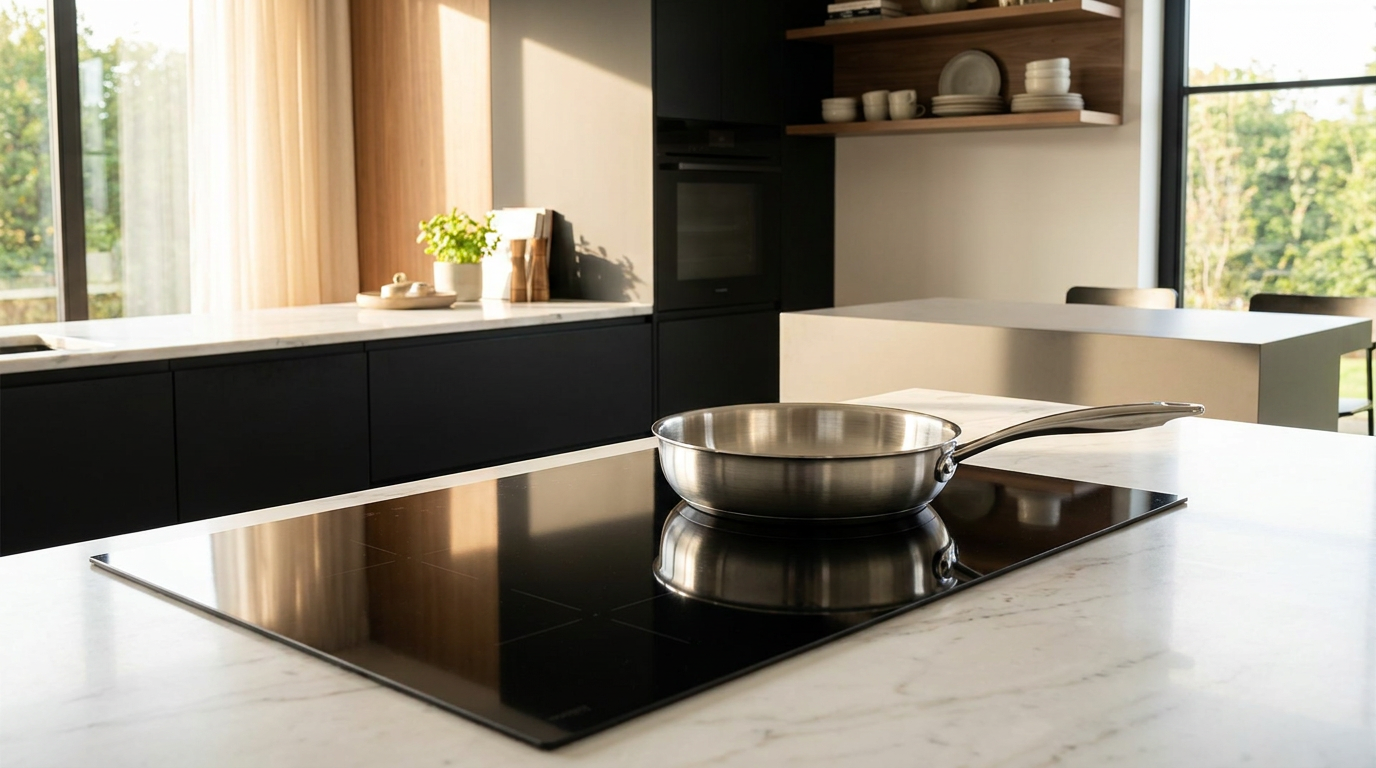
To understand why induction is fundamentally different, you have to look beneath the sleek ceramic-glass surface. Directly under the cooking zone lies a tightly wound spiral of copper wire.[1][2]
When the stove is turned on, an alternating electrical current flows through this copper coil. This current changes direction rapidly—typically 20 to 100 thousand times a second.[1][2]

This rapid oscillation creates a dynamic, invisible magnetic field just above the cooktop. The magnetic field itself generates absolutely no heat; you could place your hand directly on the active burner and feel nothing.[3][4]
The magic happens when a piece of ferromagnetic cookware—like cast iron or magnetic stainless steel—enters that magnetic field. The fluctuating field penetrates the metal of the pan, inducing swirling electrical currents within the base of the cookware.[1][2]
These swirling currents are known in physics as "eddy currents." Because the metal of the pan has electrical resistance, it fights the flow of these eddy currents. This resistance converts the electrical energy directly into heat, a process known as Joule heating.[2][7]
The result is instantaneous and highly localized heat. The pan gets hot, but the glass surface below it only warms up residually from being in contact with the hot pan.[1][6]
The pan gets hot, but the glass surface below it only warms up residually from being in contact with the hot pan.
This direct-to-pan heating mechanism is the secret behind induction's staggering energy efficiency. According to engineering analyses, induction cooktops operate at approximately 90% thermal efficiency.[5][6]
By contrast, traditional gas stoves operate at roughly 40% efficiency. With gas, more than half of the energy generated by the flame escapes around the sides of the pot, heating the ambient kitchen air rather than the food.[5][6]

Because almost all the energy goes directly into the cookware, induction boils water up to 50% faster than gas or standard electric stoves. It also offers the instantaneous temperature control that chefs traditionally loved about gas—turn the dial down, and the magnetic field weakens immediately, dropping the heat without a lag.[3][10]
Beyond speed and efficiency, the most significant driver of induction's recent surge is indoor air quality. A growing body of research, including landmark studies from Stanford University, has highlighted the health risks of indoor combustion.[5][8]
Gas stoves release nitrogen dioxide, carbon monoxide, and fine particulate matter directly into the home. Epidemiological studies have linked gas stove usage to a 12.7% increased risk of childhood asthma in developed countries.[5][10]
Because induction is entirely electric and combustion-free, it produces zero indoor air pollutants. This health benefit, combined with the safety of having no open flames and a cooler cooking surface, has made induction a priority for families and green-building developers.[5][10]

However, the technology does come with a notable limitation: cookware compatibility. Because the system relies on magnetic fields, pots and pans made of pure aluminum, copper, or glass will not work on an induction stove.[1][2]
The cookware must contain a ferromagnetic metal. The simplest way to test compatibility is the magnet trick: if a standard refrigerator magnet sticks firmly to the bottom of a pan, it will work on an induction cooktop.[1][10]
To bridge this gap, many modern cookware manufacturers now bond a magnetic steel plate to the base of aluminum and copper pans, making them induction-ready.[3][10]

Despite the need for specific cookware and a higher initial purchase price, the market is expanding rapidly. Analysts project the global induction cooktop market will grow from $24.79 billion in 2025 to nearly $39.53 billion by 2035.[9]
How we got here
Early 1900s
First patents for induction heating are filed, though the technology remains largely theoretical for household use.
1950s
General Motors showcases early demonstration induction stoves on a touring exhibition.
1970s
The first modern induction cooktops are commercialized, though high costs limit their adoption.
2010s
Induction becomes widely adopted in Europe and Asia due to energy efficiency mandates.
2020s
Growing awareness of the health risks of gas stoves accelerates induction adoption in North America.
2026
Induction cooktops become a dominant trend in kitchen remodels and new residential construction.
Viewpoints in depth
Health & Environmental Advocates
Focuses on the elimination of indoor air pollution and the reduction of fossil fuel reliance.
For public health researchers and environmental groups, the transition to induction is primarily about air quality and climate. Gas stoves release nitrogen dioxide and particulate matter directly into the kitchen, which studies have linked to increased rates of childhood asthma. By eliminating indoor combustion, induction cooktops provide a safer breathing environment while also allowing households to power their cooking with renewable electricity rather than fossil fuels.
Culinary Traditionalists
Values the tactile control and versatility of traditional gas cooking.
While acknowledging the speed and efficiency of induction, many traditional cooks and professional chefs miss the visual feedback of a gas flame. Gas allows for techniques like charring peppers directly on the grate and works with any type of cookware, including traditional round-bottomed woks and pure copper pans. However, as induction technology improves with features like virtual flames and precise temperature holding, this resistance is gradually softening.
Appliance Industry Analysts
Views the shift as a major market trend driven by smart home integration and dropping costs.
Market analysts track the rapid growth of the induction sector, projecting it to reach nearly $40 billion by 2035. They note that the initial barrier of high upfront costs is eroding as manufacturing scales up. Furthermore, the integration of smart sensors, automated temperature control, and sleek, easy-to-clean glass surfaces makes induction highly appealing to modern consumers undertaking kitchen renovations.
What we don't know
- How quickly power grids in developing nations can handle the increased electrical load of widespread induction adoption.
- Whether the restaurant industry will fully abandon gas, given the deep-rooted culinary traditions built around open-flame cooking.
- How long it will take for the upfront cost of premium induction ranges to reach full parity with entry-level gas models.
Key terms
- Electromagnetic Induction
- The process of generating an electrical current in a conductive material by exposing it to a changing magnetic field.
- Eddy Currents
- Swirling loops of electrical current induced within the metal of the cookware by the magnetic field.
- Joule Heating
- The process by which the electrical resistance of the cookware converts eddy currents directly into heat.
- Ferromagnetic
- A material, such as iron or certain steel alloys, that is highly susceptible to magnetization and is required for induction cooking.
Frequently asked
Do induction cooktops use more electricity than standard electric stoves?
No. Induction cooktops are actually more energy-efficient than standard electric stoves because they transfer heat directly to the pan, minimizing wasted energy.
Can I use my existing pots and pans on an induction stove?
It depends on the material. Cookware must contain a magnetic metal like cast iron or magnetic stainless steel. Pure aluminum, copper, and glass will not work.
Is the magnetic field from an induction cooktop safe?
Yes. The low-frequency magnetic field is highly localized to the cooking zone and is considered safe for everyday use, though individuals with pacemakers are sometimes advised to consult their doctor.
Why do some chefs still prefer gas if induction is faster?
Many chefs are accustomed to the visual feedback of a gas flame and the ability to char ingredients directly on the burner, though many commercial kitchens are now switching to induction for its precision and cooler ambient temperatures.
Sources
Source coverage
10 outlets
4 viewpoints surfaced










[1]VBGK HomeScientific Explainers
How Does an Induction Cooktop Work? The Electromagnetic Science
Read on VBGK Home →[2]CNETCulinary Traditionalists
Appliance Science: The hot physics of induction cooktops
Read on CNET →[3]Massachusetts Clean Energy CenterHealth & Environmental Advocates
How Induction Cooking Works
Read on Massachusetts Clean Energy Center →[4]Rewiring AmericaHealth & Environmental Advocates
How induction stoves work
Read on Rewiring America →[5]Tap.EcoHealth & Environmental Advocates
Induction Cooktops vs. Gas Stoves: A Clean Kitchen Verdict
Read on Tap.Eco →[6]AchaHomeCulinary Traditionalists
Induction vs. Gas Stove India 2026: The Engineer's Cost Comparison
Read on AchaHome →[7]WikipediaScientific Explainers
Induction cooking
Read on Wikipedia →[8]House DigestAppliance Industry Analysts
Why An Induction Stove Will Be 2026's Big Kitchen Trend
Read on House Digest →[9]SNS InsiderAppliance Industry Analysts
Induction Cooktops Market Size & Share | Report, 2026-2035
Read on SNS Insider →[10]Factlen Editorial TeamScientific Explainers
Synthesis by Factlen editorial team
Read on Factlen Editorial Team →
Every angle. Every day.
Get home stories with full source coverage and perspective breakdowns delivered to your inbox.