
How Bidirectional Charging is Turning EVs into Mobile Power Plants in 2026
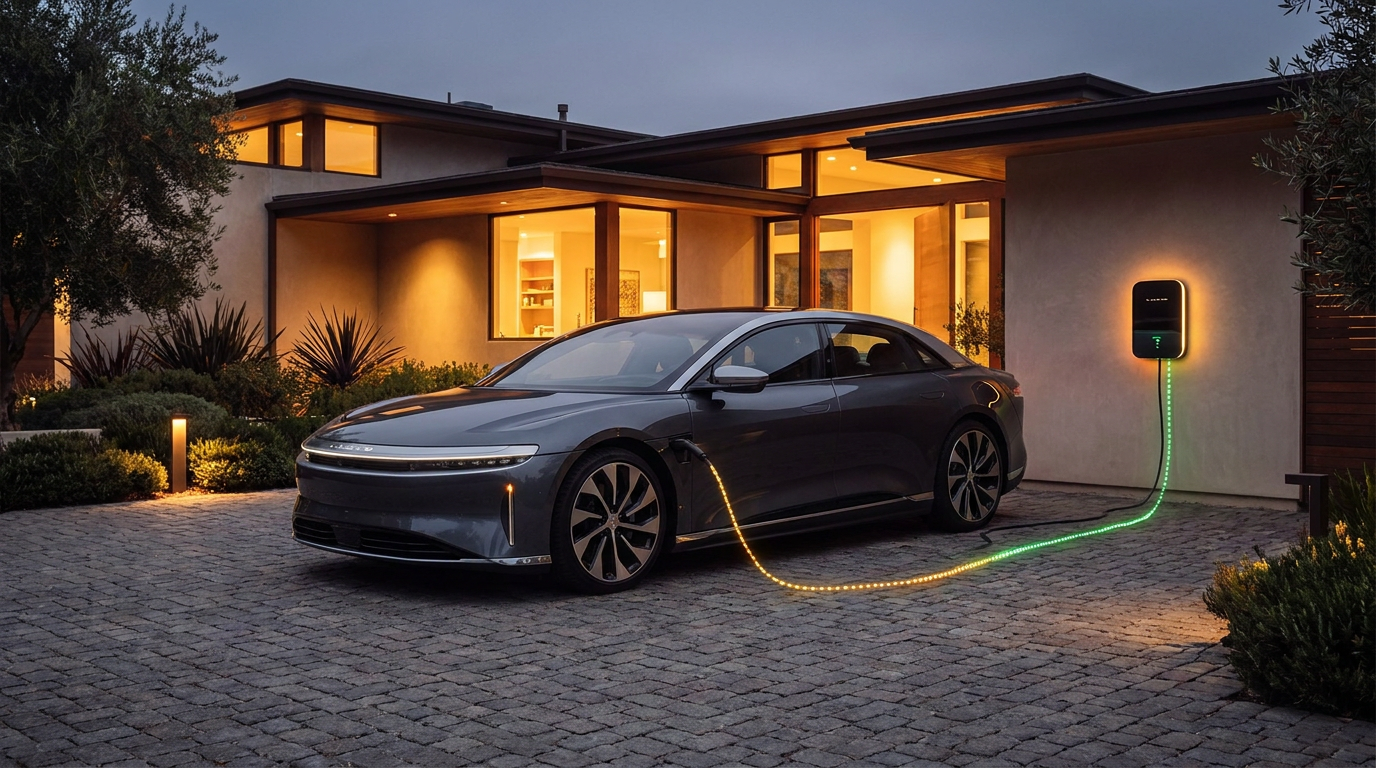
Vehicle-to-grid (V2G) and vehicle-to-home (V2H) technologies are moving from pilot programs to mainstream availability, allowing electric vehicles to power houses and stabilize local grids.
By Factlen Editorial Team
- Automakers & Utilities
- View EVs as a massive, untapped distributed battery network that can solve renewable intermittency.
- Energy Resilience Advocates
- Value bidirectional charging primarily for home backup (V2H) and energy independence during grid failures.
- Regulators & Grid Operators
- Cautious but optimistic; focused on standardizing interconnection rules and ensuring grid safety before mass rollout.
What's not represented
- · Battery warranty providers
- · Traditional home generator manufacturers
Why this matters
Electric vehicles are no longer just a cleaner way to commute; they are becoming a critical piece of home infrastructure. By unlocking the massive batteries sitting idle in driveways, homeowners can survive multi-day blackouts and significantly lower their utility bills.
Key points
- Bidirectional charging allows EVs to power homes (V2H) or sell energy back to the grid (V2G).
- California recently approved the Tesla Cybertruck as its first AC-based residential V2G asset.
- European automakers like Renault and Nissan are launching affordable, customer-facing V2G services in 2026.
- A typical EV battery holds 50 to 120 kWh of energy, vastly outperforming standard home backup batteries.
- Regulatory hurdles and interconnection delays remain the primary bottlenecks to widespread adoption.
For years, electric vehicles have been viewed by utility companies as a looming burden—massive new power loads that threaten to strain aging electrical grids. But in 2026, the narrative has flipped. A wave of new hardware, software, and regulatory approvals is transforming the EV from a passive consumer of electricity into a mobile power plant.[1]
The technology driving this shift is bidirectional charging. Unlike traditional charging, which only pushes electrons from the grid into the car's battery, bidirectional systems allow energy to flow both ways, unlocking the massive energy reserves sitting idle in residential driveways.[1]
This capability is generally split into three categories. Vehicle-to-Load (V2L) allows drivers to plug appliances or tools directly into the car. Vehicle-to-Home (V2H) enables the car to power an entire house during a blackout. Finally, Vehicle-to-Grid (V2G) allows the vehicle to sell stored energy back to the utility company during periods of peak demand.[1]

While V2L has been common for a few years, 2026 marks the commercial arrival of true V2H and V2G systems. In California, Pacific Gas and Electric (PG&E) recently approved the Tesla Cybertruck as the state's first alternating current (AC) vehicle-to-grid asset for residential use.[4]
This approval is a technical milestone. Previous bidirectional systems relied on direct current (DC) chargers, which required thousands of dollars in specialized hardware and complex installations. Tesla's AC-based approach uses the vehicle's onboard inverter to convert the power, allowing it to interface with conventional residential electrical panels much more cheaply.[4]
The sheer scale of energy stored in these vehicles makes them formidable grid assets. A standard home backup battery, like a Tesla Powerwall 2, holds about 13.5 kilowatt-hours (kWh) of energy. A Cybertruck holds 123 kWh—roughly nine times the capacity, enough to power an average American home for several days without lifestyle compromises.[4]

To encourage adoption, PG&E is offering up to $4,500 in incentives for V2X equipment and installation. A parallel pilot program in California, led by Bidirectional Energy and Wallbox, is installing specialized chargers to help standardize the notoriously slow utility interconnection process, aiming to make V2G setup as routine as installing rooftop solar.[4][5]
To encourage adoption, PG&E is offering up to $4,500 in incentives for V2X equipment and installation.
The momentum extends far beyond North America. In Europe, automakers are aggressively bundling V2G capabilities into affordable passenger cars. Renault has launched a customer-facing V2G service in France alongside the new Renault 5 E-Tech, a compact city car equipped with a bidirectional onboard charger.[6]
Renault's subsidiary, Mobilize, pairs the vehicle with a specific electricity contract that automatically manages charging and discharging. The car charges when grid power is abundant and cheap—often when solar and wind production is high—and discharges back to the grid when demand peaks.[6]
The financial proposition for European drivers is compelling. By allowing the utility to borrow a fraction of the car's battery capacity during peak hours, Renault estimates that customers in France can save up to 600 euros on their electricity bills in the first year alone.[6]
Similarly, Nissan has announced the rollout of affordable V2G technology across Europe, starting in the UK. Following a successful trial at the University of Nottingham, Nissan became the first automaker to achieve G99 Grid code certification for an AC-based solution, a legal prerequisite for supplying electricity into the UK's national grid.[3]

Utility companies are actively recruiting drivers to test these systems. In the Netherlands, energy provider Vattenfall has launched a V2G pilot program specifically for households driving the Kia EV9 or Hyundai IONIQ 9.[2]
"Electric cars are stationary for most of the day," noted Jeroen van Loon, a director at Vattenfall. He emphasized that unlocking the 50 to 60 kWh of storage in a typical EV can provide the flexibility needed to balance a grid increasingly reliant on intermittent renewable energy.[2]
Despite the rapid commercialization, uncertainties remain. The primary concern among consumers is battery degradation. Lithium-ion batteries degrade with every charge and discharge cycle, and owners worry that "micro-cycling" the battery for grid services could prematurely wear out an expensive vehicle component.[1]

Automakers counter that smart software limits the depth of discharge, keeping the battery within its optimal state of charge to minimize wear. Furthermore, the Department of Energy notes that the resilience benefits of V2H—avoiding the high failure rates of emergency diesel generators—often outweigh the marginal wear on the battery.[1]
Regulatory friction also poses a challenge. While hardware costs are falling, utility interconnection rules vary wildly by region. In many areas, homeowners face months of permitting delays before they are legally allowed to export power from their driveway back to the grid.[5]
Nevertheless, the trajectory is clear. As bidirectional hardware becomes standard and utilities streamline their permitting processes, the electric vehicle is evolving. It is no longer just a cleaner way to commute; it is a decentralized, mobile energy reserve that promises to make local power grids more resilient and renewable energy more viable.[1][5]
How we got here
2019
Early V2G pilot programs begin testing the feasibility of using EVs for grid storage.
2023
Ford introduces the F-150 Lightning with intelligent backup power, popularizing V2H in North America.
2024
Nissan achieves the UK's first G99 grid code certification for an AC-based V2G solution.
April 2026
California approves the Tesla Cybertruck as the state's first residential AC vehicle-to-grid asset.
June 2026
Renault launches its Mobilize V2G service, allowing European drivers to monetize their parked EVs.
Viewpoints in depth
Automakers & Utilities
View EVs as a massive, untapped distributed battery network that can solve renewable intermittency.
For vehicle manufacturers and power companies, bidirectional charging solves a mutual problem. Utilities face the challenge of balancing intermittent renewable energy sources like wind and solar. By tapping into the 50 to 100 kWh of storage sitting idle in millions of parked cars, they can smooth out peak demand without building expensive grid-scale battery farms. Automakers, in turn, can market their vehicles not just as transportation, but as revenue-generating assets that actively lower a driver's monthly utility bills.
Energy Resilience Advocates
Value bidirectional charging primarily for home backup (V2H) and energy independence during grid failures.
Homeowners and energy independence advocates are less focused on selling power back to the utility and more interested in the 'island' capabilities of Vehicle-to-Home (V2H) systems. With grid instability and extreme weather events causing more frequent blackouts, a fully charged electric truck can keep a house running for days. This camp views the EV as a superior replacement for loud, maintenance-heavy diesel generators, offering a silent, seamless backup power solution that is already paid for as a daily driver.
Regulators & Grid Operators
Cautious but optimistic; focused on standardizing interconnection rules and ensuring grid safety before mass rollout.
While enthusiastic about the potential of distributed storage, grid operators and regulators emphasize safety and standardization. Allowing thousands of decentralized batteries to push alternating current back into the local grid requires strict adherence to interconnection codes to prevent overloading circuits or endangering utility workers during outages. This camp is focused on moving the technology out of isolated pilot programs and into standardized, universally accepted permitting frameworks.
What we don't know
- How quickly local utilities will standardize the permitting process for V2G interconnection.
- The exact long-term impact of daily micro-cycling on EV battery lifespan and warranties.
- Whether consumers will broadly opt-in to V2G programs or prefer to reserve their battery capacity strictly for personal driving and home backup.
Key terms
- Bidirectional Charging
- Technology that allows an electric vehicle charger to both pull electricity from the grid and push electricity back out.
- V2G (Vehicle-to-Grid)
- A system where an electric vehicle communicates with the public power grid to sell back stored energy during peak demand.
- V2H (Vehicle-to-Home)
- Using an electric vehicle's battery to provide backup power to a single residence, typically during a blackout.
- Interconnection
- The technical and regulatory process of safely connecting a home power-generating system to the broader utility grid.
- Alternating Current (AC) V2G
- A newer, cheaper method of bidirectional charging that uses the car's onboard inverter to convert power, rather than relying on an expensive external wallbox.
Frequently asked
Does bidirectional charging degrade my EV battery faster?
Frequent 'micro-cycling' can add wear to a battery, but automakers use smart software to limit the depth of discharge and keep the battery in its optimal range, minimizing long-term degradation.
Do I need a special charger for V2H or V2G?
Yes. While some newer vehicles use AC-based systems that require simpler hardware, you still need a compatible bidirectional wallbox and a transfer switch installed by an electrician.
Can any electric vehicle power my home?
No. In 2026, bidirectional charging is still limited to specific models with the correct onboard hardware, such as the Ford F-150 Lightning, Tesla Cybertruck, Nissan Ariya, and Renault 5.
How much money can I make with V2G?
Earnings depend on your local utility rates and incentives. Pilot programs in Europe estimate savings of up to 600 euros per year, while some US utilities offer thousands in upfront equipment rebates.
Sources
Source coverage
6 outlets
3 viewpoints surfaced






[1]Department of EnergyRegulators & Grid Operators
Bidirectional Charging and Electric Vehicles for Mobile Storage
Read on Department of Energy →[2]VattenfallAutomakers & Utilities
Vattenfall Netherlands launches V2G pilot with Kia and Hyundai
Read on Vattenfall →[3]Nissan Global NewsroomAutomakers & Utilities
Nissan to launch affordable vehicle-to-grid technology in 2026
Read on Nissan Global Newsroom →[4]ElectrekEnergy Resilience Advocates
Tesla Cybertruck becomes first AC vehicle-to-grid asset in California through PG&E
Read on Electrek →[5]SolarVisionEnergy Resilience Advocates
California Pilot Program Turns Electric Vehicles Into Power Plants
Read on SolarVision →[6]Renault GroupAutomakers & Utilities
Mobilize V2G: where the future electric Renault 5 becomes a source of energy
Read on Renault Group →
Every angle. Every day.
Get transportation stories with full source coverage and perspective breakdowns delivered to your inbox.