
The Rise of Mass Timber: How 'Super Plywood' is Replacing Concrete and Steel
Cross-laminated timber is transforming the construction industry by offering a sustainable, fire-resistant alternative to carbon-intensive building materials. Recent building code updates now allow these engineered wood structures to soar up to 18 stories.
By Factlen Editorial Team
- Sustainable Architecture Advocates
- View mass timber as a vital tool for decarbonizing the built environment and turning cities into carbon sinks.
- Structural & Fire Engineers
- Focus on the predictable performance of engineered wood and the strict code compliance required to ensure high-rise safety.
- Forestry & Timber Industry
- Emphasize that scaling mass timber requires rigorous, sustainable forest management to ensure a renewable supply chain.
What's not represented
- · Traditional concrete and steel manufacturers
- · Local zoning boards adjusting to new building codes
Why this matters
Concrete and steel production account for nearly 10% of global greenhouse gas emissions. Shifting to mass timber not only drastically reduces the carbon footprint of new buildings but actually traps carbon inside their walls, turning cities into massive carbon sinks.
Key points
- Mass timber uses engineered wood panels, like CLT, to replace concrete and steel in mid-rise and high-rise construction.
- Unlike traditional materials, mass timber sequesters carbon, significantly lowering a building's overall environmental footprint.
- In a fire, thick timber panels char on the outside, protecting the structural integrity of the inner wood.
- Recent updates to the International Building Code now permit mass timber structures to reach up to 18 stories.
- Prefabricated timber panels allow for faster, quieter construction with less on-site labor and waste.
- The environmental benefits depend entirely on sourcing the timber from sustainably managed forests.
For over a century, the skylines of modern cities have been forged from concrete and steel. These materials are undeniably strong, but their environmental toll is staggering. The production of cement and steel requires heating mined materials to extreme temperatures, primarily by burning fossil fuels. Together, they account for roughly 9% of global greenhouse gas emissions—more than the entire aviation industry.[2][5]
As the global population urbanizes and the demand for new housing and commercial space surges, architects and engineers are searching for a climate-friendly alternative. The answer, increasingly, is a return to humanity's oldest building material: wood. But this is not the traditional stick-framing used in single-family homes. It is a highly engineered category of materials known as mass timber.[1]
Dubbed the "concrete of the future," mass timber relies on cutting-edge manufacturing to transform ordinary lumber into massive, load-bearing panels and beams. The flagship product driving this revolution is Cross-Laminated Timber, or CLT.[6]
CLT is manufactured by taking solid sawn lumber boards and gluing them together in layers. Crucially, each layer is oriented perpendicular to the one below it—creating a crisscross pattern. This alternating grain structure gives the final panel exceptional strength, stiffness, and dimensional stability in both directions. The result is a "super plywood" capable of supporting the immense weight of mid-rise and high-rise buildings.[1]

The environmental math behind mass timber is its most compelling feature. Life Cycle Assessment (LCA) studies consistently show that replacing concrete and steel with CLT dramatically lowers a building's carbon footprint. A comparative study of residential buildings found that timber structures achieved a 25% reduction in global warming potential compared to their concrete counterparts.[3]
This reduction happens in two ways. First, mass timber has significantly lower "embodied energy." Manufacturing engineered wood requires a fraction of the fossil fuels needed to mine iron ore or bake limestone for cement. Many lumber mills even power their operations using woody biomass, such as bark and sawdust, making the production process highly energy-efficient.[5]
Second, mass timber acts as a carbon sink. Trees absorb carbon dioxide from the atmosphere as they grow. When those trees are harvested and turned into CLT panels, that carbon remains locked inside the wood for the lifetime of the building—often decades or centuries. If a city is built with mass timber, its very infrastructure becomes a repository for sequestered carbon.[2]

Trees absorb carbon dioxide from the atmosphere as they grow.
Despite these benefits, the idea of building wooden skyscrapers inevitably raises a critical question: What about fire? For decades, building codes heavily restricted wood construction due to the catastrophic urban fires of the 19th and early 20th centuries.[1]
However, mass timber behaves very differently in a fire than light-frame wood. When exposed to intense heat, the outer layer of a massive wooden beam or panel chars. This charred layer acts as a natural insulator, protecting the unburned wood inside from the heat and cutting off its oxygen supply.[4]
Fire engineering experts and government laboratories have conducted extensive, full-scale burn tests on mass timber structures. These tests proved that the char rate is highly predictable, allowing engineers to design structural members that maintain their load-bearing capacity even during a prolonged blaze.[7]

Recognizing this inherent fire resistance, regulatory bodies have overhauled their rules. The International Building Code (IBC) recently introduced new construction types—IV-A, IV-B, and IV-C—specifically for mass timber. Under the latest guidelines, developers can now build mass timber structures up to 18 stories, or 270 feet tall, provided they meet specific encapsulation requirements, such as covering certain structural elements with fire-resistant gypsum board.[4][8]
Beyond environmental and safety metrics, mass timber is fundamentally changing how buildings are constructed. Because CLT panels are prefabricated in a factory, they are cut to millimeter precision using digital models. Window openings, door frames, and even channels for electrical wiring are routed out before the wood ever leaves the facility.[6]
When the panels arrive at the construction site, they are assembled much like a giant piece of flat-pack furniture. This prefabrication drastically reduces construction time. Industry estimates suggest that wooden buildings can be erected up to 50% faster than traditional concrete structures. The process requires fewer workers on-site, generates significantly less waste, and dramatically reduces the noise and disruption typical of urban construction zones.[6]

Yet, the mass timber revolution is not without its caveats. The most pressing concern is the source of the wood itself. If the timber is harvested from unsustainably managed forests, the carbon math falls apart. Clear-cutting mature forests releases stored carbon into the atmosphere and destroys vital biodiversity. For mass timber to be a genuine climate solution, the industry must rely on strictly certified, sustainably managed forests where new trees are planted to replace those harvested.[2]
There are also engineering hurdles to overcome. While incredibly strong, CLT is much lighter than concrete, which can lead to acoustic challenges. Without additional soundproofing measures—such as decoupled gypsum boards or acoustic floor mats—sound and vibrations travel more easily through wooden floors than concrete slabs.[1]
Finally, the industry faces a learning curve. Because mass timber is still relatively new in North America compared to Europe, many contractors and engineers lack experience with the material. This path dependency can make developers hesitant to deviate from the familiar, established practices of concrete and steel construction.[1]
Nevertheless, the momentum behind mass timber is accelerating. As building codes continue to modernize and the supply chain of engineered wood expands, architects are increasingly embracing the material not just for its sustainability, but for its aesthetic warmth. By bringing natural wood grains into urban interiors, mass timber is proving that the cities of the future can be both environmentally responsible and deeply connected to the natural world.[1]
How we got here
1990s
Cross-laminated timber (CLT) is first developed and utilized for construction in Europe.
2015
The International Building Code (IBC) first recognizes CLT as a structural building component.
2016
The Brock Commons tall wood building begins construction at the University of British Columbia, serving as a major North American proof-of-concept.
2021
The IBC introduces new Type IV construction categories, officially expanding allowable heights for mass timber.
2024
Updated building codes clarify encapsulation requirements, making it easier to leave mass timber exposed in high-rises.
Viewpoints in depth
Sustainable Architecture Advocates
Mass timber is a vital tool for decarbonizing the built environment.
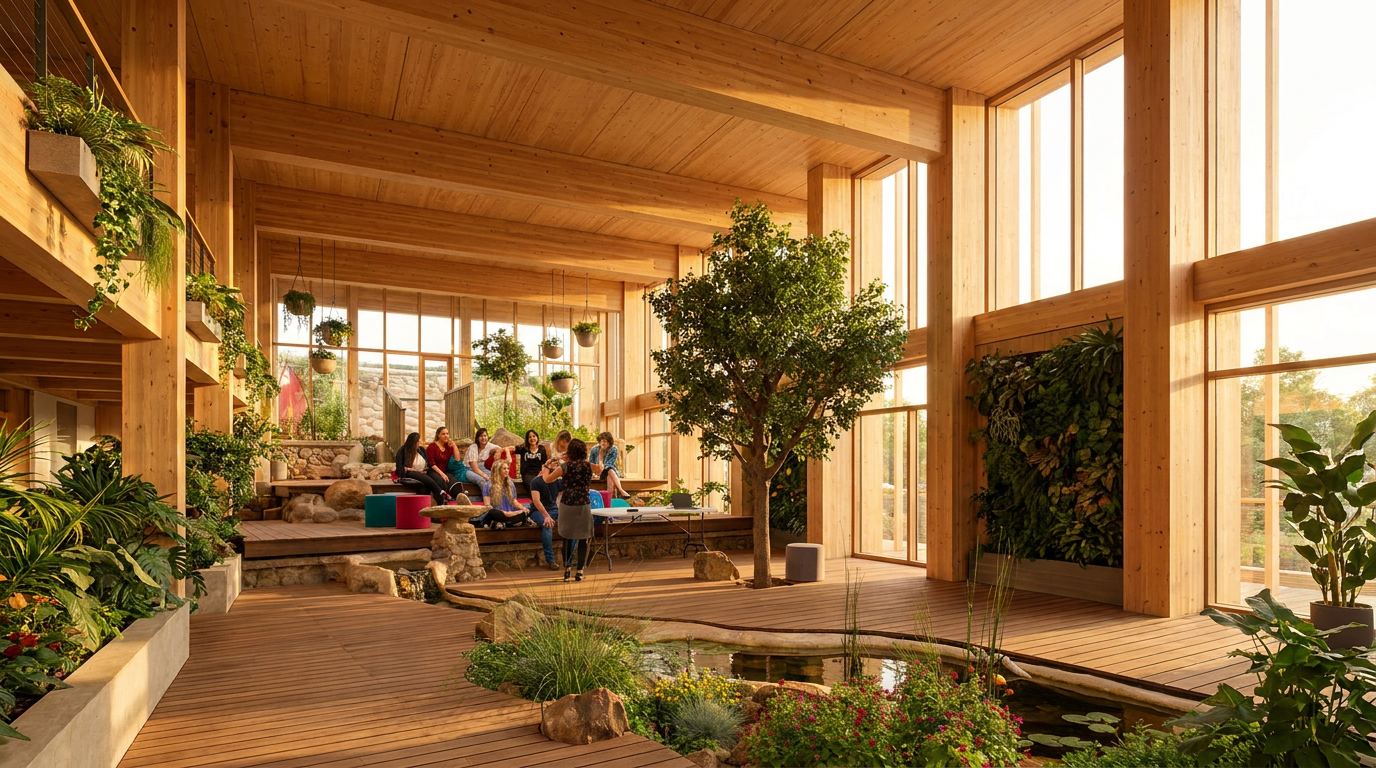
Environmental advocates and progressive architects view mass timber as a rare opportunity to turn the construction industry from a massive carbon emitter into a carbon sink. By replacing highly polluting concrete and steel with renewable wood, cities can lock away millions of tons of CO2. Furthermore, advocates highlight the psychological benefits of 'biophilic design'—the idea that exposing natural wood grains in interior spaces improves the mental well-being and productivity of occupants.
Structural & Fire Engineers
Safety relies on predictable performance and strict code compliance.
For the engineering community, the appeal of mass timber lies in its predictable behavior under stress. While the public often fears wooden skyscrapers will burn easily, fire engineers point to exhaustive data showing that heavy timber chars at a known, steady rate, maintaining its load-bearing capacity longer than unprotected steel, which can warp and buckle in extreme heat. However, engineers stress that this safety is entirely dependent on strict adherence to encapsulation codes and proper acoustic detailing to prevent sound transmission between floors.
Forestry & Timber Industry
Scaling mass timber requires rigorous, sustainable forest management.
The timber industry sees the rise of CLT as a major economic opportunity that can revitalize rural mill towns. However, industry experts acknowledge that the climate benefits of mass timber evaporate if the wood is sourced through clear-cutting or illegal logging. They argue that increased demand for mass timber must be met with rigorous certification programs, ensuring that forests are selectively harvested and replanted, thereby maintaining the forest's ability to pull carbon from the atmosphere.
What we don't know
- How quickly the North American supply chain can scale to meet the surging demand for CLT panels.
- Whether the long-term acoustic performance of mass timber buildings will meet the expectations of high-end residential buyers.
- How global forestry practices will adapt if mass timber becomes the dominant building material worldwide.
Key terms
- Cross-Laminated Timber (CLT)
- An engineered wood panel made by gluing layers of solid lumber perpendicular to one another for extreme strength.
- Embodied Carbon
- The total greenhouse gas emissions generated during the extraction, manufacturing, and transportation of building materials.
- Carbon Sequestration
- The process of capturing and storing atmospheric carbon dioxide, which trees do naturally and mass timber preserves within a building's structure.
- Char Rate
- The predictable speed at which the outer layer of heavy timber burns, creating a protective insulating layer for the unburned wood inside.
- Life Cycle Assessment (LCA)
- A method used to evaluate the environmental impact of a product through its entire lifespan, from raw material extraction to disposal.
Frequently asked
Is mass timber cheaper than concrete and steel?
While the raw materials can sometimes cost more upfront, mass timber often reduces overall project costs by significantly cutting down construction time and labor needs.
Can mass timber buildings catch fire?
Like any building, the contents inside can burn, but the mass timber structure itself resists fire by forming a protective charred layer that prevents the core from losing its structural integrity.
Does mass timber cause deforestation?
It can if forests are mismanaged. The environmental benefits of mass timber rely entirely on sourcing wood from certified, sustainably managed forests where harvested trees are replanted.
Sources
Source coverage
8 outlets
3 viewpoints surfaced








[1]Factlen Editorial Team
Synthesis by Factlen editorial team
Read on Factlen Editorial Team →[2]MIT Environmental Solutions InitiativeSustainable Architecture Advocates
Cross-Laminated Timber and the Future of Sustainable Construction
Read on MIT Environmental Solutions Initiative →[3]University of WashingtonForestry & Timber Industry
Comparative Life Cycle Assessment of Mass Timber and Concrete Residential Buildings
Read on University of Washington →[4]WoodWorksStructural & Fire Engineers
Fire Design of Mass Timber Structural Members
Read on WoodWorks →[5]Think WoodForestry & Timber Industry
Environmental Impacts of Wood vs. Concrete and Steel
Read on Think Wood →[6]ArchDailySustainable Architecture Advocates
Why Wood is the Concrete of the Future
Read on ArchDaily →[7]J.S. HeldStructural & Fire Engineers
Mass Timber Construction: Fire Resistance Rating and Code Compliance
Read on J.S. Held →[8]Offsite BuilderStructural & Fire Engineers
How New Codes Are Unlocking Taller Wood Buildings
Read on Offsite Builder →
Every angle. Every day.
Get home stories with full source coverage and perspective breakdowns delivered to your inbox.