
Wall Street Embraces Blockchain: NYSE and Major Banks Move Toward 24/7 Tokenized Trading
A wave of institutional adoption is reshaping financial markets this month, highlighted by the New York Stock Exchange's push to trade tokenized stocks around the clock and a consortium of major banks developing a blockchain-based deposit network.
By Factlen Editorial Team
- Traditional Finance Institutions
- Legacy banks and exchanges view tokenization as a necessary infrastructure upgrade to remain competitive and reduce settlement risk.
- Crypto-Native Innovators
- Web3 pioneers celebrate institutional adoption but advocate for decentralized, permissionless systems over closed bank networks.
- Regulatory & Asset Managers
- Regulators and fund managers prioritize investor protection and clear statutory frameworks as digital assets mature.
What's not represented
- · Retail day traders
- · International emerging market regulators
Why this matters
For everyday investors, the shift toward tokenized assets promises faster settlement times, lower transaction fees, and the eventual ability to trade traditional stocks and bonds 24/7. It also cements blockchain technology as a permanent fixture in global finance, potentially stabilizing the historically volatile crypto sector.
Key points
- The New York Stock Exchange is partnering with Securitize to enable 24/7 trading of tokenized equities.
- A consortium of major U.S. banks is developing a shared tokenized deposit network for instantaneous settlement.
- The SEC has approved T. Rowe Price's actively managed crypto ETF for listing on the NYSE Arca.
- Tokenization aims to replace traditional T+1 settlement with instantaneous T+0 atomic swaps.
Wall Street is no longer just observing blockchain technology from the sidelines; it is actively rewiring its core infrastructure. In mid-June 2026, a series of landmark announcements confirmed that the tokenization of real-world assets—long heralded as the next evolution of finance—has moved from a theoretical concept to an operational reality. Rather than focusing solely on the price fluctuations of Bitcoin or Ethereum, the world's largest financial institutions are adopting the underlying distributed ledger technology to modernize how traditional equities, bonds, and fiat currencies are issued, traded, and settled. This shift marks a historic transition for digital assets, moving them out of the speculative fringe and cementing them as the foundational plumbing for a faster, more efficient global economy.[4]
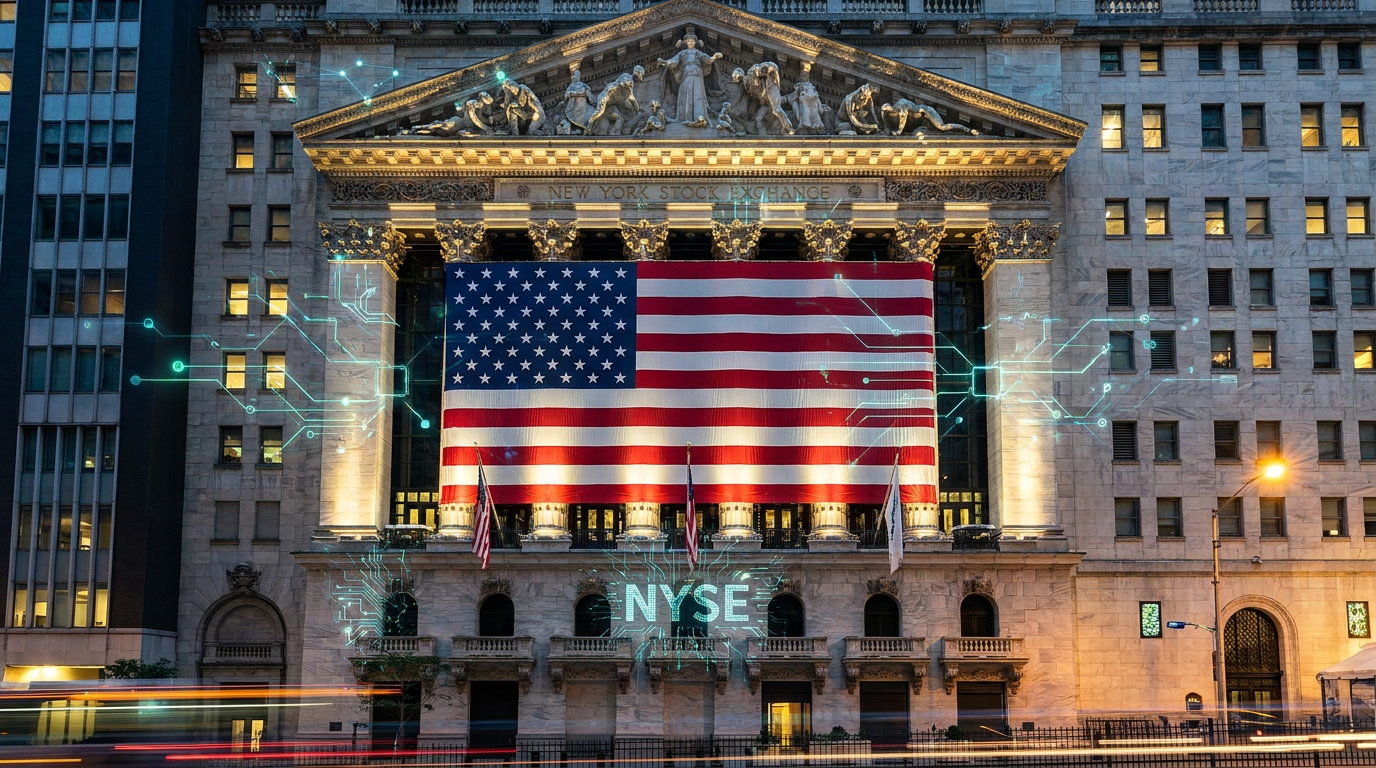
The most striking development in this institutional wave comes from the epicenter of traditional finance: the New York Stock Exchange. In a move that challenges decades of established market structure, the NYSE is advancing initiatives to trade tokenized stocks around the clock. By partnering with Securitize, a leading digital asset securities firm, the exchange aims to bring the 24/7 liquidity and borderless accessibility of cryptocurrency markets to traditional equities. This native tokenization ensures that the digital token represents the actual underlying security, complete with voting rights and dividend distributions, rather than functioning as a synthetic derivative.[2]
The economic implications of migrating traditional equities to a blockchain are staggering. Securitize CEO Carlos Domingo recently emphasized the sheer scale of the opportunity, noting that if even a mere 1% of the New York Stock Exchange's volume transitions to on-chain trading, it would represent a $4 trillion migration of value. Such a move would effectively triple the current market capitalization of the entire cryptocurrency industry overnight. To facilitate this massive structural shift, traditional finance is increasingly relying on crypto-native infrastructure providers and market makers to bridge the gap between legacy systems and decentralized networks.[2]

Ensuring deep liquidity for these newly tokenized assets requires sophisticated trading architecture. To that end, Jump Trading, one of the most prominent market makers in both traditional and digital asset markets, is deploying a proprietary automated market maker system. This on-chain liquidity engine is designed to facilitate seamless transactions for tokenized equities outside of standard market hours, ensuring that buyers and sellers can execute trades efficiently at any time of day or night. The integration of decentralized finance mechanisms into regulated securities trading represents a profound blurring of the lines between Wall Street and Web3.[2]
The push for blockchain modernization extends far beyond the equities market. A powerful consortium of America's largest financial institutions—reportedly including JPMorgan Chase, Bank of America, Citigroup, and Wells Fargo—is in the advanced stages of preparing a shared tokenized deposit network. Operated through The Clearing House, this bank-led initiative is designed to move commercial bank money across borders and between institutions 24 hours a day, seven days a week. The project serves as a direct, regulated response to the explosive growth of public stablecoins, which have already achieved a market capitalization of roughly $300 billion.[3]
The push for blockchain modernization extends far beyond the equities market.
Unlike decentralized stablecoins, which are often backed by a mix of Treasury bills and cash equivalents held in reserve, these tokenized deposits represent actual traditional commercial bank liabilities. However, by utilizing blockchain-style infrastructure, the banks can achieve instantaneous settlement and unlock programmable treasury functions. This allows corporate treasurers to automate complex payment flows, manage intraday liquidity with unprecedented precision, and execute cross-border transactions without relying on the sluggish correspondent banking network. For the broader financial system, it signals that major banks are transitioning from merely observing crypto payment rails to actively competing with them.[3]
At the heart of this technological overhaul is the pursuit of "atomic settlement," a holy grail for capital markets. Currently, traditional stock trades in the United States settle on a T+1 basis, meaning the actual transfer of cash and securities occurs one business day after the trade is executed. Tokenization allows the asset and the payment to swap hands simultaneously—in what is known as T+0 or instantaneous settlement. This eliminates counterparty risk, reduces the need for costly clearinghouse intermediaries, and frees up billions of dollars in capital that brokerages are currently required to post as collateral.[2]

Federal regulators are showing a newfound willingness to accommodate these institutional digital asset products, providing the clarity necessary for widespread adoption. The Securities and Exchange Commission recently approved T. Rowe Price's actively managed crypto exchange-traded fund for listing on the NYSE Arca. Unlike the passive spot Bitcoin ETFs approved earlier in the decade, this actively managed vehicle will hold a dynamic basket of 5 to 15 digital assets, including Ethereum, Solana, and XRP. The approval signals a maturing regulatory framework that is increasingly comfortable with complex, multi-asset crypto portfolios managed by legacy financial titans.[1]
Simultaneously, the Commodity Futures Trading Commission has taken steps to bring offshore crypto trading dynamics into the regulated U.S. market. The agency recently issued a no-action letter allowing designated contract markets to offer true perpetual digital commodity futures—contracts without expiration dates that have long been wildly popular on unregulated international exchanges. By opening the door for regulated domestic platforms to offer equivalent products, the CFTC is creating a clear pathway to bring billions of dollars in trading volume onshore, subjecting it to proper oversight and consumer protection standards.[1]
Asset managers are rapidly launching specialized products to capitalize on this infrastructure build-out. Global X ETFs, for instance, has introduced a Stablecoins and Tokenization ETF designed to capture the growth of the emerging token economy. Rather than investing directly in cryptocurrencies, the fund targets companies that generate revenue from building the digital tokenized asset market, spanning interoperability frameworks, privacy layers, and blockchain ancillary solutions. This approach allows traditional equity investors to gain exposure to the blockchain revolution without holding digital bearer instruments directly.[5]

Despite the undeniable momentum, the transition faces significant hurdles, particularly from entrenched legacy systems. Transfer agents and traditional clearinghouses, such as the Depository Trust & Clearing Corporation, must fundamentally adapt their business models to a world where physical addresses and multi-day settlements are obsolete. Industry pioneers warn that institutions clinging to legacy market structures risk being bypassed entirely. The prevailing sentiment among innovators is that legacy clearinghouses face a paradigm shift akin to the disruption telecom companies experienced when internet-based messaging applications bypassed traditional SMS networks.[2]
Ultimately, the convergence of Wall Street and blockchain technology promises a more accessible, transparent, and frictionless global financial system. As regulatory frameworks crystallize and institutional capital flows into tokenization infrastructure, the distinction between traditional finance and decentralized finance is rapidly dissolving. Looking ahead, the prospect of artificial intelligence agents and algorithmic trading systems interacting seamlessly with tokenized assets in real-time suggests that the financial markets of the future will operate with a speed and efficiency that was previously unimaginable.[2][4][6]
How we got here
Early 2024
BlackRock launches its first tokenized fund on the Ethereum blockchain, signaling initial institutional interest.
Late 2025
Stablecoin market capitalization surpasses $200 billion as cross-border payment utility grows.
May 2026
The U.S. Senate Banking Committee advances the CLARITY Act, providing a legislative framework for digital assets.
Early June 2026
The CFTC issues a no-action letter allowing regulated U.S. platforms to offer perpetual digital commodity futures.
Mid-June 2026
The New York Stock Exchange partners with Securitize to enable 24/7 trading of tokenized stocks.
Viewpoints in depth
Traditional Finance Institutions
Legacy banks and exchanges view tokenization as a necessary infrastructure upgrade to remain competitive.
For Wall Street giants, blockchain is no longer viewed as a disruptive threat but rather as a highly efficient backend technology. By adopting tokenization, institutions like the NYSE and major commercial banks aim to drastically reduce settlement risks, free up billions in collateral, and offer their clients 24/7 liquidity. Their goal is to maintain control over the financial system by integrating the best features of Web3 into regulated, permissioned environments.
Crypto-Native Innovators
Web3 pioneers celebrate institutional adoption but advocate for decentralized, permissionless systems.
The crypto industry views Wall Street's embrace of tokenization as ultimate validation of the technology they have spent a decade building. However, many innovators remain skeptical of "bank-led" deposit networks and permissioned blockchains. They argue that true financial innovation requires open, decentralized networks where anyone can participate, warning that closed institutional systems may simply recreate the walled gardens of legacy finance with new technology.
Regulatory & Asset Managers
Regulators and fund managers prioritize investor protection and clear statutory frameworks as digital assets mature.
For asset managers and government watchdogs, the transition to tokenized finance must be carefully managed to prevent systemic risk. Regulators like the SEC and CFTC are gradually approving active ETFs and perpetual futures, provided they operate within strict compliance structures. Asset managers view this regulatory clarity as the essential catalyst needed to confidently deploy billions of dollars into the emerging token economy.
What we don't know
- How quickly traditional clearinghouses like the DTCC will adapt their legacy systems to support instantaneous on-chain settlement.
- Whether retail investors will directly interact with blockchain wallets or if institutions will entirely abstract the technology.
- How international regulators will harmonize rules for cross-border tokenized asset trading.
Key terms
- Tokenization
- The process of converting rights to a real-world asset into a digital token on a blockchain.
- Atomic Settlement (T+0)
- The instantaneous and simultaneous exchange of an asset and payment, eliminating the traditional multi-day waiting period.
- Automated Market Maker (AMM)
- A decentralized trading protocol that relies on mathematical formulas and liquidity pools to price assets, rather than a traditional order book.
- Perpetual Futures
- A type of derivative contract that allows traders to speculate on the future price of an asset without an expiration date.
- Stablecoin
- A digital currency pegged to a stable reserve asset, like the U.S. dollar, designed to reduce volatility.
Frequently asked
What is tokenization in finance?
Tokenization is the process of issuing a digital representation of a real-world asset, like a stock or bond, on a blockchain. This allows the asset to be traded and settled instantly on digital networks.
How does a tokenized stock differ from a regular stock?
A tokenized stock represents the exact same underlying equity, including voting rights and dividends, but it trades on a blockchain network, enabling 24/7 liquidity and instantaneous settlement.
What is a tokenized deposit network?
It is a blockchain-based system developed by major banks to move commercial bank money instantly. Unlike public stablecoins, tokenized deposits represent traditional bank liabilities.
Why is the NYSE moving toward 24/7 trading?
The NYSE aims to capture the borderless, round-the-clock liquidity seen in cryptocurrency markets, allowing global investors to trade traditional equities outside of standard U.S. market hours.
Sources
Source coverage
6 outlets
3 viewpoints surfaced






[1]The CryptonomistCrypto-Native Innovators
SEC Clears T. Rowe Price Active Crypto ETF for NYSE Arca
Read on The Cryptonomist →[2]Yahoo FinanceTraditional Finance Institutions
Securitize CEO on NYSE Partnership and the Future of Tokenization
Read on Yahoo Finance →[3]Metal Pay InsightsTraditional Finance Institutions
Major Banks Plan Tokenized Deposit Network
Read on Metal Pay Insights →[4]Rothschild & CoTraditional Finance Institutions
Institutionalization signals kept multiplying in digital assets
Read on Rothschild & Co →[5]Global X ETFsRegulatory & Asset Managers
Global X Stablecoins & Tokenization ETF
Read on Global X ETFs →[6]Crypto Market AnalysisCrypto-Native Innovators
The Global Cryptocurrency Market: Asset Tokenization
Read on Crypto Market Analysis →

More in finance
See all 9 stories →Social Security
The Math and Psychology of Delaying Social Security to Age 70
0 sources

Space Economy
How the Space Economy Became a $2 Trillion Asset Class
0 sources

Market Mechanics
Why Economic Cooling Could Spark a Stock Market Rally Under the New Fed Chair
0 sources
Retirement Strategy
The Evidence on When to Claim Social Security: Why the 'Break-Even' Math is Changing
0 sources

Every angle. Every day.
Get finance stories with full source coverage and perspective breakdowns delivered to your inbox.