
The Rise of Local AI: Running Frontier Models on Consumer Hardware
Advances in model architecture and software tools have made it possible to run highly capable artificial intelligence entirely offline on standard laptops. This shift offers users complete data privacy and eliminates the need for expensive cloud subscriptions.
By Factlen Editorial Team
- Open-Source Developers
- Builders who value the freedom to customize and deploy AI without API costs.
- Privacy & Enterprise Users
- Advocates for keeping sensitive data entirely on-premise to comply with regulations.
- Hardware Ecosystem
- Chipmakers leveraging on-device AI to drive a massive hardware upgrade cycle.
- Industry Analysts
- Observers tracking the closing gap between cloud and local AI capabilities.
What's not represented
- · Everyday consumers who find local AI setup still too technical
- · Environmental advocates concerned about the energy draw of running AI on millions of personal devices
Why this matters
Running AI locally gives you complete privacy, eliminates monthly subscription fees, and allows you to use frontier-class language models entirely offline. This shift democratizes AI, ensuring your sensitive data and proprietary code never have to leave your personal computer.
Key points
- Local AI allows users to run powerful language models entirely offline, ensuring complete data privacy.
- Mixture-of-Experts architectures and quantization have made it possible to run massive models on standard laptops.
- Tools like Ollama and LM Studio have replaced complex coding setups with simple, one-click installations.
- Open-weight models in 2026 now rival the performance of early cloud-based systems for coding and drafting.
- Apple's integration of on-device AI signals that local inference is becoming the baseline for consumer tech.
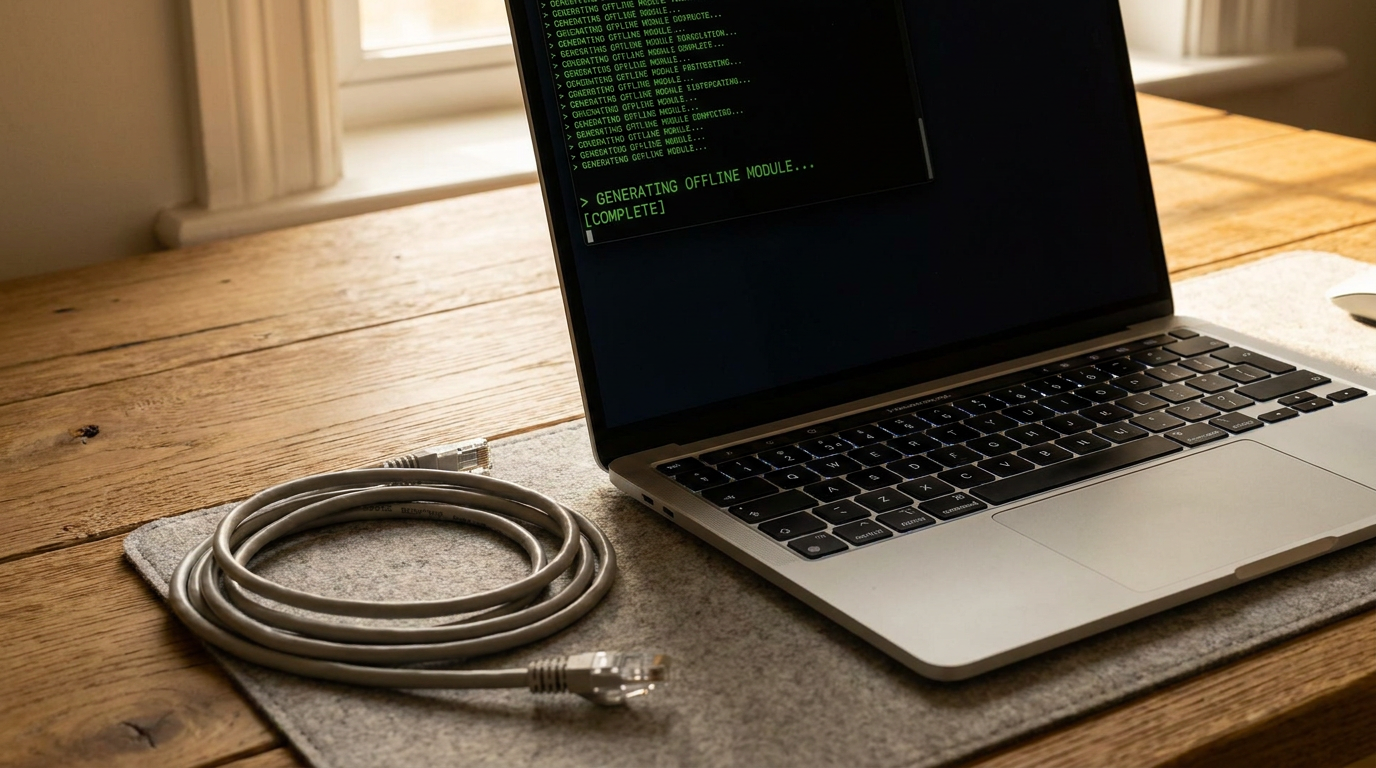
For the past three years, the generative AI boom was defined by a landlord-tenant relationship. Users paid monthly subscriptions to access massive, cloud-hosted models, trading their data and privacy for intelligence. But in 2026, the center of gravity has shifted from the cloud back to the personal computer. Running frontier-class large language models entirely offline is no longer a hobbyist stunt reserved for engineers with server racks. It has become a mainstream practice, allowing standard laptops and desktop computers to generate text, write code, and analyze documents with zero internet connection.[4][7]
This transition marks a tipping point where the performance moat of cloud AI providers has largely evaporated for daily tasks. Open-weight models released in recent months now routinely match or exceed the performance of the cloud models that dominated the industry just two years ago. For instance, open-source coding models have recently scored above 70 percent on SWE-bench—a rigorous test of real-world software engineering—comfortably beating the early versions of GPT-4 that developers previously paid to access. The realization that this level of intelligence can now live permanently on a local hard drive is reshaping how businesses approach artificial intelligence.[3][8]
The appeal of local inference boils down to three absolute guarantees: privacy, cost, and control. When an AI model runs locally, the prompts, documents, and code pasted into the chat window never leave the machine. This has become a critical feature for corporate environments navigating strict data sovereignty laws like GDPR, or for developers handling proprietary source code. Furthermore, local AI eliminates API rate limits and monthly subscription fees. Once the model is downloaded, the only cost is the electricity required to run the processor.[2][5]

The fact that these massive neural networks can now run on consumer hardware is the result of two major technical breakthroughs, the first being Mixture-of-Experts architectures. Previously, running a large language model required loading its entire parameter count into active memory for every single word generated. This dense architecture meant that a highly capable model demanded massive amounts of Video RAM, restricting them to enterprise-grade data centers. In a Mixture-of-Experts model, the neural network is divided into specialized sub-networks. When the user asks a question, a routing mechanism determines which specific experts are best suited to answer, activating only a fraction of the model's total parameters.[3][4]
This architectural shift allows users to benefit from the vast knowledge base of a massive model while only paying the computational cost of a much smaller one. For example, a modern 80-billion parameter model might only use 3 billion active parameters during inference. The second breakthrough is quantization, specifically formats like GGUF. Neural networks are traditionally trained using high-precision numbers that take up significant digital space. Quantization compresses these weights into lower-precision formats, shrinking the model's file size by 60 to 75 percent.[2][8]
While this compression introduces a minor degradation in the model's absolute reasoning ceiling, the trade-off is what makes local AI viable for the masses. A model that once required 32 gigabytes of memory can now run comfortably on a standard laptop with 8 gigabytes of unified memory. But hardware optimization is only half the story; the software ecosystem has also undergone a radical simplification. Just a few years ago, running a local model required navigating complex Python environments, managing dependencies, and troubleshooting command-line errors.[2][7]

While this compression introduces a minor degradation in the model's absolute reasoning ceiling, the trade-off is what makes local AI viable for the masses.
Today, the user experience mirrors downloading a standard desktop application, thanks to platforms like LM Studio and Ollama. LM Studio has emerged as the graphical interface of choice for many users, offering a familiar, chat-style window that runs entirely offline. It features a built-in browser to discover and download models, automatically detects the host computer's hardware capabilities, and optimizes the settings for maximum speed. For developers, it even spins up a local server that mimics cloud APIs, allowing existing applications to seamlessly swap cloud services for local models without rewriting code.[2][8]
Ollama, meanwhile, has captured the developer ecosystem by offering a frictionless, container-like experience for AI. With a single terminal command, users can pull a model from the internet and start chatting. Ollama manages the underlying complexity of model weights and system prompts, making it incredibly easy to integrate local AI into automated workflows, private coding assistants, or internal business tools. The convergence of these tools means that deploying a private AI assistant now takes minutes rather than days, requiring no specialized machine learning expertise.[2][5]
The landscape of available open-weight models in 2026 is highly competitive, with major tech companies releasing powerful systems optimized for consumer hardware. Google's Gemma 4 family, Meta's Llama 4, Alibaba's Qwen 3.6, and Microsoft's Phi-4 represent the current frontier of local inference. Because these models are free to download, the choice of which to use is entirely dictated by the user's available hardware. For entry-level machines with just 4 to 8 gigabytes of memory, highly compressed models like Phi-4-mini or Gemma 4's smaller variants provide excellent summarization and basic drafting capabilities.[1][2]

The sweet spot for local AI in 2026 is 16 gigabytes of RAM, which comfortably runs highly capable coding and reasoning models. For power users and developers with 24 gigabytes of Video RAM—such as those using high-end gaming GPUs or Apple Silicon Macs with unified memory—the performance ceiling rivals the best commercial cloud services available. This hardware reality has fundamentally changed the purchasing decisions of professionals, who now prioritize memory capacity over almost every other specification when buying a new computer.[1][3]
Apple has heavily validated this on-device approach with the rollout of Apple Intelligence. By integrating its own Apple Foundation Models directly into iOS and macOS, Apple has positioned local inference as a core operating system feature rather than a standalone application. The company's architecture processes everyday requests locally on the device's Neural Engine, only routing highly complex queries to its Private Cloud Compute servers. This hybrid approach signals to the broader industry that privacy-first, on-device AI is the expected baseline for consumer technology moving forward.[6][8]
Despite the rapid maturation of local AI, significant bottlenecks remain. The primary constraint is no longer raw computational power, but memory bandwidth—the speed at which data can be moved from the computer's memory to its processor. Even with specialized architectures and quantization, generating text requires shuffling gigabytes of data every second. On consumer hardware, the processor often sits idle waiting for the memory to catch up, which can result in slower generation speeds compared to the instantaneous responses of massive cloud clusters.[4][8]

Furthermore, local inference is highly taxing on battery life and thermal management. Running a massive neural network at full capacity will quickly drain a laptop's battery and generate significant heat, making it less practical for prolonged use while traveling away from a power source. There is also a hard ceiling on capabilities; while local models excel at coding, drafting, and summarizing, the absolute bleeding edge of complex, multi-step reasoning still requires the massive parameter counts that only data center clusters can accommodate.[2][4]
Nevertheless, the state of local language models in 2026 represents a profound democratization of artificial intelligence. The ability to run frontier-class models offline ensures that advanced AI is no longer a rented utility subject to corporate policy changes, internet outages, or sudden subscription hikes. It has become a permanent, private capability embedded directly into the personal computer, fundamentally changing how developers build software and how users protect their most sensitive data.[5][7]
How we got here
Early 2023
Llama.cpp is released, proving that large language models can run on standard consumer CPUs.
Late 2023
Tools like Ollama and LM Studio launch, replacing complex command-line setups with user-friendly interfaces.
Mid 2024
Apple announces Apple Intelligence, signaling a massive industry shift toward on-device, privacy-first AI processing.
Early 2026
Open-weight MoE models routinely beat previous-generation cloud APIs on real-world coding and reasoning benchmarks.
Viewpoints in depth
Privacy & Enterprise Users
Advocates for keeping sensitive data entirely on-premise to comply with regulations and protect intellectual property.
For corporate IT departments and privacy advocates, the shift to local AI is primarily a security mandate. Sending proprietary source code, patient records, or unreleased financial data to a cloud provider introduces unacceptable compliance risks, particularly under frameworks like GDPR. This camp views tools like Ollama not just as conveniences, but as essential infrastructure that allows businesses to leverage generative AI without violating data sovereignty or risking a catastrophic leak.
Open-Source Developers
Builders who value the freedom to customize, tinker, and deploy AI without API costs or corporate guardrails.
The developer community champions local AI for its flexibility and economics. Relying on cloud APIs means building products on top of a dependency that can change its pricing, alter its model behavior, or suffer outages at any moment. By running open-weight models locally, developers gain absolute control over the inference stack. They can fine-tune models for highly specific niche tasks, build autonomous agent workflows that run 24/7 without racking up massive bills, and experiment without fear of hitting rate limits.
Hardware Ecosystem
Chipmakers and device manufacturers leveraging on-device AI to drive a massive hardware upgrade cycle.
For companies like Apple, Nvidia, and Qualcomm, the local AI boom is a powerful catalyst for consumer hardware sales. By establishing on-device inference as the new baseline for privacy and speed, these manufacturers are convincing consumers and professionals that their current laptops are obsolete. This perspective emphasizes that the future of computing requires unified memory architectures and dedicated neural processing units, positioning their latest silicon as the only way to unlock the next generation of software.
Cloud AI Providers
Companies building the absolute largest frontier models, arguing that true artificial general intelligence will always require data centers.
While acknowledging the utility of local models for basic tasks, cloud AI providers maintain that the bleeding edge of reasoning will always live on servers. They argue that as models scale to trillions of parameters to solve complex scientific and mathematical problems, the compute requirements will permanently outpace what can physically fit in a laptop. From this viewpoint, local AI is a useful companion for drafting and coding, but the cloud remains the indispensable engine for true cognitive breakthroughs.
What we don't know
- Whether future breakthroughs in model compression will eventually allow trillion-parameter models to run on smartphones.
- How cloud providers will adjust their pricing models as local open-weight alternatives continue to improve.
- The long-term impact of running heavy inference workloads on the lifespan of consumer laptop batteries.
Key terms
- Local Inference
- The process of running an artificial intelligence model directly on a personal computer or smartphone, rather than sending data to a cloud server.
- Mixture-of-Experts (MoE)
- An AI architecture that divides a model into specialized sub-networks, activating only a small fraction of its total parameters for any given task to save memory.
- Quantization
- A compression technique that reduces the precision of an AI model's internal numbers, dramatically shrinking its file size so it can fit on consumer hardware.
- VRAM (Video RAM)
- The dedicated memory on a graphics card, which is crucial for loading and running large language models efficiently.
Frequently asked
Do I need an expensive graphics card to run local AI?
No. While dedicated GPUs offer the best speeds, modern quantization techniques allow capable models to run on standard laptops with 8GB of standard RAM or Apple Silicon unified memory.
Is local AI as smart as cloud models like ChatGPT?
For specific tasks like coding, drafting, and summarizing, the best 2026 open-weight models match or exceed early 2024 cloud models. However, the absolute bleeding edge of reasoning still requires cloud infrastructure.
Is my data actually private when using these tools?
Yes. When running a model locally through tools like Ollama or LM Studio, your prompts and documents are processed entirely on your machine and never transmitted over the internet.
Sources
Source coverage
8 outlets
4 viewpoints surfaced








[1]AI ML InsightsOpen-Source Developers
Best Open Source LLMs for Local Use in 2026: Top Models Compared
Read on AI ML Insights →[2]AI Thinker LabPrivacy & Enterprise Users
Run AI models locally and offline on a laptop with no internet connection
Read on AI Thinker Lab →[3]MediumOpen-Source Developers
Why 2026 Is the Tipping Point Year for Local Coding LLMs
Read on Medium →[4]Agent NativeOpen-Source Developers
The state of local LLMs in 2026
Read on Agent Native →[5]CohortePrivacy & Enterprise Users
Run LLMs Locally with Ollama: Privacy-First AI for Developers in 2025
Read on Cohorte →[6]AppleHardware Ecosystem
Apple Intelligence brings powerful AI capabilities into everyday experiences
Read on Apple →[7]XDA DevelopersIndustry Analysts
The model quality gap between local and cloud AI has closed
Read on XDA Developers →[8]Factlen Editorial TeamIndustry Analysts
Synthesis by Factlen editorial team
Read on Factlen Editorial Team →

Every angle. Every day.
Get ai stories with full source coverage and perspective breakdowns delivered to your inbox.