
The Longevity Lift: Why Heavy Resistance Training is the Ultimate Anti-Aging Protocol
Recent clinical data reveals that heavy weightlifting, once considered too dangerous for older adults, is one of the most effective ways to slow cellular aging, preserve bone density, and maintain functional independence.
By Factlen Editorial Team
- Longevity Researchers
- Scientists focused on the cellular and metabolic impacts of exercise.
- Geriatric Physical Therapists
- Clinicians focused on functional independence and fall prevention in older adults.
- The Fitness Industry
- Gym owners and trainers adapting to an aging demographic.
What's not represented
- · Older adults with severe mobility limitations who cannot safely access barbell training
Why this matters
As life expectancy increases, the focus is shifting from simply living longer to living well. Understanding the profound impact of heavy resistance training empowers individuals to protect their mobility, metabolic health, and independence well into their later decades.
Key points
- Heavy resistance training is now recognized as a critical intervention for slowing biological aging and preserving cellular health.
- Lifting heavy loads stimulates osteoblasts, increasing bone mineral density and combatting osteoporosis in older adults.
- Training with weights near 80% of a one-rep max recruits fast-twitch muscle fibers, which are essential for preventing falls.
- Recent studies show that the strength gains from a dedicated heavy lifting program can last for years, even if structured training stops.
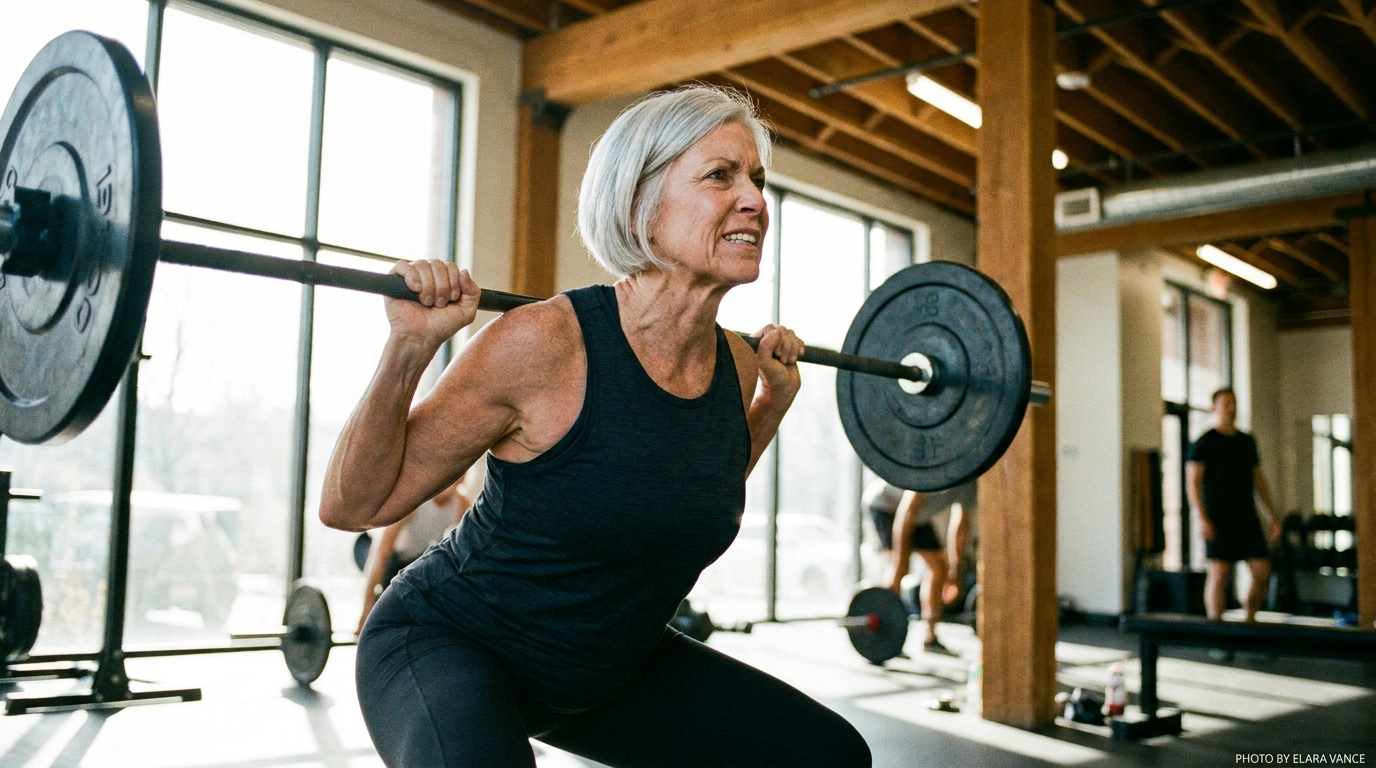
The cultural shift is impossible to ignore. Gyms in 2026 look fundamentally different than they did a decade ago. The squat racks and lifting platforms are no longer exclusively occupied by 20-something athletes or competitive bodybuilders. Instead, a new demographic is chalking up their hands and stepping under the barbell: men and women in their 60s, 70s, and beyond.[6]
For decades, the standard medical advice for older adults was to walk, swim, and perhaps lift two-pound dumbbells to avoid injury. Heavy lifting—especially compound movements derived from powerlifting and Olympic weightlifting, like squats, deadlifts, and cleans—was widely considered too dangerous for aging joints and connective tissues.[4]
But a wave of recent clinical data has entirely flipped that assumption. Researchers are discovering that heavy resistance training is not merely safe for older adults; it is arguably the most potent anti-aging intervention available in modern medicine, capable of altering biological aging at the cellular level.[3]
The shift in understanding is driven by studies examining the physiological mechanisms of aging. In early 2026, a landmark study published in the journal Biology analyzed data from nearly 5,000 U.S. adults, focusing on the relationship between strength training and telomeres—the protective caps at the ends of DNA chromosomes.[1]
Telomeres naturally shorten as cells divide over a lifetime, serving as a biological clock that dictates cellular aging. The researchers found that adults who engaged in at least 90 minutes of strength training per week possessed telomeres that were, on average, 60.3 base pairs longer than their sedentary peers.[1]

To put that into perspective, this preservation of telomere length equates to approximately 3.9 years of reduced biological aging. The mechanical stress of lifting heavy loads appears to signal the body to maintain its cellular infrastructure, effectively slowing the clock from the inside out.[1]
Beyond the cellular level, heavy lifting directly combats one of the most debilitating aspects of aging: sarcopenia. This natural decline in muscle mass begins in our 30s, accelerating to a loss of 3% to 6% per decade, and drops off even faster after age 60.[4]
Sarcopenia does not just affect aesthetics; it compromises the metabolic engine of the body. Muscle tissue is highly metabolically active, acting as a primary sink for blood glucose. As muscle mass dwindles, the risk of insulin resistance and type 2 diabetes skyrockets.[3]

Traditional advice suggested light weights and high repetitions to maintain muscle tone. However, a 2024 randomized controlled trial published in BMJ Open Sport & Exercise Medicine demonstrated that "heavy" is the operative word for lasting, structural results.[2]
Traditional advice suggested light weights and high repetitions to maintain muscle tone.
The trial followed retirement-aged adults who engaged in a year of heavy resistance training. When researchers followed up four years later, the participants who lifted heavy loads had retained significantly more muscle strength compared to those who did moderate or light training—even if they had stopped structured exercise in the interim.[2]
The researchers concluded that heavy loads—approaching 80% to 85% of a person's one-repetition maximum—are required to recruit the fast-twitch muscle fibers that are most susceptible to age-related atrophy.[2][4]
This revelation has led geriatric physical therapists to incorporate concepts from Olympic weightlifting and powerlifting into senior care. Movements that require explosive power and full-body coordination, like modified cleans or heavy deadlifts, train the nervous system to fire rapidly.[4]
That rapid firing is exactly what prevents falls. When an older adult trips, it is not a lack of endurance that causes them to hit the ground; it is a lack of fast-twitch muscle response to catch their balance. Heavy lifting trains the body to generate force quickly, effectively acting as an insurance policy against fatal falls.[5]
Furthermore, heavy resistance training is uniquely effective at preserving bone mineral density. Bones are dynamic tissues that respond to mechanical stress. When a heavy load is lifted, the muscles pull against the bones, signaling osteoblasts—the cells responsible for bone formation—to reinforce the skeletal structure.[3]

This is particularly crucial for postmenopausal women, who experience a sharp drop in estrogen that accelerates bone loss. Clinical data shows that heavy, weight-bearing exercises can halt and even reverse osteopenia, significantly reducing the risk of debilitating fractures.[3][5]
The safety profile of heavy lifting for older adults has also been vindicated. A comprehensive review by researchers in Norway analyzed multiple studies and concluded that heavy lifting, including testing a one-rep max, is safe for both healthy seniors and those managing chronic illnesses, provided they use proper form.[4]
The fitness industry is rapidly adapting to this paradigm shift. In 2025 and 2026, "functional longevity" became a dominant trend, with boutique gyms and community centers launching small-group barbell classes specifically tailored for the over-60 demographic.[6]

These classes focus on progressive overload—gradually increasing the weight over time—rather than the high-intensity, exhaustion-driven models popularized by extreme fitness fads. The goal is not to leave the gym exhausted, but to leave it structurally stronger.[6]
Public health officials are now echoing this sentiment, urging a pivot in how we view exercise in our later years. While cardiovascular activities like walking and cycling remain vital for heart health, they are no longer considered sufficient on their own to guarantee a high quality of life.[5]
How we got here
1990s
Standard medical advice for older adults focuses almost exclusively on low-impact cardiovascular exercise and light dumbbells.
2014
Studies begin to show that muscle strength, rather than just muscle mass, is a primary predictor of longevity and independence.
2024
A landmark BMJ Open study reveals that heavy resistance training in retirement-aged adults yields strength gains that last for over four years.
Early 2026
Research published in the journal Biology links 90 minutes of weekly strength training to longer telomeres, equating to 3.9 years of reduced biological aging.
Viewpoints in depth
Longevity Researchers
Scientists focused on the cellular and metabolic impacts of exercise.
This camp views heavy resistance training primarily through the lens of metabolic health and cellular preservation. Researchers emphasize data showing that muscle tissue acts as a glucose sink, mitigating the risk of type 2 diabetes. They point to biomarkers like telomere length to argue that lifting weights fundamentally alters the biological aging process, advocating for strength training to be prescribed as preventative medicine.
Geriatric Physical Therapists
Clinicians focused on functional independence and fall prevention in older adults.
For physical therapists, the value of heavy lifting lies in its ability to train the nervous system and fast-twitch muscle fibers. They argue that traditional light-weight, high-rep exercises fail to prepare older adults for real-world physical challenges, such as catching their balance during a trip. By incorporating heavy, explosive movements, they aim to preserve the functional independence of their patients and drastically reduce the incidence of fatal falls.
The Fitness Industry
Gym owners and trainers adapting to an aging demographic.
The commercial fitness sector is pivoting away from high-intensity, exhaustion-based models toward 'functional longevity.' Industry leaders argue that the future of fitness lies in small-group barbell training tailored for older adults. They emphasize the need for educated coaching to safely guide seniors through progressive overload, viewing this demographic shift as both a public health necessity and a massive business opportunity.
What we don't know
- The exact upper age limit at which the body stops responding to the mechanical stress of heavy lifting with new bone and muscle formation.
- How genetic variations influence an individual's specific telomere response to heavy resistance training over a lifetime.
Key terms
- Sarcopenia
- The natural, age-related decline in muscle mass and strength that begins in adulthood and accelerates after age 60.
- Telomeres
- Protective caps at the ends of DNA chromosomes that shorten as cells divide, serving as a biomarker for biological aging.
- Progressive Overload
- The practice of gradually increasing the weight, frequency, or number of repetitions in a strength training routine to continuously challenge the body.
- One-Repetition Maximum (1RM)
- The maximum amount of weight a person can lift for a single repetition of a given exercise with proper form.
- Osteoblasts
- Specialized cells in the body that are responsible for the formation of new bone tissue, activated by mechanical stress.
- Bone Mineral Density (BMD)
- A measurement of the amount of minerals, mostly calcium and phosphorus, contained in a certain volume of bone.
Frequently asked
Is it safe to lift heavy weights if I am over 60?
Yes. Recent reviews indicate that heavy resistance training, including lifting near your maximum capacity, is safe for older adults and those with chronic illnesses when performed with proper form and supervision.
Do I need to do Olympic weightlifting to see benefits?
No. While Olympic-style lifts build explosive power, basic heavy compound movements like squats, deadlifts, and presses provide the necessary mechanical stress to build bone and muscle.
How much time do I need to spend lifting?
Studies show that just 90 minutes of strength training per week—such as three 30-minute sessions—is enough to significantly impact cellular aging and preserve muscle mass.
Can lifting weights replace cardiovascular exercise?
No. While strength training is crucial for muscle, bone, and metabolic health, experts recommend pairing it with cardiovascular exercise for a complete approach to longevity.
Sources
Source coverage
6 outlets
3 viewpoints surfaced






[1]Biology JournalLongevity Researchers
Strength Training Slows Biological Aging: Telomere Length Study
Read on Biology Journal →[2]BMJ Open Sport & Exercise MedicineLongevity Researchers
Heavy resistance training at retirement age induces 4-year lasting beneficial effects in muscle strength
Read on BMJ Open Sport & Exercise Medicine →[3]TimeLongevity Researchers
Why Strength Training Is the Key to Aging Well
Read on Time →[4]UCLA HealthGeriatric Physical Therapists
Heavy resistance training builds muscle mass and strength in older adults
Read on UCLA Health →[5]National Institute on AgingGeriatric Physical Therapists
Maintaining Mobility and Independence with Strength Training
Read on National Institute on Aging →[6]Factlen Editorial TeamThe Fitness Industry
Synthesis by Factlen editorial team
Read on Factlen Editorial Team →

More in sports
See all 10 stories →NFL Records
Calvin Johnson Predicts Puka Nacua Will Break His Historic NFL Receiving Record
0 sources

Standings
Global Chess Standings: Caruana Surges in Grand Chess Tour as Abdusattorov Leads FIDE Circuit
0 sources

NBA Finals
New York Knicks Win First NBA Championship in 53 Years, Defeating Spurs in Five Games
0 sources

Injury
GIANTS Veteran Jane Watson Caps Off Career With Emotional Return From Injury in Derby Win
0 sources
Every angle. Every day.
Get sports stories with full source coverage and perspective breakdowns delivered to your inbox.